Negative numbers and counting on
What this lesson covers
- Negative numbers are to the left of 0 on a horizontal number line and below 0 on a vertical number line.
- Negative numbers are represented symbolically with a negative sign (−) and named ‘negative’ along with the numeral (e.g. −4 is named negative four).
- Zero is neither positive nor negative.
- Negative numbers arise in a range of situations (e.g. debt, temperature).
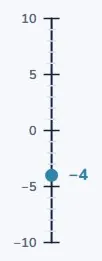
Four below zero
- A thermometer on a frosty morning does not stop at zero.
- It keeps going down.
- Four below zero is written −4.
Say "negative", not "minus"
- −4 is read "negative four".
- The small dash in front is a negative sign.
- "Minus" is the name of a subtraction. This is not one.
| written | said |
|---|---|
| −4 | negative four |
| −1 | negative one |
| −12 | negative twelve |
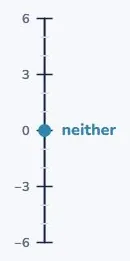
Zero is neither
- Above zero the numbers are positive.
- Below zero they are negative.
- Zero itself is neither. It is the place they meet.
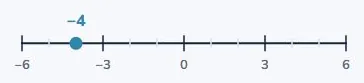
Turn the line on its side
- A thermometer stands up, so its negatives sit below zero.
- Lay the same line flat and nothing changes but the direction.
- Now the negatives are to the left of zero.
Money does it too
- Temperature is not the only place negatives turn up.
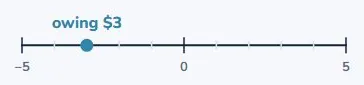
- If you have $5 and you owe $8, you are $3 short.
- A bank writes that balance as −3.
Further down is smaller
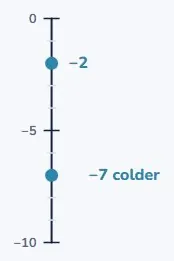
- Which is colder, −2 or −7?
- −7 is further down the thermometer, so it is colder.
- Further from zero on the negative side means smaller.
Count backwards past zero
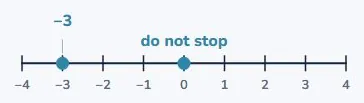
- Count down from 3. Three, two, one, zero.
- Do not stop. The next number is −1.
- Then −2, then −3. The counting never had to stop.
Try it: count past zero
Maths blocks
Counting in elevens
- Start at 0 and add 11 each time.
- Zero, eleven, twenty two, thirty three, forty four.
- Both digits climb together, which makes it easy to check.
| step | you land on |
|---|---|
| start | 0 |
| add 11 | 11 |
| add 11 | 22 |
| add 11 | 33 |
| add 11 | 44 |
| add 11 | 55 |
| add 11 | 66 |
And in twelves
- Start at 12 and add 12 each time.
- Twelve, twenty four, thirty six, forty eight, sixty.
- These are the twelve times table, said out loud.
| step | you land on |
|---|---|
| start | 12 |
| add 12 | 24 |
| add 12 | 36 |
| add 12 | 48 |
| add 12 | 60 |
| add 12 | 72 |
Big steps from an untidy number
- Count in thousands from 3,450.
- Only the thousands digit changes: 4,450 then 5,450.
- The start does not have to be a round number.
| step | you land on |
|---|---|
| start | 3,450 |
| add 1,000 | 4,450 |
| add 1,000 | 5,450 |
| add 1,000 | 6,450 |
Bigger steps, same idea
- Count in ten thousands from the same 3,450.
- 13,450 then 23,450 then 33,450.
- One digit does the work. The rest sit still.
| step | you land on |
|---|---|
| start | 3,450 |
| add 10,000 | 13,450 |
| add 10,000 | 23,450 |
| add 10,000 | 33,450 |
Common mistakes
- −7 is bigger than −2, because 7 is bigger than 2.−7 is further below zero, so it is colder and smaller: −7 < −2.
- Counting down: 3, 2, 1, 0, and then I have to stop.The line keeps going below zero: after 0 come −1, −2, −3.
- Counting in thousands from 3,450 goes 4,000, 5,000, 6,000.Only the thousands digit changes, so it goes 4,450, 5,450, 6,450.
- I have $5 and owe $8, so my balance is $3.You are $3 short, not $3 ahead, so the balance is −3.
Your turn
Say these out loud: −6, −11, −20.
Count backwards from 2 down to −4.
Which is warmer, −9 or −3?
Count in ten thousands from 6,200, eight steps.
Is zero a positive number or a negative number?
Aroha has $6 and owes her brother $10. How would a bank write her balance?
Count back in 12s from 72, eight steps.
Overnight in eight Otago towns it was −2°C, 3°C, −8°C and 0°C. Order them coldest first.
Show answer
1. Negative six, negative eleven, negative twenty. 2. 2, 1, 0, −1, −2, −3, −4. 3. −3 is warmer, because it is closer to zero. 4. 16,200 then 26,200 then 36,200 then 46,200. 5. Neither. Positive numbers are above zero, negative numbers are below it, and zero is where they meet. 6. −4. Paying $10 out of $6 leaves her $4 short, and short is written with a negative sign. 7. 60, 48, 36, 24. Take 12 away each time: 72 − 12 = 60, then 48, 36 and 24. 8. −8°C, −2°C, 0°C, 3°C. Further below zero is colder, so −8°C comes before −2°C, then 0°C, then 3°C.
Number Line: Integers
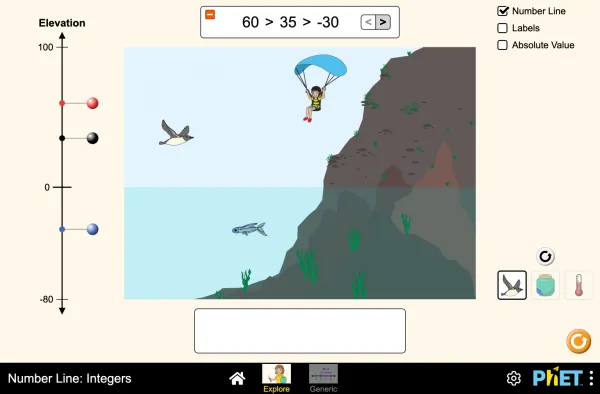
Full screen · PhET Interactive Simulations, University of Colorado Boulder, CC BY 4.0
What to take away
- Below zero on a thermometer, left of zero on a flat line.
- −4 is said "negative four". Zero is neither positive nor negative.
- Counting does not stop at zero, and a step can be any size.
| written | said |
|---|---|
| −4 | negative four |
| 0 | zero, neither |
| 4 | four |
Challenge
A lift goes from floor −3 (the lowest car park) up to floor 12. Floor 0 is the street. Three people ride the lift, each starting at floor 5. Tui goes down 7 floors, then up 10, then down 13. Sam goes up 6, then down 14, then up 2. Ana goes down 8, then up 15, then down 4. Which journey is impossible, and why? Where do the other two finish?
Hint
Follow each journey on a vertical number line, one move at a time, and check that every floor is between −3 and 12.
Answer
Tui's journey is impossible: it would end at floor −5, below the lowest floor −3. Sam finishes at floor −1 and Ana at floor 8.
Step by step
- Tui: 5 down 7 is −2, up 10 is 8, down 13 is −5. There is no floor −5, so it cannot happen.
- Sam: 5 up 6 is 11, down 14 is −3, up 2 is −1. Every floor is between −3 and 12, so Sam ends on floor −1.
- Ana: 5 down 8 is −3, up 15 is 12, down 4 is 8. She touches both the top and the bottom, but never goes past them.
- So Ana ends on floor 8.
Full working
- 5 → −2 → 8 → −5Tui
- −5 < −3below the lowest floor
- 5 → 11 → −3 → −1Sam
- 5 → −3 → 12 → 8Ana, exactly at both ends
- Tui's is impossible; Sam ends on −1, Ana on 8
Start at 47 and count backwards in 6s: 47, 41, 35, and so on, going past zero. What is the first negative number you say? Write down every number you say between 0 and −20. Will you ever say −20?
Hint
Keep counting back past 5. For the last part, think about what the numbers you say on the negative side end with.
Answer
The first negative is −1. Between 0 and −20 you say −1, −7, −13 and −19. You never say −20: after −19 comes −25.
Step by step
- Counting back in 6s from 47: 41, 35, 29, 23, 17, 11, 5.
- 5 back 6 goes past 0 and lands on −1, the first negative number.
- Keep going: −7, −13, −19.
- The next number after −19 is −25, so −20 is jumped over.
- You never come back up, so −20 is never said.
Full working
- 47, 41, 35, 29, 23, 17, 11, 5back 6 each time
- 5 − 6 = −15 to 0, then 1 more
- −1, −7, −13, −19the next four steps
- −19 − 6 = −25skips over −20
- First negative −1; then −7, −13, −19; −20 is never said
Count up in elevens, starting at −40: −40, −29, −18, and so on. Write down every number you land on between 0 and 100. Explain why you never land on 11, 22, 33 or any other two-digit number with both digits the same.
Hint
When you count in elevens from 0 you get 0, 11, 22, 33, and so on. How far is each of your numbers above one of those?
Answer
You land on 4, 15, 26, 37, 48, 59, 70, 81 and 92. Each one is 4 more than 0, 11, 22, 33, 44, 55, 66, 77 or 88, so you are always 4 past a number with matching digits and never on one.
Step by step
- −40, −29, −18, −7, then −7 plus 11 is 4, the first positive number.
- Keep adding 11: 15, 26, 37, 48, 59, 70, 81, 92. The next one, 103, is past 100.
- 4 is 4 more than 0. Adding 11 each time keeps the gap the same: 15 is 4 more than 11, 26 is 4 more than 22, and so on.
- The numbers with matching digits, 11 to 99, are the ones you get counting in elevens from 0.
- Your count is always 4 ahead of that count, so it can never land on one of them.
Full working
- −40 + 11 = −29, −29 + 11 = −18, −18 + 11 = −7still negative
- −7 + 11 = 4first positive number
- 4, 15, 26, 37, 48, 59, 70, 81, 92between 0 and 100
- 4 = 0 + 4, 15 = 11 + 4, 26 = 22 + 4, ..., 92 = 88 + 4always 4 past a matching-digit number
- 92 + 11 = 103past 100
- Lands on 4, 15, 26, 37, 48, 59, 70, 81, 92; always 4 past 11, 22, 33, ..., so never on one
Practise this
Report a mistake
More in Number
 Big numbers, factors and rounding5 minNegative numbers and counting on5 min
 Adding and subtracting big numbers5 min
 Multiplying and dividing bigger numbers6 min
 Tenths, hundredths and comparing decimals6 min
 Multiplying and dividing by 10 and 1006 min
 Adding fractions and decimals, and fractions of amounts5 min
 Money: totals, change and rounding5 min
Is your child on track?
Take the free placement test