Tenths, hundredths and comparing decimals
What this lesson covers
- Hundredths can be created by dividing whole numbers by 100 and can be expressed as fractions or decimals.
- Equivalent fractions can be generated using common factors.
A question almost everybody gets wrong
- Which is bigger, 0.12 or 0.2?
- Most people pick the first one, because 12 beats 2.
- That is the wrong answer. Here is why.
| this one | or this one |
|---|---|
| 0.12 | 0.2 |
Cut one whole into ten
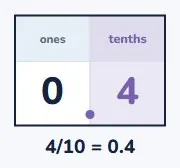
- Ten equal pieces. Each one is one tenth.
- As a fraction, 1/10. As a decimal, 0.1.
- Four pieces is 4/10, or 0.4. Same amount, two spellings.
Cut each tenth into ten again
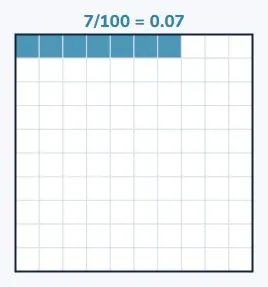
- A hundred pieces now. Each one is one hundredth.
- Or: divide one whole by 100.
- As a fraction, 1/100. As a decimal, 0.01.
Try it: shade hundredths
The two places are not alike
- 0.7 is seven tenths. 0.07 is seven hundredths.
- The second is ten times smaller than the first.
- That middle zero is not decoration. It holds the tenths empty.
| decimal | fraction | in words |
|---|---|---|
| 0.7 | 7/10 | seven tenths |
| 0.07 | 7/100 | seven hundredths |
Written the same way, it is easy
- 5 tenths beats 3 tenths. No surprises there.
- A fraction against a decimal? Convert one of them first.
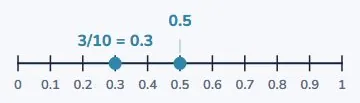
- 3/10 against 0.5 becomes 0.3 against 0.5.
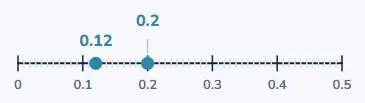
Now put them on a line
- 0.2 sits at two tenths.
- 0.12 sits between one tenth and two tenths.
- It has not even reached 0.2. So 0.2 is bigger.
Compare place by place, from the left
- Tenths first: 1 against 2. Two wins, so stop there.
- You never needed to look at the hundredths.
- Length is the false signal. Place value is the real one.
| number | tenths | hundredths |
|---|---|---|
| 0.12 | 1 | 2 |
| 0.20 | 2 | 0 |
Try it: compare place by place
A zero on the right is free
- Writing 0.2 as 0.20 did not change it.
- It only says out loud that there are no hundredths.
- Use it to make two decimals the same length.
| written | means | value |
|---|---|---|
| 0.2 | 2 tenths | the same |
| 0.20 | 2 tenths and 0 hundredths | the same |
With whole numbers on the front
- 3.55 against 3.84. Ones first: 3 and 3, no help.
- Move right to the tenths: 5 against 8.
- 8 is more, so 3.84 is bigger. Hundredths never came up.
| number | ones | tenths | decides it |
|---|---|---|---|
| 3.55 | 3 | 5 | |
| 3.84 | 3 | 8 | bigger |
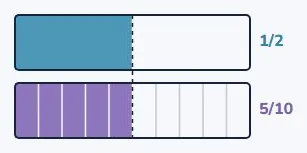
One half is 0.5
- Half of ten is five, so 1/2 is the same as 5/10.
- 5/10 is 0.5. It is also 50/100.
- One amount, three ways of writing it.
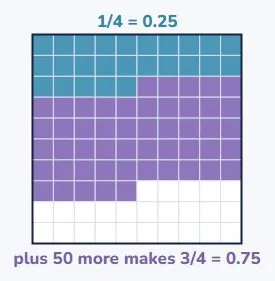
Quarters on a hundred square
- Count a quarter out: two full rows and five more.
- That is 25 squares, so 1/4 = 25/100 = 0.25.
- Fill 50 more and 75 of them is 3/4 = 0.75.
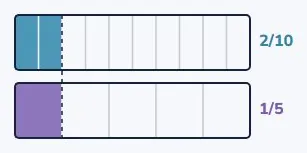
Equivalent fractions come from common factors
- 20/100. Both 20 and 100 divide by 10, giving 2/10.
- Both 2 and 10 divide by 2, giving 1/5.
- Three fractions, one amount. All of them are 0.2.
Per cent means per hundred
- A percentage is already a count of hundredths.
- 50% is 50/100, which is 1/2, which is 0.5.
- Know the hundredths and you already know these.
| percent | fraction | decimal |
|---|---|---|
| 10% | 1/10 | 0.1 |
| 25% | 1/4 | 0.25 |
| 50% | 1/2 | 0.5 |
Common mistakes
- 0.12 is bigger than 0.2, because 12 is bigger than 2.Compare the tenths first: 0.12 has 1 tenth and 0.2 has 2 tenths, so 0.2 is bigger.
- Seven hundredths is 0.7.0.7 is seven tenths. Seven hundredths needs a zero to hold the tenths place, so it is 0.07.
- A quarter is 1/4, so 1/4 = 0.4A quarter of a hundred square is 25 squares, so 1/4 = 25/100 = 0.25.
- Smallest first: 0.6, 0.16, 0.06, because 0.6 is the shortest.Length does not tell you size. Look at the tenths: 0.06, then 0.16, then 0.6.
Your turn
Write eight tenths, then nine hundredths, as decimals.
Which is bigger, 0.3 or 0.15?
Order these, smallest first: 0.6, 0.06, 0.16.
Write 3/4 as a decimal, and 25% as a fraction.
Which pair is the same amount as 10%?
Which decimal sits between 0.3 and 0.4 on a number line?
Use common factors to write 40/100 as simply as you can.
Which is bigger, 0.6 or 45/100?
Show answer
1. 0.4 and 0.09. 2. 0.3: compare the tenths, 3 beats 1. 3. 0.06, 0.16, 0.6. 4. 0.75, and 1/4. 5. 1/10 and 0.1. 10% is 10/100, which is 1/10, and one tenth is written 0.1. 6. 0.35. It is 3 tenths and 5 hundredths, so it is past 0.30 but has not reached 0.40. 7. 2/5. Divide top and bottom by 10 to get 4/10, then by 2 to get 2/5. 8. 0.6, as it is 60/100. Six tenths is the same as 60 hundredths, and 60 beats 45.
Area Model Decimals
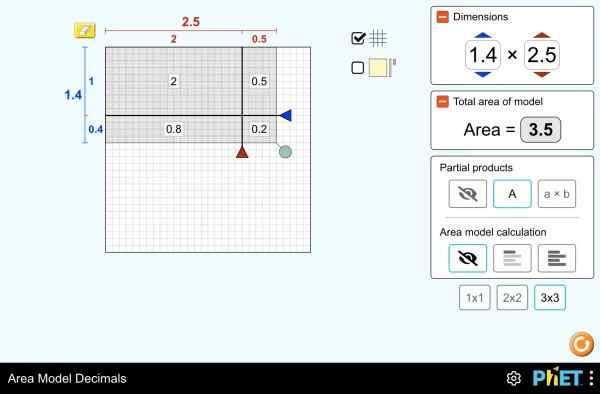
Full screen · PhET Interactive Simulations, University of Colorado Boulder, CC BY 4.0
What to take away
- The second place past the point is hundredths.
- Compare place by place from the left, never by length.
- Learn these three cold. They come up constantly.
| fraction | decimal | percent |
|---|---|---|
| 1/2 | 0.5 | 50% |
| 1/4 | 0.25 | 25% |
| 3/4 | 0.75 | 75% |
Challenge
Rāwiri lists every number written with exactly two digits after the point that is bigger than 0.3 and smaller than 12. How many numbers are on his list? Which one of them is equal to a fraction with bottom number 5?
Hint
Write 0.3 and 12 in hundredths first. Then count the hundredths in between.
Answer
19 numbers (0.31 up to 0.49). The one equal to a number of fifths is 0.40, which is 25.
Step by step
- 0.3 is 0.30, which is 30 hundredths. 12 is 0.50, which is 50 hundredths.
- Between them are 31, 32, and so on up to 49 hundredths.
- From 31 to 49 is 49 − 31 + 1 = 19 numbers.
- One fifth is 20 hundredths, so the fifths are 0.20, 0.40, 0.60 and 0.80.
- Only 0.40 is on the list, and it equals 25.
Full working
- 0.3 = 0.30, 12 = 0.50same number of places
- 0.31, 0.32, ..., 0.49strictly between
- 49 − 31 + 1 = 19count them
- 15 = 20100 = 0.20so fifths go up by 0.20
- 25 = 40100 = 0.40the only fifth on the list
- 19 numbers; 0.40 = 25
I am a number between 0 and 1 with two digits after the point. My tenths digit is double my hundredths digit, and neither digit is 0. I am bigger than 34 but smaller than 90%. What number am I? Write me as a fraction in its simplest form too.
Hint
List every number whose tenths digit is double its hundredths digit. Then change 34 and 90% into hundredths.
Answer
0.84, which is 2125.
Step by step
- Tenths double the hundredths: 0.21, 0.42, 0.63 and 0.84. (A tenths digit of 10 or more is impossible.)
- 34 is 75100, which is 0.75. 90% is 90100, which is 0.90.
- Only 0.84 is between 0.75 and 0.90.
- 0.84 = 84100. Both 84 and 100 divide by 4, giving 2125.
Full working
- 0.21, 0.42, 0.63, 0.84tenths = 2 × hundredths
- 34 = 75100 = 0.75lower limit
- 90% = 90100 = 0.90upper limit
- 0.75 < 0.84 < 0.90compare the tenths first
- 84100 = 2125divide top and bottom by 4
- 0.84 = 2125
Hine wants a fraction between 0.62 and 0.68 (not equal to either). Is there one with bottom number 5? With bottom number 20? With bottom number 25? For each one you find, write it as a decimal.
Hint
Turn fifths, twentieths and twenty-fifths into hundredths by multiplying top and bottom by the same number.
Answer
No fifth works. 1320 = 0.65 works, and 1625 = 0.64 works (each is the only one with that bottom number).
Step by step
- The gap is from 62 hundredths to 68 hundredths.
- Fifths: multiply by 20. The fifths are 20, 40, 60, 80 hundredths. 60 is too small and 80 is too big, so none fits.
- Twentieths: multiply by 5. They go up in 5 hundredths: 60, 65, 70. Only 65 fits, so 1320 = 0.65.
- Twenty-fifths: multiply by 4. They go up in 4 hundredths: 60, 64, 68. 68 is not allowed, so only 1625 = 0.64 fits.
Full working
- 0.62 = 62100, 0.68 = 68100the gap in hundredths
- 35 = 60100, 45 = 80100no fifth in the gap
- 1320 = 65100 = 0.651220 = 0.60 and 1420 = 0.70 miss
- 1625 = 64100 = 0.641725 = 0.68 is not allowed
- no fifth; 1320 = 0.65; 1625 = 0.64
Where science uses this
Practise this
Report a mistake
More in Number
 Big numbers, factors and rounding5 min
 Negative numbers and counting on5 min
 Adding and subtracting big numbers5 min
 Multiplying and dividing bigger numbers6 minTenths, hundredths and comparing decimals6 min
 Multiplying and dividing by 10 and 1006 min
 Adding fractions and decimals, and fractions of amounts5 min
 Money: totals, change and rounding5 min
Is your child on track?
Take the free placement test