Adding and subtracting big numbers
What this lesson covers
- Addition and subtraction can be carried out mentally, using known facts, place value and partitioning, or column methods.
- Standard written algorithms (e.g. column addition, column subtraction) rely on place value, regrouping, and renaming.
Four ways, not one
- There is more than one way to add two numbers.
- The curriculum names four of them.
- The skill is choosing, not memorising one method.
| method | use it when |
|---|---|
| known facts | you already know the answer |
| place value | the numbers are round |
| partitioning | you can split one of them up |
| columns | it is too awkward to hold in your head |
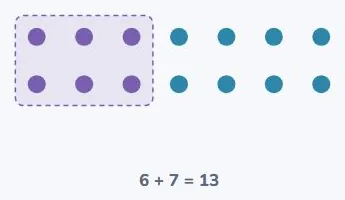
Known facts come free
- 6 + 7 = 13. You do not work that out.
- You remember it, and that is the fastest method there is.
- Every other method leans on facts like this one.
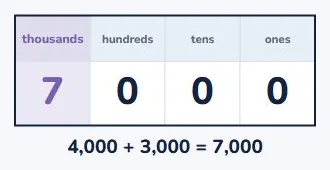
Round numbers use place value
- 4,000 + 3,000. Do not reach for a pencil.
- 4 thousands plus 3 thousands is 7 thousands.
- The same fact, 4 + 3, moved up a place.
Split one of them up
- 2,350 + 1,400 looks awkward.
- Split the 1,400 into 1,000 and 400.
- 2,350 + 1,000 is 3,350. Then + 400 is 3,750.
| step | running total |
|---|---|
| start | 2,350 |
| add 1,000 | 3,350 |
| add 400 | 3,750 |
When to give up and write it down
- Those three work when the numbers are kind.
- 4,678 + 2,565 is not kind. Too much to hold.
- That is what the column method is for.
| sum | how | answer |
|---|---|---|
| 6 + 7 | known fact | 13 |
| 4,000 + 3,000 | place value: 4 + 3 thousands | 7,000 |
| 2,350 + 1,400 | partition: 2,350 + 1,000 + 400 | 3,750 |
Columns line up place value
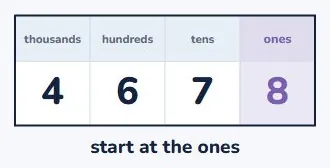
- Write one number above the other, ones under ones.
- The columns are not tidiness. They are place value.
- Then add one column at a time, starting from the right.
A carry is a rename
- 8 + 5 = 13. That will not fit in the ones column.
- 13 ones is 1 ten and 3 ones. Write 3, carry the 1.
- Nothing was invented. Ten ones were renamed as one ten.
| column | add | write | carry |
|---|---|---|---|
| ones | 8 + 5 = 13 | 3 | 1 |
| tens | 7 + 6 + 1 = 14 | 4 | 1 |
| hundreds | 6 + 5 + 1 = 12 | 2 | 1 |
| thousands | 4 + 2 + 1 = 7 | 7 | 0 |
Try it: add in columns
Check it roughly
- Round both numbers before you trust the answer.
- 4,678 is about 5,000. 2,565 is about 2,500.
- About 7,500. Our answer was 7,243, so it is believable.
| exact | rounded |
|---|---|
| 4,678 | 5,000 |
| 2,565 | 2,500 |
| 7,243 | about 7,500 |
Subtraction renames too
- 5,003 − 1,476. Start at the ones: 3 − 6 will not go.
- So borrow. But the tens are 0, and so are the hundreds.
- Go to the thousands, and rename all the way down.
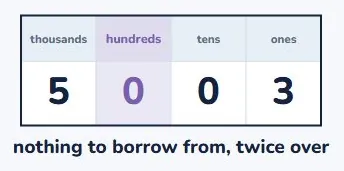
Maths blocks
Rename across the zeros
- 5,003 is 4 thousands, 9 hundreds, 9 tens and 13 ones.
- The number did not change. Only its name did.
- Now every column subtracts: 3,527.
| column | take away | left |
|---|---|---|
| ones | 13 − 6 | 7 |
| tens | 9 − 7 | 2 |
| hundreds | 9 − 4 | 5 |
| thousands | 4 − 1 | 3 |
Try it: rename across the zeros
Add it back to be sure
- A subtraction can always be checked by adding.
- 3,527 + 1,476 should give 5,003.
- If it does not, the borrowing went wrong somewhere.
| check | result |
|---|---|
| 3,527 + 1,476 | 5,003 |
| matches the start? | yes |
Common mistakes
- 5,003 − 1,476: in the ones, 3 − 6 will not go, so I just do 6 − 3 = 3.Always take the bottom number from the top one. Rename 5,003 as 4 thousands, 9 hundreds, 9 tens and 13 ones, then 13 − 6 = 7.
- To borrow in 5,003, I take 1 from the 5 and make the 3 into 13, and leave the zeros as 0.The borrow has to pass through the zeros, so they become 9s: 5,003 is 4 thousands, 9 hundreds, 9 tens and 13 ones.
- 4,678 + 2,565: 8 + 5 = 13, so I write 13 under the ones.Only one digit fits in a column. Write the 3 and carry the 1 ten into the tens column.
- For 3,847 + 476 I lined the two numbers up on the left.Line them up from the right, ones under ones, because each column is a place value.
Your turn
In your head: 5,000 + 2,000, then 3,240 + 1,500.
In columns: 3,847 + 1,976.
In columns: 6,002 − 2,438.
Check your answer to question 3 by adding.
In columns, 3,648 + 2,475. What do you write and carry in the tens column?
Round each number to the nearest thousand to estimate 5,890 + 2,140.
Tama works out 4,506 − 1,238 in columns and gets 3,332. What went wrong?
Ruapehu sold 13,475 lift passes on Saturday and 8,968 on Sunday. How many more were sold on Saturday?
Show answer
1. 7,000 and 4,740. 2. 5,823. 3. 3,564. 4. 3,564 + 2,438 = 6,002, so it is right. 5. Write 2, carry 1. The ones give 8 + 5 = 13, so 1 ten is carried, then 4 + 7 + 1 = 12 tens: write 2, carry 1. 6. About 8,000. 5,890 rounds to 6,000 and 2,140 rounds to 2,000, and 6,000 + 2,000 is 8,000. 7. He took the smaller digit from the bigger one instead of renaming; it is 3,268. Check: 3,268 + 1,238 = 4,506. 8. 4,507. In columns, 13,475 − 8,968 = 4,507, and 4,507 + 8,968 = 13,475 checks it.
What to take away
- Four methods. Pick the one the numbers suit.
- A carry or a borrow is a rename, not a trick.
- Round to check an addition, add to check a subtraction.
| method | use it when |
|---|---|
| known facts | you already know the answer |
| place value | the numbers are round |
| partitioning | you can split one of them up |
| columns | it is too awkward to hold in your head |
Challenge
The distance counter in Aunty Mere's car shows 39,893 km. That number reads the same forwards and backwards. How many more kilometres until the counter next shows a number like that? And how many kilometres after that until the one after?
Hint
Keep the first two digits the same and see what the middle digit can do. What happens when you run out of middle digits?
Answer
The next one is 39,993, which is 100 km away. The one after is 40,004, only 11 km further on.
Step by step
- A number that reads the same both ways is decided by its first three digits: 3, 9 and the middle digit.
- With 3 and 9 at the front, the middle digit can go up from 8 to 9. That gives 39,993.
- 39,993 − 39,893 = 100 km.
- The middle digit cannot go past 9, so the front has to change to 4 and 0. The smallest is 40,004.
- 40,004 − 39,993 = 11 km. The gaps are not all the same.
Full working
- 39,893 → 39,993middle digit goes from 8 to 9
- 39,993 − 39,893 = 100first gap
- 39,993 → 40,004front becomes 4, 0, so the back is 0, 4
- 40,004 − 39,993 = 11second gap
- 100 km to 39,993, then 11 km more to 40,004
Three bags of flour, A, B and C, are weighed two at a time. A and B together weigh 5,312 g. B and C together weigh 6,047 g. A and C together weigh 4,903 g. How heavy is each bag?
Hint
Add all three readings. Every bag has been on the scales twice.
Answer
A is 2,084 g, B is 3,228 g and C is 2,819 g.
Step by step
- Add the three readings: 5,312 + 6,047 + 4,903 = 16,262 g.
- Each bag was weighed twice, so that is double the weight of all three bags.
- Halve it: all three bags together weigh 8,131 g.
- Take away a pair to leave the third bag. For A, take away B and C.
- Check: 2,084 + 3,228 = 5,312, 3,228 + 2,819 = 6,047 and 2,084 + 2,819 = 4,903.
Full working
- 5,312 + 6,047 + 4,903 = 16,262each bag counted twice
- 16,262 ÷ 2 = 8,131all three bags once
- A = 8,131 − 6,047 = 2,084take away B and C
- B = 8,131 − 4,903 = 3,228take away A and C
- C = 8,131 − 5,312 = 2,819take away A and B
- A = 2,084 g, B = 3,228 g, C = 2,819 g
Rua picks a four-digit number whose digits go down by 1 each step, like 6,543 or 9,876. He writes the digits in reverse order and takes the smaller number away from the bigger one. Show that he always gets the same answer, whichever number he picks. What is it?
Hint
Set it out in columns. In the ones and the tens you will have to rename. How far apart are the two digits in each column?
Answer
He always gets 3,087.
Step by step
- Try one: 6,543 − 3,456 = 3,087. Another: 9,876 − 6,789 = 3,087.
- Why: in the ones, the top digit is always 3 less than the bottom one. Rename a ten: 10 − 3 = 7.
- In the tens, the top digit was 1 less than the bottom one, and it also gave a ten away. It is now 2 short. Rename a hundred: 10 − 2 = 8.
- In the hundreds, the top digit was 1 more than the bottom one, but it gave a hundred away. So 0.
- In the thousands, the top digit is always 3 more than the bottom one: 3.
- Those column answers never depend on which number he picked, so the answer is always 3,087.
Full working
- 6,543 − 3,456 = 3,087one example
- ones: bottom digit is 3 more, so rename: 10 − 3 = 7borrow a ten
- tens: bottom digit is 1 more, plus the ten given away: 10 − 2 = 8borrow a hundred
- hundreds: top digit is 1 more, minus the hundred given away: 0no borrow
- thousands: top digit is 3 more: 3always
- always 3,087
Practise this
Report a mistake
More in Number
 Big numbers, factors and rounding5 min
 Negative numbers and counting on5 minAdding and subtracting big numbers5 min
 Multiplying and dividing bigger numbers6 min
 Tenths, hundredths and comparing decimals6 min
 Multiplying and dividing by 10 and 1006 min
 Adding fractions and decimals, and fractions of amounts5 min
 Money: totals, change and rounding5 min
Is your child on track?
Take the free placement test