Percentages as multipliers, and ratios
What this lesson covers
- Percentages are a way of expressing a fraction of 100.
- Percentages can be used to proportionally increase or decrease a quantity by multiplication and can be presented as decimal multipliers. A percentage increase can be described by the additional percentage or the percentage of the final amount compared to the original amount (e.g. a 20% increase represents 120% of the original amount). A percentage decrease can be described by the percentage lost or the percentage of the final amount compared to the original amount (e.g. a 20% decrease represents 80% of the original amount).
- Ratios show part-to-part or part-to-whole comparisons of two or more quantities.
A percentage is an instruction
- Per cent means per hundred. Nothing more mysterious than that.
- So a percentage is a fraction with the bottom fixed at 100.
- And a fraction of something is an instruction to multiply.
Three ways to write the same thing
- 45 percent is 45 out of 100.
- As a fraction that is 45 over 100, which cancels to 9 over 20.
- As a decimal, 0.45. Divide by a hundred and you are there.
| Form | Written | Note |
|---|---|---|
| 45% | 45 out of 100 | |
| As a fraction | 45/100 | cancels to 9/20 |
| As a decimal | 0.45 | divide by 100 |
| Per cent | means per hundred | that is all |
Finding a part of something
- 15 percent of 240. The word "of" means multiply.
- So it is 0.15 times 240, which is 36.
- A fraction of an amount works exactly the same way.
| Question | Working | Answer |
|---|---|---|
| 15% of 240 | 0.15 × 240 | 36 |
| 3/8 of 240 | 240 ÷ 8 × 3 | 90 |
| 35% of 260 | 0.35 × 260 | 91 |
| The word "of" | means multiply | every time |
Try it: change a percentage
This out of that, as a percentage
- 18 out of 40. Divide first: 18 over 40 is 0.45.
- Times by a hundred and it is 45 percent.
- It does not have to come out tidy. 7 out of 30 is 23.3 percent.
| Question | Dividing | As a percent |
|---|---|---|
| 18 out of 40 | 18 ÷ 40 = 0.45 | 45% |
| As a fraction | 18/40 | 9/20 |
| 7 out of 30 | 7 ÷ 30 = 0.2333… | 23.3% |
| Divide, then | times by 100 |
A rise or a fall is one multiplication
- Going up 20 percent means you end with 120 percent of it.
- So multiply by 1.2. One multiply, not an add-on afterwards.
- Going down 20 percent leaves 80 percent, so multiply by 0.8.
| Change | Multiplier | Same as saying |
|---|---|---|
| Up 20% | × 1.2 | 120% of it |
| Down 20% | × 0.8 | 80% of it |
| Up 5% | × 1.05 | 105% of it |
| Down 35% | × 0.65 | 65% of it |
Two sentences, one multiplication
- "A 20 percent increase" and "120 percent of the original".
- Those are the same instruction in different words.
- Being able to swap between them is most of this topic.
Up 20 percent, then down 20 percent
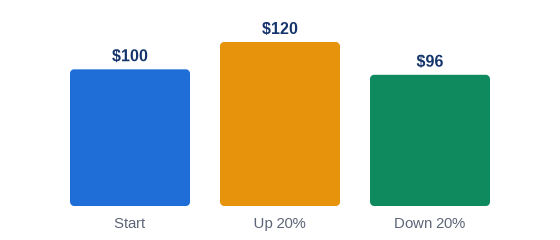
- A hundred dollars goes up 20 percent, to 120.
- Then down 20 percent. You do not get a hundred back.
- You get 96, because that 20 percent was 20 percent of 120.
| Step | Working | Amount |
|---|---|---|
| Start | $100 | |
| Up 20% | × 1.2 | $120 |
| Down 20% | × 0.8 | $96 |
| Why | the 20% was of $120 | a bigger amount |
Finding the whole amount back
- 20 percent of some amount is 30. What was the amount?
- It got to 30 by multiplying by 0.2, so divide by 0.2.
- 150. And check it forwards: 0.2 times 150 is 30.
| Question | Working | Answer |
|---|---|---|
| 20% of it is 30 | 30 ÷ 0.2 | 150 |
| Check | 0.2 × 150 = 30 | correct |
| 15% of it is 45 | 45 ÷ 0.15 | 300 |
| Going back | divide, never multiply |
The one that catches everybody
- After a 20 percent rise a jacket costs 120 dollars.
- Taking 20 percent off 120 gives 96, and it is wrong.
- It arrived by multiplying by 1.2, so divide by 1.2. A hundred.
| Step | What happens | Result |
|---|---|---|
| After a 20% rise | the price is $120 | |
| Tempting | take 20% off $120 | $96, wrong |
| It got here by × 1.2 | so divide by 1.2 | $100 |
| Check | 100 × 1.2 = 120 | correct |
Which direction are you going?
- Going with the change, multiply.
- Coming back from it, divide by the same multiplier.
- Every percentage question is one of those two.
Try it: multiply or divide?
A ratio, and the number nobody sees
- 3 to 2 compares two parts against each other.
- But there are five parts altogether, and five is the useful number.
- So 3 to 2 is three fifths and two fifths of the whole.
| Written | Means | Value |
|---|---|---|
| 3 : 2 | part to part | two groups |
| Parts altogether | 3 + 2 | 5 |
| As part to whole | 3/5 and 2/5 | |
| Not 3/2 and 2/3 | those are something else |
Sharing in a ratio
- Share 40 in the ratio 3 to 2. Add them: five parts.
- Forty divided by five is eight, so one part is eight.
- Three parts is 24, two parts is 16, and they add back to 40.
| Step | Working | Result |
|---|---|---|
| Share 40 in 3 : 2 | 5 parts | |
| One part | 40 ÷ 5 | 8 |
| Three parts, two parts | 3 × 8, 2 × 8 | 24 and 16 |
| Check | 24 + 16 | 40 |
Try it: share in a ratio
The check that costs five seconds
- Add your shares back up. They must give the original.
- Run a percentage answer forwards again and see if it lands.
- Both catch the wrong-direction error, which is the common one.
What to take away
- Seven lines, and the fourth and fifth are the marks.
| A percentage | is an instruction to multiply |
| "of" means multiply | 15% of 240 is 0.15 × 240 |
| This out of that | divide, then times 100 |
| Up 20% is × 1.2 | which is 120% of the original |
| Going back | divide by the multiplier |
| Up then down by 20% | does not return |
| A ratio 3 : 2 | has five parts in it |
Common mistakes
- After a 20% rise a jacket costs $120, so the original was $120 − 20% of $120 = $96.It got there by × 1.2, so divide: 120 ÷ 1.2 = $100; check 100 × 1.2 = 120.
- Up 20% then down 20% gets $100 back to $100.The fall is 20% of $120, a bigger amount: 100 × 1.2 × 0.8 = $96.
- Share $72 in 5 : 4: $72 ÷ 5 = $14.40 and $72 ÷ 4 = $18.Add the parts first: 5 + 4 = 9, one part is $72 ÷ 9 = $8, so $40 and $32, which add back to $72.
- 15% of an amount is 45, so the amount is 0.15 × 45 = 6.75.Going back, divide: 45 ÷ 0.15 = 300; check 0.15 × 300 = 45.
Your turn: eight questions
- Work all eight.
- Question 3 is the backwards one. Divide.
- Question 4 starts by adding the two numbers in the ratio.
Find 35% of 260.
24 is what percentage of 80?
15% of an amount is 45. Find it.
Share $72 in the ratio 5 : 4.
Find 5/6 of $420.
A kayak's price falls by 8%. Which single multiplier gives the new price?
In a Hamilton class, boys to girls is 3 : 5. What fraction of the class are girls?
Mere and Tama share $60 in the ratio 2 : 3. What percentage of the money does Tama get?
Show answer
1. 91. Multiply by 0.35, because "of" means multiply. 2. 30%. Divide 24 by 80 to get 0.3, then times by a hundred. 3. 300. This is the backwards direction, so divide rather than multiply: 45 ÷ 0.15 = 300. Check it by going forwards again, 0.15 × 300 = 45. 4. $40 and $32. Five and four make nine parts, and $72 ÷ 9 is $8 a part. Five parts is $40 and four parts is $32, and they add back to $72, which is the check worth doing every time. 5. $350. "Of" means multiply: 420 ÷ 6 × 5 = 350. 6. × 0.92. A fall of 8% leaves 92% of the price, and 92% is 0.92. 7. 5/8. There are 3 + 5 = 8 parts altogether, and the girls are 5 of them. 8. 60%. There are 2 + 3 = 5 parts and Tama has 3 of them: 3 ÷ 5 = 0.6, which is 60%.
The answers
- 0.35 times 260 is 91.
- 24 over 80 is 0.3, so 30 percent.
- 45 divided by 0.15 is 300.
- Nine parts of eight dollars: 40 dollars and 32 dollars.
Challenge
In a waka ama club the ratio of boys to girls is 3 : 5. Six more boys join and no one leaves, and now the ratio is 3 : 4. How many members did the club have before the new boys joined?
Hint
The number of girls did not change. Write both ratios with the same number of parts for the girls.
Answer
64 members (24 boys and 40 girls)
Step by step
- The girls stayed the same, so make the girls' parts match in both ratios.
- 5 and 4 both go into 20: 3 : 5 is the same as 12 : 20, and 3 : 4 is the same as 15 : 20.
- Now one part means the same in both. The boys went from 12 parts to 15 parts, so 3 parts are the 6 new boys.
- One part is 2 people. Before: 12 × 2 = 24 boys and 20 × 2 = 40 girls, 64 members.
- Check: 24 : 40 = 3 : 5, and with 6 more boys 30 : 40 = 3 : 4.
Full working
- 3 : 5 = 12 : 20multiply by 4
- 3 : 4 = 15 : 20multiply by 5, girls are 20 parts in both
- 15 − 12 = 3 parts = 6 boysthe new boys
- 1 part = 6 ÷ 3 = 2people per part
- 12 × 2 = 24 boys, 20 × 2 = 40 girlsbefore
- 64 members
A surf shop buys wetsuits from a supplier and marks the price up by 60%. In a winter sale it takes 40% off its marked price. (a) Does the shop make or lose money on a sale wetsuit, and by what percentage of what it paid? (b) What percentage discount on the marked price would make the shop exactly break even?
Hint
Use multipliers on the price the shop paid. A 60% mark-up is × 1.6. For (b), going back to where you started means dividing.
Answer
(a) It loses 4% of what it paid (b) 37.5% off
Step by step
- A 60% mark-up multiplies the cost by 1.6. Taking 40% off leaves 60%, so multiply by 0.6.
- Altogether the cost is multiplied by 1.6 × 0.6 = 0.96, which is 96% of what the shop paid: a 4% loss.
- The 40% was taken off the bigger, marked-up price, which is why it wipes out more than the 60% added.
- To break even, the sale must undo × 1.6, so it must multiply by 1 ÷ 1.6 = 0.625.
- Keeping 62.5% of the marked price means taking 37.5% off.
Full working
- cost × 1.6 × 0.6mark-up then sale
- 1.6 × 0.6 = 0.9696% of the cost
- 1 − 0.96 = 0.04a 4% loss
- 1 ÷ 1.6 = 0.625the multiplier that undoes × 1.6
- 1 − 0.625 = 0.375the discount needed
- (a) a 4% loss (b) 37.5% off
A farmer in Waikato cuts 200 kg of fresh grass for hay. It is 90% water. After drying in the sun it is 80% water. How much does it weigh now? Explain why the answer is so much less than most people guess.
Hint
The water dries off, but the dry part does not change. Find the dry part first, then ask what percentage of the new weight it makes.
Answer
100 kg
Step by step
- 90% water means 10% is the dry part: 10% of 200 kg is 20 kg.
- Drying removes only water, so there are still 20 kg of dry part afterwards.
- Now the hay is 80% water, so the dry part is 20% of the new weight.
- 20% of the new weight is 20 kg, so the new weight is 20 ÷ 0.2 = 100 kg. Going back, divide.
- Most people think 10% less water means about 10% less weight. But the dry part doubled its share, from 10% to 20%, so the whole had to halve.
Full working
- 200 × 0.10 = 20dry part, in kg
- dry part stays 20 kgonly water is lost
- dry part is 100% − 80% = 20% of new weightafter drying
- 20 ÷ 0.2 = 100working backwards, divide
- Check: 100 kg with 80 kg water is 80% watercorrect
- 100 kg
Where science uses this
Practise this
Report a mistake
More in Number
 Rational, irrational, and scientific notation7 min
 Exponent rules and working with roots7 min
 Significant figures, rounding and estimating7 min
 Order of operations, signs and reciprocals7 minPercentages as multipliers, and ratios7 min
 Ratios, rates, speed and percentage change7 min
 Exchange rates, unit prices and compound interest7 min
Is your child on track?
Take the free placement test