Order of operations, signs and reciprocals
What this lesson covers
- The order of operations is important when evaluating or forming expressions. Operations are done as follows: grouped operations (e.g. expressions under a square root, involving the numerator of a fraction, or inside brackets) exponents or powers multiplication and division, from left to right addition and subtraction, from left to right.
- A mnemonic can be used to remember the order of operations, such as GEMA: Grouped (e.g. √(3²+ 4²)), Exponents (e.g. (−2)³), Multiplicative (× and ÷), Additive (+ and −).
- Every non-zero number has a multiplicative inverse (reciprocal), and their product is 1 (e.g. 5 and 1/5 are reciprocals, so 5 × 1/5 = 1/5 × 5 = 1).
Why there is an order at all
- Two people work out the same expression and disagree.
- That cannot happen, or written maths would not work.
- So the order is a shared agreement about what binds tightest.
Four tiers, in order
- Grouped things first. Then exponents.
- Then multiply and divide, working left to right.
- Then add and subtract, left to right. GEMA.
| Tier | What it covers | |
|---|---|---|
| G | Grouped | brackets, fractions, roots |
| E | Exponents | powers and roots |
| M | Multiplicative | × and ÷, left to right |
| A | Additive | + and −, left to right |
Grouped means more than brackets
- A root sign groups everything underneath it.
- A fraction bar groups the whole top and the whole bottom.
- That is why the G is grouped and not brackets.
| Expression | What groups | Value |
|---|---|---|
| (8 − 3) | ordinary brackets | obvious |
| √(3² + 4²) | the root groups | = 5 |
| (2 + 4) / 3 | the bar groups | = 2 |
| Not just brackets | anything that encloses |
Minus two squared
- Minus two squared is minus four.
- Minus two, in brackets, squared is positive four.
- The bracket decides what the exponent owns.
| Written | What is squared | Value |
|---|---|---|
| −2² | the 2 is squared | −4 |
| (−2)² | the −2 is squared | 4 |
| The bracket | decides what is squared | |
| Same digits | different expressions |
Powers of negative numbers
- Negatives pair off. Each pair makes a positive.
- An even exponent pairs them all, so the answer is positive.
- An odd one leaves a negative over.
| Power | Why | Value |
|---|---|---|
| (−1)⁴ | four negatives pair up | 1 |
| (−1)⁵ | one is left over | −1 |
| (−2)³ | odd, so negative | −8 |
| (−3)² | even, so positive | 9 |
One expression, tier by tier
- Grouped first: eight take three is five.
- Exponent next: five squared is twenty-five.
- Then times and divide, then the addition. Ten.
| Tier | Doing | Leaves |
|---|---|---|
| 5 + 2 × (8 − 3)² ÷ 10 | start | |
| Grouped | 8 − 3 = 5 | 5 + 2 × 5² ÷ 10 |
| Exponents | 5² = 25 | 5 + 2 × 25 ÷ 10 |
| × and ÷, left to right | 50 ÷ 10 = 5 | 5 + 5 = 10 |
Try it: tier by tier
Adding and subtracting with signs
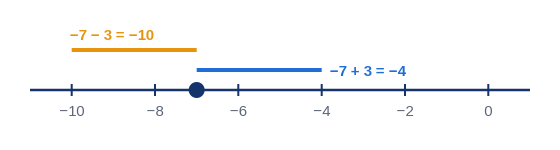
- Adding moves right. Subtracting moves left.
- From minus seven, adding three gets you to minus four.
- Subtracting a negative turns round and goes right.
| Working | On the line | Answer |
|---|---|---|
| −7 + 3 | move 3 right | −4 |
| −7 − 3 | move 3 further left | −10 |
| 5 − (−3) | taking away a debt | 8 |
| Subtracting a negative | is adding |
Multiplying and dividing with signs
- Count the minus signs, then look at whether it is even or odd.
- Two negatives multiplied give a positive.
- One negative in a division leaves the answer negative.
| Working | Minus signs | Answer |
|---|---|---|
| −6 × −4 | the signs pair off | 24 |
| −20 ÷ 5 | one negative | −4 |
| −20 ÷ −5 | two negatives | 4 |
| Count the minuses | even is positive | odd is negative |
Fractions and decimals do the same thing
- A negative fraction is a fraction with a sign on it.
- Find a common denominator, then follow the sign rules.
- Decimals are no different. Nothing new to learn.
| Working | Because | Answer |
|---|---|---|
| −3/4 + 1/2 | common denominator | −1/4 |
| −2.5 × 0.4 | one minus, so negative | −1 |
| −0.6 − 0.75 | both going left | −1.35 |
| Nothing new | the rules do not change |
The reciprocal: whatever undoes a multiply
- Five times a fifth is one. They undo each other.
- Two thirds and three halves do the same thing.
- The test is always the same: does it multiply back to 1?
| Number | Its reciprocal | Check |
|---|---|---|
| 5 | 1/5 | 5 × 1/5 = 1 |
| 2/3 | 3/2 | turn it over |
| −4 | −1/4 | the sign stays |
| −0.2 | −5 | still gives 1 |
Which is why you cannot divide by zero
- Every number except one has a reciprocal.
- Nothing multiplied by zero gives 1. Nothing at all.
- So zero has no reciprocal, and nobody decided that.
Try it: where the minus goes
And why you flip the second fraction
- Dividing by something is multiplying by what undoes it.
- What undoes two fifths is five halves.
- So three quarters divided by two fifths is fifteen eighths.
| Step | Reason | Result |
|---|---|---|
| 3/4 ÷ 2/5 | dividing by 2/5 | |
| Dividing undoes | so multiply by 5/2 | |
| 3/4 × 5/2 | across the top and bottom | 15/8 |
| Which is | 1 and 7/8 |
Try it: why you flip the second
One habit worth building
- Write the expression again after every tier.
- It takes four seconds and stops the sign errors.
- Most lost marks here are not understanding. They are rushing.
What to take away
- Seven lines, and the last two are the same idea.
| Grouped, exponents | then × ÷, then + − |
| Grouped is wider than brackets | roots and fraction bars too |
| −2² is −4 | and (−2)² is 4 |
| Even power of a negative | is positive |
| Subtracting a negative | is adding |
| A reciprocal | multiplies back to 1 |
| Dividing by a fraction | multiplies by its reciprocal |
Common mistakes
- −3² = 9, because a negative squared is positiveOnly the 3 is squared and the minus stays outside, so −3² = −9; it is (−3)² that equals 9.
- 12 − 3 × (2 + 2)² ÷ 8 = 9 × 16 ÷ 8 = 18Multiply and divide before subtracting: 3 × 16 ÷ 8 = 6, then 12 − 6 = 6.
- 5 − (−3) = 2Subtracting a negative is adding: 5 − (−3) = 5 + 3 = 8.
- The reciprocal of −0.2 is 5.The sign stays: the reciprocal is −5, because −0.2 × −5 = 1.
Your turn: eight questions
- Work all eight out on paper.
- Question 2 is two different expressions, not one.
- Question 4 wants the check as well as the answer.
Work out 12 − 3 × (2 + 2)² ÷ 8.
Evaluate (−3)² and −3².
Work out −5/6 ÷ 2/3.
What is the reciprocal of −0.2?
Work out −4 − (−9).
Work out 30 − 12 ÷ 3 × 2.
Work out (−2)³ + (−1)⁴.
Work out −1.5 × 4 − 2.5.
Show answer
1. 6. Grouped first: 2 + 2 is 4. Then the exponent: 4² is 16. Then times and divide left to right: 3 × 16 is 48, divided by 8 is 6. Then the subtraction: 12 − 6 = 6. 2. 9 and −9. In the first, the bracket squares the whole negative three. In the second, only the 3 is squared and the minus sign stays outside it. 3. −5/4, or −1.25. Dividing by two thirds means multiplying by three halves: −5/6 × 3/2 = −15/12, which cancels to −5/4. One negative, so the answer is negative. 4. −5. Nought point two is one fifth, so its reciprocal is five, and the negative comes along: −0.2 × −5 = 1, which is the test a reciprocal has to pass. 5. 5. Subtracting a negative is adding, so −4 + 9 = 5. 6. 22. × and ÷ go left to right before the subtraction: 12 ÷ 3 = 4, 4 × 2 = 8, then 30 − 8 = 22. 7. −7. An odd power of a negative is negative and an even one is positive: −8 + 1 = −7. 8. −8.5. Multiply first: −1.5 × 4 = −6, one minus so negative. Then −6 − 2.5 = −8.5.
The answers
- Twelve take six is six.
- Nine, and minus nine. The bracket is the whole difference.
- Minus five sixths times three halves is minus five quarters.
- Minus five, because minus nought point two times minus five is 1.
Challenge
Start with 2 + 3 × 4² − 6 ÷ 2. You may add one pair of brackets, opening just before one number and closing just after a later number. Treat 4² as a single number: the brackets cannot split the 4 from its small 2. (a) What is the value with no brackets? (b) What is the largest value you can make? (c) What is the smallest?
Hint
Brackets change which operation happens first. To make it big, get an addition done before a multiply. To make it small, get a subtraction done before a multiply.
Answer
(a) 47 (b) 77, from (2 + 3) × 4² − 6 ÷ 2 (c) 17, from 2 + 3 × (4² − 6) ÷ 2
Step by step
- No brackets: the exponent first, 4² = 16. Then 3 × 16 = 48 and 6 ÷ 2 = 3. Then 2 + 48 − 3 = 47.
- To make it bigger, the 2 should be added before multiplying by 16: (2 + 3) × 4² − 6 ÷ 2 = 5 × 16 − 3 = 80 − 3 = 77.
- To make it smaller, take the 6 away before multiplying by 3: 2 + 3 × (4² − 6) ÷ 2 = 2 + 3 × 10 ÷ 2 = 2 + 15 = 17.
- The other places give (2 + 3 × 4² − 6) ÷ 2 = 22, 2 + (3 × 4² − 6) ÷ 2 = 23 and 2 + 3 × (4² − 6 ÷ 2) = 41.
- Every other place leaves the order unchanged and gives 47, so the values are 17, 22, 23, 41, 47 and 77.
Full working
- 2 + 3 × 16 − 3 = 47no brackets, GEMA
- (2 + 3) × 4² − 6 ÷ 2 = 5 × 16 − 3add first
- = 80 − 3 = 77largest
- 2 + 3 × (4² − 6) ÷ 2 = 2 + 3 × 10 ÷ 2subtract first
- = 2 + 15 = 17smallest
- other places give 22, 23, 41 or 47all between 17 and 77
- (a) 47 (b) 77 (c) 17
Find whole numbers a, b and c so that 1 ÷ (a + 1 ÷ (b + 1c)) = 730. (Here a, b and c are whole numbers bigger than 1.)
Hint
Work from the outside in. If 1 divided by something is 730, the something is the reciprocal of 730. Then split it into a whole number and a fraction less than 1.
Answer
a = 4, b = 3, c = 2
Step by step
- 1 ÷ (a + …) = 730, so a + … is the reciprocal of 730, which is 307.
- 307 = 4 and 27. The part 1 ÷ (b + 1c) is less than 1, so a = 4 and 1 ÷ (b + 1c) = 27.
- So b + 1c is the reciprocal of 27, which is 72 = 3 and 12.
- 1c is less than 1, so b = 3 and 1c = 12, giving c = 2.
- Check: 3 + 12 = 72, 1 ÷ 72 = 27, 4 + 27 = 307, and 1 ÷ 307 = 730.
Full working
- a + 1 ÷ (b + 1c) = 307reciprocal of 730
- 307 = 4 + 27so a = 4
- b + 1c = 72reciprocal of 27
- 72 = 3 + 12so b = 3 and c = 2
- 1 ÷ (4 + 1 ÷ (3 + 12)) = 1 ÷ (4 + 27) = 730check
- a = 4, b = 3, c = 2
Work out the exact value of (12 − 1) × (13 − 1) × (14 − 1) × … × (1100 − 1). There is one bracket for every whole number from 2 to 100.
Hint
Work out the first few brackets as fractions. How many of them are negative, and what cancels when you multiply them?
Answer
−1100
Step by step
- Each bracket is negative: 12 − 1 = −12, 13 − 1 = −23, 14 − 1 = −34, and so on up to 1100 − 1 = −99100.
- There are 99 brackets, from 2 to 100. 99 is odd, so the minus signs do not all pair off and the answer is negative.
- Ignoring the signs, the product is 12 × 23 × 34 × … × 99100.
- Each top cancels with the bottom just before it: the 2s, the 3s and so on up to the 99s.
- Only the 1 on top and the 100 on the bottom are left, so the size is 1100 and the answer is −1100.
Full working
- 1k − 1 = −k − 1keach bracket is negative
- k = 2 to 100 gives 99 brackets99 minus signs, odd
- 12 × 23 × 34 × … × 99100the size of the product
- = 1100each top cancels the bottom before it
- odd number of negatives, so negativesign rule
- −1100
Where science uses this
Practise this
Report a mistake
More in Number
 Rational, irrational, and scientific notation7 min
 Exponent rules and working with roots7 min
 Significant figures, rounding and estimating7 minOrder of operations, signs and reciprocals7 min
 Percentages as multipliers, and ratios7 min
 Ratios, rates, speed and percentage change7 min
 Exchange rates, unit prices and compound interest7 min
Is your child on track?
Take the free placement test