Exchange rates, unit prices and compound interest
What this lesson covers
- Percentages, ratios, rates, and proportions are often applied in financial situations.
Three money problems, one piece of maths
- Changing currency. Comparing prices. Earning interest.
- Every one of them is a rate: something per something.
- Get the "per" right and all three are the same question.
| The rate | How much | Per what |
|---|---|---|
| Exchange rate | 0.92 AUD | per NZ dollar |
| Unit price | $18.00 | per kilogram |
| Interest rate | 2.5% | per month |
Going with the rate: multiply
- The rate is 0.92 Australian dollars for every New Zealand dollar.
- You have 250 New Zealand dollars to spend.
- 250 times 0.92 is 230 Australian dollars.
| Step | Working | Result |
|---|---|---|
| You have | NZD 250 | |
| The rate | 0.92 AUD per NZD | |
| Going to AUD | 250 × 0.92 | AUD 230.00 |
Now the other direction
- You are on an Australian website and something costs 230 dollars.
- What is that in New Zealand money?
- Most people multiply by 0.92 again. That is the wrong way.
Divide, because you are undoing the rate
- Multiplying again gives 211.60, and it is wrong.
- Something was multiplied by 0.92 to land on 230. So divide.
- 230 over 0.92 is exactly 250 New Zealand dollars.
| Step | What is happening | Value |
|---|---|---|
| A price of | AUD 230 | |
| Tempting | 230 × 0.92 | 211.60, wrong |
| It got here by × 0.92 | so undo it | |
| Divide | 230 ÷ 0.92 | NZD 250.00 |
| Check | 250 × 0.92 | 230, correct |
Again, with a different rate
- 0.60 US dollars per New Zealand dollar this time.
- Going out: 500 New Zealand dollars is 300 US dollars.
- Coming back: a 45 dollar US item is 75 New Zealand dollars.
| Step | Working | Result |
|---|---|---|
| Rate | 0.60 USD per NZD | |
| NZD 500 to US | 500 × 0.60 | USD 300.00 |
| USD 45 back to NZ | 45 ÷ 0.60 | NZD 75.00 |
| The NZ figure | is the bigger one | both times |
Dollars per kilogram is a rate too
- Cheese at eighteen dollars a kilogram. You want 400 grams.
- 400 grams is 0.4 of a kilogram.
- 0.4 times 18 is seven dollars twenty.
| Step | Working | Result |
|---|---|---|
| Cheese | $18.00 per kg | |
| You want | 400 g | that is 0.4 kg |
| So | 0.4 × 18 | $7.20 |
| Going back | 7.20 ÷ 18 | 0.4 kg, correct |
Which pack is actually cheaper?
- Three sizes at three prices. You cannot compare them as they are.
- Put every one on the same basis: dollars per kilogram.
- The medium pack wins, and the biggest one does not.
| Pack | Price | Per kilogram |
|---|---|---|
| Small, 400 g | $7.20 | $18.00 per kg |
| Medium, 750 g | $12.75 | $17.00 per kg |
| Large, 1.2 kg | $21.60 | $18.00 per kg |
| Best value | the medium one | not the largest |
The thing last year promised you
- Simple interest pays on the amount you started with, every time.
- Real accounts pay on whatever is in there now.
- So the interest earns interest. That is compound interest.
One hundred dollars, 2.5% a month, three months
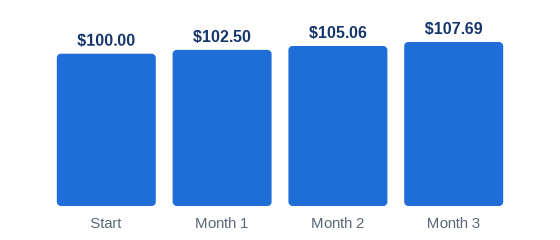
- Month one: 2.5% of a hundred is two fifty. You have 102.50.
- Month two: 2.5% of 102.50, not of a hundred. Two fifty-six.
- Month three: 2.5% of 105.06. Two sixty-three. You finish on 107.69.
| When | Interest | Balance |
|---|---|---|
| Start | $100.00 | |
| Month 1 | + $2.50 | $102.50 |
| Month 2 | + $2.56 | $105.06 |
| Month 3 | + $2.63 | $107.69 |
Try it: compound interest
Why those three numbers are different
- Two fifty, then two fifty-six, then two sixty-three.
- The rate was 2.5% every single month. It never moved.
- What changed is the balance it was applied to.
| Month | Interest | Applied to |
|---|---|---|
| Month 1 | $2.50 | on $100.00 |
| Month 2 | $2.56 | on $102.50 |
| Month 3 | $2.63 | on $105.06 |
| Rate never changed | the balance did |
Try it: use the rate the right way
Honestly, how much did that win?
- Simple interest over the same three months gives 107.50.
- Compounding gives 107.69. Nineteen cents.
- Leave it a year at the same rate and the gap is four forty-nine.
| Method | Working | You end with |
|---|---|---|
| Simple, 3 months | $7.50 interest | $107.50 |
| Compound, 3 months | month by month | $107.69 |
| Difference | 19 cents | small, but real |
| Same rate, 12 months | $134.49 | against $130.00 |
Money calculator
There is a formula, and you do not need it yet
- Doing it month by month is the point at this stage.
- Later you will meet the shortcut for the same thing.
- It does exactly what you just did, twelve times in one line.
The part worth remembering
- 2.5% a month compounded is 34.49% over a year.
- No savings account pays that. Credit cards charge it.
- Compound interest is the same maths pointed the other way.
| 2.5% a month, compounded | 34.49% a year |
| No savings account | pays anything like that |
| Credit cards and loans | charge rates like that |
| Same arithmetic | pointed at you instead |
What to take away
- Six things, and the last two are the ones that cost money.
| A rate | is a multiplier with a unit |
| Going with it | multiply |
| Coming back | divide, never multiply twice |
| To compare packs | use dollars per kilogram |
| Compound interest | recalculates every month |
| Which is why | it bites hardest on debt |
Common mistakes
- A jacket is USD 63 at 0.60 USD per NZD, so 63 × 0.60 = NZD 37.80Coming back against the rate, divide: 63 ÷ 0.60 = NZD 105.00; check 105 × 0.60 = 63.
- $100 at 2.5% a month for 3 months earns $2.50 each month, so $107.50.Compound interest is on the current balance: $2.50, then $2.56 on $102.50, then $2.63 on $105.06, giving $107.69.
- The 1.2 kg pack is the biggest, so it must be the best value.Compare per kilogram: $21.60 ÷ 1.2 = $18.00/kg, but the 750 g pack is $12.75 ÷ 0.75 = $17.00/kg, so it is cheaper.
- 400 g of cheese at $18.00 per kg costs 400 × 18 = $7 200.Change grams to kilograms first: 400 g is 0.4 kg, so 0.4 × 18 = $7.20.
Your turn: eight questions
- Work all eight properly.
- Question 2 is the one going against the rate.
- Question 4 wants the month-by-month walk, not a shortcut.
Convert NZD 350 to AUD. Rate 0.92.
A jacket is USD 63. Rate 0.60. NZD?
Coffee: 600 g for $21.00. Cost of 250 g?
$200 at 2% a month, for 3 months.
Rice: a 2 kg bag for $5.80 or a 5 kg bag for $13.50. Which is better value?
$500 earns 1% a month, compounded. How much interest is paid in month 2?
At the same monthly rate, why is month 2's compound interest bigger than month 1's?
Sione changes NZD 200 to AUD at 0.92 AUD per NZD, spends AUD 69, then changes the rest back. How many NZD?
Show answer
1. AUD 322.00, from 350 × 0.92. 2. NZD 105.00, from 63 ÷ 0.60. Dividing, because you are coming back against the rate. Multiplying gives 37.80, which is the classic wrong answer. 3. $35.00 per kg, from 21.00 ÷ 0.6, and then 0.25 × 35 = $8.75 for 250 g. 4. Month 1 earns $4.00 to reach $204.00. Month 2 earns $4.08 to reach $208.08. Month 3 earns $4.16 to reach $212.24. Simple interest would have given $212.00, so compounding is worth 24 cents over the three months. 5. The 5 kg bag. 13.50 ÷ 5 = $2.70 per kg, against 5.80 ÷ 2 = $2.90 per kg for the 2 kg bag. 6. $5.05. Month 1 pays $5.00, making $505.00, and month 2 pays 1% of $505.00, which is $5.05. 7. It is worked out on a bigger balance. The rate never changes; the balance now includes month 1's interest. 8. NZD 125.00. 200 × 0.92 = AUD 184, less 69 leaves AUD 115, and coming back divides: 115 ÷ 0.92 = 125.
The answers
- 350 times 0.92 is 322 Australian dollars.
- 63 divided by 0.60 is 105 New Zealand dollars. Divided, not times.
- Coffee is 35 dollars a kilo, so 250 grams is eight seventy-five.
- And the balances run 204.00, then 208.08, then 212.24.
Unit Rates
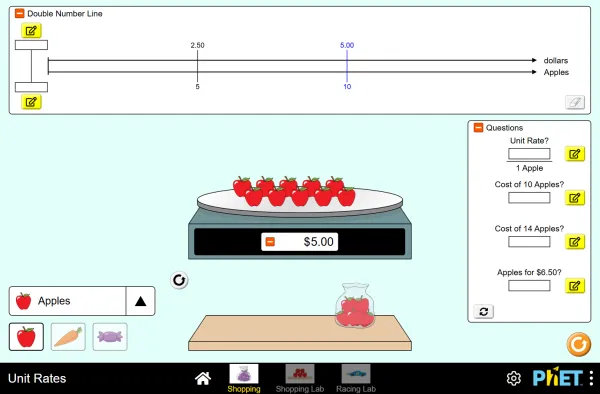
Full screen · PhET Interactive Simulations, University of Colorado Boulder, CC BY 4.0
Challenge
A currency booth at Auckland Airport sells US dollars at 0.56 USD per NZD. When you bring US dollars back, it buys them at 0.60 USD per NZD, so every NZ dollar you get back costs you 0.60 USD. Hana changed some NZ dollars into US dollars, spent USD 205 on her trip, and changed what was left back into NZ dollars, receiving exactly NZD 125. (a) How many NZ dollars did she change at the start? (b) The US dollars she brought home had cost her more than NZD 125. How much did the booth's two rates cost her on that leftover money, to the nearest cent?
Hint
Work backwards. To receive NZD 125 at 0.60 USD per NZD, how many US dollars did she hand back? Add what she spent to find what she bought.
Answer
(a) NZD 500 (b) NZD 8.93
Step by step
- Coming home, each NZ dollar cost her 0.60 USD, so NZD 125 needed 125 × 0.60 = USD 75.
- She had spent USD 205, so she must have bought 205 + 75 = USD 280 at the start.
- Buying US dollars, she got 0.56 USD for each NZ dollar. To get USD 280 she undid the rate: 280 ÷ 0.56 = NZD 500.
- The USD 75 she brought home had cost her 75 ÷ 0.56 = NZD 133.93 when she bought it.
- She got only NZD 125 for it, so the gap between the two rates cost her 133.93 − 125 = NZD 8.93.
Full working
- 125 × 0.60 = 75USD handed back to get NZD 125
- 205 + 75 = 280USD bought at the start
- 280 ÷ 0.56 = 500undo the buying rate, so divide
- Check: 500 × 0.56 = 280correct
- 75 ÷ 0.56 = 133.928… ≈ 133.93what the leftover USD 75 cost in NZD
- 133.93 − 125 = 8.93lost on the round trip
- (a) NZD 500 (b) NZD 8.93
Some boots cost AUD 99 on an Australian website when the exchange rate is 0.90 AUD per NZD. A month later the website raises its price by 10%, and the NZ dollar strengthens by 10%, so each NZ dollar now buys 10% more Australian dollars. (a) Show that the boots cost exactly the same in NZ dollars as before. (b) A year after the start, the AUD price is 20% higher than the original AUD 99, and each NZ dollar buys 25% more Australian dollars than at the original rate of 0.90. By what percentage has the NZ dollar price changed since the start?
Hint
Coming back to NZ dollars, divide by the rate. Both changes are multipliers: one on the top of the division and one on the bottom.
Answer
(a) NZD 110 both times (b) 4% cheaper, NZD 105.60
Step by step
- At the start, coming back to NZ dollars means dividing by the rate: 99 ÷ 0.90 = NZD 110.
- A 10% rise multiplies the price by 1.1, giving AUD 108.90. A 10% stronger NZ dollar multiplies the rate by 1.1, giving 0.99 AUD per NZD.
- 108.90 ÷ 0.99 = NZD 110. The price and the rate were multiplied by the same 1.1, and dividing one by the other cancels it.
- In part (b) the price is multiplied by 1.2 and the rate by 1.25, so the NZ price is multiplied by 1.2 ÷ 1.25 = 0.96.
- A multiplier of 0.96 is 96% of the original, which is a 4% decrease: 110 × 0.96 = NZD 105.60.
Full working
- 99 ÷ 0.90 = 110start price in NZD
- 99 × 1.1 = 108.90AUD price after a 10% rise
- 0.90 × 1.1 = 0.99rate after the NZ dollar strengthens 10%
- 108.90 ÷ 0.99 = 110same NZD price as before
- 99 × 1.2 = 118.80 and 0.90 × 1.25 = 1.125the part (b) price and rate
- 118.80 ÷ 1.125 = 105.60new NZD price
- 105.60 ÷ 110 = 0.96multiplier 0.96 means down 4%
- (a) NZD 110 both times (b) down 4%, to NZD 105.60
Aroha owes $1,000 on a credit card that charges 2% interest a month on whatever she owes. At the end of each month the interest is added to the balance (rounded to the nearest cent), and then she pays $300, or the whole balance if that is less than $300. (a) How many payments does it take to clear the card? (b) How much interest does she pay altogether? (c) What single yearly percentage is the same as 2% a month compounded, to 2 decimal places?
Hint
Walk it month by month in a table: balance, interest on that balance, new balance, payment, what is left. For (c), think of $100 left alone for 12 months, multiplied by 1.02 each month.
Answer
(a) 4 payments (b) $45.95 (c) 26.82% a year
Step by step
- Month 1: 2% of $1,000 is $20, so she owes $1,020, pays $300 and owes $720.
- Month 2: 2% of $720 is $14.40, she owes $734.40, pays $300 and owes $434.40.
- Month 3: 2% of $434.40 is $8.69, she owes $443.09, pays $300 and owes $143.09.
- Month 4: 2% of $143.09 is $2.86, she owes $145.95 and pays it all. Four payments, and the interest adds to $45.95.
- For (c), $100 multiplied by 1.02 twelve times is 100 × 1.02¹² = $126.82, so 2% a month is the same as 26.82% a year, not 24%.
Full working
- 1000 × 1.02 = 1020, 1020 − 300 = 720month 1, interest $20.00
- 720 × 1.02 = 734.40, 734.40 − 300 = 434.40month 2, interest $14.40
- 434.40 × 0.02 = 8.688 ≈ 8.69, 443.09 − 300 = 143.09month 3
- 143.09 × 0.02 = 2.8618 ≈ 2.86, 143.09 + 2.86 = 145.95month 4, pays it all
- 20 + 14.40 + 8.69 + 2.86 = 45.95total interest
- 1.02¹² = 1.26824…twelve months of × 1.02
- (a) 4 payments (b) $45.95 (c) 26.82% a year
Practise this
Report a mistake
More in Number
 Rational, irrational, and scientific notation7 min
 Exponent rules and working with roots7 min
 Significant figures, rounding and estimating7 min
 Order of operations, signs and reciprocals7 min
 Percentages as multipliers, and ratios7 min
 Ratios, rates, speed and percentage change7 minExchange rates, unit prices and compound interest7 min
Is your child on track?
Take the free placement test