Significant figures, rounding and estimating
What this lesson covers
- The rules for identifying significant figures are: all non-zero digits are significant zeros appearing anywhere between two non-zero digits are significant leading zeros are not significant trailing zeros are significant if there is a decimal point present, and are not significant otherwise exact numbers have an unlimited number of significant figures.
- For numbers written in scientific notation as a × 10^k, the number of significant figures is determined by applying the rules to the value of a.
A number says how well you know it
- Your calculator will give you twelve digits for anything.
- Almost none of them mean anything about the real thing.
- Significant figures are how you say which ones do.
One length, three claims
- Four metres. Four point two metres. Four point two zero zero.
- Those are three different claims about the same wall.
- The zeros are not decoration. They say what you measured with.
| Written | Means measured to | Using |
|---|---|---|
| 4 m | nearest metre | a pace |
| 4.2 m | nearest 10 cm | a tape |
| 4.200 m | nearest mm | a good tape |
| The zeros | are not decoration | they are a claim |
Which digits count
- Every non-zero digit counts, always.
- Zeros are the whole problem, and there are three cases.
- In the middle they count. In front they never do.
| Digit | Does it count? |
|---|---|
| Any non-zero digit | always counts |
| A zero between two of them | counts |
| Zeros in front | never count |
| Zeros at the end | count only after a point |
Why zeros in front are different
- In 0.004, the two zeros do not tell you about the 4.
- They only say where the decimal point is.
- Precision is about the digits you measured, not the size.
Counting them in practice
- Nought point nought nought four two nought has three figures.
- One thousand two hundred and five has four. The inside zero counts.
- Start counting at the first digit that is not a zero.
| Number | What counts | How many |
|---|---|---|
| 0.004 20 | the 4, 2 and 0 | 3 figures |
| 0.000 5 | just the 5 | 1 figure |
| 1 205 | the inside zero counts | 4 figures |
| Front zeros | only place the point | 0 figures |
The case nobody can settle
- A crowd of exactly 4200 people has four figures.
- 4200 rounded from a survey might only have two.
- Written bare, the number cannot tell you which.
| Where it came from | Really has | Rule says |
|---|---|---|
| 4200 people counted | exact | all 4 count |
| 4200 from rounding | could be 2 or 3 | unclear |
| The rule says | no point, no credit | 2 figures |
| Which is | a convention, not a fact |
Scientific notation settles it
- The front number carries the figures.
- The power of ten carries the size. They are separate jobs.
- So 4.2, 4.20 and 4.200 times ten cubed are all 4200.
| Written | Value | Figures |
|---|---|---|
| 4.2 × 10³ | 4200 | 2 figures |
| 4.20 × 10³ | 4200 | 3 figures |
| 4.200 × 10³ | 4200 | 4 figures |
| Same size | different claim | no ambiguity |
Rounding to a number of figures
- Count from the first non-zero digit, then look at the next one.
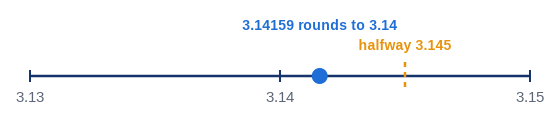
- Pi to three figures is three point one four.
- Nought point nought nine nine nine to two figures carries to 0.10.
| Round this | Counting | Gives |
|---|---|---|
| 3.14159 to 3 s.f. | count 3, 1, 4 | 3.14 |
| 0.004 672 9 to 2 s.f. | count 4, 6 | 0.0047 |
| 0.0999 to 2 s.f. | the 9s carry | 0.10 |
| Start counting | at the first non-zero |
Try it: which way does it round?
Figures are not decimal places
- Decimal places count from the point, whatever the number is.
- Figures count from the number, wherever the point is.
- For a small number those give wildly different answers.
| The question | The answer |
|---|---|
| 0.004 67 to 2 d.p. | 0.00 |
| 0.004 67 to 2 s.f. | 0.0047 |
| Places count from the point | figures count from the number |
| Both answers are right | to different questions |
Estimate before you calculate
- Forty-eight times nought point two one.
- Round both: fifty times nought point two is ten.
- Now you know the answer should be near ten before you start.
| Working | Rounded | About |
|---|---|---|
| 48 × 0.21 | round to 50 × 0.2 | about 10 |
| Calculator says | 10.08 | sensible |
| If it said 100.8 | a point is misplaced | check it |
| The estimate | catches size errors | not small ones |
What the estimate actually catches
- Calculators do not make small mistakes. People do.
- A mistyped point or a wrong button is out by a factor of ten.
- An estimate spots that instantly. Nothing else will.
Try it: count, round, claim, estimate
How precise should you be?
- Money goes to the cent. Height goes to the centimetre.
- A bus timetable to the second would be useless.
- The context decides, not the calculator display.
| Situation | Rounded to | Looks like |
|---|---|---|
| Money | to the cent | $14.27 |
| A person’s height | to the centimetre | 171 cm |
| A bus timetable | to the minute | 8:14 |
| 7 people shared by 3 | not 2.333333 | people are whole |
Try it: how precise should you be?
Too many digits is its own mistake
- Seven people shared between three is not 2.333333 people.
- Writing digits you did not measure is claiming what you do not know.
- It reads as careful and it is the opposite.
What to take away
- Seven lines, and the first one is the reason for the rest.
| A number claims its own precision | that is what figures record |
| Non-zero digits | always count |
| Zeros in the middle | count |
| Zeros in front | never count |
| Zeros at the end | count after a decimal point |
| Scientific notation | removes the ambiguity |
| Estimate first | it catches the big mistakes |
Common mistakes
- 0.003 050 has 3 significant figures; the zero on the end is just padding.A final zero after the point counts: the 3, the middle 0, the 5 and the last 0 make 4 figures.
- 0.028 47 to 2 significant figures is 0.03Start counting at the first non-zero digit, the 2: the figures are 2 and 8, and the next digit 4 rounds down, so 0.028.
- 0.0999 to 2 significant figures is 0.099The next digit is a 9, so round up; the 9s carry to give 0.10, and the final zero stays to show 2 figures.
- The calculator says 39 × 0.48 = 187.2, so that is the answer.Estimate first: 40 × 0.5 = 20, so 187.2 has a misplaced point; the real answer is 18.72.
Your turn: eight questions
- Answer all eight.
- Question 1 has three kinds of zero in it.
- Question 4 cannot be done without scientific notation.
How many figures in 0.003 050?
Round 0.028 47 to 2 significant figures.
Estimate 39 × 0.48. Is 18.72 sensible?
Write 4200 with exactly 3 figures.
Which has exactly 3 significant figures: 0.0050, 3.060, 4005 or 0.0405?
A race time is written as 12.50 s. What does the final zero claim?
A calculator shows 61 × 0.29 = 1.769. Use an estimate to find the correct answer.
26 students go on a trip in vans that seat 8 each. A calculator shows 26 ÷ 8 = 3.25. How many vans are needed?
Show answer
1. Four. The two zeros in front do not count, the 3 counts, the zero between the 3 and the 5 counts, the 5 counts, and the final zero counts because it comes after a decimal point. 2. 0.028. Start counting at the 2, so the first two figures are 2 and 8, and the next digit is a 4, which rounds down. 3. Round to 40 times 0.5, which is 20. The calculator answer of 18.72 is close to 20, so it is sensible. An answer of 187.2 or 1.872 would not be. 4. 4.20 × 10³. Writing 4200 on its own cannot say three figures, which is exactly the problem scientific notation solves. 5. 0.0405: the 4, the zero between and the 5. 0.0050 has 2, 3.060 has 4 and 4005 has 4. 6. Timed to the nearest 0.01 s. A zero at the end after a decimal point is significant, so 12.50 says the hundredths were measured. 7. 17.69. Estimate 60 × 0.3 = 18, so 1.769 has the point one place out; the answer is 17.69. 8. 4 vans. Vans are whole, and 3 vans seat only 24, so 3.25 rounds up to 4.
The answers
- Four figures: the 3, the middle zero, the 5 and the last zero.
- Nought point nought two eight, because the next digit is a 4.
- Forty times nought point five is twenty, so 18.72 is sensible.
- Four point two zero times ten cubed.
Challenge
A measurement is written as 0.0450 m. (a) How many significant figures does it have? (b) What is the range of true lengths it could stand for? (c) A careless copy writes it as 0.045 m. How much wider is the range of lengths that 0.045 m could stand for?
Hint
Find the place value of the last significant figure. The true value could be up to half of one unit in that place either side.
Answer
(a) 3 (b) 0.04495 m up to (but not including) 0.04505 m (c) 10 times wider: 0.001 m instead of 0.0001 m
Step by step
- The front zeros only place the point. The 4, the 5 and the final zero after the point count: 3 figures.
- The last figure is in the ten-thousandths place, so the value was rounded to the nearest 0.0001.
- Half of 0.0001 is 0.00005, so the true length is from 0.04495 up to just under 0.04505. That range is 0.0001 m wide.
- Written as 0.045, the last figure is in the thousandths, so the true length is from 0.0445 up to just under 0.0455, a range 0.001 m wide.
- Dropping the final zero makes the claim 10 times less precise, even though the number looks the same.
Full working
- 0.0450: figures 4, 5, 0front zeros do not count, final zero after a point does
- rounded to nearest 0.0001, half is 0.00005last figure is ten-thousandths
- 0.04495 ≤ length < 0.04505width 0.0001 m
- 0.045: 0.0445 ≤ length < 0.0455width 0.001 m
- 0.001 ÷ 0.0001 = 10how much wider
- (a) 3 (b) 0.04495 ≤ length < 0.04505 m (c) 10 times wider
A rectangular deck is measured as 4.2 m by 3.6 m, each to 2 significant figures. A calculator gives the area as 15.12 m². (a) What are the smallest and largest areas the deck could really have? (b) Which of 15.12 m², 15.1 m² and 15 m² is the honest way to give the area, and why?
Hint
4.2 to 2 significant figures could be anything from 4.15 up to just under 4.25. Smallest times smallest gives the smallest area.
Answer
(a) from 14.7325 m² up to just under 15.5125 m² (b) 15 m², because the true area could be anywhere from about 14.7 to 15.5
Step by step
- Each length was rounded to the nearest 0.1 m, so it could be up to 0.05 m either side.
- The length is from 4.15 to just under 4.25 m, and the width from 3.55 to just under 3.65 m.
- Smallest area: 4.15 × 3.55 = 14.7325 m². Largest: just under 4.25 × 3.65 = 15.5125 m².
- 15.12 and 15.1 claim the area is known to 0.01 or 0.1 of a square metre, but it could be out by about 0.4 m² either way.
- Even the second figure is in doubt, so 15 m² (2 figures, matching the measurements) is the most you can honestly claim.
Full working
- 4.15 ≤ length < 4.254.2 to 2 s.f.
- 3.55 ≤ width < 3.653.6 to 2 s.f.
- 4.15 × 3.55 = 14.7325smallest area
- 4.25 × 3.65 = 15.5125largest area (not quite reached)
- range is about 14.7 to 15.5 m²15.12 claims far more than this
- (a) 14.7325 m² ≤ area < 15.5125 m² (b) 15 m²
A whole number rounds to 5000 when rounded to 1 significant figure, to 4600 when rounded to 2 significant figures, and to 4550 when rounded to 3 significant figures. How many whole numbers fit all three facts? List them.
Hint
Write down the range of whole numbers for each fact separately, then find the numbers that are in all three ranges.
Answer
5 numbers: 4550, 4551, 4552, 4553, 4554
Step by step
- Rounding to 5000 at 1 figure means the number is from 4500 up to 5499.
- Rounding to 4600 at 2 figures (to the nearest hundred) means it is from 4550 up to 4649.
- Rounding to 4550 at 3 figures (to the nearest ten) means it is from 4545 up to 4554.
- The second fact needs at least 4550 and the third needs at most 4554.
- So the numbers are 4550 to 4554, which is 5 numbers, and all of them are inside the first range too.
Full working
- 1 s.f. → 5000: 4500 to 5499nearest thousand
- 2 s.f. → 4600: 4550 to 4649nearest hundred
- 3 s.f. → 4550: 4545 to 4554nearest ten
- overlap: at least 4550 and at most 4554in all three ranges
- 4550, 4551, 4552, 4553, 4554check 4554: 5000, 4600, 4550
- 5 numbers: 4550 to 4554
Practise this
Report a mistake
More in Number
 Rational, irrational, and scientific notation7 min
 Exponent rules and working with roots7 minSignificant figures, rounding and estimating7 min
 Order of operations, signs and reciprocals7 min
 Percentages as multipliers, and ratios7 min
 Ratios, rates, speed and percentage change7 min
 Exchange rates, unit prices and compound interest7 min
Is your child on track?
Take the free placement test