The water cycle part 1: Earth's spheres, the Sun and weather
What this lesson covers
- Earth is one system of four spheres, and water moves between all of them.
- Evaporation, condensation, freezing, melting and precipitation move water around the cycle.
- Changes of state take in or give out energy, and this drives clouds, humidity, temperature and rain.
- The atmosphere is mostly nitrogen and oxygen, with argon, carbon dioxide and a changing amount of water vapour.
- Sunlight heats Earth's surface most at the equator and less and less towards the poles.
Earth is a system of four spheres
- Scientists split the Earth system into four connected parts, called spheres.
- Water is found in all four, and it is constantly moving from one to another.
- The same water molecule might be in the sea one month, in a cloud the next, and in a kūmara plant after that.
- Frozen water in glaciers and sea ice is sometimes given its own name, the cryosphere, but it is often counted as part of the hydrosphere.
| Sphere | What it is | Water there |
|---|---|---|
| Atmosphere | The layer of air around Earth | Water vapour, cloud droplets, ice crystals |
| Hydrosphere | All of Earth's water | Oceans, lakes, rivers, glaciers, groundwater |
| Geosphere | Rock, soil and Earth's interior | Water in soil and in cracks and pores in rock |
| Biosphere | All living things | Water inside plants, animals and people |
What the atmosphere is made of
- The atmosphere is a thin shell of gases held to Earth by gravity.
- Dry air is about four fifths nitrogen and one fifth oxygen.
- Argon and carbon dioxide make up most of the rest, and carbon dioxide is only about 0.04%, though it matters a lot for trapping heat.
- Water vapour is different: its amount changes from almost none over a desert or polar ice to around 4% in hot, humid tropical air.
- Water vapour is an invisible gas. Clouds and steam you can see are tiny liquid droplets, not vapour.
| Gas | Share of dry air | Note |
|---|---|---|
| Nitrogen | about 78% | Unreactive; most of what you breathe in |
| Oxygen | about 21% | Used in respiration and burning |
| Argon | about 0.9% | Unreactive noble gas |
| Carbon dioxide | about 0.04% | Used in photosynthesis; traps heat |
| Water vapour | 0% to about 4% (varies) | Source of clouds and rain |
The Sun heats the equator most
- Energy from the Sun warms land, water and air, and this energy powers the water cycle.
- Latitude is how far north or south of the equator a place is, from 0° at the equator to 90° at the poles.
- Near the equator the Sun is high in the sky, so its rays hit the ground almost straight on and the energy is concentrated on a small area.
- At higher latitudes the rays arrive at a low angle, so the same energy is spread over a bigger area and also passes through more atmosphere.
- So average temperatures fall as latitude increases, which is one reason Kaitaia (about 35° S) is warmer than Invercargill (about 46° S).
| Latitude | Example | Sun's rays | Heating |
|---|---|---|---|
| 0° | Equator, Indonesia | Nearly straight down | Strongest |
| about 35° to 47° S | New Zealand | At a moderate angle | Medium |
| about 78° S | Scott Base, Antarctica | Very low angle | Weakest |
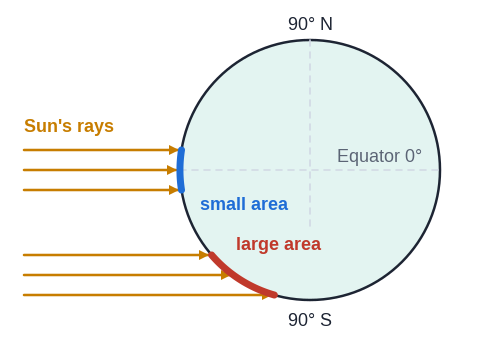
Try it: the Sun's angle and the seasons
Example: why a low Sun heats less
- A torch shone straight down onto paper lights up a patch of 100 cm².
- Tilt the torch so the beam hits the paper at 30° to the surface, like the Sun low in the sky. The patch stretches to 200 cm².
- What happens to the energy reaching each square centimetre?
- same torch, so the same total energy each secondonly the angle changed
- area: 100 cm² becomes 200 cm²a slanted beam spreads out
- energy per cm² = total ÷ areaspread over twice the area
- each cm² gets half as much energy, so it warms less
- this is why high latitudes and winter are colderthe Sun is lower in the sky
Changes of state move water and energy
- Water changes state as it moves around the cycle: solid ice, liquid water and gaseous water vapour.
- Evaporation and melting take in energy, so they cool their surroundings. That is why you feel cold getting out of the sea on a windy day.
- Condensation and freezing give out energy, so they warm their surroundings.
- Precipitation is not a change of state. It is water, liquid or frozen, falling from clouds to the ground.
- Some ice turns straight into vapour without melting (sublimation), which slowly shrinks snow on dry, sunny mountain days.
| Process | Change | Energy | Where you see it |
|---|---|---|---|
| Evaporation | Liquid to gas | Taken in | Puddles drying, the ocean surface |
| Condensation | Gas to liquid | Given out | Clouds, fog, dew on grass |
| Freezing | Liquid to solid | Given out | Frost on puddles, sea ice |
| Melting | Solid to liquid | Taken in | Snowmelt feeding rivers in spring |
| Precipitation | No change, just falling | Not applicable | Rain, snow, sleet, hail |
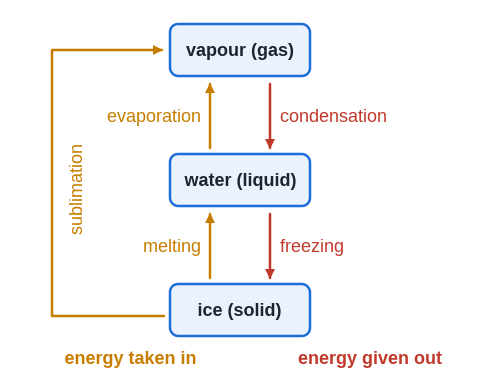
How changes of state make weather
- Humidity is the amount of water vapour in the air. Warm air can hold much more vapour than cold air.
- When moist air cools enough, some vapour condenses into droplets and a cloud or fog forms. The temperature where this starts is the dew point.
- Condensation releases energy, which warms the air and helps it keep rising. That extra energy is what powers thunderstorms and cyclones.
- When cloud droplets grow big enough, they fall as precipitation.
- Evaporation does the opposite job: it takes energy away, so lakes, the sea and damp ground cool the air above them.
| Weather feature | Change of state behind it |
|---|---|
| Cloud and fog | Condensation as moist air cools |
| High humidity | Lots of evaporation into warm air |
| Cool sea breeze | Evaporation taking energy from the sea surface |
| Storm energy | Condensation releasing energy in rising air |
| Frost | Vapour turning straight into ice on cold surfaces overnight |
Example: why the West Coast is wet and Canterbury is dry
- Hokitika gets about 2.9 m of rain a year. Christchurch, on the other side of the Southern Alps, gets about 0.6 m.
- Use changes of state to explain the difference.
| Place | Average rain a year (mm), 1991 to 2020 |
|---|---|
| Hokitika | 2921 |
| Christchurch | 618 |
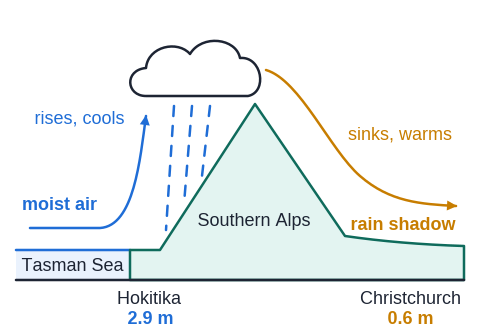
- westerly winds cross the Tasman Seaevaporation loads the air with water vapour
- the air reaches the Southern Alps and is forced upmountains block its path
- rising air coolspressure is lower higher up, so the air expands and cools
- vapour condenses into cloud, then falls as rain or snow on the west sidecooled below its dew point
- the air sinks down the east side and warms, with little water lefta dry, warm nor'wester
- the West Coast is wet and Canterbury is in a rain shadow
Try it: changes of state and weather
Where Earth's water is stored
- At any moment almost all of Earth's water is sitting in a store, not moving between them.
- The time water spends in a store is its residence time. A long residence time means a store slows down the cycle.
- The atmosphere holds very little water, but it is replaced every week or two, so it is the fastest part of the cycle.
- Ice sheets and deep groundwater can lock water away for thousands of years, taking it out of the cycle for a long time.
- The figures below are rounded values from hydrology references, so treat them as a guide, not exact numbers.
| Store | Share of Earth's water | Typical residence time |
|---|---|---|
| Oceans | about 96.5% | about 3000 years |
| Ice sheets and glaciers | about 1.7% | decades (glaciers) to many thousands of years (Antarctica) |
| Groundwater | about 1.7% | months to 10 000 years, depending on depth |
| Lakes | about 0.01% | years to about 100 years |
| Rivers | less than 0.001% | weeks to months |
| Atmosphere | about 0.001% | about 9 days |
Example: using storage data
- Use the storage table to answer: why does a store such as a glacier or an aquifer change how quickly water moves through the cycle?
- Christchurch's tap water is pumped from aquifers under the Canterbury Plains, filled by rain and by water soaking from rivers such as the Waimakariri.
- atmosphere: about 9 dayswater passes through quickly
- groundwater: months to thousands of yearswater moves slowly through rock and gravel
- rain soaking into the plains can take years or decades to reach a deep welllong residence time
- stores hold water back, delaying its return to rivers, the sea and the air
- a dry summer does not empty a deep aquifer straight awayit was filled over many years
Common mistakes
- The steam from a kettle and the clouds in the sky are water vapour.Water vapour is an invisible gas; steam and clouds are tiny liquid droplets that formed when vapour condensed.
- Condensation cools the air, because it happens when things are cold.Cooling starts condensation, but condensation itself gives out energy and warms the air; it is evaporation that takes energy in and cools.
- Precipitation is the change of state from gas to liquid.That change is condensation; precipitation is water or ice falling from clouds, with no change of state needed.
- The equator is hotter because it is closer to the Sun.The difference in distance is tiny; the equator is hotter because the Sun's rays arrive nearly straight on, so the same energy lands on a smaller area.
Model the Sun's rays with a torch
You need: a torch or a phone torch, an empty toilet roll tube, sticky tape, 2 sheets of plain paper, a ruler and a pencil, a stack of books
- Tape the toilet roll tube over the torch so the light comes out as a neat round beam.
- Rule a grid of 1 cm squares on one sheet of paper and lay it flat on the table.
- Rest the torch on a stack of books so it points straight down at the grid from about 15 cm above, trace round the lit patch, and count the squares inside it.
- Keep the end of the tube the same distance from the middle of the grid, but tilt the torch so the beam meets the paper at a low angle, then trace and count the patch again.
- Look for: the tilted patch is longer, covers far more squares and looks dimmer, because the same light is spread over a bigger area, just as low sunlight near the poles heats each square metre less than overhead sunlight at the equator.
Safety: A phone torch is bright enough to dazzle, so keep the beam pointed at the paper and never shine it into anyone's eyes.
Your turn
Water is inside the leaves of a kauri tree. Which sphere is it in?
A puddle dries up on a sunny afternoon. Name the change of state, and say whether energy is taken in or given out.
Explain why the equator is warmer than Antarctica, using the idea of sunlight being spread out.
Dry air is about 21% oxygen. About how many litres of oxygen are there in 100 L of dry air?
Use the storage table to explain why water in the atmosphere is replaced much faster than water in the oceans.
A student says the steam from a boiling jug and the clouds over Hokitika are both water vapour. What is the mistake?
A torch shone straight down lights 50 cm² of paper. Tilted low, the same beam lights 150 cm². How does the energy on each cm² change?
Hokitika gets about 2921 mm of rain a year and Christchurch about 618 mm. Which statement explains the difference?
Show answer
1. The biosphere (living things). 2. Evaporation; energy is taken in from the Sun and the ground. 3. At the equator the Sun's rays arrive nearly straight on, so the energy is concentrated on a small area; near the poles the rays arrive at a low angle, so the same energy is spread over a much larger area (and passes through more air), heating each square metre less. 4. About 21 L. 5. The atmosphere holds a tiny amount of water that stays about 9 days before falling as precipitation, while the oceans hold a huge amount that stays about 3000 years on average. 6. Water vapour is an invisible gas. Steam and clouds are tiny liquid droplets that formed when vapour condensed. 7. The same energy is spread over three times the area (150 ÷ 50 = 3), so each cm² gets one third as much energy and warms less. 8. Moist air from the Tasman Sea is forced up over the Southern Alps, cools, and its vapour condenses and falls on the west side, so the air reaching Christchurch has little water left: a rain shadow.
States of Matter: Basics
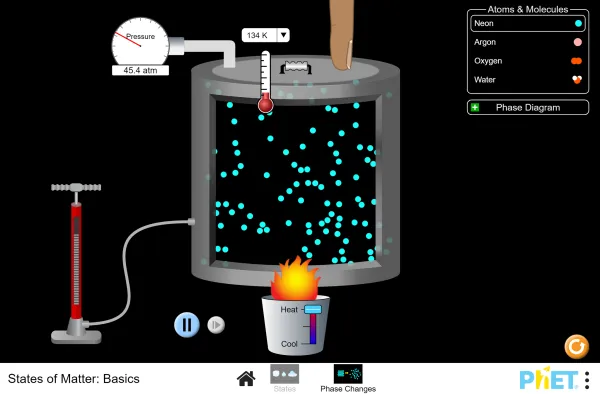
Full screen · PhET Interactive Simulations, University of Colorado Boulder, CC BY 4.0
Recap
- Water moves between the atmosphere, hydrosphere, geosphere and biosphere.
- Dry air is about 78% nitrogen, 21% oxygen, 0.9% argon and 0.04% carbon dioxide, plus a varying amount of water vapour.
- The Sun's heating is strongest at the equator and weakens as latitude increases.
- Evaporation and melting take in energy; condensation and freezing give it out, and this shapes clouds, humidity and storms.
- Stores such as ice and groundwater hold water for a long time and slow the cycle.
| Idea | Key fact |
|---|---|
| Spheres | atmosphere, hydrosphere, geosphere, biosphere |
| Atmosphere | mostly nitrogen and oxygen |
| Latitude | higher latitude, less heating |
| Energy in | evaporation, melting |
| Energy out | condensation, freezing |
| Stores | long residence time slows the cycle |
Challenge
Residence time can be estimated as: amount held in a store ÷ amount leaving it each year. (a) The atmosphere holds about 12 900 km³ of water, and about 505 000 km³ falls as precipitation each year. Show that water stays in the air for about 9 days. (b) Lake Taupō holds about 59 km³ of water, and about 4.1 km³ flows out down the Waikato River each year (ignore evaporation). Estimate its residence time. (c) A dye is spilled into the air and the same amount into Lake Taupō. Which one would you expect to stay around longer, and why?
Hint
Store ÷ yearly flow gives an answer in years. To change a fraction of a year into days, multiply by 365.
Answer
(a) about 9.3 days (b) about 14 years (c) the lake, because its water is replaced only once every 14 years or so, while air moisture is replaced every 9 days
Step by step
- For the atmosphere, 12 900 ÷ 505 000 ≈ 0.0255 of a year.
- 0.0255 × 365 ≈ 9.3 days, which matches the table's 9 days.
- For Lake Taupō, 59 ÷ 4.1 ≈ 14.4 years.
- A store with a long residence time holds on to what gets into it, because its water is swapped out slowly.
- So a spill into the lake would linger for years, while anything in the air is rained out within weeks.
Full working
- 12 900 ÷ 505 000 ≈ 0.0255 yearsstore ÷ yearly flow
- 0.0255 × 365 ≈ 9.3 daysyears to days
- 59 ÷ 4.1 ≈ 14.4 yearsLake Taupō
- 14 years ≫ 9 daysslow store holds pollutants
- (a) about 9 days (b) about 14 years (c) the lake keeps the dye far longer
On a clear, still night when frost is forecast, some Central Otago orchardists switch on sprinklers and coat their apricot blossoms in water. Ice forms on the blossoms, yet the blossoms survive at about 0 °C while unsprayed blossoms nearby drop to −3 °C and are killed. Explain how a coat of freezing water keeps the blossoms warmer, and why the sprinklers must keep running all night.
Hint
Look at the energy column of the changes of state table. What does freezing do to its surroundings? What happens once all the water has turned to ice?
Answer
Freezing water gives out energy, which keeps the blossom at about 0 °C; the sprinklers must keep adding new water so there is always water freezing and releasing energy
Step by step
- On a clear night the blossoms lose energy and cool towards the cold air temperature.
- When the sprayed water reaches 0 °C it starts to freeze, and freezing gives out energy to its surroundings.
- While liquid water is still freezing on the blossom, that energy stops the blossom cooling below about 0 °C.
- Once all the water has frozen, no more energy is released and the ice and blossom can cool below 0 °C.
- So fresh water must keep landing on the blossoms all night, so there is always some freezing and giving out energy.
Full working
- clear night: blossom loses energy and coolsthe stimulus
- water at 0 °C freezes: liquid to solidchange of state
- freezing gives out energyfrom the table
- energy released stops the blossom going below 0 °Cwhile water is still freezing
- all water frozen: no more energy given outso keep spraying
- freezing water releases energy that holds the blossoms near 0 °C, so the sprinklers must run all night
Use these made-up round figures. On a clear midsummer day, sunlight delivers 24 MJ of energy to each square metre of Lake Taupō's surface (1 MJ = 1000 kJ), and 40% of it goes into evaporating water. Evaporating 1 g of water takes 2.4 kJ. (a) What mass of water evaporates from each square metre that day, and what depth of water is that in mm? (1 kg of water spread over 1 m² is 1 mm deep.) (b) The lake's surface is about 616 km². What volume of water, in m³, evaporates from the whole lake that day? (c) On a clear midwinter day each square metre gets only 6 MJ. Give two reasons, linked to the Sun, why winter gets so much less. (d) Later, this water vapour condenses to form cloud. What happens to the energy that went into evaporating it, and how can that affect the weather?
Hint
Change MJ to kJ first, then divide by the energy needed for each gram. For (b), 1 km² is 1 000 000 m², and a depth in mm must be changed to metres.
Answer
(a) 4 kg per m², a depth of 4 mm. (b) About 2 460 000 m³ (2.46 million m³). (c) In winter the Sun is lower in the sky, so its light is spread over a bigger area of surface, and the days are shorter, so there are fewer hours of sunlight. (d) The energy is given out again as the vapour condenses, warming the air in the cloud; this warm air keeps rising, so the cloud can grow taller and produce heavier rain or thunderstorms.
Step by step
- Find the energy that goes into evaporation, then divide by 2.4 kJ for each gram.
- Turn the mass per square metre into a depth, then multiply depth by the area of the lake.
- Low Sun angle spreads the same beam over more ground, and short days give fewer hours of heating.
- Evaporation takes in energy and condensation gives the same energy back out to the air.
Full working
- 24 MJ = 24 000 kJchange units
- 24 000 × 0.40 = 9600 kJenergy used for evaporation per m²
- 9600 ÷ 2.4 = 4000 g = 4 kgwater evaporated per m²
- 4 kg over 1 m² = 4 mm = 0.004 mdepth of water
- 616 km² = 616 000 000 m²change units
- 616 000 000 × 0.004 = 2 464 000 m³volume from the whole lake
- 4 kg (4 mm) per m², about 2 460 000 m³ from the whole lake
The maths behind it
Report a mistake
How is Year 10 maths going?
See the Year 10 maths guide