Fractions on a number line
What this lesson covers
- Tenths can be created by dividing whole numbers by 10 and can be expressed as fractions or decimals.
- Improper fractions and mixed numbers are different representations of the same quantity.
A fraction is a place
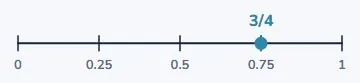
- Every fraction names a spot on the number line.
- 3/4 is three quarters of the way from 0 to 1.
- Find the spot and you have found the fraction.
The bottom number counts the cuts
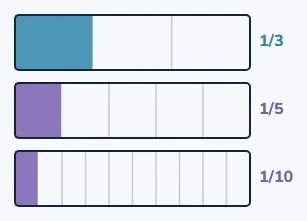
- The bottom number is an instruction: cut into this many.
- Cut a cake into 5 and the pieces are smaller than into 3.
- So 1/5 is SMALLER than 1/3. More cuts, smaller pieces.
Bigger bottom, smaller piece
- This is the one thing about fractions that feels backwards.
- It only feels backwards if you read it as a number.
- Read it as "how many pieces" and it is obvious.
| fraction | cut into | so each piece is |
|---|---|---|
| 1/3 | 3 pieces | big pieces |
| 1/5 | 5 pieces | smaller |
| 1/10 | 10 pieces | smaller again |
Same bottom? Just count
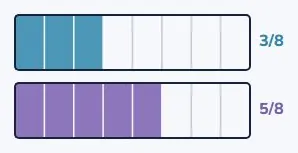
- If the bottoms match, the pieces are the same size.
- So 5/8 beats 3/8: more of the same piece.
- That is the easy case, and it is easy for a reason.
The line does not stop at 1
- 8/8 is a whole one. So what is 9/8?
- One eighth past 1. The line just keeps going.
- Nothing breaks. You walked past a whole number.
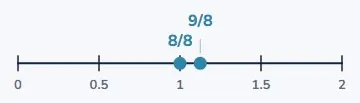
Try it: a fraction is a place on the line
Two ways to say the same place
- 9/8 and 1 1/8 are the same spot on the line.
- One counts eighths. The other counts wholes, then eighths.
- Same place. Two spellings.
| improper | mixed number | where it lands |
|---|---|---|
| 8/8 | 1 | exactly on 1 |
| 9/8 | 1 1/8 | one eighth past 1 |
| 12/8 | 1 4/8 | halfway between 1 and 2 |
| 16/8 | 2 | exactly on 2 |
Equivalent means "lands on the same mark"
- 1/2 and 5/10 sit on exactly the same spot.
- So do 4/8 and 2/4. All of them are halfway.
- That is all equivalent means. Same place.
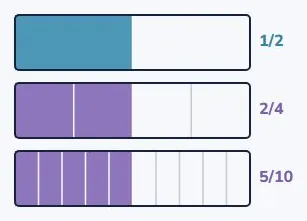
Maths blocks
Different cuts, same amount
- Cutting a cake into more pieces does not add cake.
- Take twice the pieces from twice the cuts and you have the same.
- That is why the top and bottom move together.
| this | equals | because both land |
|---|---|---|
| 1/2 | 5/10 | halfway |
| 1/2 | 4/8 | halfway |
| 2/4 | 1/2 | halfway |
Multiplying tenths by 10
- Dividing by 10 moved digits right. This goes back.
- 0.3 × 10 moves the 3 left, into the ones. That is 3.
- One move, two directions.
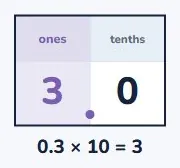
Common mistakes
- 1/5 is bigger than 1/3, because 5 is bigger than 3.The bottom number counts the cuts: 5 pieces are smaller than 3 pieces, so 1/5 is smaller than 1/3.
- 9/8 is not a real fraction, because the top is bigger than the bottom.9/8 is one eighth past 1 on the number line, the same place as 1 1/8.
- 4/8 is bigger than 1/2, because 4 and 8 are bigger numbers.4/8 and 1/2 land on the same mark, halfway, so they are equivalent: the same amount.
- 0.3 × 10 = 0.30Multiplying by 10 moves the 3 one column left, into the ones, so 0.3 × 10 = 3.
Your turn
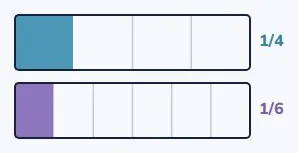
Which is bigger: 1/4 or 1/6?
Write 7/4 as a mixed number.
Is 3/6 the same as 1/2?
Tama ate 3/8 of a pizza. Kiri ate 5/8 of the same size pizza. Who ate more?
What is 0.6 × 10?
Show answer
1. 1/4 is bigger: cutting into four makes bigger pieces than cutting into six. 2. 1 3/4: four quarters make a whole, leaving three quarters. 3. Yes: three of six pieces is half of them, so 3/6 and 1/2 land on the same mark. 4. Kiri: the bottoms match, so the pieces are the same size, and 5 eighths is more than 3. 5. 6: multiplying by 10 moves the 6 one column left, from the tenths into the ones.
Fractions: Intro
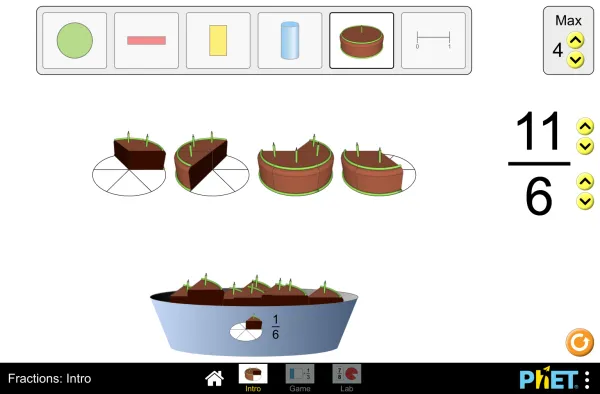
Full screen · PhET Interactive Simulations, University of Colorado Boulder, CC BY 4.0
One place, several spellings
- A fraction is a place on the line.
- The bottom number counts cuts, so bigger means smaller.
- Equivalent fractions land on the same mark.
| idea | what to remember |
|---|---|
| a fraction | a place on the number line |
| the bottom number | how many pieces you cut into |
| same numerator | bigger bottom, smaller piece |
| same denominator | just count the pieces |
| 9/8 and 1 1/8 | one place, two spellings |
| equivalent | they land on the same mark |
Challenge
Kahu says that 2 14 is the same as 214, because you just push the 2 and the 1 together. Is he right? Write 2 14 as a fraction, and say which two whole numbers 214 is between.
Hint
How many quarters make 1 whole? So how many quarters are in 2 wholes?
Answer
No. 2 14 is 94. 214 is 5 14, so it is between 5 and 6.
Step by step
- 4 quarters make 1 whole, so 2 wholes are 8 quarters.
- 2 14 is 8 quarters and 1 more, which is 94.
- 214 is 21 quarters. 20 quarters make 5 wholes, and 1 quarter is left.
- So 214 is 5 14, between 5 and 6, a long way from 2 14.
- Kahu is wrong.
Full working
- 2 = 844 quarters in each whole
- 2 14 = 84 + 14 = 94the right fraction
- 214 = 204 + 14 = 5 1420 quarters make 5 wholes
- No: 2 14 = 94, and 214 is between 5 and 6
Some cakes are all the same size. Each one is cut into 8 equal slices. At a party, 29 slices are eaten. How many cakes is that? Write it as a fraction and as a mixed number. How many more slices would make exactly 4 cakes?
Hint
Each slice is 18 of a cake. How many slices make 1 whole cake?
Answer
298 cakes, which is 3 58 cakes. 3 more slices would make exactly 4 cakes.
Step by step
- Each slice is one eighth of a cake, so 29 slices is 298 of a cake.
- 8 slices make 1 cake, so 24 slices make 3 cakes.
- 29 is 24 and 5 more, so 298 is 3 58.
- 4 cakes is 32 slices, and 32 − 29 = 3.
Full working
- 29 slices = 298each slice is 18
- 248 = 33 lots of 8 slices
- 298 = 248 + 58 = 3 58tidy into wholes
- 4 cakes = 328, 32 − 29 = 3slices still needed
- 298 = 3 58 cakes; 3 more slices
A number line goes from 0 to 2. Mere puts a mark at every quarter, starting at 0 and ending at 2. Sam puts a mark at every eighth, also from 0 to 2. Some spots get two marks. How many spots get only one mark?
Hint
Count Mere's marks and Sam's marks. Does every one of Mere's marks land on one of Sam's?
Answer
8 spots
Step by step
- Mere marks 0, 14, 24, up to 84. That is 9 marks.
- Sam marks 0, 18, 28, up to 168. That is 17 marks.
- Every quarter is two eighths, so each of Mere's marks lands on one of Sam's.
- So 9 spots get two marks, and Sam has 17 − 9 = 8 marks on his own.
- They are 18, 38, 58, 78, 98, 118, 138 and 158.
Full working
- 04 to 84: 9 marksMere, quarters from 0 to 2
- 08 to 168: 17 marksSam, eighths from 0 to 2
- 14 = 28every quarter mark is also an eighth mark
- 17 − 9 = 8Sam's marks that nobody shares
- 8 spots
Practise this
Report a mistake
More in Number
Is your child on track?
Take the free placement test