Column methods, and why they work
What this lesson covers
- Addition and subtraction can be carried out mentally, using known facts, place value and partitioning, or column methods.
- Standard written algorithms (e.g. column addition, column subtraction) rely on place value, regrouping, and renaming.
- Multiplication can be represented as repeated addition, scaling, or arrays, and larger numbers can be multiplied using an area model or column multiplication.
Written methods are not new tricks
- Column addition looks like a ritual you have to memorise.
- It is not. It is place value, written down.
- Everything in this lesson is partitioning in disguise.
| what it looks like | what it actually is |
|---|---|
| column addition | partitioning, arranged in columns |
| the carried 1 | ten ones that became one ten |
| the area model | partitioning, turned sideways |
First, do it in your head
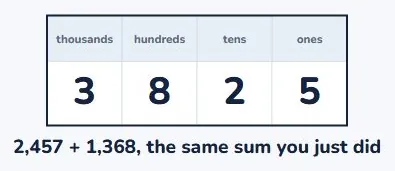
- 2,457 + 1,368. Break both into their columns.
- Add the thousands, then hundreds, then tens, then ones.
- 3,000 and 700 and 110 and 15. That is 3,825.
| column | add them |
|---|---|
| thousands | 2,000 + 1,000 = 3,000 |
| hundreds | 400 + 300 = 700 |
| tens | 50 + 60 = 110 |
| ones | 7 + 8 = 15 |
Now the same sum, in columns
- Exactly the same work. Same numbers, same order.
- The columns just hold the parts for you.
- Same answer: 3,825.
What the carried 1 actually is
- 7 ones and 8 ones make 15 ones.
- Ten of them become one ten, and move to the next column.
- 5 stays behind. That is the whole of carrying.
| you get | which is | so |
|---|---|---|
| 15 ones | 1 ten and 5 ones | write 5, carry the ten |
| 11 tens | 1 hundred and 1 ten | write 1, carry the hundred |
Try it: add in columns
Maths blocks
Subtraction borrows the same way, backwards
- If a column has too few, take one from its left.
- One hundred arrives as ten tens. Not as one ten.
- Same exchange rate, travelling the other way.
| you take | it arrives as |
|---|---|
| 1 ten | 10 ones |
| 1 hundred | 10 tens |
| 1 thousand | 10 hundreds |
Multiplying is rows of the same thing
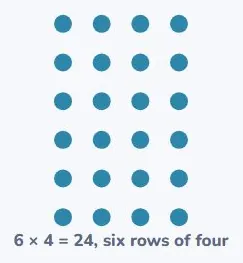
- 6 × 4 is six rows of four.
- You can count them, or add 4 six times.
- Or just know it. These are the facts worth memorising.
Bigger numbers: cut the rectangle
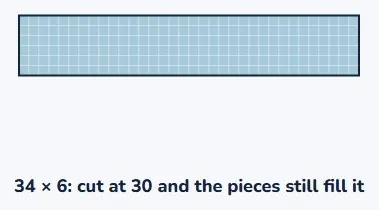
- 34 × 6 is a rectangle 34 long and 6 high.
- Cut it at 30. Now there are two easy rectangles.
- Nothing is lost in the cut, so the areas add up.
Try it: cut the rectangle
Two easy sums instead of one hard one
- 30 × 6 is 180.
- 4 × 6 is 24.
- Put them back together: 204.
| piece | sum | gives |
|---|---|---|
| the 30 part | 30 × 6 | 180 |
| the 4 part | 4 × 6 | 24 |
| put together | 180 + 24 | 204 |
Zero and one are not the same in both
- 6 × 0 is nothing. No groups at all.
- But 6 + 0 is still 6.
- Say "groups of" and the difference is obvious.
| sum | answer | say it out loud |
|---|---|---|
| 6 × 1 | 6 | one group of six |
| 6 × 0 | 0 | no groups at all |
| 6 + 0 | 6 | six, and nothing added |
| 6 ÷ 1 | 6 | shared between one person |
Dividing is sharing out the columns
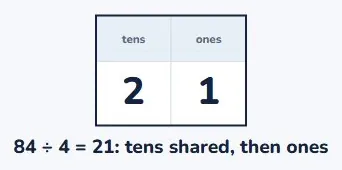
- 84 ÷ 4. Share the 8 tens first: 2 tens each.
- Then share the 4 ones: 1 each.
- 21. Place value again, one column at a time.
Try it: trade ten for one
Common mistakes
- 2,457 + 1,368: 7 + 8 = 15, so I write 15 in the ones column.15 ones is 1 ten and 5 ones: write 5 and carry the 1 to the tens column. The answer is 3,825.
- 34 × 6 = 30 × 6 + 4 = 184Both parts get multiplied: 30 × 6 = 180 and 4 × 6 = 24, so 34 × 6 = 204.
- 6 × 0 = 6, just like 6 + 0 = 6.6 × 0 means no groups at all, so it is 0; only adding 0 leaves the number as 6.
- 52 − 17: 7 take away 2 is 5, so the answer is 45.You cannot swap the digits round; borrow a ten so 12 − 7 = 5, then 4 − 1 = 3, so 52 − 17 = 35.
Your turn
In columns: 2,608 + 1,495. Watch the carrying.
Work out 47 × 3 by cutting the rectangle at 40.
Work out 96 ÷ 3, sharing the tens first.
Tama has 3,250 points and loses 1,436. In columns, how many are left?
Which of these is true?
Show answer
1. 4,103. The ones make 13 and the tens make 10, so there are two carries in a row. 2. 141. 40 × 3 is 120, 7 × 3 is 21, and 120 + 21 = 141. 3. 32. 9 tens shared 3 ways is 3 tens, and 6 ones shared 3 ways is 2 ones. 4. 1,814. 3,250 − 1,436: take a ten as 10 ones and a thousand as 10 hundreds, so 1,814 are left. 5. 8 × 0 = 0. No groups at all is nothing, but 8 + 0 and 8 ÷ 1 both stay 8.
Arithmetic
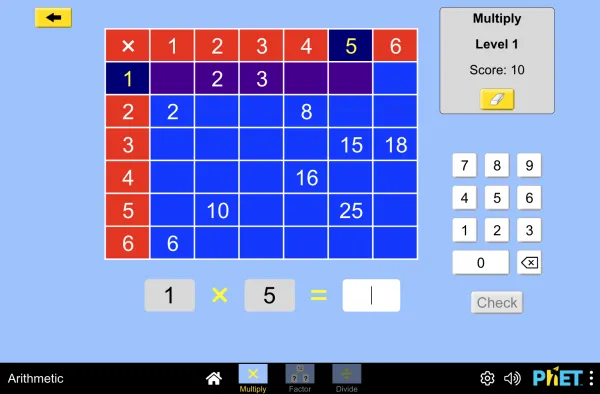
Full screen · PhET Interactive Simulations, University of Colorado Boulder, CC BY 4.0
Why the methods work
- Every written method is place value, written down.
- Carrying and borrowing are ten-for-one exchanges.
- Cutting a rectangle loses nothing, so the pieces add.
| method | what it really is |
|---|---|
| column addition | partition, add columns, reassemble |
| the carried 1 | 10 ones became 1 ten |
| subtraction | the same exchange, backwards |
| arrays | rows of the same thing |
| area model | cut it, do two easy sums, add |
| × 0 and × 1 | count the groups, not the objects |
| dividing | share the biggest columns first |
Challenge
What is the smallest number you can add to 3,768 to get an answer that ends in 000? What is the next number that works?
Hint
Which number ending in 000 comes straight after 3,768? Take 3,768 away from it, in columns.
Answer
232 (3,768 + 232 = 4,000). The next one is 1,232 (3,768 + 1,232 = 5,000).
Step by step
- The first number after 3,768 that ends in 000 is 4,000.
- So work out 4,000 − 3,768 in columns.
- The ones column needs renaming, but the tens and hundreds are 0. Rename 1 thousand as 10 hundreds, 1 hundred as 10 tens, and 1 ten as 10 ones.
- Now 4,000 is 3 thousands, 9 hundreds, 9 tens and 10 ones. Take away: 10 − 8 = 2, 9 − 6 = 3, 9 − 7 = 2, 3 − 3 = 0. That is 232.
- The next number ending in 000 is 5,000, which is 1,000 more, so add 1,000 more: 1,232.
- Check: 3,768 + 232 = 4,000.
Full working
- 4,000first number after 3,768 that ends in 000
- 4,000 = 3 thousands, 9 hundreds, 9 tens, 10 onesrename across the zeros
- 10 − 8 = 2, 9 − 6 = 3, 9 − 7 = 2, 3 − 3 = 0column subtraction
- 4,000 − 3,768 = 232the smallest number
- 5,000 − 3,768 = 1,2321,000 more for the next one
- 232, then 1,232
The two boxes hide two different numbers: 4 × 36 = 8 × □ = □ × 9. What are the missing numbers?
Hint
Work out 4 × 36 first. Then think: if one number doubles, what must happen to the other to keep the same answer?
Answer
4 × 36 = 8 × 18 = 16 × 9 (all are 144). The missing numbers are 18 and 16.
Step by step
- Cut 36 at the tens: 30 × 4 = 120 and 6 × 4 = 24, so 4 × 36 = 144.
- 4 rows of 36 is the same as 8 rows of 18: double the rows, halve the row length. So the first box is 18.
- Check: 8 × 18 is 80 + 64 = 144.
- Now 18 halves to 9, so the other number doubles: 8 becomes 16. So 16 × 9.
- Check: 10 × 9 = 90 and 6 × 9 = 54, and 90 + 54 = 144.
Full working
- 4 × 36 = 120 + 24 = 144cut 36 at the tens
- 8 × 18 = 80 + 64 = 144double 4, halve 36
- 16 × 9 = 90 + 54 = 144double 8, halve 18
- 18 and 16
Tama worked out a 2-digit number times a 1-digit number by cutting the rectangle at the tens. His two pieces were 210 and 35. What was his multiplication, and what is the answer?
Hint
Both pieces are the same height, the 1-digit number. Which number up to 9 goes into 35 and also makes 210 from a tens number?
Answer
35 × 7 = 245
Step by step
- Both pieces are times the same 1-digit number.
- The small piece, 35, is ones digit × that number. 35 is 5 × 7 or 7 × 5.
- If the number is 5, the big piece is 210 ÷ 5 = 42, which is not a tens number. So that fails.
- If the number is 7, the big piece is 30 × 7 = 210. That works, and the ones digit is 5.
- So the multiplication was 35 × 7, and 210 + 35 = 245.
Full working
- 35 = 5 × 7 or 7 × 5the ones piece
- 210 ÷ 5 = 42, not a tens numberthe 5 does not work
- 30 × 7 = 210the tens piece works
- 5 × 7 = 35the ones piece
- 210 + 35 = 245put the pieces back together
- 35 × 7 = 245
Where science uses this
Practise this
Report a mistake
More in Number
Is your child on track?
Take the free placement test