Place value: what each digit is worth
What this lesson covers
- Whole numbers can be represented in the base 10 number system, where each digit has a place value 10 times that of the digit on the right.
- Each digit’s value depends both on its position (e.g. the tens position) and the numeral in the position. Zero is used as a placeholder.
The same digit, two different values
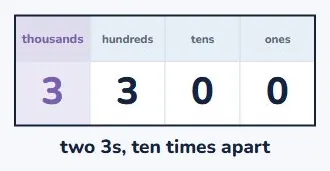
- Look at 3,300. There are two 3s.
- One is worth 3,000. The other is worth 300.
- Same digit. Where it stands changes what it is worth.
Each column is ten times the one on its right
- Ones, then tens, then hundreds, then thousands.
- Every step left multiplies by 10.
- That is what "base 10" means. One rule, repeated.
| column | worth | how it is built |
|---|---|---|
| ones | 1 | the start |
| tens | 10 | 10 × 1 |
| hundreds | 100 | 10 × 10 |
| thousands | 1,000 | 10 × 100 |
Try it: build a number
Reading a four-digit number
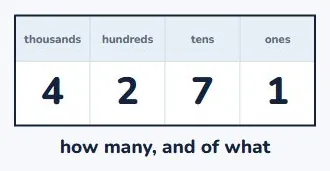
- 4,271. Start at the left and name each column.
- Four thousand, two hundred, seventy, one.
- The digit tells you how many. The column tells you of what.
Zero has a job
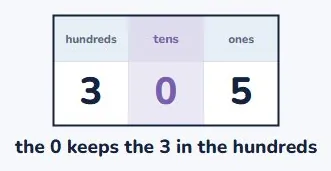
- 305 is three hundred and five.
- Not thirty-five. The 0 is doing something.
- It is holding the tens column open.
Take the zero away and everything moves
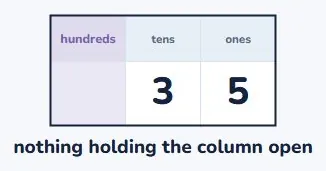
- Same 3, same 5. No 0 between them.
- The 3 falls into the tens column.
- Now it is worth 30, not 300. Zero was holding it up.
Where the zero sits changes the number
- Same two digits, three different numbers.
- Only the zero moved.
- Zero is not nothing. Zero is a place being held.
| number | you say | what the 0 is doing |
|---|---|---|
| 305 | three hundred and five | 0 keeps the tens column open |
| 35 | thirty-five | no 0, so the 3 falls into the tens |
| 350 | three hundred and fifty | 0 holds the ones instead |
Compare from the left
- The leftmost column is worth the most.
- So the first column where they differ settles it.
- Nothing on the right can catch up.
| th | h | t | o | |
|---|---|---|---|---|
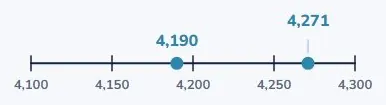
| 4,271 | 4 | 2 | 7 | 1 |
| 4,190 | 4 | 1 | 9 | 0 |
Try it: hop in thousands and hundreds
Why the right cannot catch up
- 4,271 beats 4,190 on the hundreds column.
- The 9 in 4,190 looks big, but it is only 90.
- One hundred beats ninety, however big the 9 looks.
Common mistakes
- Three hundred and five is written 35, or 3005.It is 305: the 0 holds the tens column open, so the 3 stays in the hundreds.
- 4,190 is bigger than 4,271 because 9 is a big digit.Compare from the left: the thousands match, then 2 hundreds beats 1 hundred, so 4,271 is bigger.
- In 3,300 both 3s are worth 3.The column tells you what a digit is worth: one 3 is worth 3,000 and the other is worth 300.
- 4,271 is four thousand, two hundred and seven, one.Name each column: four thousand, two hundred and seventy-one, because the 7 is in the tens column.
Your turn: which is bigger?
Which is true? Compare 2,608 and 2,680, working left to right.
Which is true? Compare 5,040 and 5,400, working left to right.
Comparing 5,040 and 5,400 from the left, which column is the first difference?
Put in order, smallest first: 3,090, 3,900, 3,009.
In 7,305, what is the 3 worth?
Show answer
1. 2,680 is bigger. Thousands and hundreds tie, then 8 tens beats 0 tens. 2. 5,400 is bigger. Thousands tie, then 4 hundreds beats 0 hundreds. 3. The hundreds. Both have 5 thousands, then 4 hundreds beats 0 hundreds, so you stop there. 4. 3,009, 3,090, 3,900. Thousands tie; 0 hundreds comes before 9 hundreds, then 0 tens before 9 tens. 5. 300. The 3 is in the hundreds column, and the 0 holds the tens column open.
What each digit is worth
- Where a digit stands changes what it is worth.
- Zero holds a column open. It is a job, not a nothing.
- Compare from the left and stop at the first difference.
| idea | what to remember |
|---|---|
| place value | position and digit, together |
| base 10 | each column 10× the one on its right |
| zero | holds a column open |
| reading | how many, and of what |
| comparing | left to right, first difference wins |
Challenge
Look at the number 7,777. The first 7 is worth how many times as much as the third 7?
Hint
Name the column each 7 stands in. Each step left is ten times bigger.
Answer
100 times as much
Step by step
- The first 7 is in the thousands column, so it is worth 7,000.
- The third 7 is in the tens column, so it is worth 70.
- From the tens to the thousands is two steps left.
- Each step left is ten times bigger, so two steps is 10 × 10 = 100 times.
- Check: 100 lots of 70 is 7,000.
Full working
- first 7 = 7,000thousands column
- third 7 = 70tens column
- tens → hundreds → thousandstwo steps left
- 10 × 10 = 100ten times each step
- 70 × 100 = 7,000check
- 100 times as much
Kai writes the number 4,056. Then he swaps the 0 and the 5 around. Does his number get bigger or smaller, and by how much?
Hint
Do not do a big take away. Ask what the 5 is worth before the swap, and what it is worth after.
Answer
It gets bigger by 450 (from 4,056 to 4,506).
Step by step
- Before the swap, the 5 is in the tens column, so it is worth 50.
- After the swap, the 5 is in the hundreds column, so it is worth 500.
- The 0 just holds a place, so moving it adds nothing.
- The 4 and the 6 do not move.
- So the number goes up by 500 take away 50, which is 450.
Full working
- 4,056 → 4,506swap the 0 and the 5
- 5 in the tens = 50before
- 5 in the hundreds = 500after
- 500 − 50 = 450the only change
- 4,056 + 450 = 4,506check
- bigger by 450
You have four cards: 0, 0, 5 and 7. Use all four cards to make four-digit numbers. How many different numbers can you make? Which two of your numbers are closest together?
Hint
A four-digit number cannot start with 0. So start with 5, then start with 7, and move the zeros around.
Answer
6 numbers. The closest are 7,005 and 7,050, which are 45 apart.
Step by step
- The first card must be 5 or 7, because a 0 at the front would leave only three digits.
- Starting with 5, the 7 can go in the hundreds, tens or ones: 5,700, 5,070, 5,007.
- Starting with 7, the 5 can go in the same three places: 7,500, 7,050, 7,005.
- Put all 6 in order and look at the gap between each neighbour.
- The smallest gap is from 7,005 to 7,050, which is 45.
Full working
- 5,007, 5,070, 5,700start with 5
- 7,005, 7,050, 7,500start with 7
- 5,070 − 5,007 = 63gap
- 5,700 − 5,070 = 630; 7,005 − 5,700 = 1,305gaps
- 7,050 − 7,005 = 45; 7,500 − 7,050 = 450gaps
- 6 numbers; 7,005 and 7,050 are closest (45 apart)
Practise this
Report a mistake
More in Number

Is your child on track?
Take the free placement test