Money: totals, change and coins
What this lesson covers
- New Zealand currency is a decimal system of dollars made up of 100 cents.
A dollar is 100 cents
- You already know this one.
- 100 cents make a dollar. Not 10. A hundred.
- So money needs two columns after the point.
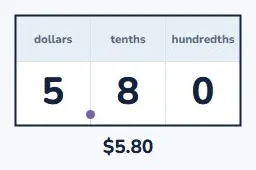
The same columns, one step further
- A 10c coin is one tenth of a dollar.
- One cent would be one hundredth.
- Same rule as always: ten times, every step left.
| column | worth | the coin |
|---|---|---|
| dollars | $1 | the $1 coin |
| tenths | 10c | the 10c coin |
| hundredths | 1c | no coin: NZ has none |
New Zealand has no 1c coin
- Our smallest coin is 10c.
- There is no 1c, no 2c, no 5c any more.
- So cash amounts always end on a 10.
| what we have | values |
|---|---|
| coins | 10c · 20c · 50c · $1 · $2 |
| notes | $5 · $10 · $20 · $50 · $100 |
| no longer made | 1c · 2c · 5c |
Making $5.80
- A $5 note, a 50c, a 20c and a 10c.
- Or two $2 coins, a $1, and the same silver.
- Same amount. Different handfuls.
| way | what you hand over |
|---|---|
| the fewest pieces | $5 note + 50c + 20c + 10c |
| with $2 coins | $2 + $2 + $1 + 50c + 20c + 10c |
| all in 20s and 50s | $5 note + 20c × 4 |
Try it: pay the exact amount
Adding up a shop
- A $4 book, a $3 pen, and two $2 stickers.
- The stickers are 2 × $2 = $4.
- $4 + $3 + $4 = $11 altogether.
| item | how many | costs |
|---|---|---|
| book | 1 | $4 |
| pen | 1 | $3 |
| stickers | 2 | $4 |
| total | $11 |
Change is not really subtraction
- You pay $20 for something costing $13.40.
- Written as a subtraction it is full of borrowing.
- So do not subtract. Count forwards instead.
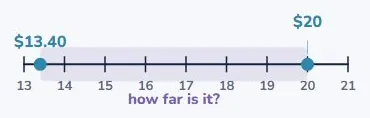
Count on to a tidy number first
- From $13.40, 60c takes you to $14.
- From $14, six dollars takes you to $20.
- 60c and $6 is $6.60. That is the change.
| from | add | and you reach |
|---|---|---|
| $13.40 | 60c | $14.00 |
| $14.00 | $6.00 | $20.00 |
| so the change is | $6.60 |
Try it: count on to give change
Why shopkeepers do it that way
- They hand you coins to a round number, then notes.
- Every step is an easy one.
- And you can check it as it is counted into your hand.
| they say | they hand you |
|---|---|
| "thirteen forty..." | |
| "...and sixty makes fourteen" | 50c + 10c |
| "...and six makes twenty" | $5 note + $1 |
Common mistakes
- I pay $20 for $13.40, so my change is $7.60.Count on: 60c takes $13.40 to $14, then $6 takes it to $20, so the change is $6.60.
- A $4 book, a $3 pen and two $2 stickers cost $4 + $3 + $2 = $9.Two stickers cost 2 × $2 = $4, so the total is $4 + $3 + $4 = $11.
- $5.80 is $5 and 8 cents.100 cents make a dollar, so .80 is 80 cents: $5.80 is $5 and 80 cents.
- I can make $2.45 with NZ coins.New Zealand's smallest coin is 10c, so cash amounts always end on a 10, like $2.40 or $2.50.
Your turn
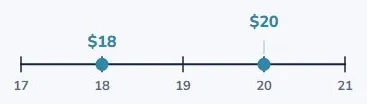
Three $6 tickets. What do they cost altogether?
Three $6 tickets cost $18. You pay with a $20 note. What is the change?
Make $3.70 using the fewest NZ coins you can.
A pie costs $4.60. Mere pays with a $10 note. What is her change?
At a Rotorua market Hemi buys two $5 lunches and a $3 drink. What is the total?
Show answer
1. $18. Three sixes: 3 × $6 = $18. 2. $2. Count on from $18 to $20. 3. $2 + $1 + 50c + 20c, which is four coins. Two 10c coins or three $1 coins would use more. 4. $5.40. From $4.60, 40c takes you to $5, then $5 takes you to $10. 5. $13. The lunches are 2 × $5 = $10, then $10 + $3 = $13.
Money, totals and change
- 100 cents in a dollar, so two columns of cents.
- Our smallest coin is 10c.
- Count change forwards. Never borrow.
| idea | what to remember |
|---|---|
| $1 | 100 cents: two columns after the point |
| 10c | one tenth of a dollar |
| NZ coins | 10c · 20c · 50c · $1 · $2 |
| totals | multiply the repeats, then add |
| change | count on to a tidy number, then up |
Challenge
Aroha buys a drink for $3.70 and pays with a $5 note. The shop has run out of 10c coins. It still has 20c, 50c, $1 and $2 coins. How can the shopkeeper give Aroha the right change?
Hint
Find the change first. Then think about which coins can make the cents part without a 10c.
Answer
$1.30 change: a 50c coin and four 20c coins
Step by step
- Count on from $3.70: 30c makes $4, then $1 makes $5. So the change is $1.30.
- A $1 coin leaves 30c, and 30c cannot be made from 20c and 50c coins.
- So do not use the $1 coin. Try a 50c coin: that leaves 80c.
- 80c is four 20c coins.
- So the change is 50c and four 20c coins.
Full working
- $3.70 + 30c = $4.00count on to a tidy number
- $4.00 + $1 = $5.00count on to the note
- change = $1.3030c and $1
- $1 + 30c does not work20c and 50c cannot make 30c
- 50c + 20c + 20c + 20c + 20c = $1.30it works
- a 50c coin and four 20c coins
Tama swaps $4 for a pile of 10c, 20c and 50c coins. He gets the same number of each kind of coin. How many coins does he get altogether?
Hint
Think of one 10c, one 20c and one 50c as a set. What is one set worth?
Answer
15 coins (5 of each)
Step by step
- One 10c, one 20c and one 50c together make 80c.
- So the money comes in sets of 80c.
- Count in 80c: 80c, $1.60, $2.40, $3.20, $4.00. That is 5 sets.
- So there are 5 coins of each kind.
- 3 kinds of coin, 5 of each, is 15 coins.
Full working
- 10c + 20c + 50c = 80cone set
- 80, 160, 240, 320, 400count in 80s to $4
- $4 = 5 sets5 of each coin
- 3 × 5 = 153 kinds of coin
- 15 coins
Three friends buy a pizza for $13.80. Ana pays for all of it with a $20 note. The friends want to share the cost fairly. How much should each of the other two friends give Ana?
Hint
$13 does not share into 3 evenly, so split $13.80 into $12 and $1.80 and share each part into 3. Does Ana's change matter?
Answer
$4.60 each
Step by step
- Each friend should pay a third of $13.80.
- Split $13.80 into $12 and $1.80, which both share into 3 easily.
- $12 shared by 3 is $4. $1.80 is 180c, and 180c shared by 3 is 60c.
- So each share is $4.60.
- Ana's change does not matter: she paid her own share too, so each of the others gives her $4.60.
Full working
- $13.80 = $12 + $1.80split into easy parts
- $12 ÷ 3 = $4share the dollars
- 180c ÷ 3 = 60cshare the cents
- $4 + 60c = $4.60one share
- $4.60 + $4.60 + $4.60 = $13.80check
- $4.60 each
Practise this
Report a mistake
More in Number
Is your child on track?
Take the free placement test