Units, tools and estimating
What this lesson covers
- Different measurement tools and scales use different-sized units; the unit must be recorded with the measurement amount.
Seven what?
- "How long is the desk?" "Seven."
- Seven what? Seven centimetres? Seven metres?
- A number on its own is not a measurement.
| if you say | you mean something about |
|---|---|
| 7 mm | the thickness of a pencil |
| 7 cm | a matchbox |
| 7 m | a classroom wall |
| 7 km | a long walk (over an hour) |
The unit is part of the answer
- Always write the unit next to the number.
- Not because a teacher says so.
- Because without it you have not said anything.
| written down | is this a measurement? |
|---|---|
| 7 | no, seven of what? |
| 7 cm | yes |
| 7 kg | yes, but of something quite different |
Different jobs, different tools
- Length gets a ruler. Mass gets scales.
- Capacity gets a jug. Temperature gets a thermometer.
- And each tool comes with its own units.
| to measure | use | units |
|---|---|---|
| length | ruler or tape measure | mm · cm · m |
| mass | scales | g · kg |
| capacity | measuring jug | mL · L |
| temperature | thermometer | degrees Celsius |
Try it: what is being measured?
Read the scale before you read the number
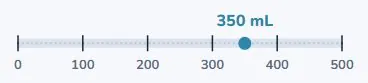
- Look at what one little mark is worth first.
- On one ruler a mark is 1 mm. On a jug it might be 50 mL.
- Same-looking gap. Completely different amount.
Carry your own measuring tools
- Your hand span is about 15 cm. Always with you.
- One big stride is about half a metre.
- Learn a few of these and you can estimate anywhere.
| this thing | is about |
|---|---|
| your hand span | about 15 cm |
| one big stride | about half a metre |
| a bag of sugar | 1 kg |
| a milk bottle | 2 L |
Benchmarks catch mistakes
- Someone measures the door and writes 8 cm.
- Your hand is 15 cm. The door is not half a hand.
- You do not need the right answer to spot a wrong one.
| someone says | check it against | verdict |
|---|---|---|
| the door is 8 cm | your hand span, 15 cm | far too small |
| the door is 2 m | a bit taller than a grown-up | sounds right |
| the door is 2 km | a twenty minute walk | nonsense |
Mixed units are place value again
- 1 m and 23 cm. Two units, one length.
- 100 cm make a metre, like 10 tens make a hundred.
- Same idea you already know, wearing different clothes.
| written as | means | all in one unit |
|---|---|---|
| 1 m 23 cm | 1 metre and 23 centimetres | 123 cm |
| 2 L 500 mL | 2 litres and 500 millilitres | 2,500 mL |
| 10 kg 3 g | 10 kilograms and 3 grams | 10,003 g |
Try it: one length, every unit
Temperature has units too
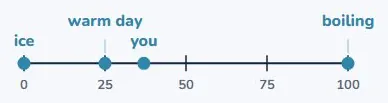
- We measure it in degrees Celsius.
- Water freezes at 0 and boils at 100.
- A warm day here is about 25 degrees.
Common mistakes
- The desk is 7 long.Always write the unit: 7 cm and 7 m are very different, so a number on its own is not a measurement.
- Each mark on the jug is 1 mL, so the water is at 4 mL.Check what one mark is worth first; if each mark is 50 mL, 4 marks is 200 mL.
- 1 m 23 cm is the same as 1.23 cm, or 123 m.100 cm make 1 m, so 1 m 23 cm is 100 cm + 23 cm = 123 cm.
- 2 L 500 mL = 2500 L1 L is 1000 mL, so 2 L 500 mL is 2000 mL + 500 mL = 2500 mL, not litres.
Your turn
Would you measure the length of a pencil in mm, m or km?
Is a bag of apples 2 g, 2 kg or 2 L?
How many cm in 3 m and 40 cm? (100 cm make 1 m)
Which tool would you use to find how much water a bucket holds?
Which is the best estimate of the temperature on a warm summer day in Auckland?
Show answer
1. Millimetres (mm). A pencil measured in metres would be as long as a broom handle. 2. 2 kg. 2 g is about two paperclips, and litres measure capacity, not mass. 3. 340 cm: three lots of 100 cm is 300 cm, plus the 40 cm. 4. A measuring jug, because how much a bucket holds is its capacity, measured in mL and L. 5. About 25 °C. Water freezes at 0 °C and boils at 100 °C, so 25 °C is a warm day.
Units and estimating
- A number with no unit is not a measurement.
- Check what one mark on the scale is worth.
- Know a few benchmarks and you can check anything.
| idea | what to remember |
|---|---|
| the unit | part of the answer, not an extra |
| the tool | ruler, scales, jug, thermometer |
| the scale | find out what one mark is worth first |
| your hand span | about 15 cm, always with you |
| 1 m 23 cm | the same as 123 cm |
| temperature | degrees Celsius: 0 ice, 100 boiling |
Challenge
On a measuring jug, the gap between the 200 mL mark and the 400 mL mark is split into 4 equal parts by little marks. The water is at the 3rd little mark above 200 mL. How much water is in the jug? How much more water is needed to make 1 L?
Hint
First find what one little gap is worth. Remember 1 L is 1,000 mL.
Answer
350 mL of water, and 650 mL more makes 1 L
Step by step
- From 200 mL to 400 mL is 200 mL.
- 200 mL split into 4 equal gaps is 50 mL for each gap.
- 3 gaps above 200 mL is 200 + 150 = 350 mL.
- 1 L is 1,000 mL, so 1,000 − 350 = 650 mL more is needed.
Full working
- 400 − 200 = 200 mLthe space between the big marks
- 200 ÷ 4 = 50 mLone little gap
- 200 + 3 × 50 = 350 mL3 gaps above 200
- 1 L = 1,000 mLchange the unit
- 1,000 − 350 = 650 mLstill needed
- 350 mL in the jug, 650 mL more
Sam has a rope 3 m long. He cuts off a piece 1 m 8 cm long. Then he cuts off another piece 85 cm long. How long is the rope that is left? Write it in metres and centimetres. His friend says, "1 m 8 cm is the same as 180 cm." How far out is his friend?
Hint
Change everything into centimetres first. How many centimetres are in 1 m?
Answer
1 m 7 cm is left. The friend is out by 72 cm, because 1 m 8 cm is 108 cm.
Step by step
- 3 m is 300 cm.
- 1 m 8 cm is 100 cm and 8 cm, which is 108 cm.
- 300 − 108 = 192 cm, then 192 − 85 = 107 cm.
- 107 cm is 100 cm and 7 cm, which is 1 m 7 cm.
- The friend read 8 cm as 80 cm. 180 − 108 = 72 cm too much.
Full working
- 3 m = 300 cm100 cm in each metre
- 1 m 8 cm = 100 + 8 = 108 cmnot 180
- 300 − 108 = 192 cmafter the first cut
- 192 − 85 = 107 cmafter the second cut
- 107 cm = 1 m 7 cmback to metres and centimetres
- 180 − 108 = 72 cmhow far out the friend is
- 1 m 7 cm left; the friend is out by 72 cm
Two pineapples that weigh the same are put on the kitchen scales with a 500 g weight. The scales show 3 kg 100 g. How heavy is one pineapple? Write your answer in kilograms and grams.
Hint
Change 3 kg 100 g into grams. Then take off the weight that is not pineapple.
Answer
1 kg 300 g (1,300 g)
Step by step
- 1 kg is 1,000 g, so 3 kg 100 g is 3,100 g.
- Take away the 500 g weight: 3,100 − 500 = 2,600 g of pineapple.
- That is 2 pineapples, so one pineapple is half of 2,600 g.
- Half of 2,600 g is 1,300 g.
- 1,300 g is 1,000 g and 300 g, which is 1 kg 300 g.
Full working
- 3 kg 100 g = 3,000 + 100 = 3,100 g1,000 g in each kilogram
- 3,100 − 500 = 2,600 gtake off the weight
- 2,600 ÷ 2 = 1,300 g2 pineapples the same
- 1,300 g = 1 kg 300 gback to kilograms and grams
- check: 1,300 + 1,300 + 500 = 3,100 git matches the scales
- 1 kg 300 g
Where science uses this
Report a mistake
More in Measurement
Is your child on track?
Take the free placement test