Contact and non-contact forces: ramps, magnets and gravity
What this lesson covers
- Heavier things need a bigger force to start, stop or change direction
- Ramps, slopes and wheels make moving heavy things easier
- Contact forces need touching; non-contact forces work across a gap
- Magnets have north and south poles that attract or repel
- Magnets attract iron, steel and nickel, but not every metal
- Gravity is a non-contact force that pulls things together
- Following a method fairly, and checking that it was followed
Forces and heavy things
- A force is a push or a pull.
- Forces can start, stop, speed up, slow down or turn things.
- Heavier things need a bigger force to get them moving, and a bigger force to stop them.
- An empty supermarket trolley is easy to push. A full one needs a bigger push, and it is harder to stop.
Ramps and wheels make it easier
- A ramp is a sloping surface, like a slope up to a door.
- Pushing a load up a ramp takes a smaller force than lifting it straight up. You just push it a longer way.
- Wheels roll instead of scraping along. That means less friction, the rubbing force between surfaces, so less force is needed.
- That is why trolleys, wheelbarrows and suitcases have wheels.
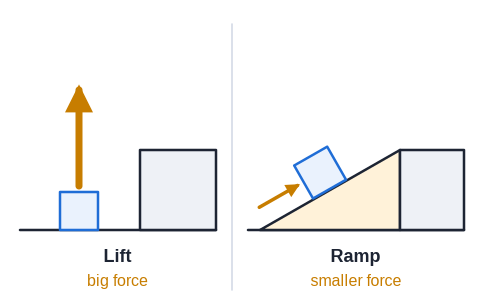
Example: ramp height and how far a car rolls
- Room 4 followed a method: let the toy car go from the top of the ramp, do not push it, and measure how far it rolls along the floor. They did each ramp height three times.
- What pattern do the results show, and is any result untrustworthy?
| Ramp height | Try 1 | Try 2 | Try 3 |
|---|---|---|---|
| 1 book | 80 cm | 85 cm | 82 cm |
| 2 books | 150 cm | 148 cm | 155 cm |
| 3 books | 220 cm | 290 cm | 225 cm |
- Higher ramp: the car rolls furtherabout 80, then 150, then 220 cm
- 3 books, try 2: 290 cm is far from 220 cm and 225 cm
- Their notes say the car was pushed on that try, so the method was not followed. Do that try again
- The higher the ramp, the further the car rolls
Contact and non-contact forces
- A contact force only works when two things touch. Kicking a ball, pushing a door and friction are contact forces.
- A non-contact force works across a gap, without touching.
- Magnetism and gravity are non-contact forces.
Try it: contact or non-contact?
Magnet poles
- A magnet has two ends called poles: north (N) and south (S).
- Attract means pull together. Repel means push apart.
- A north pole and a south pole attract each other.
- Two north poles repel each other, and so do two south poles.
- The force works across a gap, and even through paper or a thin table top.
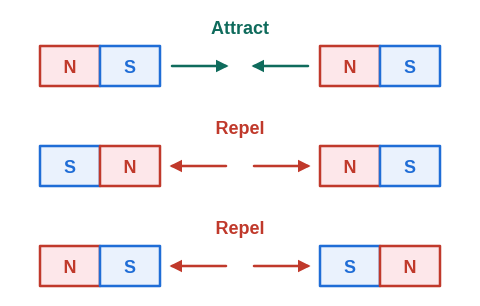
Try it: attract or repel?
Example: which metals does a magnet pick up?
- A class tested five metal things with a fridge magnet. What do the results show?
| Thing | Made of | Attracted? |
|---|---|---|
| Paper clip | Steel | Yes |
| Nail | Iron | Yes |
| Drink can | Aluminium | No |
| Piece of wire | Copper | No |
| Ring | Gold | No |
- Steel is mostly iron, so iron and steel are attracted
- Aluminium, copper and gold are metals but are not attracted
- Magnets attract some metals, like iron, steel and nickel, but not all metals
Try it: will a magnet pick it up?
Gravity
- Gravity is a pull between objects. Earth's gravity pulls everything towards the middle of the Earth.
- It is a non-contact force. An apple falls from a tree even though nothing touches it.
- Gravity is why balls fall, rivers flow downhill, and a car rolls down a ramp by itself.
How people use magnets
- Fridge magnets and the magnetic strips that keep fridge doors shut.
- Magnetic catches on cupboards, and clasps on bags.
- Recycling centres use big magnets to pull steel cans out from aluminium cans.
- Cranes in scrap yards use huge magnets to lift old steel cars.
Common mistakes
- All metals stick to magnets.Only some metals are attracted, mainly iron, steel and nickel; aluminium, copper and gold are not.
- Two north poles pull together.Matching poles repel; only a north pole and a south pole attract.
- A ramp makes the box lighter.The box weighs the same; a ramp lets you use a smaller push over a longer distance.
- Gravity only works on things that are falling.Gravity pulls on you all the time, even standing still; the floor pushes back up so you do not fall.
Magnet hunt
You need: a fridge magnet, a steel paper clip, a scrap of tinfoil, a steel spoon, a plastic lid, a wooden peg, some sheets of paper
- Predict which things the magnet will attract. Write your predictions down.
- Touch the magnet to each thing. Write down which ones it attracts.
- Put one sheet of paper between the magnet and the paper clip. Does the magnet still pull the clip?
- Add more sheets one at a time. Count how many sheets it can pull through.
- Look for this: only the steel things are attracted, and the magnet pulls through paper without touching, because magnetism is a non-contact force.
Safety: Small magnets and paper clips can be very dangerous if swallowed, so an adult keeps them away from younger children.
Your turn
Kicking a ball: is that a contact or a non-contact force?
The north pole of one magnet is near the south pole of another. Do they attract or repel?
Which one will a magnet attract: a steel nail, an aluminium can, or a copper pipe?
Why is a wheelie bin easier to move than a box of the same weight dragged on the ground?
An apple falls from a tree. Which force pulls it, and is it a contact force?
Why does a full trolley need a bigger push than an empty one?
Show answer
1. Contact, because the foot touches the ball. 2. Attract. 3. The steel nail. 4. Its wheels roll, so there is less friction than dragging. 5. Gravity, a non-contact force. 6. It is heavier, and heavier things need a bigger force to start moving.
Forces and Motion: Basics
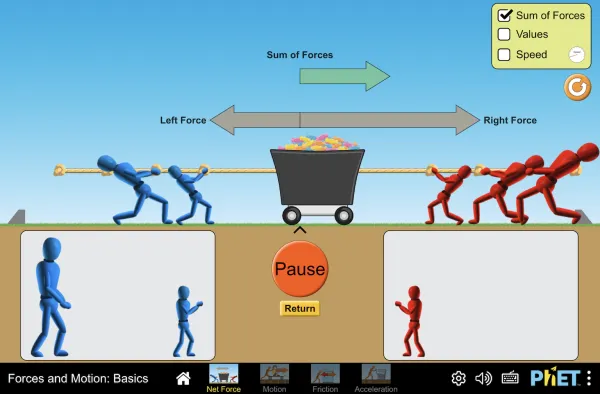
Full screen · PhET Interactive Simulations, University of Colorado Boulder, CC BY 4.0
Recap
- Heavier things need bigger forces to start, stop or turn.
- Ramps and wheels mean a smaller force can move a load.
- Contact forces need touching; magnetism and gravity work across a gap.
- North and south poles attract; matching poles repel.
- Magnets attract iron, steel and nickel, not all metals.
- Follow a method carefully, and repeat any result where it was not followed.
Challenge
Kiri slides two ring magnets onto a pencil that stands straight up. Each ring magnet has a north pole on one flat side and a south pole on the other. The top magnet floats above the bottom one without touching it. Which force pulls the top magnet down, and which force holds it up? Is each one a contact or a non-contact force? What happens if Kiri turns the top magnet upside down and slides it back on?
Hint
Nothing touches the top magnet from below. Which forces can work across a gap?
Answer
Gravity pulls it down, and the bottom magnet pushes it up because the sides facing each other are the same pole. Both are non-contact forces. Turned upside down, the facing poles are different, so they attract and the top magnet drops onto the bottom one.
Step by step
- Gravity pulls the top magnet down. It works without touching, so it is a non-contact force.
- Nothing touches the top magnet from below, so the push holding it up must also work across a gap.
- The two magnets push apart, so the sides facing each other are the same pole (north and north, or south and south). Magnetism is a non-contact force.
- Turning the top magnet over puts its other pole at the bottom. Now the facing poles are different, so they attract.
- The magnet's pull and gravity now both pull the top magnet down, so it drops and sticks to the bottom magnet.
Full working
- gravity pulls the top magnet downnon-contact
- the bottom magnet pushes it upsame poles repel, non-contact
- turned over: the facing poles are differentdifferent poles attract
- the top magnet drops and sticks to the bottom oneboth forces now pull down
- Gravity down and magnetism up, both non-contact; turned over, it drops and sticks
Three bar magnets, A, B and C, lie in a row, end to end, with small gaps. The right end of A is a north pole. A and B pull together. B and C push apart. Which pole is at each end of magnet C?
Hint
Work along the row one gap at a time. Each magnet has a north pole at one end and a south pole at the other.
Answer
The left end of C is north and the right end of C is south.
Step by step
- A and B pull together, so the ends facing each other are different poles.
- A's right end is north, so B's left end is south. That makes B's right end north.
- B and C push apart, so the ends facing each other are the same pole.
- B's right end is north, so C's left end is north too.
- C's other end, on the right, is south.
Full working
- A: right end Ngiven
- B: left end Sdifferent poles attract
- B: right end Na magnet has one N and one S
- C: left end Nsame poles repel
- C: right end Sthe other end of C
- C is N on the left, S on the right
A steel paper clip is tied to a thread, and the thread is taped to the table. A magnet is held just above the clip, without touching it, so the clip floats in the air with the thread pulled tight. Leo slides a sheet of paper into the gap: the clip keeps floating. He tries a sheet of aluminium foil: it keeps floating. Then he slides in a thin steel sheet: the clip drops. Explain all three results.
Hint
Think about what the magnet pulls on, and which force is pulling the clip down the whole time.
Answer
Magnetism is a non-contact force that works across a gap and through paper and aluminium, because the magnet does not pull on them. Steel is attracted to the magnet, so a steel sheet in the gap stops most of the pull reaching the clip. Gravity is still pulling the clip down, so the clip drops.
Step by step
- The clip floats because the magnet pulls it up harder than gravity pulls it down. The thread stops it flying up to the magnet.
- Magnetism works across a gap without touching, so it can reach the clip through things in between.
- Paper and aluminium are not attracted by a magnet, so the pull goes straight through them and the clip stays up.
- Steel is attracted by a magnet. A steel sheet in the gap gets in the way and stops most of the magnet's pull reaching the clip.
- Gravity is still pulling the clip down, so now gravity wins and the clip falls.
Full working
- magnet's pull up > gravity's pull downwhy the clip floats
- paper: not attracted, pull passes throughclip stays up
- aluminium: a metal, but not attracted, pull passes throughclip stays up
- steel: attracted, it stops most of the pulllittle pull reaches the clip
- gravity is now stronger than the magnet's pullclip drops
- Paper and foil let the pull through; steel stops most of it, so gravity wins
The maths behind it
Report a mistake
How is Year 4 maths going?
See the Year 4 maths guide