Earth spins and orbits: days, years and the Sun's path
What this lesson covers
- Earth is shaped roughly like a ball
- Earth spins on its axis once about every 24 hours
- Earth travels once around the Sun about every 365 and a quarter days
- Galileo's view of Venus gave evidence that Earth goes around the Sun
- Why the Sun seems to rise in the east and set in the west
- Recording where the Sun is using fixed landmarks
Earth is a ball
- Earth is roughly a sphere, which means a ball shape.
- Photos taken from space show a round Earth.
- When a ship sails away, its bottom disappears over the horizon first, because the sea curves.
- In an eclipse of the Moon, Earth's shadow on the Moon always has a curved edge.
Earth spins
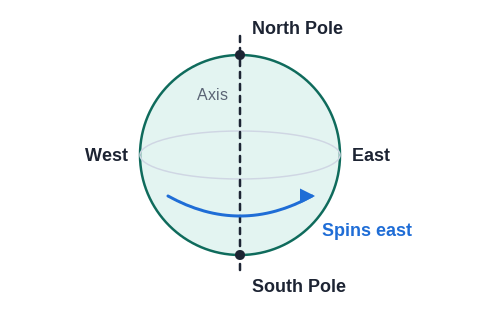
- Earth spins on its axis. The axis is an imaginary line through the North Pole and the South Pole.
- One full spin is called a rotation. It takes about 24 hours, which is one day.
- Earth spins towards the east.
- We do not feel it spin, because we spin along with it.
Why the Sun seems to move
- The Sun does not really travel across our sky. It is Earth that turns.
- In the morning, our part of Earth turns towards the Sun, so the Sun comes into view in the east. That is sunrise.
- As Earth keeps turning, the Sun seems to climb and cross the sky.
- In the evening, our part of Earth turns away, and the Sun goes out of view in the west. That is sunset.
- In New Zealand, the Sun is in the northern part of the sky at midday.
Example: recording the Sun with landmarks
- Room 6 stood on the same spot at three times of day. They faced north and noted which landmark the Sun was above, without looking straight at it.
- What do their results show?
| Time | Sun was above | Direction | Height |
|---|---|---|---|
| 9 am | The gym roof | North-east | Low |
| 12 pm | The flagpole | North | Highest |
| 3 pm | The pōhutukawa tree | North-west | Lower |
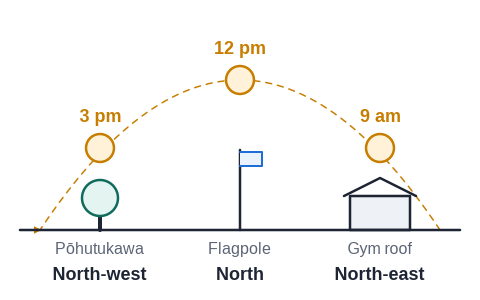
- Same spot and fixed landmarks each timeso the results can be compared
- North-east, then north, then north-westmoving from east to west
- Highest at midday
- The Sun seemed to move from east to west across the northern sky, highest at midday
Try it: the Sun's path across the sky
Earth travels around the Sun
- As well as spinning, Earth travels around the Sun. One trip around is called an orbit.
- One orbit takes about 365 and a quarter days. That is one year.
- So in one year, Earth spins about 365 times.
Example: why do we have leap years?
- A calendar year has 365 days, but one orbit takes about 365 and a quarter days.
- Why do we add an extra day every 4 years?
- Each year, about a quarter of a day is left over
- 4 × a quarter = 1 whole dayafter 4 years
- So every 4 years we add 1 day, 29 February. That year has 366 days and is called a leap year
Try it: spin or orbit?
Galileo's evidence
- Long ago, most people thought the Sun travelled around the Earth.
- In 1610, the Italian scientist Galileo Galilei looked at the planet Venus through his telescope.
- Over months, he saw Venus change shape, like the Moon does: from a thin crescent to nearly full. It also looked bigger and smaller.
- Those changes only fitted if Venus travels around the Sun.
- This evidence supported the idea that the planets, Earth included, go around the Sun.
Common mistakes
- The Sun moves across the sky every day.The Sun only seems to move; Earth spinning towards the east makes it look that way.
- A day is how long Earth takes to go around the Sun.A day is one spin, about 24 hours; a year is one orbit, about 365 and a quarter days.
- In New Zealand the midday Sun is straight overhead.In New Zealand the midday Sun is in the northern part of the sky, never straight overhead.
Track the Sun with a shadow stick
You need: a stick or a long pencil, a lump of play dough or a cup of sand, 6 small stones, chalk or paper and a pen, a sunny day
- In the morning, stand the stick upright in the play dough on flat, sunny ground that will stay sunny all day.
- At 9 am, put a stone on the tip of the stick's shadow and write the time next to it.
- Do the same at 12 pm and 3 pm. Do not move the stick.
- The Sun is always on the opposite side of the stick from its shadow. Use your stones to work out where the Sun was each time.
- Look for this: the shadow swings round during the day, which shows the Sun moving from the east, through the north, to the west.
Safety: Never look straight at the Sun, even for a moment, because it can damage your eyes; look only at the shadows.
Your turn
How long does Earth take to spin once on its axis?
In which direction does the Sun rise?
How long does Earth take to travel once around the Sun?
What did Galileo see Venus do that gave evidence it goes around the Sun?
In New Zealand at midday, which part of the sky is the Sun in?
At 9 am the Sun is above the gym roof in the north-east. Which direction will it be in at 3 pm?
Show answer
1. About 24 hours. 2. The east. 3. About 365 and a quarter days. 4. Change shape, like the Moon's phases, and change size. 5. The north. 6. The north-west, because it moves from east to west.
Recap
- Earth is roughly a ball.
- Earth spins on its axis about once every 24 hours: one day.
- It spins towards the east, so the Sun seems to rise in the east and set in the west.
- Earth orbits the Sun about once every 365 and a quarter days: one year.
- Galileo's view of Venus changing shape supported the idea that planets orbit the Sun.
- Use the same spot and fixed landmarks to record where the Sun is.
Challenge
Kiri lives in Gisborne, on the east coast of New Zealand. Her cousin Sam lives in Perth, in Australia, which is a long way to the west. (a) Who sees the Sun rise first each morning? (b) Who sees the Sun set first each evening? (c) At the moment the Sun is highest in Kiri's sky, is the Sun in Sam's sky still climbing or already going down? Explain each answer using the way Earth spins.
Hint
Earth spins towards the east. As it turns, which of the two places comes round to face the Sun first?
Answer
(a) Kiri. (b) Kiri. (c) Still climbing: it is still morning in Perth. Earth spins towards the east, so Gisborne, being further east, turns to face the Sun before Perth does, and also turns away from it before Perth does.
Step by step
- Earth spins towards the east, so places further east are carried round towards the Sun first.
- Gisborne is east of Perth, so Kiri's part of Earth turns into the sunlight first: she sees sunrise first.
- In the evening, Gisborne is also first to turn away from the Sun, so Kiri sees sunset first too.
- When Kiri's Sun is at its highest (midday), Perth has not turned as far yet, so it is still morning there and Sam's Sun is still climbing.
Full working
- Earth spins towards the eastthe key fact
- Gisborne is east of Perthfrom the question
- Gisborne turns towards the Sun firstso sunrise comes first there
- Gisborne turns away from the Sun firstso sunset comes first there
- Kiri's midday: Perth is still turning towards itstill morning in Perth
- (a) Kiri (b) Kiri (c) Sam's Sun is still climbing
A house in New Zealand has four windows: one faces east, one north, one west and one south. On a clear day in autumn, which window lets the low early-morning Sun shine in? Which lets the late-afternoon Sun shine in? Which window lets the midday Sun shine in? Explain using Earth's spin.
Hint
Earth spins towards the east. Where does that make the Sun appear in the morning, where is it at midday in New Zealand, and where is it in the evening?
Answer
Early morning: the east window. Late afternoon: the west window. Midday: the north window, because in New Zealand the midday Sun is in the northern part of the sky.
Step by step
- Earth spins towards the east, so in the morning our side turns to face the Sun and it appears in the east.
- Low morning sunlight comes from the east, so it shines in the east window.
- At midday in New Zealand the Sun is in the north, so it shines in the north window and not the south one.
- In the evening our side turns away and the Sun sinks in the west, so the west window gets the late sun.
Full working
- Earth spins towards the eastSun appears in the east in the morning
- early morningeast window
- midday in New ZealandSun in the north, north window
- late afternoonSun low in the west, west window
- East in the early morning, north at midday, west in the late afternoon
On a calm, clear day, Hemi stands on the beach and watches a big ship sail straight out to sea. After a while he can still see the top of the ship, but not the bottom. (a) Why does the bottom go out of sight first? (b) Hemi then runs up a tall hill right next to the beach and looks at the ship again. Will he see more of the ship, less of it, or the same? Explain using the shape of Earth.
Hint
Earth is shaped like a ball, so the sea is not flat. Draw a curved sea, a ship far away, and Hemi low down. Then draw Hemi higher up.
Answer
(a) Earth is shaped like a ball, so the sea curves. As the ship sails away, the curve of the sea comes between Hemi and the ship and hides the bottom first, while the tall top still sticks up above it. (b) More. From high on the hill Hemi can see further over the curve of the sea, so more of the ship comes back into view.
Step by step
- Earth is roughly a ball, so the sea curves down away from Hemi.
- When the ship is far away, the curved sea is in the way between Hemi's eyes and the bottom of the ship.
- The top of the ship is higher, so it still sticks up above the curve and he can see it.
- On the hill, Hemi's eyes are much higher, so he can see further over the curve.
- So less of the ship is hidden, and he sees more of it again.
Full working
- Earth is a ballthe sea curves
- far-away shipthe curve hides the bottom first
- top of the ship is higherstill in view
- Hemi up the hillhe sees further over the curve
- (a) the curve of the sea hides the bottom first (b) more of the ship
The maths behind it
Report a mistake
How is Year 4 maths going?
See the Year 4 maths guide