Day, night and shadows: modelling the Sun and Earth
What this lesson covers
- Shadows change length and direction as the Sun moves across the sky
- The half of Earth facing the Sun has daytime
- The half facing away from the Sun has night-time
- Earth's spin causes day and night and the Sun's path across the sky
- Earth's orbit around the Sun makes a year
- Using a torch and a ball to model the Sun and Earth
Shadows through the day
- A shadow forms where something blocks the sunlight.
- A shadow always points away from the Sun.
- In the morning the Sun is low in the eastern sky, so shadows are long and point towards the west side.
- At midday the Sun is at its highest, in the north, so shadows are at their shortest and point south.
- In the afternoon the Sun is low in the western sky, so shadows are long again and point towards the east side.
Example: a shadow stick record
- Room 6 stood a 1 m stick in the school field and marked its shadow three times in one day.
- Describe how the shadow changed, and explain why.
| Time | Shadow length | Shadow points |
|---|---|---|
| 9 am | 70 cm | South-west |
| 12 pm | 30 cm | South |
| 3 pm | 65 cm | South-east |
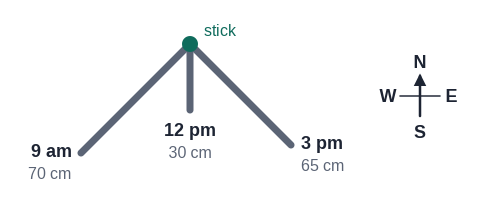
- Length: 70 cm, then 30 cm, then 65 cmshortest at midday
- Direction: south-west, then south, then south-eastswinging from west to east
- The Sun was highest at midday, so the shadow was shortest then
- As the Sun moved from east to west, the shadow got shorter then longer, and swung from west to east
Try it: what time of day?
Day and night
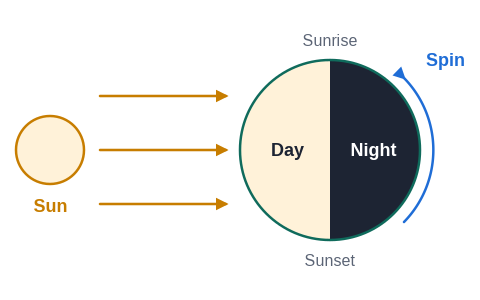
- The Sun can only light up the half of Earth that faces it.
- The half facing the Sun has daytime.
- The half facing away is in Earth's own shadow, so it has night-time.
- As Earth spins, each place turns into the sunlight (sunrise), across it (day), and out of it again (sunset).
Example: day here, night there
- It is 1 pm on a sunny day in Auckland. London is on the other side of the Earth.
- Is it day or night in London?
- At 1 pm, New Zealand faces the Sunit is daytime here
- The other side of Earth faces away from the Sun
- It is night-time in London
The spin explains the Sun's path
- Earth turns towards the east.
- Each morning our part of Earth turns to face the Sun, so the Sun appears in the east.
- All day we keep turning, so the Sun seems to cross the sky.
- In the evening we turn away, so the Sun disappears in the west.
Spinning and orbiting together
- Earth does two things at once.
- It spins once about every 24 hours. That gives day and night.
- It orbits the Sun once about every 365 and a quarter days. That gives a year.
- Through the year, the Sun's path across the sky shifts a little: higher in summer and lower in winter. So when you record the Sun, use the same times and the same spot each time.
Try it: the Sun through the year
Example: a torch-and-ball model
- Room 6 used a torch as the Sun and a ball with a sticker on New Zealand as the Earth.
- How does the model show day, night and a year?
- Torch held still, shining on the ballthe Sun
- Ball turned slowly, so the sticker moved into the light: sunrise
- Sticker facing the torch: midday. Sticker turned into the dark: sunset, then night
- One full turn of the ball models one day
- Then the ball was carried slowly in a big circle around the torch, still turning: one circle models one year
Common mistakes
- Night happens because the Sun goes around to the other side of Earth.The Sun does not go around Earth; Earth spins, so our side turns away from the Sun.
- Day and night happen because Earth goes around the Sun.Day and night come from Earth's spin every 24 hours; one trip around the Sun takes a whole year.
- Shadows are longest at midday, when the Sun is strongest.At midday the Sun is highest in the sky, so shadows are shortest.
Model day and night
You need: a torch, a ball or an orange, a small sticker or a piece of tape, a pen, a room you can make dark
- Put the sticker on the ball where New Zealand would be.
- Make the room dark. Ask an adult to hold the torch still and shine it at the ball from about one metre away.
- Hold the ball at the top and bottom, and turn it slowly so the sticker moves from the dark side into the light.
- Say 'sunrise' when the sticker enters the light, 'midday' when it faces the torch, and 'sunset' when it leaves the light.
- Look for this: the half facing the torch is always lit and the other half is always dark, so one turn gives one day and one night.
Safety: Do not shine the torch into anyone's eyes, and clear the floor first so nobody trips in the dark room.
Your turn
At midday, is your shadow long or short?
In the morning in New Zealand, which way do shadows point: towards the east side or the west side?
Which half of Earth has daytime?
What causes day and night?
It is midday in New Zealand. Is it day or night on the opposite side of Earth?
In the torch-and-ball model, what does one full turn of the ball stand for?
Show answer
1. Short, because the Sun is high. 2. Towards the west side, away from the morning Sun in the east. 3. The half facing the Sun. 4. Earth spinning on its axis. 5. Night. 6. One day.
Recap
- Shadows point away from the Sun: long in the morning and afternoon, shortest at midday.
- The half of Earth facing the Sun has day; the other half has night.
- Earth's spin turns us into and out of the sunlight, giving day, night and the Sun's path across the sky.
- Earth's orbit around the Sun takes a year.
- A torch and a ball can model day, night and a year.
Challenge
It is a sunny afternoon in a New Zealand playground. Mere's shadow is long and points towards the south-east. Where in the sky is the Sun: high or low, and which direction? In one more hour, will her shadow be longer or shorter?
Hint
A shadow always points away from the Sun. Turn the shadow's direction right round to find the Sun.
Answer
The Sun is low in the north-west. In one more hour the Sun is even lower, so her shadow will be longer.
Step by step
- A shadow points the opposite way to the Sun.
- The opposite of south-east is north-west, so the Sun is in the north-west.
- A long shadow means the Sun is low in the sky.
- In the afternoon the Sun keeps sinking towards the west.
- A lower Sun makes a longer shadow.
Full working
- shadow points south-eastthe shadow is on the side away from the Sun
- Sun is in the north-westturn south-east right round
- long shadow, so the Sun is lowhigh Sun gives short shadows
- later the Sun sinks lower in the westit sets in the evening
- Sun low in the north-west; one hour later the shadow is longer
In the torch-and-ball model, the New Zealand sticker faces the torch: it is midday there. A second sticker is on the exact opposite side of the ball. Is it day or night at the second sticker? Earth takes 24 hours to spin once. How many hours until the second sticker faces the torch? How much of a turn is that?
Hint
Which half of the ball is lit? Then think: how far must the ball turn to bring the back of the ball round to the front?
Answer
It is night at the second sticker, in the middle of the night. It faces the torch after 12 hours, which is half a turn.
Step by step
- The torch only lights the half of the ball facing it.
- The New Zealand sticker faces the torch, so the opposite sticker is on the dark half, right in the middle of it: the middle of the night.
- To face the torch, the second sticker must come round from the back to the front.
- That is half of a full turn.
- One full turn takes 24 hours, so half a turn takes 24 ÷ 2 = 12 hours.
Full working
- New Zealand sticker faces the torchmidday in New Zealand
- opposite sticker is on the dark halfnight there
- back of the ball to the fronthalf a turn
- 24 ÷ 2 = 12 hoursone turn is 24 hours
- Night; 12 hours; half a turn
Imagine Earth stopped spinning, but still went round the Sun once a year. Model it: carry the ball round the torch in a big circle, but do not turn it, so the New Zealand sticker always points at the same wall of the room. How long would one day and one night in New Zealand take now?
Hint
Walk the ball halfway round the torch. Is the sticker still on the lit side, or has the torch moved to its back?
Answer
One day and one night would take a whole year: about half a year of daylight, then about half a year of night.
Step by step
- Without spinning, the sticker keeps facing the same wall.
- At the start of the circle the torch is in front of the sticker, so it is day.
- Halfway round, the torch is now behind the ball, so the sticker is in the dark half: night.
- Only after a full circle is the sticker facing the torch again.
- One full circle is one year, so one day and one night together would last a year.
Full working
- ball does not turnsticker always faces the same wall
- start of circle: torch in front of stickerdaytime
- halfway round: torch behind the ballnight-time
- one full circle = 1 year, about 365 daysEarth's orbit
- daylight ≈ 365 ÷ 2 ≈ 182 days, night ≈ 182 dayshalf the circle each
- One day and one night would take about a whole year
The maths behind it
Report a mistake
How is Year 4 maths going?
See the Year 4 maths guide