Eggs, live young, seeds and spores: how living things begin
What this lesson covers
- Some animals hatch from eggs; others grow inside the mother and are born
- Most mammals are born alive, but echidnas and platypuses lay eggs
- Young mammals feed on milk from their mother
- Most plants make seeds, which sprout and grow into new plants
- Mosses, ferns and fungi make spores instead of seeds
- Looking inside a flower and making a scientific drawing of it
Making new living things
- Reproduction means making new living things of the same kind.
- The young are called offspring.
- Every kind of living thing has to reproduce, or it would die out.
Hatched or born?
- Many animals start life inside an egg. The egg is laid, and later the young hatch out.
- Birds, frogs, most fish, most insects and most reptiles lay eggs. Kiwi, tuatara and wētā all lay eggs.
- Other animals grow inside the mother's body and are then born. Dogs, cows, whales and people are born this way.
- Most New Zealand geckos and skinks are unusual reptiles: their young are born alive.
Mammals and milk
- A mammal is an animal with hair or fur that feeds its young on milk.
- The milk is made in the mother's mammary glands.
- Milk is the young mammal's food until it can eat other food. A calf drinks milk from its mother, and so does a fur seal pup.
- Almost all mammals grow inside the mother and are born alive.
- Two kinds are different. Echidnas and platypuses lay eggs, and are called monotremes. They live in Australia and New Guinea. Once their young hatch, they still drink milk.
Example: is it a mammal?
- Sort these animals: kiwi, cow, platypus, tuatara, fur seal.
- Which are mammals?
| Animal | Egg or born? | Young drink milk? |
|---|---|---|
| Kiwi | Egg | No |
| Cow | Born | Yes |
| Platypus | Egg | Yes |
| Tuatara | Egg | No |
| Fur seal | Born | Yes |
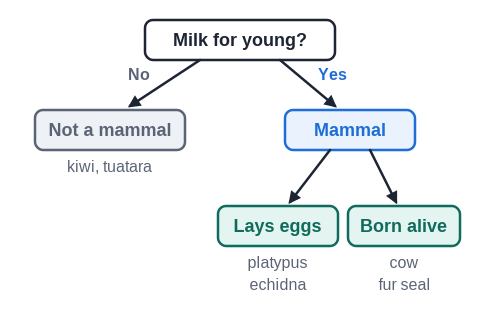
- Milk for the young is the clue for a mammalnot eggs
- The platypus lays eggs but feeds its young milk, so it is a mammal
- Mammals: cow, platypus and fur seal
Try it: mammal or not?
Plants and seeds
- Most plants reproduce with seeds.
- Seeds are made inside flowers.
- A seed holds a tiny new plant and a store of food for it.
- When a seed gets water and warmth, it germinates. That means it splits open and a root and a shoot grow out.
Spores: mosses, ferns and fungi
- Mosses and ferns have no flowers and no seeds. They make spores instead.
- Spores are tiny specks, as small as dust. Look under a fern frond: the brown dots hold the spores.
- Fungi, such as mushrooms and moulds, also make spores. A mushroom drops huge numbers of them from under its cap.
- When a spore lands somewhere damp, it germinates and grows into a new moss, fern or fungus.
Try it: seeds or spores?
Inside a flower
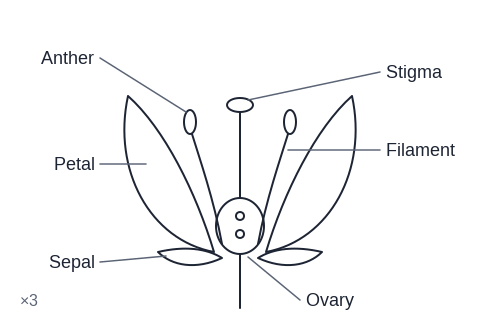
- Petals are often bright and scented. They attract insects and birds.
- Stamens are thin stalks, called filaments, with an anther at the tip. The anther makes pollen.
- The carpel is in the middle. Its sticky tip is the stigma, and its swollen base is the ovary, where seeds form.
- Sepals are small green leaves under the petals. They protected the flower when it was a bud.
Try it: match the flower part
Example: a scientific drawing
- A scientific drawing uses a sharp pencil and single clear lines, with no shading or colouring.
- Draw it large, in the middle of the page. Add a title, and label lines drawn with a ruler that do not cross.
- Write the magnification: how many times bigger the drawing is than the real thing.
- A real flower is 3 cm across. The drawing is 9 cm across. What is the magnification?
- Magnification = drawing size ÷ real size
- 9 cm ÷ 3 cm = 3
- The magnification is ×3
Common mistakes
- All mammals give birth to live young.Echidnas and platypuses are mammals that lay eggs; they still feed their young on milk.
- Ferns grow from seeds.Ferns and mosses grow from spores; they have no flowers and no seeds.
- Shade and colour a scientific drawing so it looks real.Use single clear pencil lines and no shading, so every part and label is easy to see.
- The magnification of a 9 cm drawing of a 3 cm flower is ×6.Divide, do not subtract: 9 ÷ 3 = 3, so the magnification is ×3.
Take a flower apart
You need: a large, simple flower such as a hibiscus or a lily, a sheet of white paper, sticky tape, a pencil, a ruler, a magnifying glass, if you have one
- Gently pull off the green sepals, then the petals. Tape them to the paper in rows and count them.
- Find the stamens. Touch an anther with a fingertip and look for the pollen.
- Find the carpel in the middle. Split its swollen base, the ovary, with your fingernail and look for tiny seeds forming.
- Make a scientific drawing of the carpel, with a title, labels and a magnification.
- Look for this: how many of each part the flower has, and where the seeds would grow.
Safety: Lily pollen is poisonous to cats and some garden flowers are toxic, so ask an adult to pick the flower, and wash your hands afterwards.
Your turn
Does a kiwi lay eggs or give birth to live young?
A platypus lays eggs. Is it a mammal?
What do ferns make instead of seeds?
Which part of a flower makes pollen?
A drawing is 12 cm long. The real flower is 4 cm long. What is the magnification?
What does a seed need to germinate?
Show answer
1. It lays eggs. 2. Yes, because it feeds its young on milk. 3. Spores. 4. The anther, at the tip of the stamen. 5. ×3, because 12 ÷ 4 = 3. 6. Water and warmth.
Recap
- Animals either hatch from laid eggs or grow inside the mother and are born.
- Mammals feed their young on milk; most are born alive, but echidnas and platypuses lay eggs.
- Most plants reproduce with seeds, which are made in flowers.
- Mosses, ferns and fungi reproduce with spores.
- A flower has sepals, petals, stamens (filament and anther) and a carpel (stigma and ovary).
- Scientific drawings use clear lines, ruled labels, a title and a magnification.
Challenge
Ana is making a scientific drawing of a flower that is 3 cm across. Her page is 21 cm wide, and she wants to leave 2 cm of empty space on each side of the drawing. The magnification must be a whole number. What is the biggest magnification she can use, and how wide will her drawing be?
Hint
First work out how much of the page is left for the drawing. Then try ×1, ×2, ×3 and so on, and see which still fits.
Answer
×5, and the drawing will be 15 cm wide.
Step by step
- The two empty spaces use 2 + 2 = 4 cm of the page.
- That leaves 21 − 4 = 17 cm for the drawing.
- Drawing size = real size × magnification.
- ×5 gives 3 × 5 = 15 cm, which fits in 17 cm.
- ×6 gives 3 × 6 = 18 cm, which is too wide, so ×5 is the biggest.
Full working
- 2 + 2 = 4 cmspace on the two sides
- 21 − 4 = 17 cmroom for the drawing
- 3 × 5 = 15 cmfits, 15 is less than 17
- 3 × 6 = 18 cmtoo wide, 18 is more than 17
- Magnification ×5, drawing 15 cm wide
In a shady, damp corner of the school, a small fern is growing out of a crack in a brick wall. No other ferns grow nearby. Hemi says, "A bird must have dropped a fern seed there." Ana says, "No, it grew from a spore." Who is right? Give two reasons that use what you know about ferns.
Hint
Do ferns ever make flowers? How big are the things ferns make, and what could carry them up a wall?
Answer
Ana is right. Ferns have no flowers, so they never make seeds; they make spores instead. Spores are as small as dust, so the wind can carry them a long way, and one that landed in the damp crack could germinate and grow into the fern.
Step by step
- Seeds are made inside flowers.
- Ferns have no flowers, so a fern cannot make a seed. Hemi's idea cannot be right.
- Ferns make spores in the brown dots under their fronds.
- Spores are tiny, like dust, so moving air can carry them far, even up a wall.
- A spore that lands somewhere damp germinates, and the corner is damp, so a fern can grow there.
Full working
- seeds form in flowersferns have no flowers
- so ferns make no seedsHemi is wrong
- ferns make sporesbrown dots under the fronds
- spores are dust-sizedblown by the wind
- damp crackthe spore can germinate
- Ana is right: the fern grew from a wind-blown spore
Tama makes two rules. Rule 1: "If an animal lays eggs, it is not a mammal." Rule 2: "If an animal's young are born alive, it is a mammal." Both rules are wrong. For each rule, name an animal from this lesson that breaks it, and explain how it breaks the rule. Then write one better rule for spotting a mammal.
Hint
Look for an egg-laying animal whose young drink milk, and a reptile from New Zealand whose young are born alive.
Answer
Rule 1 is broken by the platypus (or echidna): it lays eggs, but it feeds its young on milk, so it is a mammal. Rule 2 is broken by most New Zealand geckos and skinks: their young are born alive, but they are reptiles, not mammals. Better rule: an animal is a mammal if it has hair or fur and feeds its young on milk.
Step by step
- To break Rule 1 we need an animal that lays eggs and is still a mammal.
- The platypus and the echidna lay eggs, but their young drink milk, so they are mammals.
- To break Rule 2 we need an animal born alive that is not a mammal.
- Most New Zealand geckos and skinks give birth to live young, but they are reptiles with scales and no milk.
- So eggs or live birth is not the test. Milk (and hair or fur) is.
Full working
- platypus: lays eggs, young drink milka mammal, so Rule 1 fails
- NZ gecko: young born alive, no milk, scalesa reptile, so Rule 2 fails
- what every mammal shareshair or fur, and milk for its young
- Better rule: a mammal has hair or fur and feeds its young on milk
The maths behind it
Report a mistake
How is Year 4 maths going?
See the Year 4 maths guide