Simultaneous equations: two lines, or a line and a curve
What this lesson covers
- Solving two equations together finds the points where their graphs meet.
- Substituting a linear equation into a quadratic gives a quadratic, whose discriminant counts the meeting points.
Two equations, one answer
- Each equation is a graph.
- Solving them together finds where they meet.
- Every meeting point satisfies both.
Two lines: elimination
- Match the y terms.
- Add: y cancels.
- 3x + 2y = 16 (1)
- x − y = 2 (2)
- 2x − 2y = 4(2) × 2
- 5x = 20add: y cancels
- x = 4divide by 5
- 4 − y = 2substitute in (2)
- y = 2
Check in both
- Check in both equations.
- One is not enough.
- (1): 3(4) + 2(2) = 12 + 4 = 16
- (2): 4 − 2 = 2
Try it: move the lines
A line and a parabola
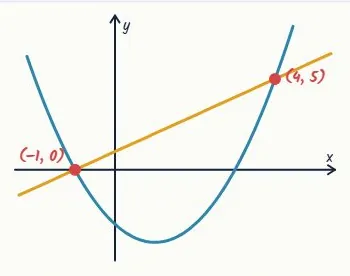
- y = x² − 2x − 3 and y = x + 1.
- They meet at two points.
- (−1, 0) and (4, 5).
Substitute the line into the curve
- Set the ys equal.
- Find y for each x.
- x² − 2x − 3 = x + 1set the ys equal
- x² − 3x − 4 = 0subtract x + 1
- (x − 4)(x + 1) = 0−4 × 1 = −4
- x = 4 or x = −1
- x = 4: y = 4 + 1 = 5from y = x + 1
- x = −1: y = −1 + 1 = 0
- (4, 5) and (−1, 0)
How many meeting points?
- Substituting always gives a quadratic.
- Its discriminant counts the meeting points.
- Two, one, or none.
| Discriminant | Line and curve |
|---|---|
| Δ > 0 | line cuts the curve twice |
| Δ = 0 | line touches: a tangent |
| Δ < 0 | line misses the curve |
Graphing calculator
Cut, touch, or miss
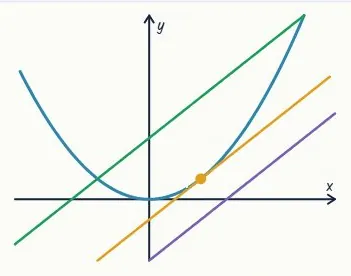
- y = 2x + 3 cuts y = x² twice.
- y = 2x − 1 just touches it.
- y = 2x − 3 misses it completely.
Try it: cut, touch or miss
Using Δ = 0 to find a tangent
- A tangent: Δ = 0.
- Then find the point.
- x² = 2x + cset the ys equal
- x² − 2x − c = 0rearrange
- Δ = 0a tangent touches once
- (−2)² − 4(1)(−c) = 0a = 1, b = −2
- 4 + 4c = 0
- 4c = −4, so c = −1
- x² − 2x + 1 = (x − 1)² = 0
- x = 1, y = 1: touches at (1, 1)
From a word problem
- One equation per fact.
- Substitute, then expand.
- 2a + 3c = 58 (1)
- a + c = 24 (2)
- a = 24 − crearrange (2)
- 2(24 − c) + 3c = 58substitute in (1)
- 48 − 2c + 3c = 58expand
- 48 + c = 58, so c = 10collect
- a = 24 − 10 = 14
- adult $14, child $10
- 2(14) + 3(10) = 28 + 30 = 58
Try it: close the gap
Where the marks are
- Achieved: solve two linear equations.
- Merit: a line and a quadratic.
- Excellence: the discriminant with both values.
What to take away
- Substitute, solve, then find both coordinates.
| Two lines | eliminate or substitute |
| Line and curve | substitute the line in |
| Result | a quadratic, so up to two points |
| Both values | find x, then y, for each |
| How many points | the discriminant decides |
Common mistakes
- a = 24 − c into 2a + 3c = 58: 48 − c + 3c = 58The 2 multiplies both terms: 2(24 − c) = 48 − 2c, so 48 + c = 58 and c = 10.
- x² − 2x − 3 = x + 1 gives x = 4 or x = −1, and that is the answer.Find y for each x too: the meeting points are (4, 5) and (−1, 0).
- Tangent to y = x²: x² − 2x − c = 0, so Δ = (−2)² − 4(1)(c) = 4 − 4cThe constant term is −c, so Δ = (−2)² − 4(1)(−c) = 4 + 4c = 0, giving c = −1.
- x = 4, y = 2 works in x − y = 2, so it is correct.Check in both equations: 3(4) + 2(2) = 16 too. Wrong values can still fit one equation.
Your turn: eight questions
- Give both coordinates of each point.
- Questions 3 and 4 use the discriminant.
Solve 2x + y = 11 and x − y = 1.
Where do y = x² and y = x + 6 meet?
Does y = 2x − 3 meet y = x² + 1? Use the discriminant.
Find k so y = 4x + k is a tangent to y = x².
Which point satisfies both 3x − 2y = 4 and x + 4y = 13?
A Rotorua show sells 40 tickets for $760. Adults pay $25 and children $15. How many of each were sold?
Solving y = x² + x and y = 3x + 8 together, Ana writes x² − 2x + 8 = 0. What should the quadratic be?
For which values of k does the line y = kx − 1 meet the curve y = x² + 3 at two points?
Show answer
1. Add: 3x = 12, x = 4, y = 3. 2. x² − x − 6 = 0, x = 3 or −2: (3, 9) and (−2, 4). 3. x² − 2x + 4 = 0, Δ = 4 − 16 = −12 < 0: they never meet. 4. x² − 4x − k = 0, Δ = 16 + 4k = 0, k = −4. 5. (3, 2.5). Check in both: 3 × 3 − 2 × 2.5 = 4 and 3 + 4 × 2.5 = 13. 6. 16 adult, 24 child. a + c = 40 and 25a + 15c = 760; substitute c = 40 − a: 25a + 600 − 15a = 760, so 10a = 160, a = 16 and c = 24. 7. x² − 2x − 8 = 0. Setting x² + x = 3x + 8 and taking 3x + 8 from both sides gives x² − 2x − 8 = 0; the 8 changes sign too. 8. k < −4 or k > 4. Substituting gives x² − kx + 4 = 0, and two points need Δ = k² − 16 > 0, so k < −4 or k > 4.
The answers: questions 1 and 2
- 1. 2x + y = 11, x − y = 1
- 3x = 12, so x = 4add: y cancels
- 4 − y = 1, so y = 3substitute
- (4, 3)
- 2. x² = x + 6set the ys equal
- x² − x − 6 = 0
- (x − 3)(x + 2) = 0factorise
- x = 3, y = 9; x = −2, y = 4y = x + 6
- (3, 9) and (−2, 4)
The answers: questions 3 and 4
- 3. x² + 1 = 2x − 3set the ys equal
- x² − 2x + 4 = 0rearrange
- Δ = (−2)² − 4(1)(4)substitute
- = 4 − 16 = −12 < 0they never meet
- 4. x² = 4x + kset the ys equal
- x² − 4x − k = 0rearrange
- Δ = (−4)² − 4(1)(−k) = 0a tangent: Δ = 0
- 16 + 4k = 0
- k = −4
Sample question: Achieved
Solve the simultaneous equations 3x + 2y = 16 and 5x − 2y = 8.
Hint
The y terms are +2y and −2y, so adding the equations removes y.
Answer
x = 3, y = 3.5
Step by step
- Look for a variable that will disappear. The y terms are +2y and −2y, which add to zero.
- Add the equations: (3x + 5x) + (2y − 2y) = 16 + 8, so 8x = 24.
- Divide by 8: x = 3.
- Put x = 3 into the first equation: 9 + 2y = 16, so 2y = 7 and y = 3.5.
- Classic mistake: stopping after finding x. You need both values to give the meeting point.
- Check in the other equation: 5 × 3 − 2 × 3.5 = 15 − 7 = 8. Correct.
- So the lines meet at (3, 3.5).
Full working
- 8x = 24add the equations; the y terms cancel
- x = 3
- 9 + 2y = 16, so y = 3.5substitute into the first equation
- Check: 15 − 7 = 8second equation
- x = 3, y = 3.5
Sample questions: Merit
Find the points where the line y = 2x − 3 meets the curve y = x² − 3x + 1.
Hint
Both expressions equal y, so set them equal. That gives a quadratic for the x values. Then use the line to find each y.
Answer
(1, −1) and (4, 5)
Step by step
- At a meeting point both equations give the same y, so set the right sides equal: x² − 3x + 1 = 2x − 3.
- Rearrange to zero: x² − 3x − 2x + 1 + 3 = 0, which is x² − 5x + 4 = 0.
- Factorise: two numbers that multiply to 4 and add to −5 are −1 and −4. So (x − 1)(x − 4) = 0.
- So x = 1 or x = 4. Two x values means the line cuts the curve twice.
- Find each y with the line, because it is simpler: x = 1 gives y = 2 − 3 = −1, and x = 4 gives y = 8 − 3 = 5.
- Classic mistake: giving only x = 1 and x = 4. A meeting point needs both coordinates.
- Check (4, 5) on the curve: 16 − 12 + 1 = 5. Check (1, −1): 1 − 3 + 1 = −1. Both are on the curve too.
- So the line meets the curve at (1, −1) and (4, 5).
Full working
- x² − 3x + 1 = 2x − 3both equal y
- x² − 5x + 4 = 0
- (x − 1)(x − 4) = 0, so x = 1 or 4
- y = 2(1) − 3 = −1; y = 2(4) − 3 = 5substitute into the line
- (1, −1) and (4, 5)
A rectangular paddock has a perimeter of 46 m and a diagonal of 17 m. Form two equations and solve them to find the length and width of the paddock.
Hint
Perimeter gives a linear equation and Pythagoras gives a quadratic one. Make one letter the subject of the linear equation and substitute.
Answer
15 m by 8 m
Step by step
- Let the length be l m and the width be w m.
- Perimeter: 2l + 2w = 46, so l + w = 23.
- The diagonal makes a right triangle with the length and width, so by Pythagoras l² + w² = 17² = 289.
- Make w the subject of the linear equation: w = 23 − l.
- Substitute into the quadratic: l² + (23 − l)² = 289.
- Expand: l² + 529 − 46l + l² = 289, so 2l² − 46l + 240 = 0. Divide by 2: l² − 23l + 120 = 0.
- Classic mistake: writing (23 − l)² = 529 − l². The square of a bracket has a middle term, −46l.
- Factorise: two numbers that multiply to 120 and add to −23 are −8 and −15. So l = 8 or l = 15.
- If l = 15 then w = 8, and if l = 8 then w = 15. Both give the same rectangle, so the paddock is 15 m by 8 m.
- Check: the perimeter is 2 × (15 + 8) = 46 m and the diagonal is √(225 + 64) = √289 = 17 m. Correct.
Full working
- l + w = 23perimeter 46 m
- l² + w² = 289Pythagoras, diagonal 17 m
- l² + (23 − l)² = 289substitute w = 23 − l
- l² − 23l + 120 = 0, so l = 8 or 15
- 15 m by 8 m
Sample questions: Excellence
Find the values of m for which the line y = mx − 1 is a tangent to the curve y = x² + 3, and find the point of contact for each. For which values of m does the line miss the curve completely?
Hint
Substitute the line into the curve to get a quadratic in x. A tangent touches once, so its discriminant is zero; a line that misses has a negative discriminant.
Answer
m = 4, touching at (2, 7); m = −4, touching at (−2, 7); the line misses the curve when −4 < m < 4
Step by step
- Where the line and the curve meet, their y values are equal: x² + 3 = mx − 1.
- Rearrange to zero: x² − mx + 4 = 0. This quadratic's roots are the x values of the meeting points.
- Recall: two roots means the line cuts the curve, one repeated root means it touches (a tangent), and no roots means it misses.
- Here a = 1, b = −m and c = 4, so Δ = m² − 16.
- Tangent: Δ = 0, so m² = 16 and m = 4 or m = −4.
- Point of contact: with Δ = 0 the root is x = −b ÷ (2a) = m2.
- m = 4 gives x = 2 and y = 4 × 2 − 1 = 7. m = −4 gives x = −2 and y = −4 × (−2) − 1 = 7.
- Miss: Δ < 0, so m² < 16. That means −4 < m < 4.
- Classic mistake: writing m < 4 only. m² < 16 also needs m > −4, because a very negative m gives a large m².
- Make sense of it: every one of these lines passes through (0, −1), below the curve's lowest point (0, 3). Shallow lines miss the curve, and steep ones cut it twice.
- Check m = 4: x² − 4x + 4 = (x − 2)² = 0, a single touching point at x = 2. Correct.
Full working
- x² + 3 = mx − 1, so x² − mx + 4 = 0substitute the line into the curve
- Δ = m² − 16a = 1, b = −m, c = 4
- Tangent: m² − 16 = 0, so m = ±4
- x = m2: (2, 7) for m = 4, (−2, 7) for m = −4single root −b ÷ (2a)
- Miss: m² − 16 < 0, so −4 < m < 4
- m = ±4 at (±2, 7); misses for −4 < m < 4
The line y = x + k meets the curve y = x² − 3x + 5 at two points A and B. Find the values of k for which the line meets the curve at all. Then find the value of k for which the distance AB is 2√2, and the coordinates of A and B.
Hint
Substitute and solve the quadratic in x in terms of k. Because the line has gradient 1, the vertical gap between A and B equals the horizontal gap.
Answer
The line meets the curve when k ≥ 1 (at two points when k > 1); AB = 2√2 when k = 2, with A(1, 3) and B(3, 5)
Step by step
- At a meeting point: x² − 3x + 5 = x + k, so x² − 4x + (5 − k) = 0.
- Discriminant: Δ = 16 − 4(5 − k) = 4k − 4. The line meets the curve when Δ ≥ 0, so k ≥ 1. At k = 1 it only touches, so two points A and B need k > 1.
- Solve the quadratic with the formula: x = 4 ± √(4k − 4)2 = 2 ± √(k − 1), since √(4k − 4) = 2√(k − 1).
- So the x values of A and B differ by 2√(k − 1).
- The line has gradient 1, so as x goes up by any amount, y goes up by the same amount. The y values also differ by 2√(k − 1).
- By Pythagoras, AB = √(d² + d²) = d√2, where d = 2√(k − 1). So AB = 2√2 × √(k − 1).
- Set AB = 2√2: then √(k − 1) = 1, so k − 1 = 1 and k = 2.
- Classic mistake: setting the horizontal gap equal to 2√2. AB is the straight-line distance, which is longer than the horizontal gap.
- With k = 2: x = 2 ± 1, so x = 1 or x = 3. Use the line y = x + 2: A(1, 3) and B(3, 5).
- Check both are on the curve: 1 − 3 + 5 = 3 and 9 − 9 + 5 = 5. Correct.
- Check the distance: √((3 − 1)² + (5 − 3)²) = √8 = 2√2. Correct.
Full working
- x² − 4x + (5 − k) = 0substitute the line into the curve
- Δ = 4k − 4 ≥ 0, so k ≥ 1real meeting points
- x = 2 ± √(k − 1)quadratic formula
- AB = √2 × 2√(k − 1)gradient 1: equal horizontal and vertical gaps
- 2√2 × √(k − 1) = 2√2, so k = 2
- x = 1 or 3; A(1, 3), B(3, 5)y = x + 2
- k ≥ 1; k = 2, A(1, 3) and B(3, 5)
Challenge
Solve the simultaneous equations 2ˣ × 4ʸ = 32 and 3ˣ ÷ 9ʸ = 127 without a calculator.
Hint
Write each equation with a single base (2 in the first, 3 in the second), then compare the indices.
Answer
x = 1, y = 2
Step by step
- 4ʸ = 2^(2y), so the first equation is 2^(x + 2y) = 2⁵.
- 9ʸ = 3^(2y) and 127 = 3⁻³, so the second is 3^(x − 2y) = 3⁻³.
- Equal powers of the same base have equal indices: x + 2y = 5 and x − 2y = −3.
- Add to get 2x = 2, so x = 1, then y = 2.
- Check: 2 × 16 = 32 and 3 ÷ 81 = 127.
Full working
- 2ˣ × 2^(2y) = 2⁵, so x + 2y = 5 (1)4 = 2², 32 = 2⁵
- 3ˣ ÷ 3^(2y) = 3⁻³, so x − 2y = −3 (2)9 = 3², 27 = 3³
- 2x = 2, x = 1(1) + (2)
- 1 + 2y = 5, y = 2substitute in (1)
- x = 1, y = 2
The line y = 2x − 1 is a tangent to the curve y = x² + bx + c, and it touches the curve at the point (2, 3). Find b and c.
Hint
Set the ys equal. Touching at x = 2 means the resulting quadratic has a double root at x = 2, so it must be (x − 2)².
Answer
b = −2 and c = 3, so the curve is y = x² − 2x + 3
Step by step
- Setting the ys equal gives x² + (b − 2)x + (c + 1) = 0.
- A tangent touching at x = 2 means this quadratic has only the root x = 2, twice.
- So it must be exactly (x − 2)² = x² − 4x + 4.
- Match terms: b − 2 = −4 and c + 1 = 4, so b = −2 and c = 3.
- Check: at x = 2 the curve gives 4 − 4 + 3 = 3, and the line gives 3.
Full working
- x² + bx + c = 2x − 1set the ys equal
- x² + (b − 2)x + (c + 1) = 0rearrange to zero
- = (x − 2)² = x² − 4x + 4double root at x = 2
- b − 2 = −4, so b = −2match the x terms
- c + 1 = 4, so c = 3match the constants
- b = −2, c = 3
Solve the simultaneous equations x + y = 5 and x³ + y³ = 35. Explain why substituting gives a quadratic, even though the second equation has cubes.
Hint
Substitute y = 5 − x and expand (5 − x)³ carefully. Watch what happens to the x³ terms.
Answer
(x, y) = (2, 3) or (3, 2). The x³ from x³ and the −x³ from (5 − x)³ cancel, leaving a quadratic.
Step by step
- From the first equation, y = 5 − x.
- Expand (5 − x)³ = 125 − 75x + 15x² − x³.
- Adding x³ cancels the −x³, so the cube terms disappear and a quadratic is left.
- 125 − 75x + 15x² = 35 simplifies to x² − 5x + 6 = 0, so x = 2 or x = 3.
- Then y = 3 or y = 2. Check: 8 + 27 = 35.
Full working
- y = 5 − xrearrange the line
- (5 − x)³ = 125 − 75x + 15x² − x³expand (5 − x)²(5 − x)
- x³ + 125 − 75x + 15x² − x³ = 35substitute
- 15x² − 75x + 90 = 0the x³ terms cancel
- x² − 5x + 6 = 0, so (x − 2)(x − 3) = 0÷ 15, factorise
- x = 2, y = 3 or x = 3, y = 2y = 5 − x
- (2, 3) and (3, 2)
Practise this
Report a mistake
More in AS 91261
 Index laws, fractional indices and surds7 min
 Expanding, factorising and simplifying algebraic fractions9 min
 Quadratic equations: solving, and forming from the roots8 min
 The discriminant: how many roots, and what kind9 min
 Logarithms: what they mean and the log laws7 min
 Exponential growth and decay: interest, depreciation, half-life9 minSimultaneous equations: two lines, or a line and a curve8 min
 Algebraic modelling: completing a model from the context9 min
 Indices and surds: 7 exam questions solved step by step11 min
 Algebraic fractions: 7 exam questions solved step by step11 min
 Quadratic equations: 7 exam questions solved step by step11 min
 The discriminant: 7 exam questions solved step by step11 min
 Logarithms: 7 exam questions solved step by step10 min
 Exponential models: 7 exam questions solved step by step10 min
 Simultaneous equations: 7 exam questions solved step by step11 min
 Algebraic modelling: 6 exam questions solved step by step11 min
Is your child on track?
Take the free placement test