Expanding, factorising and simplifying algebraic fractions
What this lesson covers
- A fraction can only be cancelled by a factor of the whole numerator and the whole denominator.
- Factorising first turns a hard fraction into one where the common factor can be seen.
Three skills, one chain
- Expand brackets without losing signs.
- Factorise, including with a leading number.
- Factorising is what makes fractions simplify.
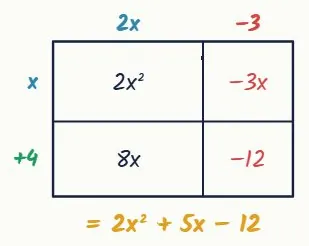
Expand (2x − 3)(x + 4)
- Each term meets each term: four products.
- 2x², 8x, −3x and −12.
- Collect: 2x² + 5x − 12.
Try it: expand two brackets
A minus in front of a bracket
- Expand the square first.
- Keep it in a bracket.
- Then change every sign.
- −(x − 5)²
- = −(x − 5)(x − 5)write the square out
- = −(x² − 5x − 5x + 25)four products
- = −(x² − 10x + 25)collect
- = −x² + 10x − 25change every sign
Factorising 2x² + 5x − 12
- Multiply a by c: −24.
- Product −24, sum 5.
- Split, group, factorise.
- a × c = 2 × (−12) = −24
- 8 × (−3) = −24, 8 − 3 = 5
- 2x² + 8x − 3x − 12split 5x
- = 2x(x + 4) − 3(x + 4)group in pairs
- = (2x − 3)(x + 4)common bracket
Try it: the factors are the roots
Check by expanding
- Expand your answer back.
- It must match the start.
- (2x − 3)(x + 4) = 2x² + 5x − 12
- 6x² − x − 2 = (3x − 2)(2x + 1)
- (3x − 2)(2x + 1)
- = 6x² + 3x − 4x − 2four products
- = 6x² − x − 2collect
Simplifying a fraction: factorise first
- Factorise top and bottom.
- Cancel a whole factor.
- x² − 9 = (x − 3)(x + 3)two squares
- 3 × (−2) = −6, 3 − 2 = 1
- x² + x − 6 = (x + 3)(x − 2)
- (x² − 9)/(x² + x − 6)
- = (x − 3)(x + 3)/((x + 3)(x − 2))
- = (x − 3)/(x − 2)cancel (x + 3)
Only whole factors cancel
- (x + 6)/6 is not x.
- 6 multiplies nothing on top; it is added.
- A factor must multiply the whole top.
| Fraction | Simplifies? | Because |
|---|---|---|
| (x + 6)/6 | is NOT x | 6 is not a factor of x + 6 |
| (x² + 3x)/x | is x + 3 | x is a factor of both terms |
Adding algebraic fractions
- Common denominator first.
- Then add the numerators.
- 2/x + 3/(x + 1)
- common denominator x(x + 1)
- 2/x = 2(x + 1)/(x(x + 1))
- 3/(x + 1) = 3x/(x(x + 1))
- sum = (2(x + 1) + 3x)/(x(x + 1))
- = (2x + 2 + 3x)/(x(x + 1))expand
- = (5x + 2)/(x(x + 1))collect
Subtracting: bracket the second top
- Bracket the second top.
- The minus hits both terms.
- 3/(x − 2) − 1/(x + 2)
- denominator (x − 2)(x + 2)
- top: 3(x + 2) − (x − 2)bracket it
- = 3x + 6 − x + 2expand
- = 2x + 8collect
- bottom: (x − 2)(x + 2) = x² − 4
- result: (2x + 8)/(x² − 4)
- 3x + 6 − x − 2 = 2x + 4no bracket
Try it: cancel, factorise, combine
Where the marks are
- Achieved: expand and factorise accurately.
- Merit: factorise and cancel.
- Simplest form, with every step shown.
What to take away
- Factorise first. Cancel only factors.
| Expand | every term by every term |
| A minus outside | changes every sign inside |
| Factorise ax² + bx + c | split using a × c |
| Cancel | only whole factors |
| Add or subtract | common denominator first |
| Subtracting | bracket the second numerator |
Common mistakes
- −(x − 5)² = −x² − 10x + 25Expand the square inside a bracket first, −(x² − 10x + 25), then change every sign: −x² + 10x − 25.
- (x + 6)/6 = xThe 6 on top is added, not multiplied, so it is not a factor of x + 6 and nothing cancels. Only whole factors cancel.
- (x² − 9)/(x² + x − 6): cancel the x² to get −9/(x − 6)Factorise first: (x − 3)(x + 3)/((x + 3)(x − 2)) = (x − 3)/(x − 2), cancelling the whole factor (x + 3).
- 3(x + 2) − (x − 2) = 3x + 6 − x − 2 = 2x + 4Bracket the second numerator so the minus hits both terms: 3x + 6 − x + 2 = 2x + 8.
Your turn: eight questions
- Check factorising by expanding.
- Simplest form.
Expand (3x + 1)(x − 5).
Factorise 3x² + 10x − 8.
Simplify (x² − 4x) ÷ (x² − 16).
Write x/2 + (x + 1)/3 as a single fraction.
Expand −(x − 4)².
Which fraction has no common factor to cancel?
Write 4/(x − 1) − 2/(x + 3) as a single fraction.
Simplify (2x² + 5x − 3)/(4x² − 1).
Show answer
1. 3x² − 15x + x − 5 = 3x² − 14x − 5. 2. a × c = −24, use 12 and −2: (3x − 2)(x + 4). 3. x(x − 4) ÷ (x − 4)(x + 4) = x/(x + 4). 4. (3x + 2(x + 1))/6 = (5x + 2)/6. 5. −x² + 8x − 16. Expand the square first: (x − 4)² = x² − 8x + 16, then change every sign. 6. (x + 5)/5: the 5 on top is added to x, not a factor of the whole top. The others give x + 5, x + 2 and x − 5. 7. (2x + 14)/((x − 1)(x + 3)). Top: 4(x + 3) − 2(x − 1) = 4x + 12 − 2x + 2 = 2x + 14, with the second top bracketed. 8. (x + 3)/(2x + 1). The top is (2x − 1)(x + 3) and the bottom is (2x − 1)(2x + 1), so cancel (2x − 1).
The answers: questions 1 and 2
- 1. (3x + 1)(x − 5)
- = 3x² − 15x + x − 5four products
- = 3x² − 14x − 5collect
- 2. a × c = 3 × (−8) = −24
- 12 × (−2) = −24, 12 − 2 = 10
- 3x² + 12x − 2x − 8split 10x
- = 3x(x + 4) − 2(x + 4)group in pairs
- = (3x − 2)(x + 4)common bracket
The answers: questions 3 and 4
- 3. (x² − 4x)/(x² − 16)
- = x(x − 4)/((x − 4)(x + 4))factorise both
- = x/(x + 4)cancel (x − 4)
- 4. x/2 + (x + 1)/3
- = 3x/6 + 2(x + 1)/6denominator 6
- = (3x + 2x + 2)/6expand
- = (5x + 2)/6collect
Sample question: Achieved
Simplify fully x² − 9x² + x − 6.
Hint
Factorise the top and the bottom first, then cancel a bracket that is a factor of both.
Answer
x − 3x − 2
Step by step
- You can only cancel a factor of the whole top and the whole bottom, so factorise both first.
- The top, x² − 9, is a difference of two squares: x² − 3² = (x − 3)(x + 3).
- The bottom, x² + x − 6, needs two numbers that multiply to −6 and add to 1. They are 3 and −2, so it is (x + 3)(x − 2).
- Now the fraction is (x − 3)(x + 3)(x + 3)(x − 2).
- (x + 3) is a factor of both, so it cancels. That leaves x − 3x − 2.
- Classic mistake: cancelling the x² terms straight away. x² is a term, not a factor, so that is never allowed.
- Check with x = 4: the original is 714 = 12 and the answer is 12. They match.
Full working
- x² − 9 = (x − 3)(x + 3)difference of two squares
- x² + x − 6 = (x + 3)(x − 2)3 × (−2) = −6, 3 + (−2) = 1
- (x − 3)(x + 3)(x + 3)(x − 2)cancel the common factor (x + 3)
- x − 3x − 2
Sample questions: Merit
Simplify fully 2x² + 5x − 124x² − 9.
Hint
The bottom is a difference of two squares. That tells you one bracket the top should have too.
Answer
x + 42x + 3
Step by step
- Factorise first, because only whole factors can cancel.
- The bottom is easier: 4x² − 9 = (2x)² − 3², a difference of two squares, so it is (2x − 3)(2x + 3).
- The top has a leading 2, so use the ac method. a × c = 2 × (−12) = −24.
- Find two numbers that multiply to −24 and add to 5: they are 8 and −3.
- Split the middle: 2x² + 8x − 3x − 12 = 2x(x + 4) − 3(x + 4) = (2x − 3)(x + 4).
- Check by expanding: (2x − 3)(x + 4) = 2x² + 8x − 3x − 12 = 2x² + 5x − 12. Correct.
- Now the fraction is (2x − 3)(x + 4)(2x − 3)(2x + 3).
- (2x − 3) is a factor of both, so cancel it. The answer is x + 42x + 3.
- Check with x = 1: the original is 2 + 5 − 124 − 9 = −5/−5 = 1, and 1 + 42 + 3 = 1. They match.
Full working
- 4x² − 9 = (2x − 3)(2x + 3)difference of two squares
- 2x² + 5x − 12 = 2x² + 8x − 3x − 12ac = −24: 8 × (−3) = −24, 8 − 3 = 5
- = (2x − 3)(x + 4)group in pairs
- (2x − 3)(x + 4)(2x − 3)(2x + 3)cancel (2x − 3)
- x + 42x + 3
Write x + 5x² − x − 2 − 2x − 2 as a single fraction in its simplest form.
Hint
Factorise x² − x − 2 first. It already contains (x − 2), so the common denominator is just that factorised bottom.
Answer
3 − x(x − 2)(x + 1)
Step by step
- To add or subtract fractions you need one common denominator. Factorise the bottoms to find it.
- x² − x − 2: two numbers that multiply to −2 and add to −1 are −2 and 1. So it is (x − 2)(x + 1).
- The second bottom is (x − 2), which is already inside (x − 2)(x + 1). So the common denominator is (x − 2)(x + 1).
- The first fraction already has that bottom. The second needs its top and bottom multiplied by (x + 1): 2(x + 1)(x − 2)(x + 1).
- Now subtract the tops. Put the second top in a bracket, because the minus applies to all of it: (x + 5) − 2(x + 1).
- Expand: x + 5 − 2x − 2 = 3 − x.
- Classic mistake: writing x + 5 − 2x + 2. The minus must change the sign of both terms of 2x + 2.
- So the answer is 3 − x(x − 2)(x + 1). Nothing cancels, because 3 − x is not a factor of the bottom.
- Check with x = 3: the original is 84 − 21 = 0, and the answer has top 3 − 3 = 0. They match.
Full working
- x² − x − 2 = (x − 2)(x + 1)factorise the first bottom
- x + 5(x − 2)(x + 1) − 2(x + 1)(x − 2)(x + 1)common denominator
- x + 5 − 2x − 2(x − 2)(x + 1)bracket the second top, then change both signs
- 3 − x(x − 2)(x + 1)
Sample questions: Excellence
Show that 1x − 1 − 1x + 1 = 2x² − 1. Hence solve 1x − 1 − 1x + 1 = 112, and explain why both of your answers are allowed.
Hint
Subtract over the common denominator (x − 1)(x + 1). For the hence, replace the left side with 2x² − 1 and cross-multiply.
Answer
x = 5 or x = −5
Step by step
- Show that: start from the left side and work until you reach the right side.
- The common denominator of (x − 1) and (x + 1) is their product, (x − 1)(x + 1).
- Rewrite each fraction: x + 1(x − 1)(x + 1) − x − 1(x − 1)(x + 1).
- Subtract the tops in brackets: (x + 1) − (x − 1) = x + 1 − x + 1 = 2.
- The bottom (x − 1)(x + 1) expands to x² − 1, a difference of two squares. So the left side is 2x² − 1, as required.
- Hence means use that result. The equation becomes 2x² − 1 = 112.
- Cross-multiply: 2 × 12 = x² − 1, so x² − 1 = 24 and x² = 25.
- Square root both sides and keep both signs: x = 5 or x = −5.
- Classic mistake: writing only x = 5. A square root gives a positive and a negative answer.
- Why both are allowed: the only values that break the fractions are x = 1 and x = −1, where a bottom is zero. Neither 5 nor −5 is one of them.
- Check x = 5: 14 − 16 = 312 − 212 = 112. Check x = −5: −16 + 14 = 112. Both work.
Full working
- (x + 1) − (x − 1)(x − 1)(x + 1)common denominator
- = 2x² − 1(x − 1)(x + 1) = x² − 1, as required
- 2x² − 1 = 112hence
- x² − 1 = 24, so x² = 25cross-multiply
- x ≠ ±1, so both roots are allowedthe fractions are only undefined at x = ±1
- x = 5 or x = −5
Show that 2x² − 7x + 3x² − 9 ÷ 4x² − 12x² + 7x + 3 is equal to 1 for every value of x where it is defined, and find the four values of x where it is not defined.
Hint
Turn the division into multiplication by the flipped second fraction, factorise all four quadratics, then cancel. The excluded values come from every bottom and from the fraction you divide by.
Answer
It simplifies to 1; it is not defined at x = 3, −3, 12 and −12
Step by step
- Dividing by a fraction is the same as multiplying by it flipped. So the expression is 2x² − 7x + 3x² − 9 × 2x² + 7x + 34x² − 1.
- Factorise each part. 2x² − 7x + 3: ac = 6, and −6 and −1 multiply to 6 and add to −7. Splitting gives (2x − 1)(x − 3).
- x² − 9 = (x − 3)(x + 3), a difference of two squares.
- 2x² + 7x + 3: ac = 6, and 6 and 1 add to 7. Splitting gives (2x + 1)(x + 3).
- 4x² − 1 = (2x − 1)(2x + 1), another difference of two squares.
- Now the top is (2x − 1)(x − 3)(2x + 1)(x + 3) and the bottom is (x − 3)(x + 3)(2x − 1)(2x + 1).
- Every factor on top also appears on the bottom, so they all cancel and the expression equals 1.
- Where is it not defined? A bottom cannot be zero: x² − 9 = 0 gives x = 3 or −3, and 2x² + 7x + 3 = 0 gives x = −12 or −3.
- You also cannot divide by a fraction that equals zero. 4x² − 1 = 0 gives x = 12 or −12.
- Classic mistake: only looking at the bottoms after flipping. The original bottoms count too, as well as the top of the fraction you divide by.
- Collect them without repeats: x = 3, −3, 12, −12.
- Check with x = 0: (3−9) ÷ (−13) = (−13) ÷ (−13) = 1. Correct.
Full working
- × 2x² + 7x + 34x² − 1dividing is multiplying by the flipped fraction
- (2x − 1)(x − 3)(x − 3)(x + 3) × (2x + 1)(x + 3)(2x − 1)(2x + 1)factorise all four
- = 1every factor cancels
- x² − 9 = 0 or 2x² + 7x + 3 = 0: x = ±3 or −12bottoms cannot be zero
- 4x² − 1 = 0: x = ±12cannot divide by zero
- Equals 1; not defined at x = 3, −3, 12, −12
Challenge
Rawiri clears the fractions in xx − 2 − 8x² − 4 = 2x + 2 and gets two answers. Show that the equation actually has no solution at all, and explain where his answers went wrong.
Hint
Before solving, write down every value of x that makes a denominator zero. Then simplify the left side to a single fraction and factorise its top.
Answer
Clearing fractions gives x² = 4, so x = 2 or x = −2, but both make a denominator zero. The equation has no solution.
Step by step
- x² − 4 = (x − 2)(x + 2), so x = 2 and x = −2 are not allowed: they make a denominator zero.
- Multiply every term by (x − 2)(x + 2): x(x + 2) − 8 = 2(x − 2).
- Expand: x² + 2x − 8 = 2x − 4, so x² = 4 and x = 2 or x = −2.
- Both are values we ruled out at the start, so neither is a real solution.
- Another view: the left side is x² + 2x − 8(x − 2)(x + 2) = (x + 4)(x − 2)(x − 2)(x + 2) = x + 4x + 2. Setting this equal to 2x + 2 needs x + 4 = 2, so x = −2, which is not allowed.
- Multiplying by an expression that can be zero can add false answers, so they must always be checked.
Full working
- x ≠ 2 and x ≠ −2x² − 4 = (x − 2)(x + 2)
- x(x + 2) − 8 = 2(x − 2)multiply by (x − 2)(x + 2)
- x² + 2x − 8 = 2x − 4, so x² = 4
- x = 2 or x = −2both are excluded values
- left side = (x + 4)(x − 2)(x − 2)(x + 2) = x + 4x + 2check by simplifying
- No solution
Simplify (1 − 4x²) ÷ (1 − 1x − 2x²) to a single fraction in simplest form, and find every value of x for which the original expression is not defined. Then find the three numbers that the expression can never equal, and explain why each one is impossible.
Hint
Multiply the top and the bottom by x² to clear the small fractions, then factorise and cancel. The divisor being zero also makes the expression undefined. For the last part, set your simplified fraction equal to p and make x the subject.
Answer
x + 2x + 1; not defined at x = 0, x = −1 and x = 2; it can never equal 1, 2 or 43
Step by step
- Multiply the top and bottom by x²: x² − 4x² − x − 2.
- Factorise: (x − 2)(x + 2)(x − 2)(x + 1) = x + 2x + 1.
- The original is not defined at x = 0 (the 4x², 1x and 2x² parts), or where the divisor is zero: x² − x − 2 = 0, so x = 2 or x = −1.
- Set x + 2x + 1 = p: x + 2 = px + p, so x(1 − p) = p − 2 and x = p − 21 − p.
- p = 1 gives 0 × x = −1, which is impossible: x + 2x + 1 = 1 + 1x + 1, and 1x + 1 is never 0.
- p = 2 needs x = 0, and p = 43 needs x = 2. Both are excluded, so these values are never reached, even though the simplified fraction gives them.
- No other value is missed: x = −1 would need p − 2 = p − 1, which never happens.
Full working
- x² − 4x² − x − 2multiply top and bottom by x²
- (x − 2)(x + 2)(x − 2)(x + 1) = x + 2x + 1cancel (x − 2)
- x ≠ 0, and x² − x − 2 ≠ 0 so x ≠ 2, x ≠ −1divisor cannot be 0
- x + 2x + 1 = p gives x = p − 21 − pmake x the subject
- p = 1: no x; p = 2: x = 0; p = 43: x = 2last two are excluded
- x + 2x + 1; undefined at x = 0, −1, 2; never equals 1, 2 or 43
Find every integer n for which n² + 3n + 8n + 1 is also an integer.
Hint
Write the top as (n + 1)(something) plus a number. Expand (n + 1)(n + 2) and compare it with the top.
Answer
n = −7, −4, −3, −2, 0, 1, 2 or 5
Step by step
- (n + 1)(n + 2) = n² + 3n + 2, which is the top minus 6. So n² + 3n + 8 = (n + 1)(n + 2) + 6.
- Dividing: n² + 3n + 8n + 1 = n + 2 + 6n + 1. Note n ≠ −1.
- n + 2 is always an integer, so the whole thing is an integer exactly when 6n + 1 is.
- So n + 1 must be a factor of 6, positive or negative: ±1, ±2, ±3 or ±6.
- That gives n = 0, −2, 1, −3, 2, −4, 5, −7.
- Check n = 5: 25 + 15 + 86 = 486 = 8. Check n = −7: 49 − 21 + 8−6 = −6.
Full working
- (n + 1)(n + 2) = n² + 3n + 2expand
- n² + 3n + 8 = (n + 1)(n + 2) + 6
- n² + 3n + 8n + 1 = n + 2 + 6n + 1split the fraction
- n + 1 ∈ {1, −1, 2, −2, 3, −3, 6, −6}n + 1 must divide 6
- n = −7, −4, −3, −2, 0, 1, 2, 5
Where science uses this
Practise this
Report a mistake
More in AS 91261
 Index laws, fractional indices and surds7 minExpanding, factorising and simplifying algebraic fractions9 min
 Quadratic equations: solving, and forming from the roots8 min
 The discriminant: how many roots, and what kind9 min
 Logarithms: what they mean and the log laws7 min
 Exponential growth and decay: interest, depreciation, half-life9 min
 Simultaneous equations: two lines, or a line and a curve8 min
 Algebraic modelling: completing a model from the context9 min
 Indices and surds: 7 exam questions solved step by step11 min
 Algebraic fractions: 7 exam questions solved step by step11 min
 Quadratic equations: 7 exam questions solved step by step11 min
 The discriminant: 7 exam questions solved step by step11 min
 Logarithms: 7 exam questions solved step by step10 min
 Exponential models: 7 exam questions solved step by step10 min
 Simultaneous equations: 7 exam questions solved step by step11 min
 Algebraic modelling: 6 exam questions solved step by step11 min
Is your child on track?
Take the free placement test