Algebraic modelling: completing a model from the context

What this lesson covers
- A model is completed by substituting known facts from the context into its given form.
- Every answer from a model has to be checked against the context it came from.
Completing a model
- The exam often gives the shape of the model.
- Your job: find the missing constant.
- Then use the model to answer the question.
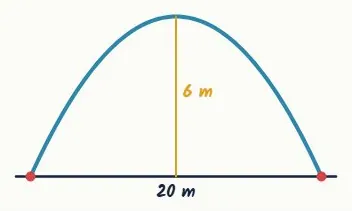
A bridge arch: 20 m wide, 6 m high
- Put the origin at one foot of the arch.
- It is zero at 0 and 20: y = kx(20 − x).
- The top is at x = 10, height 6.
Finding k
- Substitute the top point.
- Then solve for k.
- y = kx(20 − x)zero at 0 and 20
- 6 = k × 10 × (20 − 10)top: x = 10, y = 6
- 6 = 100k
- k = 6 ÷ 100 = 0.06÷ 100
- y = 0.06x(20 − x)
Try it: fit a parabola
How wide is the arch 4 m up?
- Set the height to 4 and solve.
- x = 4.23 m and x = 15.77 m.
- The width at 4 m is 11.55 m.
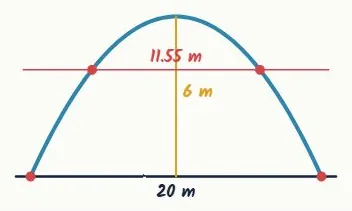
Height 4 m: rearrange to zero
- Expand the bracket.
- Clear the decimals.
- 0.06x(20 − x) = 4height 4 m
- 1.2x − 0.06x² = 4expand
- 0.06x² − 1.2x + 4 = 0rearrange to zero
- 3x² − 60x + 200 = 0× 50
The quadratic formula
- Two roots: one each side.
- Width: their difference.
- 3x² − 60x + 200 = 0
- a = 3, b = −60, c = 200
- x = (60 ± √(3600 − 2400))/6formula
- = (60 ± √1200)/6
- = 10 ± 5.774
- x = 4.226 or x = 15.774
- width = 15.774 − 4.226difference
- ≈ 11.55 m
Try it: the arch as a parabola
A thrown ball: vertex form
- Top known: vertex form.
- One more point finds a.
- y = a(x − 5)² + 8top at (5, 8)
- 3 = a(0 − 5)² + 8through (0, 3)
- 3 = 25a + 8
- 25a = −5subtract 8
- a = −0.2÷ 25
- y = −0.2(x − 5)² + 8
Where does the ball land?
- It lands where y = 0.
- Reject the negative root.
- y = −0.2(x − 5)² + 8
- −0.2(x − 5)² + 8 = 0lands: y = 0
- −0.2(x − 5)² = −8subtract 8
- (x − 5)² = 40÷ −0.2
- x − 5 = ±√40 = ±6.325square root
- x = 5 − 6.325 = −1.325behind the thrower
- x = 5 + 6.325 = 11.325
- It lands 11.3 m away.
Which form to use
- Know where it crosses zero? Use the roots.
- Know the top or bottom? Use vertex form.
- Then one more point finds the constant.
A model from Pythagoras
- Legs x and x + 7.
- Hypotenuse 13.
- A quadratic follows.
- x² + (x + 7)² = 13²Pythagoras
- x² + x² + 14x + 49 = 169expand
- 2x² + 14x − 120 = 0subtract 169
- x² + 7x − 60 = 0÷ 2
- (x + 12)(x − 5) = 0factorise
- x = −12a length is positive
- x = 5: legs 5 and 12
- area = ½ × 5 × 12 = 30 units²
Try it: build the model, find the best
Try it: finish the model
Check every answer against the context
- x = −12 fits the equation, not the triangle.
- The ball does not land behind the thrower.
- Say why each rejected answer fails.
Where the marks are
- Merit: complete the model and use it.
- Excellence: model the situation yourself.
- Both: an answer in context, with units.
What to take away
- Finish the model from the facts, then use it.
| Given a form | substitute known facts to finish it |
| Zeros known | y = kx(w − x) |
| Top known | y = a(x − h)² + k |
| Shapes | Pythagoras, area and volume formulae |
| Solve | then reject what cannot happen |
| Answer | a sentence with units |
Common mistakes
- Arch y = kx(20 − x), top 6 m high: 6 = k × 6 × (20 − 6)The top is halfway across at x = 10, where y = 6: 6 = k × 10 × 10, so k = 0.06.
- The arch is 4 m high at x = 15.774, so it is 15.77 m wide there.The two roots are the two sides of the arch, so the width is their difference: 15.774 − 4.226 ≈ 11.55 m.
- 3 = a(0 − 5)² + 8 = −25a + 8, so a = 0.2(0 − 5)² = 25, so 3 = 25a + 8 gives a = −0.2. A negative a is what makes the ball's path open downwards.
- The ball lands at x = 11.325 or x = −1.325.Reject x = −1.325 and say why: it is behind the thrower. The ball lands 11.3 m away.
Your turn: eight questions
- Sketch the situation first.
- Answers with units.
Arch: 12 m wide, 9 m high, y = kx(12 − x). Find k.
How high is that arch 2 m from one end?
Legs x and x + 2, hypotenuse 10. Find the legs.
Q3 gives x = 6 or −8. Which do you keep, and why?
A ball's path has its highest point 3 m across and 11 m up. Which form should the model start from?
A ball's path is y = a(x − 4)² + 10, and it is thrown from the point (0, 2). Find a.
A ball follows y = −0.5(x − 4)² + 10, with x and y in metres. How far across does it land, to 2 decimal places?
An arch is y = 0.25x(12 − x), in metres. How wide is it at a height of 5 m?
Show answer
1. At x = 6: 9 = 36k, so k = 0.25. 2. y = 0.25 × 2 × 10 = 5 m. 3. x² + (x + 2)² = 100 gives x² + 2x − 48 = 0, so x = 6: legs 6 and 8. 4. Keep 6: a length cannot be negative. 5. y = a(x − 3)² + 11. The top is known, so use vertex form y = a(x − h)² + k with h = 3 and k = 11. 6. a = −0.5. Substitute (0, 2): 2 = a(0 − 4)² + 10, so 16a = −8 and a = −0.5. 7. 8.47 m. Set y = 0: (x − 4)² = 20, so x = 4 ± √20, giving 8.47 or −0.47; reject −0.47 m, as the ball does not land behind the thrower. 8. 8 m. 0.25x(12 − x) = 5 gives x² − 12x + 20 = 0, so x = 2 or x = 10, and the width is 10 − 2 = 8 m.
The answers: questions 1 and 2
- 1. top at x = 6, y = 9halfway across
- 9 = k × 6 × (12 − 6)substitute
- 9 = 36k
- k = 9 ÷ 36 = 0.25
- 2. y = 0.25 × 2 × (12 − 2)x = 2
- = 0.25 × 2 × 10
- = 5 m high
The answers: questions 3 and 4
- 3. x² + (x + 2)² = 10²Pythagoras
- x² + x² + 4x + 4 = 100expand
- 2x² + 4x − 96 = 0subtract 100
- x² + 2x − 48 = 0÷ 2
- (x + 8)(x − 6) = 0factorise
- x = 6 or x = −8
- legs 6 and 6 + 2 = 8check: 36 + 64 = 100
- 4. x = −8 is negativenot a length
- keep x = 6
Sample question: Achieved
A parabolic arch is 16 m wide at the ground and 8 m high at its centre. With x measured in metres from one foot of the arch, it is modelled by y = kx(16 − x). Find k, and check your model at x = 4.
Hint
The highest point is in the middle, at x = 8, where y = 8. Substitute that point to find k.
Answer
k = 0.125, so y = 0.125x(16 − x)
Step by step
- The form y = kx(16 − x) already gives y = 0 at x = 0 and x = 16, the two feet of the arch. Only k is unknown.
- To find k, substitute one more known point. The top of the arch is halfway across, at x = 8, and it is 8 m high, so y = 8.
- Substitute: 8 = k × 8 × (16 − 8) = 64k.
- Divide by 64: k = 8 ÷ 64 = 0.125.
- So the model is y = 0.125x(16 − x).
- Classic mistake: putting x = 16 in. That point gives 0 = 0 and tells you nothing about k.
- Check at x = 4: y = 0.125 × 4 × 12 = 6 m. That is lower than the top and higher than the ground, which makes sense a quarter of the way across.
Full working
- 8 = k × 8 × (16 − 8)the top is at x = 8, y = 8
- 64k = 8, so k = 0.125
- x = 4: y = 0.125 × 4 × 12 = 6 msensible
- k = 0.125, y = 0.125x(16 − x)
Sample questions: Merit
A rugby ball is kicked from the ground and lands 40 m away. Its greatest height is 12 m. Using a model of the form y = kx(40 − x), where x is the horizontal distance in metres, find for what horizontal distances the ball is more than 9 m above the ground.
Hint
Find k from the highest point, which is halfway, at x = 20. Then solve y = 9 and decide which side of the answers is above 9 m.
Answer
For 10 m < x < 30 m (a 20 m stretch)
Step by step
- The model y = kx(40 − x) is zero at x = 0 (the kick) and x = 40 (landing). Find k first.
- The greatest height is halfway, at x = 20: 12 = k × 20 × 20 = 400k, so k = 0.03.
- Model: y = 0.03x(40 − x).
- Find where the height is exactly 9 m: 0.03x(40 − x) = 9.
- Divide both sides by 0.03: x(40 − x) = 300. Expand: 40x − x² = 300.
- Rearrange to zero with a positive x²: x² − 40x + 300 = 0.
- Factorise: two numbers that multiply to 300 and add to −40 are −10 and −30. So (x − 10)(x − 30) = 0, giving x = 10 or x = 30.
- The ball rises above 9 m at x = 10 and drops below 9 m at x = 30, so it is above 9 m between them.
- Classic mistake: giving only x = 10 and x = 30. The question asks for the distances where it is above 9 m, which is a range.
- Check x = 20: y = 12, above 9. Check x = 5: y = 0.03 × 5 × 35 = 5.25, below 9. That agrees.
Full working
- 12 = k × 20 × 20, so k = 0.03the top is halfway, at x = 20
- 0.03x(40 − x) = 9height 9 m
- x² − 40x + 300 = 0divide by 0.03 and rearrange
- (x − 10)(x − 30) = 0, so x = 10 or 30
- Above 9 m between the twoy = 12 at x = 20
- 10 m < x < 30 m
A netball is thrown from a height of 2 m. It reaches its greatest height of 6 m when it is 4 m away horizontally. Using y = a(x − 4)² + 6, find a, then find exactly how far away the ball hits the ground, and give this to 2 decimal places.
Hint
Substitute the starting point (0, 2) to find a. Then set y = 0, solve with a square root, and reject the answer that does not fit.
Answer
a = −0.25; it lands 4 + 2√6 ≈ 8.90 m away
Step by step
- The vertex form y = a(x − 4)² + 6 already has the highest point (4, 6) built in. Only a is unknown.
- The ball starts at x = 0 with height 2 m, so (0, 2) is on the curve: 2 = a(0 − 4)² + 6.
- That gives 2 = 16a + 6, so 16a = −4 and a = −0.25. It is negative, as it must be for a curve with a maximum.
- The ball hits the ground when y = 0: −0.25(x − 4)² + 6 = 0.
- Rearrange: 0.25(x − 4)² = 6, so (x − 4)² = 24.
- Square root both sides, keeping both signs: x − 4 = ±√24.
- Simplify the surd: √24 = √4 × √6 = 2√6. So x = 4 + 2√6 or x = 4 − 2√6.
- 4 − 2√6 ≈ −0.90 is behind the thrower, before the ball was even thrown, so reject it.
- Classic mistake: expanding the bracket and using the quadratic formula. It works, but undoing the square directly is quicker and gives the exact form at once.
- So the ball lands 4 + 2√6 ≈ 8.90 m away.
- Check: −0.25 × (4.899)² + 6 ≈ −0.25 × 24 + 6 = 0. Correct.
Full working
- 2 = a(0 − 4)² + 6the throw starts at (0, 2)
- 16a = −4, so a = −0.25
- −0.25(x − 4)² + 6 = 0lands when y = 0
- (x − 4)² = 24, so x = 4 ± 2√6√24 = 2√6
- 4 − 2√6 < 0 is rejectedit is behind the thrower
- x = 4 + 2√6 ≈ 8.90 m
Sample questions: Excellence
A tunnel entrance is a parabolic arch 10 m wide at road level and 6 m high at its centre. A truck 4 m tall must have at least 0.5 m of clearance above it. Find the widest truck that can safely drive through along the centre line, and give one limitation of the model.
Hint
Model the arch as y = kx(10 − x). The roof must be at least 4.5 m high above the whole width of the truck, so solve y = 4.5.
Answer
5 m wide (the roof is at least 4.5 m high from x = 2.5 m to x = 7.5 m)
Step by step
- Set up a model. Put x = 0 at one side of the road, so the arch meets the road at x = 0 and x = 10: y = kx(10 − x).
- The top is at the centre, x = 5, where y = 6: 6 = k × 5 × 5 = 25k, so k = 0.24.
- Model: y = 0.24x(10 − x).
- The truck needs 4 m plus 0.5 m of clearance, so the roof must be at least 4.5 m high above every part of the truck's top.
- Find where the arch is exactly 4.5 m high: 0.24x(10 − x) = 4.5.
- Divide by 0.24: x(10 − x) = 18.75. Rearrange: x² − 10x + 18.75 = 0.
- Quadratic formula: x = 10 ± √(100 − 75)2 = 10 ± 52, so x = 2.5 or x = 7.5.
- Between x = 2.5 and x = 7.5 the arch is higher than 4.5 m. That is a gap of 7.5 − 2.5 = 5 m, centred on the middle of the tunnel.
- So a truck up to 5 m wide fits when it drives along the centre line. Its top corners are then exactly 4.5 m below the roof line, with the 0.5 m clearance.
- Classic mistake: using 4 m instead of 4.5 m. The clearance is part of the height the roof must reach.
- Check with a 2.4 m wide truck: its corners are at x = 3.8 and 6.2, where y = 0.24 × 3.8 × 6.2 ≈ 5.65 m, well above 4.5 m. Narrower trucks fit easily, as expected.
- Limitation: real arches are not exact parabolas, and a truck is not a perfect box or perfectly centred. In practice you would allow a safety margin either side.
Full working
- 6 = k × 5 × 5, so k = 0.24top at the centre, x = 5
- 0.24x(10 − x) = 4.54 m truck + 0.5 m clearance
- x² − 10x + 18.75 = 0
- x = 10 ± √252 = 2.5 or 7.5
- width = 7.5 − 2.5 = 5 mthe roof is above 4.5 m between these
- The widest truck is 5 m
A 10 m ladder leans against a vertical wall, with its foot x m from the wall. The foot slides 2 m further from the wall, and the top slides exactly 2 m down the wall. Form an equation and find x, and the heights of the top of the ladder before and after.
Hint
Use Pythagoras twice, once for each position, with h for the first height. Subtract the two equations to link h and x.
Answer
x = 6 m; the top is 8 m up before and 6 m up after
Step by step
- Let the top of the ladder start h m up the wall. The ladder, the wall and the ground make a right triangle, with the 10 m ladder as the hypotenuse.
- Before: x² + h² = 100.
- After: the foot is x + 2 from the wall and the top is h − 2 up, so (x + 2)² + (h − 2)² = 100.
- Expand the second: x² + 4x + 4 + h² − 4h + 4 = 100.
- Use the first equation: x² + h² = 100, so replace it. 100 + 4x − 4h + 8 = 100.
- That simplifies to 4x − 4h + 8 = 0, so h = x + 2.
- Substitute into x² + h² = 100: x² + (x + 2)² = 100, so 2x² + 4x + 4 = 100.
- Simplify: 2x² + 4x − 96 = 0, then divide by 2: x² + 2x − 48 = 0.
- Factorise: (x + 8)(x − 6) = 0, so x = 6 or x = −8.
- A distance cannot be negative, so reject x = −8. The foot starts 6 m from the wall.
- Then h = 6 + 2 = 8 m before. After, the top is 8 − 2 = 6 m up and the foot is 6 + 2 = 8 m out.
- Classic mistake: trying to use just one triangle. There are two unknowns, x and h, so you need an equation from each position.
- Check: 6² + 8² = 36 + 64 = 100 and 8² + 6² = 100. Both positions fit a 10 m ladder.
Full working
- x² + h² = 100Pythagoras, first position
- (x + 2)² + (h − 2)² = 100second position
- 4x − 4h + 8 = 0, so h = x + 2expand and subtract the first equation
- x² + (x + 2)² = 100, so x² + 2x − 48 = 0
- (x + 8)(x − 6) = 0; x = −8 is rejecteda distance is positive
- x = 6 m; top 8 m up, then 6 m up
Challenge
A rectangular lawn is 12 m by 8 m. A path of the same width, x m, is laid all the way round it. (a) Find x if the path has the same area as the lawn. (b) Instead, the owner has $1500 for the path, and paving costs $25 per m². Find the widest path, in whole centimetres, that stays within the budget.
Hint
The path's area is the big rectangle (lawn plus path) minus the lawn. The big rectangle is (12 + 2x) m by (8 + 2x) m.
Answer
(a) x = 2 m. (b) 1.32 m (the exact limit is −5 + √40 ≈ 1.3246 m, and 1.33 m would cost more than $1500).
Step by step
- The big rectangle is (12 + 2x) by (8 + 2x), so the path's area is (12 + 2x)(8 + 2x) − 96 = 4x² + 40x.
- (a) 4x² + 40x = 96 gives x² + 10x − 24 = 0, so x = 2 (x = −12 is rejected: a width is positive).
- (b) $1500 at $25 per m² pays for 60 m², so 4x² + 40x = 60, which is x² + 10x − 15 = 0.
- The formula gives x = −5 + √40 ≈ 1.3246 m (the other root is negative).
- Round down, not to the nearest: 1.32 m costs $1494.24, but 1.33 m costs $1506.89, which is over budget.
Full working
- path area = (12 + 2x)(8 + 2x) − 12 × 8big rectangle minus lawn
- = 96 + 40x + 4x² − 96 = 4x² + 40xexpand
- 4x² + 40x = 96, so x² + 10x − 24 = 0(a), ÷ 4
- (x + 12)(x − 2) = 0, x = 2a width is positive
- 4x² + 40x = 1500 ÷ 25 = 60, so x² + 10x − 15 = 0(b), ÷ 4
- x = −10 + √(100 + 60)2 = −5 + √40 ≈ 1.3246formula, positive root
- 1.32 m: 25 × 59.7696 = $1494.24; 1.33 m: 25 × 60.2756 = $1506.89round down to stay in budget
- (a) 2 m (b) 1.32 m
A Napier bakery sells 200 pies a day at $5 each. For every 50c it adds to the price, it sells 10 fewer pies a day. Model the daily revenue, find both prices that give a daily revenue of $1080, and decide which of the two prices earns more profit if each pie costs $2 to make.
Hint
Let n be the number of 50c rises. The price is 5 + 0.5n and the number sold is 200 − 10n.
Answer
$6 (180 pies) or $9 (120 pies). $9 earns more profit: $840 a day against $720.
Step by step
- After n rises the price is 5 + 0.5n dollars and the sales are 200 − 10n pies.
- Revenue R = (5 + 0.5n)(200 − 10n), which expands to 1000 + 50n − 5n².
- Set R = 1080 and rearrange to n² − 10n + 16 = 0, so n = 2 or n = 8.
- n = 2: $6 each, 180 pies. n = 8: $9 each, 120 pies. Both earn $1080.
- Profit is (price − 2) × pies sold: $720 at $6 and $840 at $9, so $9 is better.
Full working
- R = (5 + 0.5n)(200 − 10n)price × number sold
- = 1000 − 50n + 100n − 5n² = 1000 + 50n − 5n²expand
- 1000 + 50n − 5n² = 1080revenue $1080
- 5n² − 50n + 80 = 0, so n² − 10n + 16 = 0rearrange, ÷ 5
- (n − 2)(n − 8) = 0, n = 2 or 8factorise
- $6 × 180 = $1080, $9 × 120 = $1080check
- profit: 4 × 180 = $720, 7 × 120 = $840(price − 2) × pies
- $6 or $9; $9 gives more profit ($840 a day)
Two hoses fill a water tank together in 6 hours. On its own, the smaller hose takes 5 hours longer than the larger hose to fill the tank. Find how long each hose takes on its own. One day both hoses start together on an empty tank, but the larger hose breaks after 2 hours. How much longer does the smaller hose need to finish filling the tank?
Hint
If a hose fills the tank in x hours, it fills 1x of the tank each hour. Add the two hoses' fractions for one hour.
Answer
Larger hose 10 hours, smaller hose 15 hours. After the break the smaller hose needs another 10 hours.
Step by step
- Let the larger hose take x hours, so the smaller takes x + 5 hours.
- In one hour together they fill 1x + 1x + 5 of the tank, which must equal 16.
- Clear the fractions to get x² − 7x − 30 = 0, so x = 10 (reject x = −3, a time is positive).
- Together for 2 hours they fill 26 = 13 of the tank, leaving 23.
- The smaller hose fills 115 of the tank each hour, so 23 takes 23 × 15 = 10 hours.
Full working
- 1x + 1x + 5 = 16fraction filled per hour
- 6(x + 5) + 6x = x(x + 5)× 6x(x + 5)
- 12x + 30 = x² + 5xexpand
- x² − 7x − 30 = 0, so (x − 10)(x + 3) = 0rearrange, factorise
- x = 10 (x = −3 rejected: a time is positive)larger 10 h, smaller 15 h
- 1 − 2 × 16 = 23 of the tank leftafter 2 hours together
- 23 × 15 = 10 hourssmaller hose alone
- 10 h and 15 h; 10 more hours after the break
Practise this
Report a mistake
More in AS 91261
 Index laws, fractional indices and surds7 min
 Expanding, factorising and simplifying algebraic fractions9 min
 Quadratic equations: solving, and forming from the roots8 min
 The discriminant: how many roots, and what kind9 min
 Logarithms: what they mean and the log laws7 min
 Exponential growth and decay: interest, depreciation, half-life9 min
 Simultaneous equations: two lines, or a line and a curve8 minAlgebraic modelling: completing a model from the context9 min
 Indices and surds: 7 exam questions solved step by step11 min
 Algebraic fractions: 7 exam questions solved step by step11 min
 Quadratic equations: 7 exam questions solved step by step11 min
 The discriminant: 7 exam questions solved step by step11 min
 Logarithms: 7 exam questions solved step by step10 min
 Exponential models: 7 exam questions solved step by step10 min
 Simultaneous equations: 7 exam questions solved step by step11 min
 Algebraic modelling: 6 exam questions solved step by step11 min
Is your child on track?
Take the free placement test