Algebraic modelling: 6 exam questions solved step by step

What this lesson covers
- A model is completed by substituting known facts from the context into its given form.
- Every answer from a model has to be checked against the context it came from.
6 models, one routine
- Write the form the context gives.
- Substitute known facts to finish it.
- Solve: get to zero, or use ±√.
- Keep only answers that fit.
- Answer in words, with units.
Question 1 · Achieved, in context
- A fountain jet lands 4 m from its nozzle.
- Height: h = kx(4 − x) m, x m along.
- At x = 1 m the jet is 1.5 m high.
- Find k, then the greatest height.
Q1: complete the model
- Substitute the known point.
- Top: halfway between roots.
- h = kx(4 − x)zero at x = 0 and 4
- 1.5 = k × 1 × (4 − 1)x = 1, h = 1.5
- 1.5 = 3k
- k = 0.5÷ 3
- h = 0.5x(4 − x)
- top at x = 2halfway between roots
- h = 0.5 × 2 × (4 − 2)
- = 0.5 × 2 × 2 = 2
- The jet is at most 2 m high.
Question 2 · Achieved, in context
- A rugby ball is kicked from the ground.
- It is highest, 16 m up, at x = 10 m.
- Model: y = a(x − 10)² + 16
- Find a, then the height at x = 15 m.
Q2: vertex form
- The kick starts at (0, 0).
- Square before × a.
- y = a(x − 10)² + 16top at (10, 16)
- 0 = a(0 − 10)² + 16starts at (0, 0)
- 0 = 100a + 16
- 100a = −16−16 both sides
- a = −0.16÷ 100
- y = −0.16(x − 10)² + 16
- y = −0.16(15 − 10)² + 16x = 15
- = −0.16 × 25 + 16 = −4 + 16
- = 12: the ball is 12 m high
Try it: from the model to its roots
Question 3 · Merit, in context
- A lawn 10 m by 6 m has a path x m wide
- All the way round it.
- Lawn and path together cover 96 m².
- Find the width of the path.
- Careful: the path is on both sides.
Q3: an area model
- Add 2x to each side.
- A width cannot be negative.
- (10 + 2x) by (6 + 2x)path on every side
- (10 + 2x)(6 + 2x) = 96area
- 60 + 20x + 12x + 4x² = 96expand
- 4x² + 32x − 36 = 0collect, −96
- x² + 8x − 9 = 0÷ 4
- (x + 9)(x − 1) = 09 × −1, 9 + −1
- x = −9a width is positive
- x = 1: 12 × 8 = 96
- The path is 1 m wide.
Try it: an area model
Question 4 · Merit, in context
- The kick from question 2:
- y = −0.16(x − 10)² + 16
- How far away is the ball 10 m high?
- Give answers to 1 decimal place.
Q4: solve the finished model
- Undo in reverse order.
- Keep ±. Round at the end.
- −0.16(x − 10)² + 16 = 10y = 10
- −0.16(x − 10)² = −6−16 both sides
- (x − 10)² = 37.5÷ −0.16
- x − 10 = ±√37.5square root: ±
- = ±6.1237…
- x = 10 − 6.1237 = 3.8763
- x = 10 + 6.1237 = 16.1237
- both before it lands at x = 20
- 3.9 m (up) and 16.1 m (down)
Question 5 · Excellence, in context
- A tunnel mouth is a parabola 8 m wide
- At the road and 6 m high in the middle.
- Model: y = ax² + 6, x m from the centre.
- Can a truck 3 m wide and 4.5 m tall fit,
- Driving down the middle? Pause and try it.
Q5: complete the model
- The road meets it at x = ±4.
- Use one of those points.
- y = ax² + 6top at (0, 6)
- 0 = a(4)² + 6meets road at x = 4
- 0 = 16a + 6
- 16a = −6−6 both sides
- a = −0.375÷ 16
- y = 6 − 0.375x²
Q5: test the tightest point
- Not the centre: the corner.
- Corner is 1.5 m out.
- y = 6 − 0.375x²
- corner at x = 1.5half of 3 m
- y = 6 − 0.375 × 1.5²height there
- = 6 − 0.375 × 2.25
- = 6 − 0.84375 = 5.15625
- 5.16 m > 4.5 mroof above the corner
- 5.15625 − 4.5 = 0.65625
- Yes: about 0.66 m to spare
Question 6 · Excellence, in context
- A garden bed is a right-angled triangle.
- Its longest side is 10 m.
- Its area is 24 m².
- Find the two shorter sides.
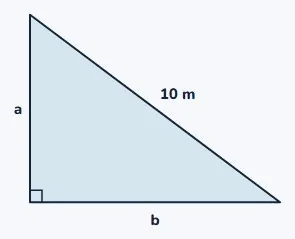
Q6: two facts, one equation
- Pythagoras and area.
- Substitute for b.
- Let the shorter sides be a and b
- a² + b² = 100Pythagoras
- ½ab = 24, so ab = 48area
- b = 48/a÷ a
- a² + (48/a)² = 100substitute
- a² + 2304/a² = 100square
- a⁴ + 2304 = 100a²× a²
- a⁴ − 100a² + 2304 = 0rearrange to zero
Q6: a quadratic in a²
- Let u = a².
- Reject negative lengths.
- a⁴ − 100a² + 2304 = 0
- u² − 100u + 2304 = 0let u = a²
- (u − 36)(u − 64) = 036 × 64, 36 + 64
- a² = 36 or a² = 64u = a²
- a = ±6 or a = ±8square root
- a = −6, a = −8a length is positive
- a = 6, b = 8 or a = 8, b = 6
- 36 + 64 = 100, ½ × 6 × 8 = 24
- The shorter sides are 6 m and 8 m.
Try it: keep the answer that fits
Common mistakes
- Path all round: (10 + x)(6 + x) = 96The path is on both sides, so the lengths are 10 + 2x and 6 + 2x: (10 + 2x)(6 + 2x) = 96.
- x = 1 or x = −9, so the path is 1 m or 9 m wide.Reject x = −9 with a reason: a width cannot be negative, so the path is 1 m wide.
- 0 = a(0 − 10)² + 16, so a = 0.16100a = −16, so a = −0.16; a negative a also makes sense, because the parabola opens down.
- h = 0.5x(4 − x) is highest at x = 4.The zeros are x = 0 and x = 4, so the top is halfway at x = 2: h = 0.5 × 2 × 2 = 2 m.
The routine that solved all six
- Form, complete, solve, reject with a reason, answer.
| Step | How |
|---|---|
| Roots | y = kx(w − x), then a point |
| Top | y = a(x − h)² + k, a point |
| Shapes | Pythagoras, area formulae |
| Solve | to zero, factorise or ±√ |
| Reject | only with a reason |
| Answer | a sentence, with units |
Challenge
A footbridge over a stream has a parabolic arch. The arch meets the water 20 m apart and is 8 m high in the middle. A rescue boat with a cabin 5 m tall must pass under it. What is the widest the cabin can be? Give your answer to 2 decimal places.
Hint
Put the top of the arch at (0, 8), so the model is y = ax² + 8 and it meets the water at x = ±10. Then find where the arch is exactly 5 m high: the cabin's corners must be inside those points.
Answer
The cabin can be at most 12.25 m wide (exactly 5√6 m)
Step by step
- Use y = ax² + 8 with x measured from the middle of the stream.
- The arch meets the water at x = 10, so 0 = 100a + 8 and a = −0.08.
- Find where the arch is 5 m high: 8 − 0.08x² = 5, so x² = 37.5.
- x = ±√37.5 = ±6.124 m, so the gap 5 m up is 2 × 6.124... wide.
- The cabin's top corners must fit inside that gap, so it can be at most 12.25 m wide.
Full working
- y = ax² + 8top at (0, 8)
- 0 = a × 10² + 8, so a = −0.08meets water at x = 10
- 8 − 0.08x² = 5arch at the cabin's height
- 0.08x² = 3, so x² = 37.5rearrange
- x = ±√37.5 = ±6.1237...keep ±
- width = 2 × 6.1237... = 12.247...from −6.12 to 6.12
- At most 12.25 m wide
A farmer has 60 m of fencing to make a rectangular pen against a long shed wall, so only three sides need fencing. (a) Find all possible sizes of a pen with area 400 m². (b) Show that a pen of 500 m² is impossible, and find the largest possible area.
Hint
Let x be each side at right angles to the wall; the side parallel to the wall is 60 − 2x. For (b), a quadratic with no real roots has b² − 4ac < 0. The greatest area is halfway between the roots of x(60 − 2x) = 0.
Answer
(a) 10 m by 40 m (40 m along the wall) or 20 m by 20 m (b) 500 m² gives b² − 4ac = −100 < 0, so it is impossible; the largest area is 450 m² (15 m by 30 m)
Step by step
- The two sides at right angles to the wall are x m each, so the side along the wall is 60 − 2x m and the area is x(60 − 2x).
- For 400 m²: x(60 − 2x) = 400 simplifies to x² − 30x + 200 = 0, so x = 10 or x = 20. Both fit the context.
- For 500 m²: x² − 30x + 250 = 0 has b² − 4ac = 900 − 1000 = −100, so there is no real x.
- The area x(60 − 2x) is zero at x = 0 and x = 30, so it is greatest halfway, at x = 15.
- That pen is 15 m by 30 m, with area 450 m², which is less than 500 m².
Full working
- A = x(60 − 2x)two sides of x, one of 60 − 2x
- x(60 − 2x) = 400 → 2x² − 60x + 400 = 0 → x² − 30x + 200 = 0expand, ÷ 2
- (x − 10)(x − 20) = 0: 10 by 40 or 20 by 2010 × 40 = 400, 20 × 20 = 400
- x(60 − 2x) = 500 → x² − 30x + 250 = 0same steps
- b² − 4ac = (−30)² − 4 × 1 × 250 = −100 < 0no real solutions
- greatest at x = 15: 15 × (60 − 30) = 450halfway between x = 0 and x = 30
- (a) 10 m by 40 m or 20 m by 20 m (b) impossible; largest is 450 m²
Hemi drives 120 km from Hamilton to Rotorua. On the way back he averages 20 km per hour faster, and the return trip takes 30 minutes less. Find his average speed on the way there, and the time each trip took.
Hint
Time = distance ÷ speed. If the speed there is v km per hour, write each trip's time in hours, then their difference is 0.5 hours. Multiply through by v(v + 20) to clear the fractions.
Answer
60 km per hour on the way there; 2 hours there and 1.5 hours back (at 80 km per hour)
Step by step
- Let v be the speed there. Then the time there is 120v hours and the time back is 120v + 20 hours.
- The return is 30 minutes, or 0.5 hours, shorter: 120v − 120v + 20 = 0.5.
- Multiply every term by v(v + 20) to clear the fractions, then rearrange: v² + 20v − 4800 = 0.
- Factorise: (v − 60)(v + 80) = 0. A speed cannot be negative, so v = 60.
- Check: 120 ÷ 60 = 2 hours there and 120 ÷ 80 = 1.5 hours back, which is 30 minutes less.
Full working
- 120v − 120v + 20 = 0.5time = distance ÷ speed; 30 min = 0.5 h
- 120(v + 20) − 120v = 0.5v(v + 20)× v(v + 20)
- 2400 = 0.5v² + 10vthe 120v terms cancel
- v² + 20v − 4800 = 0× 2, rearrange to zero
- (v − 60)(v + 80) = 0−60 × 80 = −4800, −60 + 80 = 20
- v = −80 is rejecteda speed is positive
- 60 km per hour there (2 h), 80 km per hour back (1.5 h)
Practise this
Report a mistake
More in AS 91261
 Index laws, fractional indices and surds7 min
 Expanding, factorising and simplifying algebraic fractions9 min
 Quadratic equations: solving, and forming from the roots8 min
 The discriminant: how many roots, and what kind9 min
 Logarithms: what they mean and the log laws7 min
 Exponential growth and decay: interest, depreciation, half-life9 min
 Simultaneous equations: two lines, or a line and a curve8 min
 Algebraic modelling: completing a model from the context9 min
 Indices and surds: 7 exam questions solved step by step11 min
 Algebraic fractions: 7 exam questions solved step by step11 min
 Quadratic equations: 7 exam questions solved step by step11 min
 The discriminant: 7 exam questions solved step by step11 min
 Logarithms: 7 exam questions solved step by step10 min
 Exponential models: 7 exam questions solved step by step10 min
 Simultaneous equations: 7 exam questions solved step by step11 minAlgebraic modelling: 6 exam questions solved step by step11 min
Is your child on track?
Take the free placement test