Metric prefixes, converting units, and derived units
What this lesson covers
- The number of significant figures in a measurement is the number of digits that contribute to the degree of accuracy of the measurement, given as the number of digits known with certainty plus one uncertain digit.
- When calculating, it is best to use at least one more significant figure than is required in the final solution, and round at the end of the whole calculation.
- Conversions between different-sized metric units may be needed to give the appropriate units for a measurement or calculation.
- The metric prefixes kilo–, mega–, giga–, and tera– signify a unit that is one thousand, one million, one billion, and one trillion times larger than the base unit.
- The metric prefixes centi–, milli–, micro–, and nano– signify a unit one hundredth, one thousandth, one millionth, and one billionth the size of the base unit.
- Derived units (e.g. cm², km/h) reflect a relationship (a product or quotient) between two different measurements.
One system, not forty conversions
- A kilometre is not a different kind of length from a metre.
- It is a thousand of them. That is the only difference.
- So every metric conversion is the same move: a power of ten.
The big prefixes
- Kilo is a thousand. Mega is a million.
- Giga is a billion, tera is a trillion.
- As powers: three, six, nine, twelve. Steps of three.
| Prefix | As a power | In words |
|---|---|---|
| kilo | × 10³ | a thousand |
| mega | × 10⁶ | a million |
| giga | × 10⁹ | a billion |
| tera | × 10¹² | a trillion |
And the small ones
- Milli is a thousandth. Micro is a millionth.
- Nano is a billionth, which is where computer chips live.
- Same steps of three, going the other way.
| Prefix | As a power | In words |
|---|---|---|
| centi | × 10⁻² | a hundredth |
| milli | × 10⁻³ | a thousandth |
| micro | × 10⁻⁶ | a millionth |
| nano | × 10⁻⁹ | a billionth |
Which way does the number go?
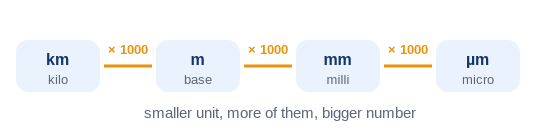
- Ask one question: is the new unit smaller or bigger?
- Smaller unit, you need more of them, so the number goes up.
- Bigger unit, fewer of them, number goes down.
| Going | Because | Effect |
|---|---|---|
| Going to a smaller unit | you need more of them | number goes up |
| Going to a bigger unit | you need fewer | number goes down |
| 2.5 km to metres | metres are smaller | 2 500 |
| 450 mm to metres | metres are bigger | 0.45 |
Try it: lengths, areas, volumes
Three conversions
- Two point five kilometres is two thousand five hundred metres.
- Four hundred and fifty millimetres is nought point four five metres.
- Kilometres to centimetres is two steps, not one.
| Conversion | Doing | Answer |
|---|---|---|
| 2.5 km → m | × 10³ | 2 500 m |
| 450 mm → m | ÷ 10³ | 0.45 m |
| 3.4 km → cm | × 10³ then × 10² | 340 000 cm |
| Count the steps | not the zeros |
Try it: every metric unit
The prefix that breaks the pattern
- Kilo, milli, micro and nano all step by a thousand.
- Centi does not. It is a hundredth.
- So a metre is a hundred centimetres but a thousand millimetres.
| Prefix | Step |
|---|---|
| kilo, milli, micro | all steps of 1 000 |
| centi | a hundredth, not a thousandth |
| So 1 m is 100 cm | but 1 000 mm |
| The habit of moving 3 places | breaks on centimetres |
Prefixes are powers of ten wearing names
- Three point two gigabytes is three point two times ten to the ninth.
- The prefix and the power are the same information.
- One is a word for talking, one is a number for calculating.
| Written | Because | Same as |
|---|---|---|
| 3.2 GB | giga is 10⁹ | 3.2 × 10⁹ bytes |
| 2 500 000 000 bytes | count back | 2.5 GB |
| Prefixes and powers | are the same idea | |
| One is a word | the other is a number |
Choosing a sensible prefix
- Nought point nought nought nought nought nought four metres.
- Nobody can read that. Four micrometres, and everyone can.
- Pick the prefix that puts the number between one and a thousand.
| Written badly | Problem | Better |
|---|---|---|
| 0.000 004 m | hard to read | 4 micrometres |
| 5 000 000 m | hard to read | 5 000 km |
| Pick the prefix | that gives 1 to 1 000 | |
| Same length | easier to say |
Units made out of other units
- A square centimetre is a centimetre times a centimetre.
- Kilometres per hour is kilometres divided by hours.
- The unit is telling you what calculation made it.
| Unit | Means | Kind |
|---|---|---|
| cm² | cm × cm | a product |
| km/h | km ÷ h | a quotient |
| m/s | metres ÷ seconds | a quotient |
| g/cm³ | grams ÷ cm³ | density |
Converting a rate
- Seventy-two kilometres per hour. Convert the top and bottom.
- Seventy-two thousand metres, in three thousand six hundred seconds.
- That is twenty metres per second.
| Part | Converting | Gives |
|---|---|---|
| 72 km/h | the top: 72 km | 72 000 m |
| the bottom: 1 h | 3 600 s | |
| So | 72 000 ÷ 3 600 | 20 m/s |
| Shortcut | km/h ÷ 3.6 | gives m/s |
Where the divide by 3.6 comes from
- A thousand metres over three thousand six hundred seconds.
- That ratio is the same every time, and it works out at 3.6.
- So the shortcut is not a separate rule. It is that division.
Try it: hop the prefix ladder
What a significant figure is on a ruler
- It is the digits you are certain of, plus one you are guessing.
- A tape marked in centimetres: you read the centimetres.
- Then you estimate the millimetre. That last digit is the uncertain one.
| Definition | In practice |
|---|---|
| Digits you are sure of | plus one you are not |
| A tape marked in cm | you read the cm, guess the mm |
| So that last digit | is always the uncertain one |
| Carry one spare figure | and round at the end |
Carry one spare figure
- If you need three figures in the answer, work with four.
- Then round once, at the very end of the whole calculation.
- Rounding early is where precision quietly disappears.
What to take away
- Seven lines, and the fourth one catches most people.
| Metric is one system | with a power of ten in front |
| kilo, mega, giga, tera | 10³, 10⁶, 10⁹, 10¹² |
| centi, milli, micro, nano | 10⁻², 10⁻³, 10⁻⁶, 10⁻⁹ |
| Centi is the odd one | a hundredth, not a thousandth |
| To a smaller unit | the number gets bigger |
| A derived unit | is a product or a quotient |
| km/h to m/s | divide by 3.6 |
Common mistakes
- 1 m = 1 000 cm, so 3.4 km = 3 400 000 cmCenti is a hundredth, not a thousandth: 3.4 km = 3 400 m = 340 000 cm.
- 450 mm to metres: metres are bigger, so 450 × 1 000 = 450 000 mA bigger unit needs fewer of them, so the number goes down: 450 ÷ 1 000 = 0.45 m.
- 90 km/h × 3.6 = 324 m/sDivide by 3.6 for km/h to m/s: 90 000 m ÷ 3 600 s = 25 m/s; 324 m/s is faster than sound.
- 0.000 004 m = 4 nanometres0.000 004 is 4 × 10⁻⁶, and micro is 10⁻⁶, so it is 4 micrometres; nano is 10⁻⁹.
Your turn: eight questions
- Work all eight.
- Question 1 is two steps, and the second is a hundred.
- Question 3 can be done either way round.
Convert 3.4 km to centimetres.
Write 0.000 004 m with a prefix.
Convert 90 km/h to m/s.
Write 2 500 000 000 bytes with a prefix.
Convert 85 mm to centimetres.
A runner goes at 5 m/s. What is that in km/h?
Density is measured in g/cm³. What calculation does that unit tell you to do?
A virus is 120 nanometres across. Write that in metres using a power of ten.
Show answer
1. 340 000 cm. Kilometres to metres is times a thousand, giving 3 400, and metres to centimetres is times a hundred. Two steps, and the second one is a hundred rather than a thousand. 2. 4 micrometres. Micro is ten to the minus six, and 0.000 004 is 4 times ten to the minus six. 3. 25 m/s. Either convert both parts, 90 000 metres over 3 600 seconds, or use the shortcut and divide by 3.6. 4. 2.5 gigabytes. Giga is ten to the ninth, and 2 500 000 000 is 2.5 times ten to the ninth. 5. 8.5 cm. A centimetre is 10 mm, not 1 000 mm, so divide by 10. 6. 18 km/h. Going from m/s to km/h is the shortcut backwards, so multiply by 3.6: 5 × 3.6 = 18. 7. Mass in grams divided by volume in cm³. The slash in a derived unit means a quotient. 8. 1.2 × 10⁻⁷ m. Nano is 10⁻⁹, so it is 120 × 10⁻⁹ m, and 120 is 1.2 × 10², giving 1.2 × 10⁻⁷ m.
The answers
- Three hundred and forty thousand centimetres.
- Four micrometres.
- Twenty-five metres per second.
- Two point five gigabytes.
Challenge
A fibre internet connection in Whangārei carries data at 1.2 gigabits per second. A photo album is 45 megabytes. One byte is 8 bits. How long does the album take to send, in milliseconds?
Hint
Turn everything into plain bits first using powers of ten, then divide. Watch out: the speed is in bits but the file is in bytes.
Answer
300 milliseconds
Step by step
- 45 megabytes is 45 × 10⁶ bytes.
- Each byte is 8 bits, so the file is 45 × 10⁶ × 8 = 3.6 × 10⁸ bits.
- The line carries 1.2 gigabits, which is 1.2 × 10⁹ bits, every second.
- Time = bits to send ÷ bits per second = 3.6 × 10⁸ ÷ (1.2 × 10⁹) = 0.3 s.
- 0.3 s is 0.3 × 10³ = 300 milliseconds.
Full working
- 45 MB = 45 × 10⁶ bytesmega is 10⁶
- 45 × 10⁶ × 8 = 3.6 × 10⁸ bits8 bits per byte
- 1.2 Gb per second = 1.2 × 10⁹ bits per secondgiga is 10⁹
- 3.6 × 10⁸ ÷ (1.2 × 10⁹) = 0.3 stime = amount ÷ rate
- 0.3 s × 1000 = 300 msmilli is a thousandth
- 300 milliseconds
During a storm, rain falls at 4 mm per hour onto a flat roof with an area of 120 m². All of it drains into a water tank that holds 5000 litres and starts empty. (a) How many litres flow into the tank each minute? (b) How long does the tank take to fill, in hours and minutes? (1 m³ = 1000 litres.)
Hint
The rain makes a very thin layer of water on the roof each hour. That layer is a box: its volume is area × depth. Make sure both are in metres before you multiply.
Answer
(a) 8 litres per minute (b) 10 hours 25 minutes
Step by step
- In one hour the rain makes a layer 4 mm deep, which is 0.004 m.
- Volume per hour = 120 × 0.004 = 0.48 m³, which is 480 litres.
- An hour is 60 minutes, so 480 ÷ 60 = 8 litres per minute.
- 5000 ÷ 8 = 625 minutes to fill the tank.
- 625 minutes is 10 hours (600 minutes) and 25 minutes.
Full working
- 4 mm = 0.004 m÷ 1000
- 120 × 0.004 = 0.48 m³ per hourvolume = area × depth
- 0.48 × 1000 = 480 L per hour1 m³ = 1000 L
- 480 ÷ 60 = 8 L per minuteper hour to per minute
- 5000 ÷ 8 = 625 min = 10 h 25 mintime = amount ÷ rate
- (a) 8 litres per minute (b) 10 hours 25 minutes
Gold has a density of 19.3 g per cm³. (a) Write this density in kg per m³. (b) Gold can be beaten into gold leaf just 0.1 micrometres thick. What area, in square metres, could 1 gram of gold cover? Give your answer to 3 significant figures.
Hint
For (a), convert the top and the bottom separately: grams to kilograms, and cm³ to m³ (a cubic metre is 100 × 100 × 100 cm³). For (b), the leaf is a very flat box, so volume = area × thickness. Find the volume first, in m³.
Answer
(a) 19 300 kg per m³ (b) about 0.518 m²
Step by step
- 19.3 g is 0.0193 kg, and 1 m³ holds 1 000 000 cm³, so 1 m³ of gold has a mass of 0.0193 × 1 000 000 = 19 300 kg.
- Volume = mass ÷ density, so 1 g of gold takes up 1 ÷ 19.3 = 0.051 81 cm³.
- Change that to cubic metres: 0.051 81 ÷ 1 000 000 = 5.181 × 10⁻⁸ m³.
- 0.1 micrometres is 0.1 × 10⁻⁶ = 10⁻⁷ m.
- Area = volume ÷ thickness = 5.181 × 10⁻⁸ ÷ 10⁻⁷ = 0.518 m², about the size of a small table top.
Full working
- 19.3 g = 0.0193 kg÷ 1000
- 0.0193 × 1 000 000 = 19 300 kg per m³1 m³ = 10⁶ cm³
- 1 ÷ 19.3 = 0.051 81 cm³volume = mass ÷ density
- 0.051 81 cm³ = 5.181 × 10⁻⁸ m³÷ 10⁶
- 0.1 µm = 10⁻⁷ mmicro is 10⁻⁶
- 5.181 × 10⁻⁸ ÷ 10⁻⁷ = 0.518 m²area = volume ÷ thickness
- (a) 19 300 kg per m³ (b) 0.518 m²
Where science uses this
Practise this
Report a mistake
More in Measurement
Is your child on track?
Take the free placement test