Forces and acceleration: F = ma, inertia and force pairs
What this lesson covers
- Acceleration measures how quickly velocity changes, including a change of direction.
- A bigger net force gives a bigger acceleration; a bigger mass gives a smaller one.
- Force, mass and acceleration are linked by F = ma.
- Inertia is an object's resistance to a change in its motion, and it grows with mass.
- Forces come in action and reaction pairs: equal in size, opposite in direction, acting on two different objects.
Acceleration is a change in velocity
- Velocity is speed in a particular direction, so it changes if you speed up, slow down or turn.
- Acceleration tells you how much the velocity changes each second.
- To calculate it, divide the change in velocity by the time taken: a = change in velocity ÷ time.
- Velocity is in metres per second (m/s) and time is in seconds, so acceleration is in metres per second per second (m/s²).
- A car going round a roundabout at a steady 30 km/h is still accelerating, because its direction keeps changing.
| What happens | Is velocity changing? | Accelerating? |
|---|---|---|
| Bus pulls away from a stop | Speed goes up | Yes |
| Cyclist brakes at a red light | Speed goes down | Yes (slowing down is acceleration too) |
| Car takes a corner at a steady speed | Direction changes | Yes |
| Ferry cruises in a straight line at a steady speed | No change | No |
Example: how quickly a car speeds up
- A car starts from rest and reaches 27 m/s (about 97 km/h) in 9 seconds.
- Find its average acceleration.
- change in velocity = 27 − 0 = 27 m/sit started at rest
- a = 27 ÷ 9change in velocity ÷ time
- a = 3 m/s²it gains 3 m/s every second
Net force and mass decide the acceleration
- Most objects have several forces on them at once, such as a push, friction and weight.
- The net force is what is left over when you combine them, taking direction into account.
- If the forces are balanced, the net force is zero and the velocity stays the same.
- If the mass stays the same, doubling the net force doubles the acceleration.
- If the net force stays the same, doubling the mass halves the acceleration, which is why an empty trolley is easier to get moving than a full one.
| Change | Kept the same | Effect on acceleration |
|---|---|---|
| Bigger net force | Mass | Bigger acceleration |
| Smaller net force | Mass | Smaller acceleration |
| Bigger mass | Net force | Smaller acceleration |
| Smaller mass | Net force | Bigger acceleration |
The equation F = ma
- Net force equals mass times acceleration: F = ma.
- Force is measured in newtons (N), mass in kilograms (kg) and acceleration in m/s².
- One newton is the net force that makes a 1 kg mass accelerate at 1 m/s².
- Rearrange it to find the other quantities: a = F ÷ m and m = F ÷ a.
- Always use the net force, not just one of the forces acting.
| To find | Use | Units |
|---|---|---|
| Net force | F = m × a | N |
| Acceleration | a = F ÷ m | m/s² |
| Mass | m = F ÷ a | kg |
Try it: F = ma
Example: pushing a loaded trolley
- A student pushes a 40 kg trolley forward with a force of 100 N.
- Friction acts backwards on the trolley with a force of 20 N.
- Find the trolley's acceleration.
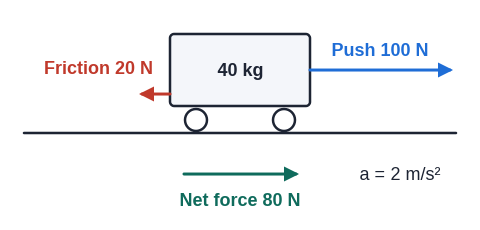
- net force = 100 − 20 = 80 N forwardthe forces act in opposite directions
- a = F ÷ m = 80 ÷ 40rearranged F = ma
- a = 2 m/s² forward
- check: 40 × 2 = 80 Nm × a gives back the net force
Motion lab
Inertia: objects resist changes in motion
- An object keeps doing what it is already doing (staying still, or moving at a steady velocity) unless a net force acts on it.
- This tendency to resist a change in motion is called inertia.
- The more mass an object has, the more inertia it has, so it takes a bigger force to start it, stop it or turn it.
- A 120 kg prop running at full speed is much harder to stop than a 70 kg halfback at the same speed.
- When a car stops suddenly, your body keeps moving forward; the seatbelt supplies the force that slows you down with the car.
Forces come in action and reaction pairs
- A force is always an interaction between two objects, so forces never appear on their own.
- If object A pushes or pulls on object B, then B pushes or pulls back on A at the same moment.
- The two forces are the same size and point in opposite directions.
- They act on different objects, so they never cancel each other out.
- That is why a swimmer can push off a wall: the swimmer pushes the wall, and the wall pushes the swimmer away.
| Action | Reaction | Acts on |
|---|---|---|
| Swimmer's feet push back on the pool wall | Wall pushes the swimmer forward | Wall, then swimmer |
| Rocket pushes hot gas downwards | Gas pushes the rocket upwards | Gas, then rocket |
| Your foot pushes back on the ground as you walk | Ground pushes you forward | Ground, then you |
| Earth pulls you down (your weight) | You pull Earth up by the same amount | You, then Earth |
Example: who gets thrown back more in a tackle?
- A 110 kg forward runs into a 75 kg winger.
- During the hit, the forward pushes the winger with 1500 N.
- Find the force on the forward, and each player's acceleration during the hit.
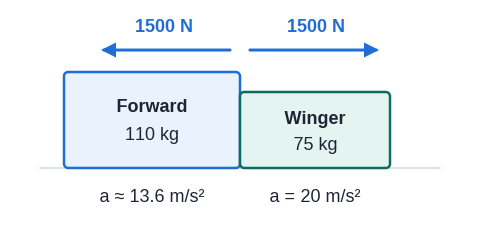
- force on forward = 1500 N, opposite directionaction and reaction pair
- winger: a = 1500 ÷ 75 = 20 m/s²a = F ÷ m
- forward: a = 1500 ÷ 110 ≈ 13.6 m/s²same force, bigger mass
- same force, but the winger accelerates moreless mass means less inertia
Air resistance and a falling skydiver
- Air resistance pushes against anything moving through air, and it gets bigger as the object goes faster.
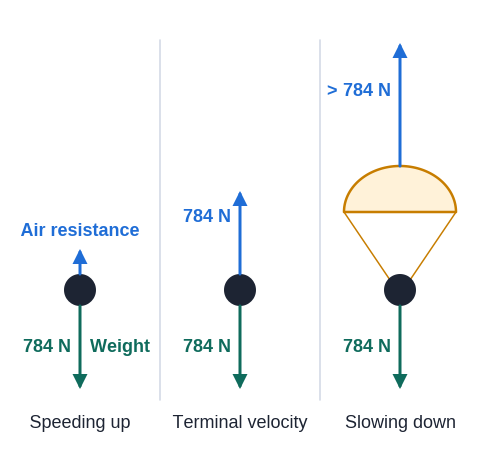
- An 80 kg skydiver has a weight of 80 × 9.8 = 784 N (using g = 9.8 N/kg), and this stays the same all the way down.
- Just after jumping, air resistance is small, so the net force is large and downward, and the skydiver accelerates.
- As speed rises, air resistance grows, the net force shrinks and the acceleration gets smaller.
- When air resistance reaches 784 N the forces balance, the acceleration is zero and the skydiver falls at a steady top speed called terminal velocity.
- Opening the parachute makes air resistance much bigger than the weight, so the net force points up and the skydiver slows down to a new, lower terminal velocity.
| Stage | Forces | Motion |
|---|---|---|
| Just after jumping | Weight much bigger than air resistance | Speeding up quickly |
| Falling faster | Air resistance growing, net force shrinking | Still speeding up, but less each second |
| Terminal velocity | Air resistance equals weight | Steady speed |
| Parachute opens | Air resistance bigger than weight | Slowing down |
| New terminal velocity | Balanced again at a lower speed | Steady, slow speed |
Try it: pairs, tackles and skydives
Investigating air resistance with paper parachutes
- Change one thing: the area of the parachute canopy.
- Measure the time to fall 2.0 m, repeated three times for each canopy, and take the mean.
- Keep the same: the load (mass) hanging under the canopy, the drop height, the canopy material, the string length and an indoor space with no draughts.
- If a bigger canopy gives a longer fall time, that shows a bigger area produces more air resistance at a given speed, so the terminal velocity is lower.
- Hand timing a short fall is the biggest source of error, so drop from as high as is safe and repeat.
Example: drawing a conclusion from the parachute data
- A class dropped the same 10 g load from 2.0 m under canopies of different area.
- Each time is the mean of three trials.
| Canopy area (cm²) | Mean fall time (s) |
|---|---|
| 0 (no canopy) | 0.7 |
| 100 | 1.1 |
| 200 | 1.5 |
| 400 | 2.1 |
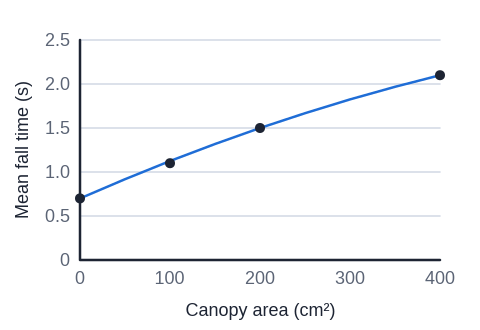
- as area goes up, fall time goes upthe trend in every row
- 400 cm² is 4 times 100 cm², but 2.1 s is not 4 times 1.1 sthe pattern is not proportional
- same weight every time, so the difference is air resistanceload was controlled
- bigger canopy: more air resistance, lower terminal velocity, longer fall
Common mistakes
- If something is moving, there must be a net force pushing it forward.An object moving at a steady velocity has zero net force on it; a net force changes the velocity, it is not needed to keep it.
- The trolley has a 100 N push, so a = 100 ÷ 40 = 2.5 m/s².F = ma uses the net force, so take away the friction first: (100 − 20) ÷ 40 = 2 m/s².
- Action and reaction forces cancel out, so nothing can accelerate.The two forces in a pair act on different objects, so they never cancel; only forces on the same object combine into a net force.
- In a tackle, the heavier player pushes harder on the lighter one.The forces on the two players are equal and opposite; the lighter player is thrown back more because the same force on less mass gives more acceleration.
Flick the card, keep the coin
You need: a plastic cup, a playing card or postcard, a $1 or $2 coin
- Lay the card flat across the top of the cup and put the coin in the middle of the card, over the opening.
- Push the card slowly sideways with one finger and see where the coin goes.
- Set it up again, then flick the edge of the card hard and fast sideways with your finger.
- Repeat the slow push and the fast flick a few times each.
- Look for: pushed slowly, the coin rides along with the card because friction has time to speed it up; flicked fast, the card shoots away and the coin drops straight into the cup, because its inertia keeps it where it was and the friction acts for too short a time to move it far.
Safety: A flicked card or coin can fly off the table, so flick sideways away from anyone's face, and use a plastic cup so nothing breaks if it tips.
Your turn
A 1200 kg car has a net forward force of 3600 N on it. What is its acceleration?
A cyclist and bike have a total mass of 80 kg and accelerate at 1.5 m/s². What net force is acting?
A 2 kg trolley is pulled with 10 N while friction acts against it with 4 N. Find the net force and the acceleration.
A swimmer pushes on the pool wall with 300 N. What force does the wall put on the swimmer, and why does the wall not move noticeably?
A ball bearing is dropped into a tall tube of cooking oil. Its speed rises at first, then stays steady. Explain this using forces.
A car goes round a roundabout at a steady 30 km/h. Is it accelerating?
An Auckland train pulls out of a station from rest and reaches 12 m/s in 20 s. What is its average acceleration?
A 10 g load fell 2.0 m in 1.1 s under a 100 cm² canopy and in 2.1 s under a 400 cm² canopy. Which conclusion fits?
Show answer
1. a = F ÷ m = 3600 ÷ 1200 = 3 m/s². 2. F = ma = 80 × 1.5 = 120 N. 3. Net force = 10 − 4 = 6 N, so a = 6 ÷ 2 = 3 m/s² in the direction of the pull. 4. 300 N pushing the swimmer away from the wall (the reaction force); the wall is fixed to the ground and the whole Earth, so its mass is huge and its acceleration is too small to notice. 5. Weight pulls the ball down; the oil pushes up with drag (and a small buoyant force). Drag grows with speed until the upward forces equal the weight, the net force is zero and the ball falls at a steady terminal velocity. 6. Yes. Velocity is speed in a direction, and the car's direction keeps changing, so its velocity changes and it is accelerating. 7. a = change in velocity ÷ time = (12 − 0) ÷ 20 = 0.6 m/s². 8. The bigger canopy gives more air resistance with the same weight, so it falls more slowly. The time is not proportional to the area, since 2.1 s is not 4 times 1.1 s.
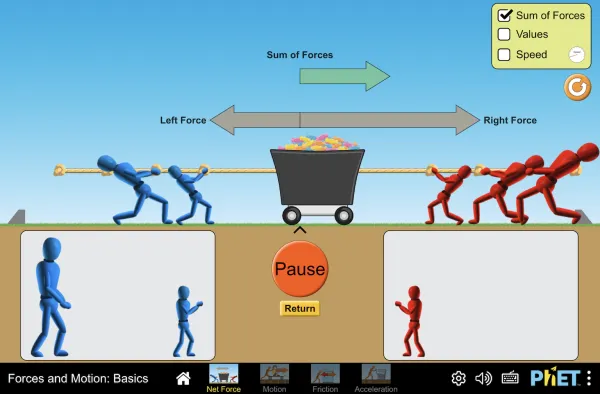
Forces and Motion: Basics
Full screen · PhET Interactive Simulations, University of Colorado Boulder, CC BY 4.0
Recap
- Acceleration is change in velocity ÷ time, in m/s², and turning counts as accelerating.
- F = ma links net force, mass and acceleration; always use the net force.
- More mass means more inertia, so the same force gives less acceleration.
- Every force has a partner that is equal, opposite and acting on the other object.
- Air resistance grows with speed until it balances weight, giving terminal velocity.
| Idea | Key fact |
|---|---|
| Acceleration | a = change in velocity ÷ time, in m/s² |
| Newton's second law | F = ma (N = kg × m/s²) |
| Inertia | Resistance to change in motion, set by mass |
| Force pairs | Equal size, opposite direction, different objects |
| Terminal velocity | Drag equals weight, so a = 0 |
Challenge
A 1200 kg ute tows a 600 kg trailer along a flat road out of Taupō. Both speed up together at 1.5 m s⁻². Friction and air resistance act backwards with 300 N on the trailer and 500 N on the ute. (a) Find the force the tow bar puts on the trailer. (b) What force does the trailer put on the ute, and in which direction? (c) Find the forward driving force the road must give the ute. (d) A passenger says: the trailer pulls back on the ute exactly as hard as the ute pulls the trailer forward, so they cancel and nothing should move. Explain the mistake.
Hint
Look at the trailer on its own first: its net force is its mass times the acceleration, and the tow bar must also beat the trailer's friction. Then use the force pair at the tow bar.
Answer
(a) 1200 N forward. (b) 1200 N backwards on the ute (the reaction force). (c) 3500 N forward. (d) The two tow bar forces act on different objects, so they never cancel; each object accelerates because of the net force on it alone, and on the ute the road's 3500 N forward is bigger than the 1700 N backwards.
Step by step
- The trailer's net force is 600 × 1.5, and the tow bar has to supply that plus enough to cancel its 300 N friction.
- Action and reaction: the trailer pulls the ute backwards with the same size force.
- On the ute, the forward driving force must beat the trailer's pull and its own 500 N friction, and still leave 1200 × 1.5 as net force.
- Forces only combine into a net force when they act on the same object.
Full working
- Trailer net force = 600 × 1.5 = 900 NF = ma
- Tow bar force = 900 + 300 = 1200 N forwardnet force plus friction
- Force on ute from trailer = 1200 N backwardsaction and reaction pair
- Ute net force = 1200 × 1.5 = 1800 NF = ma
- Driving force = 1800 + 1200 + 500 = 3500 Nnet force plus all backward forces
- Check: 3500 − 1200 − 500 = 1800 = 1200 × 1.5net force on ute
- (a) 1200 N (b) 1200 N backwards (c) 3500 N
A 1500 kg car is travelling at 25 m s⁻¹ when the driver brakes hard and the car stops at a steady rate in 5.0 s. (a) Find the deceleration and the braking force. (b) A 60 kg passenger slows down with the car. What force must the seatbelt supply, and what would happen to the passenger without it? (c) Next week the same car carries an extra 500 kg of firewood, and the brakes give the same force. How long does it now take to stop from 25 m s⁻¹? (d) When the speed drops at a steady rate, the average speed is halfway between the start and end speeds. Use this to find how much further the loaded car travels while braking.
Hint
a = change in velocity ÷ time, then F = ma. With the load, the force is the same but the mass is bigger. Distance = average speed × time.
Answer
(a) 5 m s⁻² and 7500 N. (b) 300 N backwards; without it the passenger keeps moving forward at 25 m s⁻¹ because of inertia and hits the dashboard or windscreen. (c) About 6.7 s. (d) 62.5 m empty against about 83.3 m loaded, so about 20.8 m further.
Step by step
- The car loses 25 m s⁻¹ in 5 s, which gives the deceleration.
- Multiply mass by deceleration for each force, car and passenger.
- With 2000 kg and the same 7500 N, the deceleration is smaller, so stopping takes longer.
- The average speed while braking is 12.5 m s⁻¹ both times, so the distance depends only on the time.
- More mass means more inertia, so the same brakes need a longer distance.
Full working
- a = (25 − 0) ÷ 5.0 = 5 m s⁻²change in velocity ÷ time
- F = 1500 × 5 = 7500 NF = ma
- Seatbelt: 60 × 5 = 300 Nthe passenger must slow at the same rate
- Loaded: a = 7500 ÷ 2000 = 3.75 m s⁻²same force, more mass
- t = 25 ÷ 3.75 ≈ 6.7 stime to lose 25 m s⁻¹
- Average speed = (25 + 0) ÷ 2 = 12.5 m s⁻¹steady slowing
- Empty: 12.5 × 5.0 = 62.5 m; loaded: 12.5 × 6.67 ≈ 83.3 mdistance = average speed × time
- The loaded car needs about 20.8 m more to stop
A hot air balloon with its basket, crew and sandbags has a total mass of 540 kg and is hovering, not moving, above the Waikato. Use g = 9.8 N per kg. The crew drop one 50 kg sandbag over the side, and at that instant the upward lift from the hot air does not change. (a) Find the balloon's acceleration just after the sandbag is let go. (b) The balloon rises faster and faster at first, but after a while it rises at a steady speed, even though the lift has not changed. Explain why. (c) Starting again from hovering at 540 kg, what mass of sand should they drop to get an acceleration of exactly 0.7 m s⁻²? (d) One crew member says throwing the sandbag hard downwards would give the balloon a bigger upward push at that moment than just letting it fall. Is she right? Explain using force pairs.
Hint
Hovering means the lift equals the weight. Dropping sand removes weight but leaves the lift, so the net force is the weight of the dropped sand, acting on the mass that is left. For (c), let the mass dropped be x kg.
Answer
(a) 1.0 m s⁻² upwards. (b) As the balloon speeds up, air resistance acting downwards on it grows, the net force shrinks, and when air resistance equals the 490 N spare lift the net force is zero, so it rises at a steady (terminal) speed. (c) 36 kg. (d) Yes: to throw the bag down she pushes down on it, so the bag pushes up on her, and so on the balloon, with an equal force, an extra upward push while she is throwing.
Step by step
- Hovering is balanced: lift = 540 × 9.8 N.
- After the drop, the weight falls by 50 × 9.8 = 490 N while the lift stays the same, so the net upward force is 490 N.
- That net force acts on the 490 kg that is left, so a = F ÷ m.
- For (c), the net force is 9.8x and the mass left is 540 − x; set 9.8x ÷ (540 − x) = 0.7 and solve.
- Throwing the bag is an interaction: the bag pushes back on the thrower with an equal and opposite force.
Full working
- Lift = 540 × 9.8 = 5292 Nhovering, so lift equals weight
- New weight = 490 × 9.8 = 4802 N50 kg dropped
- Net force = 5292 − 4802 = 490 N upwardslift minus weight
- a = 490 ÷ 490 = 1.0 m s⁻²a = F ÷ m
- 9.8x = 0.7 × (540 − x)net force = mass left × acceleration
- 9.8x + 0.7x = 378, so 10.5x = 378collect the x terms
- x = 378 ÷ 10.5 = 36 kgcheck: 9.8 × 36 ÷ 504 = 0.7
- (a) 1.0 m s⁻² up (c) drop 36 kg
The maths behind it
Report a mistake
How is Year 10 maths going?
See the Year 10 maths guide