Scale factors, and converting area and volume
What this lesson covers
- The general formula for the volume of a prism is V = Al, where A is the consistent cross-sectional area and l is perpendicular to the plane of the cross-sectional area.
- Resizing (enlarging or reducing) a shape changes its perimeter, area, or volume proportionally according to the dimensions of the units; linear metric conversions must be squared to convert area and cubed to convert volume.
Double a shape and the area does not double
- Make every length twice as long. Sounds like everything doubles.
- The perimeter does. The area goes up four times.
- And the volume goes up eight. That is the whole lesson.
Watch it happen
- A rectangle two by three. Perimeter ten, area six.
- Double both sides: four by six. Perimeter twenty.
- But the area is twenty-four. Four times, not two.
| Shape | Perimeter | Area |
|---|---|---|
| Rectangle 2 by 3 | perimeter 10 | area 6 |
| Double every length | now 4 by 6 | |
| Perimeter | 20 | doubled |
| Area | 24 | four times |
Try it: scale it by k
Why four and not two
- Area is length times width, and both of them doubled.
- So the area was multiplied by two, and then by two again.
- Perimeter only adds up lengths, so it only doubles.
| Measurement | What happens |
|---|---|
| Area is length × width | both of them doubled |
| So area gets × 2 × 2 | which is × 4 |
| Perimeter is only lengths | so it just doubles |
| The dimensions decide | how the factor is used |
And in three dimensions
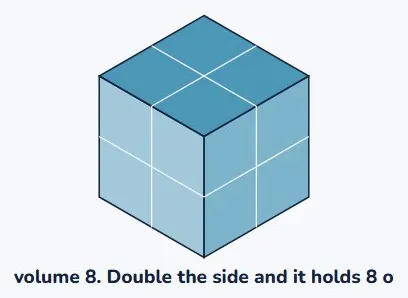
- A cube of side two has a volume of eight.
- Double the side to four and the volume is sixty-four.
- Eight times bigger, because three lengths all doubled.
The rule, in one line
- Scale every length by k.
- Areas are multiplied by k squared.
- Volumes are multiplied by k cubed. One line, every question.
| Measurement | Scales by |
|---|---|
| Lengths | × k |
| Areas | × k² |
| Volumes | × k³ |
| Going back | a k² on area means k on length |
Going the other way
- An area is nine times bigger. What happened to the lengths?
- k squared is nine, so k is three. They tripled.
- That backwards direction is what gets asked in exams.
| Given | Working | Answer |
|---|---|---|
| Area is 9 times bigger | so k² = 9 | k = 3 |
| Lengths tripled | and volume | × 27 |
| Volume is 8 times | so k³ = 8 | k = 2 |
| Undo the power | to get the length factor |
Which explains a conversion everyone gets wrong
- A metre is a hundred centimetres, so k is a hundred.
- A square metre is therefore a hundred squared square centimetres.
- Ten thousand. Not a hundred, which is the usual answer.
| Step | Working | Result |
|---|---|---|
| 1 m is 100 cm | so k = 100 | |
| 1 m² is | 100 × 100 | 10 000 cm² |
| Not 100 cm² | that is the common error | |
| Square the conversion | for a squared unit |
And a cubic metre
- Same idea, cubed: a hundred times a hundred times a hundred.
- A million cubic centimetres in one cubic metre.
- So 2.5 square metres is twenty-five thousand square centimetres.
| Conversion | Working | Result |
|---|---|---|
| 1 m³ | 100 × 100 × 100 | 1 000 000 cm³ |
| 2.5 m² | 2.5 × 10 000 | 25 000 cm² |
| 3 m² | 3 × 10 000 | 30 000 cm² |
| Cube it | for a cubic unit |
Try it: a cubic metre
That is not a new rule
- It is the k squared rule with k equal to a hundred.
- Squared units square the conversion. Cubic units cube it.
- One idea, whether it is a model boat or a metre.
Surface area of a triangular prism
- Two triangular ends, and three rectangles around the sides.
- The ends are twelve each. The sides are the perimeter times the length.
- Sixteen around, times ten long, is a hundred and sixty.
| Part | Working | Area |
|---|---|---|
| Triangle, base 6, height 4 | area | 12 cm² |
| Two ends | 2 × 12 | 24 |
| Sides: perimeter 16 | × length 10 | 160 |
| Surface area | 24 + 160 | 184 cm² |
The shortcut hiding in that
- All the side faces together are one long rectangle.
- Its width is the perimeter of the end, its length is the prism’s.
- So any prism: two ends, plus perimeter times length.
Volume when the shape is awkward
- A prism is anything with the same cross-section throughout.
- So the volume is that area times the length, whatever the shape.
- Thirty-five square centimetres, twelve long, is 420 cubic centimetres.
| Rule | Detail | Result |
|---|---|---|
| V = Al | cross-section × length | |
| Cross-section 35 cm² | length 12 cm | 420 cm³ |
| The shape | does not matter | |
| Only that it | stays the same along |
And a cylinder is one of those
- Its cross-section is a circle, so the area is π r squared.
- Radius four gives sixteen π, times a height of seven.
- A hundred and twelve π, about 352 cubic centimetres.
| Step | Working | Result |
|---|---|---|
| Cross-section | a circle, πr² | |
| r = 4 | 16π | |
| Times the height 7 | 112π | |
| Which is | 352 cm³ | to 3 figures |
Try it: wrap and fill a prism
What to take away
- Seven lines, and the first one explains the next four.
| Scale lengths by k | areas go × k², volumes × k³ |
| Perimeter | scales like a length |
| Working backwards | undo the power |
| 1 m² = 10 000 cm² | because 100 squared |
| 1 m³ = 1 000 000 cm³ | because 100 cubed |
| Surface area of a prism | two ends plus the sides |
| Volume of any prism | cross-section × length |
Common mistakes
- 1 m² = 100 cm², so 3 m² = 300 cm²Square the conversion for a squared unit: 1 m² = 100 × 100 = 10 000 cm², so 3 m² = 30 000 cm².
- A 1:50 model is 8 cm², so the real area is 8 × 50 = 400 cm².Areas scale by k² = 50² = 2 500, so the real area is 8 × 2 500 = 20 000 cm², which is 2 m².
- Double every length of a rectangle and its area doubles.Length and width both double, so the area is × 2 × 2 = × 4; only the perimeter doubles.
- The area is 9 times bigger, so the lengths are 9 times longer.k² = 9, so k = 3: the lengths tripled, and the volume would be × 27.
Your turn: eight questions
- Work all eight out.
- Question 2 needs the conversion squared.
- Question 4 is the one this lesson was built for.
A shape’s sides are tripled. The area?
Convert 3 m² to square centimetres.
Volume of a cylinder, r 4, h 7, to 3 s.f.
A 1:50 model is 8 cm². The real area?
Every length of a shape is multiplied by 5. What happens to its perimeter?
Two jugs are the same shape, and the bigger one is 4 times as tall. How many times the volume does it hold?
A photo is enlarged so its area is 25 times bigger. What were its lengths multiplied by?
A triangular prism is 10 cm long. Each end is a triangle with sides 3, 4 and 5 cm and area 6 cm². Its surface area?
Show answer
1. Nine times bigger. Tripling the lengths means k is 3, and area goes up by k squared, which is 9. 2. 30 000 cm². One square metre is 10 000 square centimetres, because the conversion of 100 has to be squared. 3. 112π, which is 352 cubic centimetres to three figures. The cross-section is 16π, and the height is 7. 4. 20 000 cm², which is 2 square metres. The lengths scale by 50, so the areas scale by 50 squared, which is 2 500. Multiplying by 50 instead of 2 500 is the mistake this whole lesson exists to prevent. 5. 5 times bigger. Perimeter only adds up lengths, so it scales by k = 5, not k². 6. 64 times. Volumes scale by k³, and 4³ = 4 × 4 × 4 = 64. 7. × 5. Area scales by k², so k² = 25 and k = 5. Undo the power to get the length factor. 8. 132 cm². Two ends are 2 × 6 = 12, the sides are perimeter 12 × length 10 = 120, and 12 + 120 = 132.
The answers
- Nine times, because three squared is nine.
- Thirty thousand square centimetres.
- A hundred and twelve π, about 352 cubic centimetres.
- Twenty thousand square centimetres, which is two square metres.
Challenge
A cube has a surface area of 150 cm². It is enlarged so that its surface area becomes 384 cm². (a) By what scale factor were its edges multiplied? (b) By what factor was its volume multiplied? (c) Check your answer by finding both volumes.
Hint
Surface area is an area, so it scales by k². Find k² from the two surface areas, then undo the square.
Answer
(a) 1.6 (b) 4.096 (c) 125 cm³ becomes 512 cm³
Step by step
- Areas scale by k², so k² = 384 ÷ 150 = 2.56.
- k = √2.56 = 1.6, so every edge is 1.6 times longer.
- Volumes scale by k³ = 1.6³ = 4.096.
- Check: the first cube has 6 faces of 25 cm², so its edge is 5 cm and its volume 125 cm³.
- The new edge is 5 × 1.6 = 8 cm, volume 512 cm³, and 512 ÷ 125 = 4.096.
Full working
- k² = 384 ÷ 150 = 2.56areas scale by k²
- k = √2.56 = 1.6undo the square
- k³ = 1.6³ = 4.096volumes scale by k³
- 150 ÷ 6 = 25, edge 5, volume 125first cube
- 384 ÷ 6 = 64, edge 8, volume 512512 ÷ 125 = 4.096
- (a) 1.6 (b) 4.096
Two bronze statues of a kererū are exactly the same shape. The small one has a surface area of 450 cm² and the large one has a surface area of 1250 cm². The small statue has a mass of 2.7 kg. What is the mass of the large statue?
Hint
Mass follows volume, because both are solid bronze. So go from the area factor back to the length factor, then forward to the volume factor.
Answer
12.5 kg
Step by step
- Area factor = 1250 ÷ 450 = 259.
- Areas scale by k², so k² = 259 and k = 53.
- Volumes scale by k³ = 12527.
- Same material, so the mass scales the same way as the volume.
- 2.7 × 12527 = 12.5 kg.
Full working
- 1250 ÷ 450 = 259area factor
- k = √(259) = 53length factor
- k³ = (53)³ = 12527volume factor
- 2.7 × 12527 = 0.1 × 1252.7 ÷ 27 = 0.1
- 12.5 kg
A model of a fishing boat is built at a scale of 1 : 50. Painting the model's hull takes 6 mL of paint. When the model floats, it pushes aside 1.2 litres of water. Assuming the real boat is painted with the same thickness of paint and floats at the same level, find (a) how many litres of paint the real hull needs, and (b) how much water the real boat pushes aside, in cubic metres. (1 m³ = 1000 litres.)
Hint
Paint covers an area, so it scales like an area. The water pushed aside is a volume, so it scales like a volume. What is k here?
Answer
(a) 15 litres (b) 150 m³
Step by step
- Every real length is 50 times the model's, so k = 50.
- Paint covers the hull's surface, an area, so it scales by k² = 2500.
- 6 mL × 2500 = 15 000 mL, which is 15 litres.
- The water pushed aside is a volume, so it scales by k³ = 125 000.
- 1.2 L × 125 000 = 150 000 L, and 150 000 ÷ 1000 = 150 m³.
Full working
- k = 501 : 50 scale
- k² = 2500, k³ = 125 000area and volume factors
- 6 × 2500 = 15 000 mL = 15 Lpaint scales like area
- 1.2 × 125 000 = 150 000 Lwater scales like volume
- 150 000 ÷ 1000 = 150 m³1 m³ = 1000 L
- (a) 15 litres (b) 150 m³
Practise this
Report a mistake
More in Measurement
Is your child on track?
Take the free placement test