Precision: your answer inherits its worst measurement
What this lesson covers
- A solution to a calculation cannot be more precise than the least precise number used in that calculation.
A calculator cannot measure anything
- It will happily give you eleven point five five square metres.
- But it never saw the room. You did, with a tape.
- An answer cannot be more precise than what went into it.
Precision comes from the equipment
- Pace out a room and you know it to the nearest metre.
- Use a tape and you know it to the nearest ten centimetres.
- How many digits you may write is decided before you write any.
| Method | Good to | You may write |
|---|---|---|
| Pacing it out | nearest metre | 4 m |
| A tape measure | nearest 10 cm | 4.2 m |
| A good steel tape | nearest cm | 4.20 m |
| The tool decides | how many figures | you may write |
One room, measured and multiplied
- Four point two metres by two point seven five metres.
- The calculator says eleven point five five square metres.
- One of those measurements has only two figures in it.
| Step | Working | Result |
|---|---|---|
| Measured | 4.2 m by 2.75 m | |
| Calculator says | 4.2 × 2.75 | 11.55 |
| Figures in | 2 and 3 | |
| So the answer gets | 2 figures | 12 m² |
The rule, in one line
- The answer takes the figures of the least precise input.
- Two figures went in, so two figures come out.
- Twelve square metres. Not eleven point five five.
What four point two actually claims
- It says the wall is nearer to 4.2 than to 4.1 or 4.3.
- So the real length is somewhere from 4.15 to 4.25.
- A measurement is a range. It was never a single value.
| Written | Meaning | Range |
|---|---|---|
| Written 4.2 | rounded to 1 decimal place | |
| So it could be | anything from 4.15 | up to 4.25 |
| Same for 2.75 | 2.745 to 2.755 | |
| A measurement | is a range | not a point |
So how big could the room be?
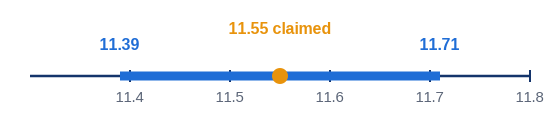
- Smallest: 4.15 times 2.745, which is 11.39.
- Largest: 4.25 times 2.755, which is 11.71.
- The second decimal place of 11.55 is not shaky. It is unknown.
| Case | Working | Area |
|---|---|---|
| Smallest possible | 4.15 × 2.745 | 11.39 |
| Largest possible | 4.25 × 2.755 | 11.71 |
| So the area is | between those | |
| 11.55 claims | a hundredth | we never measured |
Try it: how big could it be?
Adding follows a different rule
- Multiplying and dividing carry significant figures through.
- Adding and subtracting carry decimal places instead.
- 12.5 plus 3.25 is 15.75, and you write 15.8.
| Operation | Match the fewest |
|---|---|
| Multiplying or dividing | match the fewest significant figures |
| Adding or subtracting | match the fewest decimal places |
| 12.5 + 3.25 = 15.75 | but 12.5 knew no hundredths |
| So write | 15.8 |
Do not round in the middle
- 24.7 divided by 3 is 8.233 and running.
- Round it to 8.2 now, times by 3, and you get 24.6.
- Keep the extra figures and you get your 24.7 back.
| Working | Doing | Ends at |
|---|---|---|
| 24.7 ÷ 3 | is 8.233… | |
| Round now to 8.2 | then × 3 | 24.6 |
| Keep 8.233 | then × 3 | 24.7 |
| Carry one spare figure | round at the end |
The same number, two answers
- 2.346 to one decimal place is 2.3.
- But to two places first it is 2.35, and then it becomes 2.4.
- One number, two answers, because it was rounded twice.
| Route | Step | Answer |
|---|---|---|
| 2.346 to 1 d.p. | straight there | 2.3 |
| 2.346 to 2 d.p. | first | 2.35 |
| Then to 1 d.p. | rounds up again | 2.4 |
| Two different answers | so round once | at the end |
Try it: round once, at the end
Four point two zero is not four point two
- The extra zero says you measured to the nearest centimetre.
- It is a claim about your equipment, not a tidier way to write it.
- So never add a zero you did not earn.
| Written | Claims | Figures |
|---|---|---|
| 4.2 m | nearest 10 cm | 2 figures |
| 4.20 m | nearest cm | 3 figures |
| Same length | different equipment | |
| Do not add zeros | you did not measure |
Try it: cut the calculator display
Estimate the measurement too
- A door is about two metres. A step is about thirty centimetres.
- Those let you check a measurement before you trust it.
- A room that comes out at forty metres long is a misread tape.
How precise does the job need?
- A shelf in an alcove needs millimetres or it will not go in.
- Paint gets bought in whole tins, so litres are enough.
- Ask what the number is for before deciding how to round it.
| Job | Precision | Because |
|---|---|---|
| Concrete for a slab | nearest 0.1 m³ | order extra |
| A shelf in an alcove | nearest mm | or it jams |
| Paint for a wall | nearest litre | tins are whole |
| Ask what it is for | then choose |
Writing fewer digits is not being lazy
- Twelve square metres looks less impressive than 11.55.
- It is the more careful answer, not the less careful one.
- Extra digits are a claim about knowledge you do not have.
What to take away
- Seven lines, and the last one is the habit.
| A measurement is a range | not an exact value |
| The instrument decides | how many figures you may write |
| Multiplying | match the fewest significant figures |
| Adding | match the fewest decimal places |
| Round once | at the very end |
| 4.20 is not 4.2 | the zero is a claim |
| The calculator display | is not the answer |
Common mistakes
- 4.2 m × 2.75 m = 11.55 m²4.2 has only 2 significant figures, so the answer gets 2 as well: 12 m².
- 15.2 g + 3.45 g = 18.65 gAdding follows decimal places: 15.2 knew no hundredths, so the answer gets 1 decimal place, 18.7 g.
- 3.748 → 3.75 → 3.8 to 2 significant figuresRound once from the original number: 3.748 to 2 significant figures is 3.7.
- 4.2 m and 4.20 m are the same, the zero just looks tidier.4.20 m claims you measured to the nearest centimetre; never add a zero you did not measure.
Your turn: eight questions
- Work all eight.
- Question 2 is an addition, so it follows the other rule.
- Question 4 is asking you to round only once.
Area of 3.5 m by 1.24 m, properly rounded.
Add 15.2 g and 3.45 g, properly rounded.
Why is 4.20 m not the same as 4.2 m?
Round 3.748 to 2 significant figures.
Which of these measurements must be a misreading of the tape?
A plank's length is written as 2.6 m, rounded to 1 decimal place. What range could its real length be in?
Which statement about rounding partway through a calculation is true?
A square tile's side is measured as 3.0 cm, to 1 decimal place. What is the smallest its area could be?
Show answer
1. 4.3 square metres. The calculator gives 4.34, but 3.5 carries only two significant figures, so the answer gets two. 2. 18.7 grams. This is an addition, so the rule is decimal places, not significant figures: 15.2 is given to one decimal place, so the answer is too. 3. Because 4.20 says the length was measured to the nearest centimetre and 4.2 says only to the nearest ten centimetres. Same length, different claim about the equipment. 4. 3.7. If you round to two decimal places first you get 3.75, and rounding that again gives 3.8, which is wrong. Round once, from the original number. 5. A door 21 m tall. A door is about 2 m, so 21 m cannot be right; the others are all sensible sizes. 6. From 2.55 m to 2.65 m. 2.6 means nearer to 2.6 than to 2.5 or 2.7, so it is within half of 0.1 either side. 7. Rounding partway can change the final answer. 24.7 ÷ 3 rounded to 8.2 and then × 3 gives 24.6, not 24.7. 8. 8.7025 cm². The side could be as short as 2.95 cm, and 2.95 × 2.95 = 8.7025.
The answers
- 4.34 rounds to 4.3 square metres, because 3.5 has two figures.
- 18.65 rounds to 18.7 grams, on decimal places.
- The zero claims the nearest centimetre.
- 3.7. Going through 3.75 would give you 3.8, and that is wrong.
Challenge
Ana takes a number with three or more decimal places and rounds it straight to 1 decimal place: she gets 3.4. Tama takes the same number, rounds it to 2 decimal places first, then rounds that answer to 1 decimal place: he gets 3.5. Find every number they could have started with. (Use the usual rule: a 5 rounds up.)
Hint
Work backwards from each result. What range of numbers rounds straight to 3.4? What 2 decimal place answer must Tama have had to then get 3.5?
Answer
Any number from 3.445 up to (but not including) 3.45
Step by step
- Rounding straight to 3.4 means the number is at least 3.35 and less than 3.45.
- Tama's first answer had 2 decimal places and then rounded to 3.5, so it was at least 3.45. The only one also near 3.4 is 3.45 itself.
- A number rounds to 3.45 (2 decimal places) when it is at least 3.445 and less than 3.455.
- Both things must be true, so the number is at least 3.445 and less than 3.45.
- This is exactly the trap from the lesson: rounding twice pushed it up.
Full working
- straight to 1 d.p. gives 3.4so 3.35 ≤ x < 3.45
- Tama's 2 d.p. value is from 3.35 to 3.45 and rounds up to 3.5so it must be 3.45
- x rounds to 3.45so 3.445 ≤ x < 3.455
- overlap of both ranges3.445 ≤ x < 3.45
- 3.445 ≤ x < 3.45
A fridge is 0.60 m wide, measured to the nearest centimetre. Hemi paced out the gap for it in the kitchen and wrote 0.6 m, to the nearest 10 cm. He says: "0.6 − 0.60 = 0, so it fits exactly." Find the largest and smallest possible clearance (gap width minus fridge width) in centimetres, and explain what this tells Hemi.
Hint
Each measurement is a range. For the biggest possible clearance, take the biggest gap and the smallest fridge. For the smallest, do the opposite.
Answer
Clearance is between −5.5 cm and +5.5 cm, so Hemi cannot tell whether the fridge fits
Step by step
- 0.6 m to the nearest 10 cm means the gap is somewhere from 0.55 m to 0.65 m.
- 0.60 m to the nearest cm means the fridge is somewhere from 0.595 m to 0.605 m.
- Biggest clearance: widest gap take the narrowest fridge, 0.65 − 0.595 = 0.055 m.
- Smallest clearance: narrowest gap take the widest fridge, 0.55 − 0.605 = −0.055 m, which means the fridge is too wide.
- The answer 0 is meaningless: the gap needs measuring to the nearest centimetre (or better) before buying.
Full working
- gap: 0.55 ≤ g < 0.650.6 to the nearest 0.1 m
- fridge: 0.595 ≤ f < 0.6050.60 to the nearest 0.01 m
- largest clearance = 0.65 − 0.595 = 0.055 mbig gap, small fridge
- smallest clearance = 0.55 − 0.605 = −0.055 msmall gap, big fridge
- −5.5 cm to +5.5 cm, so it may or may not fit
A square courtyard has an area of 50 m², correct to the nearest square metre. A fence will run all the way round it. Find the shortest and longest the fence could be, to 2 decimal places, then give the fence length to the greatest number of significant figures you can honestly claim.
Hint
Start with the smallest and largest the area could be. The side of a square is the square root of its area, and the fence is four sides.
Answer
From 28.14 m to 28.43 m, so the fence is 28 m (2 significant figures)
Step by step
- 50 m² to the nearest square metre means the area is from 49.5 m² up to 50.5 m².
- The side is the square root of the area, so it is from √49.5 to √50.5, about 7.0356 m to 7.1063 m.
- The fence is 4 sides: from about 28.14 m to 28.43 m.
- To 3 significant figures these are 28.1 and 28.4, which disagree, so 3 figures would claim more than we know.
- To 2 significant figures both are 28, so 28 m is the honest answer.
Full working
- 49.5 ≤ A < 50.5nearest square metre
- √49.5 = 7.0356..., √50.5 = 7.1063...side of the square
- 4 × 7.0356... = 28.14 mshortest fence
- 4 × 7.1063... = 28.43 mlongest fence
- 3 s.f.: 28.1 and 28.4 differ; 2 s.f.: both 28keep only the figures both agree on
- 28.14 m to 28.43 m, so 28 m
Report a mistake
More in Measurement
Is your child on track?
Take the free placement test