Ratios you can scale, and rates that carry units
What this lesson covers
- Ratios can be scaled up or down or simplified.
- A rate proportionally compares two quantities that have different units of measure; when working with rates, ‘per’ means ‘for every’ in day-to-day contexts.
Two ideas that look alike and are not
- Ratios and rates are both written as one thing against another.
- One of them carries units. The other does not.
- Knowing which is which is most of this lesson.
A ratio is a recipe, not a pair of amounts
- 3:2 does not mean three of this and two of that.
- It means three for every two. At any size at all.
- Six and four is the same recipe. So is thirty and twenty.
One relationship, four ways to write it
- Divide both sides by the same number and you simplify.
- Multiply both sides by the same number and you scale up.
- It is one move. The direction is the only difference.
| Ratio | What was done | Note |
|---|---|---|
| 30:20 | divide both by 10 | |
| 6:4 | divide both by 2 | |
| 3:2 | simplest form | no common factor left |
| 12:8 | multiply both by 4 | still the same recipe |
Simplest form: nothing left to divide by
- Find what both numbers share and take it out.
- 12 and 18 both divide by 6, giving 2:3.
- Simplest form means there is no common factor left.
| Ratio | What divides both | Simplest |
|---|---|---|
| 12:18 | both divide by 6 | 2:3 |
| 25:15 | both divide by 5 | 5:3 |
| 30:20 | both divide by 10 | 3:2 |
Now the question ratios exist for
- Share sixty dollars between two people in the ratio 3:2.
- Do not start by dividing sixty by anything.
- Start by counting how many parts there are.
Count the parts, then size one part
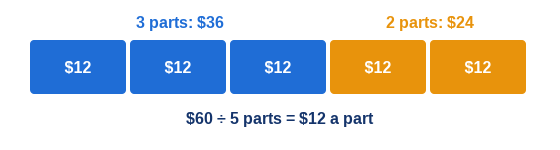
- Three parts and two parts makes five parts altogether.
- Sixty dollars over five parts, so one part is twelve dollars.
- Three parts is thirty-six, two parts is twenty-four.
| Step | Working | Result |
|---|---|---|
| Share $60 as 3:2 | first, count the parts | 3 + 2 = 5 parts |
| One part | $60 ÷ 5 | $12 |
| Three parts | 3 × $12 | $36 |
| Two parts | 2 × $12 | $24 |
| Check | 36 + 24 | $60, correct |
Try it: count the parts, then share
The same thing, seen from last lesson
- Five parts, and the first share is three of them.
- So it is three fifths of the total. Part to whole.
- Three fifths of sixty is thirty-six. It agrees.
| Step | Working | |
|---|---|---|
| 3:2 means 5 parts | so the first share is 3/5 | |
| 3/5 of $60 | 0.6 × 60 | $36 |
| 2/5 of $60 | 0.4 × 60 | $24 |
| Same answer | part-to-whole from last lesson |
The method does not care how many shares
- Concrete mixed 1:2:3, and you have twelve buckets.
- Six parts in total, so one part is two buckets.
- Two, four and six. Same method, three shares.
| Step | Working | Result |
|---|---|---|
| Concrete 1:2:3, 12 buckets | 1 + 2 + 3 | 6 parts |
| One part | 12 ÷ 6 | 2 buckets |
| The three shares | 2, 4 and 6 | adding to 12 |
Add your shares back up
- Thirty-six and twenty-four make sixty. Two, four and six make twelve.
- If they do not add to what you started with, it is wrong.
- One line, and it catches nearly every slip in this topic.
So what makes a rate different?
- A ratio compares like with like. Boys and girls. The units cancel.
- A rate compares unlike things. Kilometres and hours.
- Nothing cancels, so both units survive into the answer.
| Written | Comparing | What happens to units |
|---|---|---|
| 3:2 | boys to girls | same units, they cancel |
| 80 km/h | distance to time | different units, both stay |
| $1.30 each | money to apples | different units, both stay |
Per means for every
- 240 km in 3 hours. Divide, and you get 80 km per hour.
- Which reads: for every one hour, eighty kilometres.
- Every rate is a sentence like that.
| Situation | Working | The rate |
|---|---|---|
| 240 km in 3 hours | 240 ÷ 3 | 80 km per hour |
| $6.50 for 5 apples | 6.50 ÷ 5 | $1.30 per apple |
| 450 g for $9 | 450 ÷ 9 | 50 g per dollar |
And rates scale the same way ratios do
- Eighty kilometres for every one hour.
- So five hours is five times eighty. Four hundred kilometres.
- Half an hour is half of eighty. Forty.
| Step | Reasoning | Result |
|---|---|---|
| 80 km per hour | for every 1 hour, 80 km | |
| So in 5 hours | 5 × 80 | 400 km |
| And in half an hour | 0.5 × 80 | 40 km |
What this is actually for
- Two bottles, different sizes, different prices.
- You cannot compare them until both are per litre.
- Two twenty a litre against two thirty. The big one wins.
| Option | Working | Unit price |
|---|---|---|
| 2 L for $4.40 | 4.40 ÷ 2 | $2.20 per litre |
| 1.5 L for $3.45 | 3.45 ÷ 1.5 | $2.30 per litre |
| Better value | the larger bottle | by 10c a litre |
What to take away
- Six things, and the third one is where marks get lost.
| A ratio | is a recipe: so many for every so many |
| Simplify or scale | the same move, in two directions |
| Sharing | count the total parts first, always |
| One part | is the total divided by the number of parts |
| A rate | compares different units, so it keeps them |
| Per | means for every |
Common mistakes
- Share $60 as 3:2: 60 ÷ 3 = $20 and 60 ÷ 2 = $30.Count the parts first: 3 + 2 = 5, so one part is $12 and the shares are $36 and $24.
- 12:18 in simplest form is 6:9.6 and 9 still share a factor of 3; divide by the highest common factor, 6, to get 2:3.
- Concrete 1:2:3 with 12 buckets: 12 ÷ 3 = 4 buckets per part.Add all the parts: 1 + 2 + 3 = 6, so one part is 2 buckets, giving 2, 4 and 6.
- 80 km in 2 hours is the ratio 80:2, which is 40.Different units make it a rate, and a rate keeps its units: 80 km ÷ 2 h = 40 km/h.
Your turn
- Try all eight.
Simplify 24:36.
Share $45 in the ratio 4:5.
A car travels 180 km in 2.5 hours. What is its speed?
Scale 3:7 so the first number is 12.
Which of these is a rate, not a ratio?
Which ratio is NOT equivalent to 4:6?
Pita and Mere share lollies in the ratio 2:5. Mere gets 35. How many does Pita get?
A tap fills 12 L in 3 minutes. At that rate, how long does it take to fill 50 L?
Show answer
1. 2:3. Both parts divide by 12. 2. $20 and $25. Four plus five is nine parts, and $45 ÷ 9 is $5 a part. Check: 20 + 25 = 45. 3. 72 km per hour, from 180 ÷ 2.5. 4. 12:28. Going from 3 to 12 means multiplying by 4, so the 7 becomes 28. 5. $3 for every 2 kg of apples. It compares dollars with kilograms, different units, so both stay; the others compare like with like. 6. 6:8. 4:6 simplifies to 2:3, and so do 10:15 and 12:18, but 6:8 simplifies to 3:4. 7. 14. Mere's 5 parts are 35, so one part is 35 ÷ 5 = 7, and Pita's 2 parts are 14. 8. 12.5 minutes. The rate is 12 ÷ 3 = 4 L per minute, so 50 L takes 50 ÷ 4 = 12.5 minutes.
The answers
- Both parts of 24:36 divide by 12.
- Nine parts, so one part is five dollars.
- 3 to 12 is times four, so 7 becomes 28.
| Answer | |
|---|---|
| 1 | 2:3 |
| 2 | $20 and $25 |
| 3 | 72 km/h |
| 4 | 12:28 |
Unit Rates
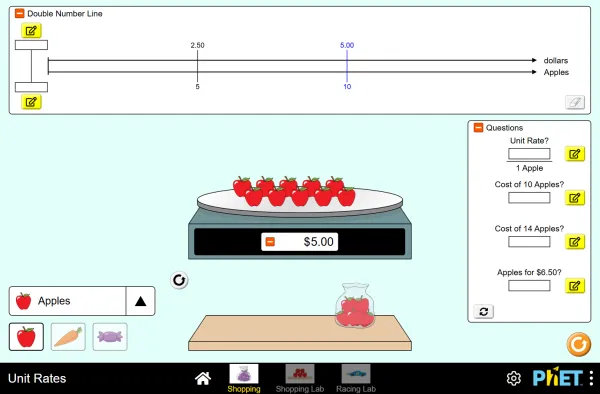
Full screen · PhET Interactive Simulations, University of Colorado Boulder, CC BY 4.0
Challenge
Aroha, Ben and Chloe share $210. The ratio of Aroha's share to Ben's share is 2 : 3, and the ratio of Ben's share to Chloe's share is 4 : 5. How much does each person get?
Hint
Ben is in both ratios, but he is 3 parts in one and 4 parts in the other. Scale both ratios so Ben has the same number of parts.
Answer
Aroha gets $48, Ben gets $72 and Chloe gets $90.
Step by step
- Ben is 3 parts in the first ratio and 4 parts in the second, so make him 12 parts in both.
- 2 : 3 scales up by 4 to 8 : 12, and 4 : 5 scales up by 3 to 12 : 15.
- So Aroha : Ben : Chloe is 8 : 12 : 15, which is 35 parts.
- One part is $210 ÷ 35 = $6.
- The shares are 8 × $6, 12 × $6 and 15 × $6, which add back to $210.
Full working
- A : B = 2 : 3 = 8 : 12multiply both by 4
- B : C = 4 : 5 = 12 : 15multiply both by 3
- A : B : C = 8 : 12 : 15Ben is 12 parts in both
- 8 + 12 + 15 = 35 partscount the parts first
- one part = 210 ÷ 35 = 6size one part
- 8 × 6 = 48, 12 × 6 = 72, 15 × 6 = 90each share
- check: 48 + 72 + 90 = 210, 48 : 72 = 2 : 3, 72 : 90 = 4 : 5add back up
- Aroha $48, Ben $72, Chloe $90
Hemi can paint a long fence on his own in 6 hours. Aroha can paint the same fence on her own in 4 hours. Hemi starts alone at 9 am. At 10 am Aroha joins him and they paint together, each at their own steady rate. (a) At what time do they finish? (b) Who painted more of the fence?
Hint
Turn each time into a rate: what fraction of the fence does each person paint per hour? Then work out how much is left at 10 am.
Answer
(a) They finish at 12 noon. (b) Neither: each painted exactly half of the fence.
Step by step
- Hemi paints 16 of the fence per hour and Aroha paints 14 of the fence per hour.
- By 10 am Hemi has painted 16, so 56 of the fence is left.
- Together they paint 16 + 14 = 512 of the fence per hour.
- 56 of the fence at 512 per hour takes 2 hours, so they finish at 12 noon.
- Hemi painted for 3 hours, which is 36 = 12. Aroha painted for 2 hours, which is 24 = 12.
Full working
- Hemi: 16 of the fence per hour1 fence in 6 hours
- Aroha: 14 of the fence per hour1 fence in 4 hours
- left at 10 am: 1 − 16 = 56Hemi worked 1 hour alone
- together: 16 + 14 = 212 + 312 = 512 per hourrates add when they work at once
- time: 56 ÷ 512 = 1012 × 125 = 2 hoursamount ÷ rate
- Hemi: 3 × 16 = 12, Aroha: 2 × 14 = 12check: 12 + 12 = 1 fence
- (a) 12 noon, (b) they each painted half
Jug A holds 500 mL of drink mixed as cordial to water 1 : 4. Jug B holds a stronger drink mixed as cordial to water 1 : 2. How many mL of jug B must be poured into jug A so that jug A becomes cordial to water 1 : 3?
Hint
Keep track of the cordial and the water separately. In jug A, how many mL of each are there? In x mL of jug B, what fraction is cordial?
Answer
300 mL of jug B. Jug A then holds 200 mL of cordial and 600 mL of water, which is 1 : 3.
Step by step
- Jug A has 5 parts, so 100 mL is cordial and 400 mL is water.
- Jug B has 3 parts, so a third of whatever you pour is cordial and two thirds is water.
- For 1 : 3, the water must be three times the cordial.
- Try amounts or set up an equation: pouring 300 mL adds 100 mL of cordial and 200 mL of water.
- That gives 200 mL of cordial and 600 mL of water, which is 1 : 3.
Full working
- jug A: 500 ÷ 5 = 100, so 100 mL cordial and 400 mL water1 : 4 is 5 parts
- x mL of jug B: x3 cordial and 2x3 water1 : 2 is 3 parts
- water = 3 × cordial: 400 + 2x3 = 3 × (100 + x3)the target ratio 1 : 3
- 400 + 2x3 = 300 + xexpand the bracket
- 100 = x3, so x = 300collect the x terms
- check: 100 + 100 = 200 cordial, 400 + 200 = 600 water, 200 : 600 = 1 : 3add back up
- 300 mL of jug B
Where science uses this
Practise this
Report a mistake
More in Number
 Scientific notation, and three names for one number8 min
 Powers of two, unit fractions, and roots on the line7 min
 Order of operations, integers, and a sensible estimate8 min
 Reciprocals, and why decimal rules are fraction rules7 min
 Percentages as multipliers, and working backwards7 minRatios you can scale, and rates that carry units7 min
 Mark-ups, discounts, GST and interest7 min
Is your child on track?
Take the free placement test