Powers of two, unit fractions, and roots on the line
What this lesson covers
- Multiplying a fraction by an equivalent form of 1, such as 3/3, results in an equivalent fraction.
- When giving a fraction as an answer, there should be a positive or negative integer in the numerator and a positive integer in the denominator.
- Numbers, including fractions, decimals, and percentages, can be represented using number lines.
Some numbers are worth knowing by heart
- Not because memorising is good for you.
- Because they are what you measure other numbers against.
- Three sets of landmarks, and then a line to put things on.
The powers of two, up to 1024
- Ten numbers. You will meet all of them this year.
- Two, four, eight, sixteen, thirty-two.
- Then sixty-four, one twenty-eight, and on to 1024.
| Power | Value | Power | Value |
|---|---|---|---|
| 2¹ | 2 | 2⁶ | 64 |
| 2² | 4 | 2⁷ | 128 |
| 2³ | 8 | 2⁸ | 256 |
| 2⁴ | 16 | 2⁹ | 512 |
| 2⁵ | 32 | 2¹⁰ | 1024 |
Try it: powers of two
You already know how to rebuild them
- Every one is the one before it, doubled.
- So forgetting 2⁸ costs you nothing. Count up from 2⁵.
- A table you can rebuild is worth more than one you memorised.
| Step | Value | Note |
|---|---|---|
| Start at | 2 | |
| Double it | 4 | that is 2² |
| Double again | 8 | that is 2³ |
| Keep going | 1024 | that is 2¹⁰ |
Where you have seen 1024 before
- A kilobyte is 1024 bytes, not 1000.
- Computers count in twos, so their round numbers are powers of two.
- That is the whole reason for the odd-looking figure.
A negative power, with the base set free
- Last year: 10⁻² is one over ten squared, which is a hundredth.
- Look at 3⁻². One over three squared. One ninth.
- Nothing in that argument was ever about ten.
| Written | Means | Value |
|---|---|---|
| 10⁻² | 1/10² | 1/100 |
| 3⁻² | 1/3² | 1/9 |
| 2⁻³ | 1/2³ | 1/8 |
| 5⁻¹ | 1/5¹ | 1/5 |
| 4⁻² | 1/4² | 1/16 |
One rule, whatever the base
- A positive power multiplies a by itself that many times.
- A negative power is one over that same thing.
- A to the minus n equals one over a to the n. Always.
| Case | Written | What it means |
|---|---|---|
| Positive power | aⁿ | multiply a by itself n times |
| Negative power | a⁻ⁿ | one over that same number |
| Which means | a⁻ⁿ = 1/aⁿ | whatever a is |
The second set of landmarks: perfect squares
- One, four, nine, sixteen, twenty-five, and up to 144.
- These are the numbers whose square roots are whole.
- Everything else gets placed between two of them.
| 1² = 1 | 5² = 25 | 9² = 81 |
| 2² = 4 | 6² = 36 | 10² = 100 |
| 3² = 9 | 7² = 49 | 11² = 121 |
| 4² = 16 | 8² = 64 | 12² = 144 |
Trapping a root between two squares
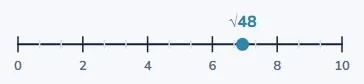
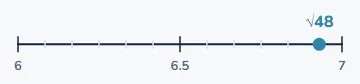
- Take √48. Which perfect squares sit either side of 48?
- 36 below it, 49 above it.
- So √48 is somewhere between 6 and 7.
| Below it | 36 | √36 = 6 |
| Above it | 49 | √49 = 7 |
| So √48 is | between 6 and 7 | |
| 48 is 12 above 36 | and only 1 below 49 | so it is nearly 7 |
Try it: trap a root
Between is not the answer. Which one is it nearer?
- This is the step people skip, and it is the one that matters.
- 48 is twelve above 36, but only one below 49.
- So √48 is barely under 7. Not halfway. Nearly seven.
Three more, same two questions each time
- Which squares trap it? Then: which gap is smaller?
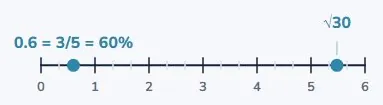
- √30 sits between 25 and 36, gaps of five and six.
- Nearly equal, tilted low. Just under five and a half.
| Root | Trapped by | The two gaps | So it is |
|---|---|---|---|
| √30 | 25 and 36 | gaps 5 and 6 | just under 5.5 |
| √70 | 64 and 81 | gaps 6 and 11 | about 8.4 |
| √90 | 81 and 100 | gaps 9 and 10 | about 9.5 |
Multiplying by a disguised 1, one more time
- Last lesson: three thirds is 1, so multiplying by it changes nothing.
- That rule has one more job to do.
- It is how you tidy up where a minus sign has landed.
Where the minus sign belongs
- Three over minus seven is a real number, but it is not tidy.
- Put the sign on top: minus three over seven. Same value.
- And if both parts are negative, the signs cancel out.
| Written | What is happening | Verdict |
|---|---|---|
| 3/(−7) | the bottom is negative | not the tidy form |
| (−3)/7 | the top is negative | this is the form to give |
| (−5)/(−8) | both negative | the signs cancel: 5/8 |
Try it: flip, trap and tidy
All of it lands on one line
- A fraction, a decimal and a percentage can be one point.
- Three fifths, nought point six, sixty percent.
- And a root is a point on that same line, like anything else.
| Written | Reading | Note |
|---|---|---|
| 3/5 | three parts of five | |
| 0.6 | divide 3 by 5 | same point |
| 60% | sixty per hundred | same point |
Placing four numbers without a calculator
- Nought point six, three fifths and sixty percent: one point.
- √30 is just under five and a half, from the squares either side.
- No calculator was involved in either of those.
What to take away
- Six things, and the landmarks are the point of all of them.
| Powers of two | up to 1024, known by heart |
| Each one | is the one before, doubled |
| Negative power | is one over the positive one, any base |
| Perfect squares | are the landmarks for roots |
| Locating a root | compare the gap below with the gap above |
| A fraction answer | keeps the minus sign on top |
Common mistakes
- 3⁻² = −9, because of the minus.A negative power means one over the positive power, not a negative number: 3⁻² = 1/3² = 1/9.
- 2⁻³ = 1/6, because 2 × 3 = 6.2³ means 2 × 2 × 2 = 8, so 2⁻³ = 1/8.
- √48 is between 6 and 7, so it is about 6.5.48 is 1 below 49 but 12 above 36, so √48 is much nearer 7 (about 6.9).
- 2/(−3) is fine to leave as the final answer.Keep the denominator positive and put the sign on top or in front: 2/(−3) = −2/3.
Your turn
- Try all eight.
What is 2⁸?
Write 4⁻² as a unit fraction.
Between which whole numbers is √30, and which is it nearer?
Rewrite 3/(−7) with a positive denominator.
512 = 2ⁿ. What is n?
Which of these is equal to 1/32?
Without a calculator, which of these square roots is closest to 8?
Which of these is NOT equal to −2/5?
Show answer
1. 256. Doubling from 2: 2, 4, 8, 16, 32, 64, 128, 256. 2. 1/16, because 4 squared is 16. 3. Between 5 and 6, and nearer 5. 30 is 5 above 25 but 6 below 36, so the lower gap is smaller. It is about 5.5, just under. 4. −3/7. Moving the sign to the numerator does not change the value. 5. 9. Doubling from 2: 2, 4, 8, 16, 32, 64, 128, 256, 512 takes 9 twos multiplied together. 6. 2⁻⁵. Since 2⁵ = 32, one over 2⁵ is 1/32, and that is 2⁻⁵. 7. √66. 8 is √64, and 66 is only 2 away from 64, closer than 60 (4 away) or 72 (8 away); √8 is under 3. 8. (−2)/(−5). Both parts are negative, so the signs cancel and it equals 2/5, a positive number. The other three all equal −2/5.
The answers
- Doubling from 32: 64, 128, 256.
- Four squared is 16, so it is one sixteenth.
- 30 is 5 above 25 but 6 below 36.
| Answer | |
|---|---|
| 1 | 256 |
| 2 | 1/16 |
| 3 | Between 5 and 6, nearer 5 |
| 4 | −3/7 |
Challenge
Here are seven numbers: 2⁻⁵, 3⁻³, 4⁻³, 5⁻², 6⁻², 8⁻² and (−2)⁻³. Exactly two of them are equal. Find that pair, then put all seven in order from smallest to largest. Write any negative one as a fraction in tidy form.
Hint
Turn each one into a unit fraction first: a⁻ⁿ is 1 over aⁿ. For (−2)⁻³, work out (−2)³ before you flip it.
Answer
4⁻³ and 8⁻² are equal (both 164). Order: (−2)⁻³ = −18, then 4⁻³ = 8⁻² = 164, then 6⁻² = 136, then 2⁻⁵ = 132, then 3⁻³ = 127, then 5⁻² = 125.
Step by step
- Each negative power is one over the positive power: 2⁻⁵ = 132, 3⁻³ = 127, 4⁻³ = 164, 5⁻² = 125, 6⁻² = 136, 8⁻² = 164.
- 4³ = 64 and 8² = 64, so 4⁻³ and 8⁻² are the same number.
- (−2)³ = −8, so (−2)⁻³ = 1−8, which in tidy form is −18. It is the only negative one, so it is smallest.
- For the positive unit fractions, a bigger bottom means a smaller number.
- Bottoms in order from largest to smallest: 64, 36, 32, 27, 25.
Full working
- 2⁻⁵ = 132, 3⁻³ = 127, 5⁻² = 125, 6⁻² = 136one over the positive power
- 4⁻³ = 164 and 8⁻² = 164the equal pair
- (−2)³ = −8three negatives multiply to a negative
- (−2)⁻³ = 1−8 = −18sign moved to the top
- 64 > 36 > 32 > 27 > 25bigger bottom, smaller fraction
- (−2)⁻³ < 4⁻³ = 8⁻² < 6⁻² < 2⁻⁵ < 3⁻³ < 5⁻²
Work out 2⁻¹ + 2⁻² + 2⁻³ + … + 2⁻¹⁰ (ten terms) as a single fraction in simplest form, without adding the fractions one by one. How far short of 1 is the total?
Hint
Add the first two, then the first three, then the first four. How far is each running total from 1? Look at the pattern.
Answer
10231024. It is 11024 short of 1.
Step by step
- The terms are 12, 14, 18, and so on down to 11024, since 2¹⁰ = 1024.
- 12 is 12 short of 1. Add 14 and you are 14 short. Add 18 and you are 18 short.
- Each new term fills exactly half of the gap that is left, so the gap is always the last term added.
- After the last term, 11024, the gap is 11024.
- So the total is 1 − 11024 = 10231024. It is already in simplest form because 1023 is odd.
Full working
- 2⁻ⁿ = 12ⁿeach term is a unit fraction
- 12 = 1 − 12after one term
- 12 + 14 = 34 = 1 − 14after two terms
- 12 + 14 + 18 = 78 = 1 − 18after three terms
- gap after the 2⁻¹⁰ term = 110242¹⁰ = 1024
- 1 − 11024 = 102310241023 is odd, so no common factor with 1024
- 10231024, which is 11024 short of 1
For how many whole numbers n is √n closer to 7 than to any other whole number? Then explain why the answer is always twice the whole number in the middle, and use that to say how many whole numbers have a square root closest to 12.
Hint
√n is closest to 7 when it is between 6.5 and 7.5. Square those two boundaries. Notice that 6.5² = 6 × 7 + 0.25.
Answer
14 numbers (43 to 56). In general there are 2k numbers whose square root is closest to k, so 24 for k = 12 (133 to 156).
Step by step
- √n is closest to 7 exactly when √n is above 6.5 and below 7.5.
- Squaring: n must be above 6.5² = 42.25 and below 7.5² = 56.25.
- So n runs from 43 to 56, which is 14 numbers. No n can tie, since 42.25 and 56.25 are not whole.
- Notice 6.5² = 6 × 7 + 0.25 and 7.5² = 7 × 8 + 0.25, so the count is 7 × 8 − 6 × 7 = 7 × 2.
- The same happens for any k: the count is k(k + 1) − (k − 1)k = 2k. For 12 that is 24, the numbers 133 to 156.
Full working
- 6.5 < √n < 7.5closer to 7 than to 6 or 8
- 6.5² = 42.25 and 7.5² = 56.25square the boundaries
- 43 ≤ n ≤ 56the whole numbers in between
- 56 − 43 + 1 = 14count them
- 6.5² = 6 × 7 + 0.25 and 7.5² = 7 × 8 + 0.25the pattern
- 7 × 8 − 6 × 7 = 14 = 2 × 7count is twice the middle number
- 11.5² = 132.25 and 12.5² = 156.25for 12: n from 133 to 156
- 14 numbers for 7, and 2 × 12 = 24 numbers for 12
Report a mistake
More in Number
 Scientific notation, and three names for one number8 minPowers of two, unit fractions, and roots on the line7 min
 Order of operations, integers, and a sensible estimate8 min
 Reciprocals, and why decimal rules are fraction rules7 min
 Percentages as multipliers, and working backwards7 min
 Ratios you can scale, and rates that carry units7 min
 Mark-ups, discounts, GST and interest7 min
Is your child on track?
Take the free placement test