Mark-ups, discounts, GST and interest

What this lesson covers
- Percentages, ratios, rates, and proportions are often applied in financial situations.
You already know how to do all of this
- Mark-up, discount, GST, interest. Four money words.
- There is one piece of maths underneath all four.
- It is the multiplier from last lesson. That is the whole lesson.
Mark-up: what a shop adds on
- A shop pays forty dollars for something. That is the cost price.
- It marks it up 60%, so it multiplies by 1.6.
- Sixty-four dollars on the ticket.
| Step | Working | Note |
|---|---|---|
| Shop pays | $40 | the cost price |
| Marks it up 60% | 40 × 1.6 | |
| Sells at | $64 | the selling price |
Discount: the same move, downwards
- Eighty dollars with 25% off.
- If a quarter comes off, you are paying three quarters of it.
- Times 0.75. Sixty dollars.
| Step | Working | Note |
|---|---|---|
| Ticket price | $80 | |
| 25% off | 80 × 0.75 | you pay 75% of it |
| You pay | $60 |
Try it: change a percentage
Both at once, which is the real situation
- The forty-dollar item is on the ticket at sixty-four.
- Now it goes into a sale at 25% off. Forty-eight dollars.
- Still above the forty the shop paid. That is the point of a mark-up.
| Step | Working | Note |
|---|---|---|
| Cost to the shop | $40 | |
| Marked up 60% | $64 | the ticket price |
| 25% off in a sale | 64 × 0.75 | $48 |
| Still above cost | 48 against 40 | the shop is fine |
A question with a surprising answer
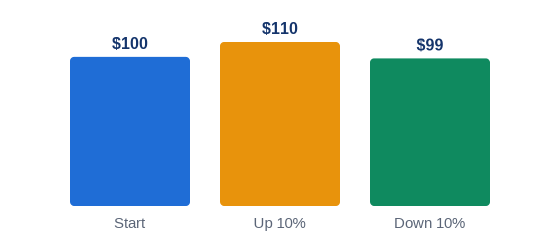
- A hundred dollar item goes up 10%. Then it comes down 10%.
- What is the price now?
- It is not a hundred dollars.
Ninety-nine dollars, and here is why
- Up 10% takes a hundred to a hundred and ten.
- Down 10% takes 10% off a hundred and ten, not off a hundred.
- Eleven dollars comes off, not ten. You land on ninety-nine.
| Step | Working | Result |
|---|---|---|
| Start | $100 | |
| Up 10% | 100 × 1.1 | $110 |
| Down 10% | 110 × 0.9 | $99 |
| Not $100 | the 10% off was off a bigger number |
GST, which in New Zealand is 15%
- A price of four hundred and thirty-two dollars before GST.
- The GST itself is 0.15 times that. Sixty-four eighty.
- The price you pay is 432 times 1.15. Four ninety-six eighty.
| Step | Working | Result |
|---|---|---|
| Price before GST | $432 | |
| The GST | 0.15 × 432 | $64.80 |
| Price including GST | 432 × 1.15 | $496.80 |
| Check | 432 + 64.80 | $496.80 |
Now the one that goes the other way
- A receipt says $115, and that price includes GST.
- How much of that $115 is GST?
- Most people take 15% of 115. That is wrong.
Fifteen dollars, not seventeen twenty-five
- 15% of 115 gives $17.25, and it is the wrong answer.
- Something was multiplied by 1.15 to reach 115. So divide.
- 115 over 1.15 is 100. So the GST is 15 dollars exactly.
| Step | What is happening | Value |
|---|---|---|
| A price of $115 including GST | the common wrong answer | 0.15 × 115 = $17.25 |
| What actually happened | × 1.15 landed on 115 | |
| So undo it | 115 ÷ 1.15 | $100 before GST |
| The GST is | 115 − 100 | $15 |
| Check | 100 × 1.15 | $115, correct |
Money calculator
Again, so you can see it is the method
- Two hundred and thirty dollars including GST.
- Divide by 1.15. Two hundred dollars before GST.
- So thirty dollars of GST. Check: 200 times 1.15 is 230.
| Step | Working | Result |
|---|---|---|
| $230 including GST | 230 ÷ 1.15 | $200 before GST |
| The GST | 230 − 200 | $30 |
| Check | 200 × 1.15 | $230, correct |
Simple interest: paid on what you put in
- Two thousand dollars, at 4% a year, for three years.
- Each year pays 4% of the original two thousand. Eighty dollars.
- Three years of that is two hundred and forty.
| Step | Working | Result |
|---|---|---|
| You save | $2000 | the principal |
| At 4% a year | 0.04 × 2000 | $80 each year |
| For 3 years | 80 × 3 | $240 interest |
| You end up with | 2000 + 240 | $2240 |
Try it: simple against compound
One honest footnote
- Simple interest always pays on the original amount.
- Real bank accounts pay interest on the interest as well.
- That is compound interest, and it is a later topic.
The claim from the start of the lesson
- Four different words. Look at the middle column.
- Every single one is a multiplier, or undoing one.
- There was never more than one idea here.
| The word | The maths | Direction |
|---|---|---|
| Mark-up of 60% | × 1.6 | a rise |
| Discount of 25% | × 0.75 | a fall |
| Adding GST | × 1.15 | a rise |
| Removing GST | ÷ 1.15 | undoing a rise |
| Simple interest | × rate × years | a rise, once per year |
What to take away
- Six things, and the fourth one will be useful for decades.
| Mark-up and discount | are multipliers, like any percentage change |
| Up then down by 10% | does not return you to the start |
| GST in New Zealand | is 15%, so adding it is × 1.15 |
| GST inside a price | is found by dividing by 1.15, not taking 15% |
| Simple interest | is paid on the original amount every year |
| Every one of these | is the same multiplier idea |
Common mistakes
- $115 includes GST, so the GST is 15% of 115 = $17.25.The price was already × 1.15, so divide: 115 ÷ 1.15 = $100 before GST, and the GST is $15.
- Up 10% then down 10% brings $100 back to $100.The 10% off is taken from $110, so 110 × 0.9 = $99.
- 25% off $80: 80 × 0.25 = $20, so it costs $20.$20 is the discount; you pay 75%, so 80 × 0.75 = $60.
- $500 at 4% simple interest for 3 years earns 500 × 4 × 3 = $6000.Use 4% as 0.04: interest = 500 × 0.04 × 3 = $60.
Your turn
- Try all eight.
A shop pays $250 and marks it up 40%. What does it sell for?
A $90 jacket has 30% off. What do you pay?
Find the GST on $60, and the price including GST.
Find the simple interest on $1500 at 5% for 4 years.
Which multiplier takes 35% off a price in one step?
A café bill in Wellington is $57.50 including GST. How much of it is GST?
After a 20% discount, a jacket costs $96. What was the price before the discount?
Ana puts $800 in a term deposit at simple interest for 3 years and earns $96. What is the yearly interest rate?
Show answer
1. $350, from 250 × 1.4. 2. $63, from 90 × 0.7. 3. GST is $9, from 0.15 × 60, and the inclusive price is $69. Note this one starts before GST, so you multiply. If it had started at $69 including GST you would divide by 1.15 instead. 4. $300, from 1500 × 0.05 × 4. That is $75 a year for four years. 5. × 0.65. Taking 35% off leaves 100% − 35% = 65% of the price, and 65% is 0.65. 6. $7.50. Undo the × 1.15: 57.50 ÷ 1.15 = $50 before GST, so the GST is 57.50 − 50 = $7.50. 7. $120. The $96 is the old price × 0.8, so undo it: 96 ÷ 0.8 = $120. Check: 120 × 0.8 = 96. 8. 4% a year. Each year pays 96 ÷ 3 = $32, and 32 ÷ 800 = 0.04, which is 4% a year.
The answers
- 250 × 1.4, then 90 × 0.7.
- This one starts before GST, so multiply.
- $75 a year, for four years.
| Answer | |
|---|---|
| 1 | $350 |
| 2 | $63 |
| 3 | $9 GST, $69 total |
| 4 | $300 |
Challenge
A supermarket sells a box of cereal for $6.40. It runs three deals, and a shopper can use only one of them. Deal A: 3 boxes for the price of 2. Deal B: 30% off every box. Deal C: buy one box at full price and get the next box half price. (a) Mere buys 6 boxes. What does she pay under each deal? (b) For 6 boxes, write each deal as a percentage discount on the full price, to 1 decimal place. (c) Tama needs only 4 boxes. Which deal is cheapest for him now, and why does the best deal change?
Hint
Work out the full price first, then what each deal really charges. For Deal A, count how many boxes are actually paid for.
Answer
(a) Deal A $25.60, Deal B $26.88, Deal C $28.80. (b) Deal A 33.3%, Deal B 30%, Deal C 25%. (c) Deal B ($17.92, against $19.20 for A and C). With 4 boxes, Deal A gives only 1 free box out of 4, which is 25% off, but Deal B is always 30% off.
Step by step
- 6 boxes at full price cost 6 × 6.40 = $38.40.
- Deal A: 6 boxes is two lots of 3, so she pays for only 4 boxes: 4 × 6.40 = $25.60.
- Deal B: she pays 70% of the full price: 38.40 × 0.7 = $26.88.
- Deal C: each pair costs 6.40 + 3.20 = $9.60, and 3 pairs cost $28.80.
- As discounts on $38.40: A saves $12.80 (33.3%), B saves $11.52 (30%), C saves $9.60 (25%).
- For 4 boxes, Deal A covers only one lot of 3, so he pays for 3 boxes: $19.20, just 25% off. Deal C is 2 pairs, also $19.20. Deal B is 4 × 4.48 = $17.92, still 30% off.
- Deal A's discount depends on how many boxes fit into lots of 3, but Deal B's does not.
Full working
- 6 × 6.40 = $38.40full price for 6
- A: pay for 4 boxes, 4 × 6.40 = $25.602 free
- B: 38.40 × 0.7 = $26.8830% off
- C: 3 × (6.40 + 3.20) = $28.803 pairs
- 12.80 ÷ 38.40 = 33.3%, 11.52 ÷ 38.40 = 30%, 9.60 ÷ 38.40 = 25%part (b)
- 4 boxes: A 3 × 6.40 = $19.20, B 4 × 4.48 = $17.92, C 2 × 9.60 = $19.20part (c)
- (a) A $25.60, B $26.88, C $28.80 (b) 33.3%, 30%, 25% (c) Deal B, $17.92
Rawiri puts some money into an account that pays simple interest at a fixed yearly rate, and he never adds or takes out any money. After 2 years the account holds $4815. After 6 years it holds $5445. (a) How much did he put in, and what is the interest rate? (b) After how many whole years does the account first hold at least $6000?
Hint
Simple interest adds the same amount every year. What happened between year 2 and year 6?
Answer
(a) $4500 at 3.5% a year. (b) After 10 years (it holds $6075).
Step by step
- Between year 2 and year 6 there are 4 years of interest, and they added $630.
- So each year adds $630 ÷ 4 = $157.50.
- Go back 2 years from $4815 to find the starting amount: $4500.
- $157.50 out of $4500 is 3.5%.
- To reach $6000 he needs $1500 of interest, which takes more than 9 years, so 10 whole years.
Full working
- 5445 − 4815 = 630interest from year 2 to year 6
- 630 ÷ 4 = 157.50interest each year
- 4815 − 2 × 157.50 = 4500the amount put in
- 157.50 ÷ 4500 = 0.035the rate is 3.5%
- 1500 ÷ 157.50 ≈ 9.52years needed for $1500 of interest
- 4500 + 9 × 157.50 = 5917.50not enough after 9 years
- 4500 + 10 × 157.50 = 6075enough after 10 years
- $4500 at 3.5% a year; first at least $6000 after 10 years
A Nelson surf shop pays $80 for a wetsuit (the shop claims back any GST it pays, so $80 is its real cost). It adds a mark-up to the cost, then adds 15% GST, and the ticket says $138. (a) What percentage mark-up did the shop use? (b) In a sale the shop takes a whole-number percentage off the $138 ticket. After the GST is removed from the sale price, the shop must still get at least its $80 cost. What is the biggest whole-number percentage it can take off?
Hint
Work backwards from $138: first remove the GST. For (b), the shop keeps the sale price divided by 1.15, so the sale price must be at least 80 × 1.15.
Answer
(a) 50%. (b) 33% off (the shop keeps about $80.40; 34% off would leave it only $79.20).
Step by step
- Undo the GST: $138 ÷ 1.15 = $120 is the price before GST.
- The mark-up took $80 to $120, a multiplier of 1.5, so the mark-up is 50%.
- For the shop to keep at least $80, the sale price must be at least 80 × 1.15 = $92.
- $92 is 23 of $138, so the shop can take off at most 13, which is 33.3...%.
- The biggest whole number not above 33.3... is 33. Check 33% and 34%.
Full working
- 138 ÷ 1.15 = 120price before GST
- 120 ÷ 80 = 1.5mark-up multiplier, so 50%
- 80 × 1.15 = 92lowest sale price the shop can accept
- 92 ÷ 138 = 23the sale price as a fraction of the ticket
- 1 − 23 = 13 ≈ 33.3%the largest possible discount
- 138 × 0.67 ÷ 1.15 = 80.4033% off: the shop keeps $80.40, fine
- 138 × 0.66 ÷ 1.15 = 79.2034% off: below $80, not allowed
- Mark-up 50%; the biggest whole-number discount is 33%
Practise this
Report a mistake
More in Number
 Scientific notation, and three names for one number8 min
 Powers of two, unit fractions, and roots on the line7 min
 Order of operations, integers, and a sensible estimate8 min
 Reciprocals, and why decimal rules are fraction rules7 min
 Percentages as multipliers, and working backwards7 min
 Ratios you can scale, and rates that carry units7 minMark-ups, discounts, GST and interest7 min
Is your child on track?
Take the free placement test