The parts of a circle
What this lesson covers
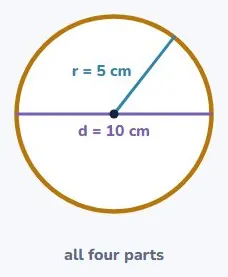
- The radius is the distance from the outside of a circle to the centre.
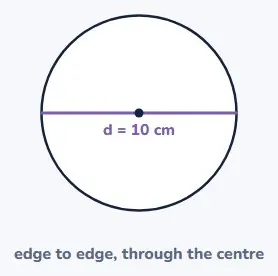
- The diameter is the length of a line through the centre of a circle that touches opposite points on the edge of the circle.
- The circumference is the distance around a circle.
A circle is defined by a distance
- A square is defined by its sides. A triangle by its three.
- A circle has no sides at all.
- It is defined by one distance, from one point.
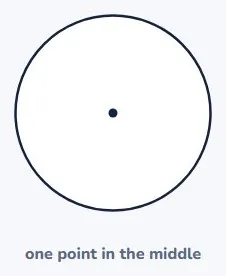
Every point, the same distance out
- Pick a centre. Pick a distance.
- Mark every point that is exactly that far from the centre.
- What you have drawn is a circle. That is the whole definition.
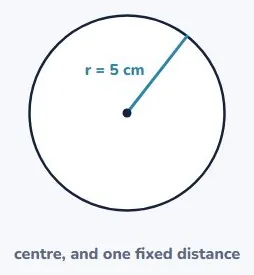
That distance is the radius
- From the centre out to the edge. Always the same.
- Draw three of them and they are equal lengths.
- Not by coincidence. That is what made it a circle.
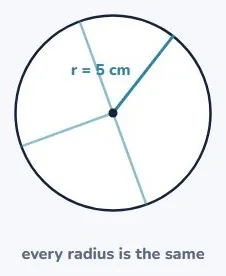
Try it: grow the circle
The four words you need
- Centre, radius, diameter, circumference.
- The centre is the only one not on the circle itself.
- The other three are all lengths.
| Part | What it is | Symbol |
|---|---|---|
| Centre | the point in the middle | not on the circle |
| Radius | centre to the edge | r |
| Diameter | edge to edge, through the centre | d |
| Circumference | the distance all the way round | C |
The diameter goes all the way across
- Edge to edge, passing through the centre.
- It touches the circle at two opposite points.
- And it is made of two radii, back to back.
So the diameter is twice the radius
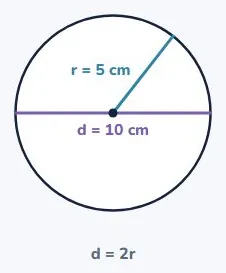
- Two radii laid end to end. d = 2r.
- Radius 5 centimetres means diameter 10.
- Going back, halve it. Diameter 18 means radius 9.
Through the centre, or it does not count
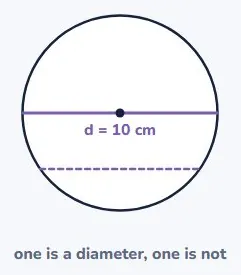
- Here is another line from edge to edge.
- It misses the centre, so it is not a diameter.
- That phrase in the definition is doing real work.
And it is the longest line across
- Slide that other line towards the centre and it gets longer.
- It is longest exactly when it passes through.
- No line across a circle beats its diameter.
| Line | Where | Verdict |
|---|---|---|
| Through the centre | edge to edge | a diameter |
| Not through the centre | edge to edge | just a chord |
| The diameter | is the longest line across |
The circumference is the way round
- Not across. Around.
- It is the perimeter of the circle, under a different name.
- If you walked the edge, that is how far you would go.

Three lengths, always in the same order
- The radius is shortest.
- The diameter is exactly twice it.
- And the circumference is longer than both. Always.
| Length | Size | Order |
|---|---|---|
| Radius | r | shortest |
| Diameter | 2r | twice that |
| Circumference | about 3.14 × d | longest |
But how much longer?
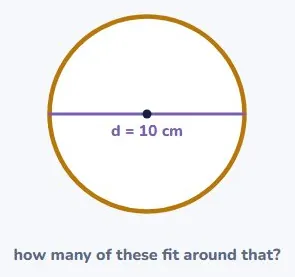
- The diameter is twice the radius, exactly.
- So how many diameters is the circumference?
- That is a question you can answer with a piece of string.
So measure some circles
- A dinner plate, 10 centimetres across, is about 31.4 round.
- A 2 metre trampoline is about 6.3 metres round.
- A bike wheel 70 centimetres across is about 220 round.
| Circle | Across | Around |
|---|---|---|
| A dinner plate | d = 10 cm | C is about 31.4 cm |
| A trampoline | d = 2 m | C is about 6.3 m |
| A bike wheel | d = 70 cm | C is about 220 cm |
Try it: roll it one turn
Now divide each one by its diameter
- 31.4 divided by 10 is about 3.14.
- 6.3 divided by 2 is about 3.14.
- 220 divided by 70 is about 3.14. Every time.
| Working | Gives | |
|---|---|---|
| 31.4 ÷ 10 | about 3.14 | |
| 6.3 ÷ 2 | about 3.14 | |
| 220 ÷ 70 | about 3.14 | |
| Every circle | ever measured | about 3.14 |
That is not about those three circles
- It happens for a bottle top and for a planet.
- Every circle is a little over three diameters around.
- The size cancels out. Only the shape is left.
| Working | Gives | |
|---|---|---|
| 31.4 ÷ 10 | about 3.14 | |
| 6.3 ÷ 2 | about 3.14 | |
| 220 ÷ 70 | about 3.14 | |
| Every circle | ever measured | about 3.14 |
That number has a name
- It is called pi, written with the Greek letter.
- 3.14159 and onwards, never repeating, never stopping.
- Which is why we say "about 3.14".
| Value | ||
|---|---|---|
| pi | 3.14159265... | never ends |
| Rounded | 3.14 | good enough here |
| C ÷ d | is always pi |
And next year you will use it
- If C ÷ d is pi, then C is pi times d.
- That formula is Year 9 work, and you will meet it properly.
- For now: know the parts, and know they are related.
Common mistakes
- The diameter is 18 cm, so the radius is 36 cm.The diameter is two radii (d = 2r), so going back you halve it: the radius is 9 cm.
- Any line from edge to edge of the circle is a diameter.A diameter must pass through the centre; a line across that misses the centre is shorter and is not a diameter.
- The circumference is the distance across the circle.Across is the diameter; the circumference is the distance around, about 3.14 times the diameter.
- The radius goes from one edge to the other.The radius goes from the centre to the edge, so it is half the diameter.
Your turn: eight questions
- Try all eight.
- Questions 1 and 2 go in opposite directions.
- Question 4 does not need a specific circle.
A circle has a radius of 6 cm. What is its diameter?
A circle has a diameter of 18 cm. What is its radius?
Which is longest: the radius, the diameter or the circumference?
You measure a circle and divide C by d. Roughly what do you get?
A straight line joins two points on a circle but does not pass through the centre. What is it?
Which statement is true for every circle?
A bike wheel is 50 cm across. Which is closest to the distance around the wheel?
Circle A has a radius of 4 cm. Circle B has a diameter of 7 cm. Which is true?
Show answer
1. 12 cm. The diameter is twice the radius. 2. 9 cm. Halve the diameter. 3. The circumference. It is about 3.14 diameters long, and a diameter is already two radii. 4. About 3.14, whatever circle you measured. That is the whole point of it: the answer does not depend on which circle you picked. 5. A chord. Only a line through the centre is a diameter, and a radius goes from the centre to the edge. 6. Every radius is the same length. That is the definition: every point is one fixed distance from the centre. 7. About 160 cm. The way round is a little over three diameters, and 3 × 50 = 150, so a bit more than 150. 8. Circle A has the longer diameter. Its diameter is 2 × 4 = 8 cm, which is more than 7 cm.
The answers
- Radius 6 gives diameter 12. Diameter 18 gives radius 9.
- The circumference is longest, at about 3.14 diameters.
- And C divided by d is about 3.14 for any circle at all.
| Answer | |
|---|---|
| 1 | 12 cm |
| 2 | 9 cm |
| 3 | the circumference |
| 4 | about 3.14 |
What to take away
- A circle is every point one fixed distance from a centre.
- The diameter is twice the radius, and goes through the centre.
- And the way round is about 3.14 ways across. For every circle.
| Remember | |
|---|---|
| A circle | is every point at one fixed distance from a centre |
| Every radius | in a circle is equal, by definition |
| Diameter | is twice the radius |
| Through the centre | or it is a chord, not a diameter |
| C ÷ d | is about 3.14 for every circle there is |
Challenge
Six identical round biscuits sit in a single row inside a rectangular tin. Each biscuit touches the biscuits next to it, and every biscuit touches both long sides of the tin. The two end biscuits also touch the short ends. The perimeter of the tin is 70 cm. What is the radius of one biscuit?
Hint
Write the length and the width of the tin in terms of the radius r, not the diameter.
Answer
2.5 cm
Step by step
- The width of the tin is one biscuit across, which is one diameter, or 2r.
- The length is six diameters end to end, which is 6 × 2r = 12r.
- The perimeter is two lengths plus two widths: 12r + 12r + 2r + 2r = 28r.
- So 28r = 70, and r = 70 ÷ 28 = 2.5 cm.
- Check: the diameter is 5 cm, so the tin is 30 cm by 5 cm, and 30 + 5 + 30 + 5 = 70.
Full working
- width = d = 2rone biscuit fills the width
- length = 6d = 12rsix diameters in a row
- perimeter = 12r + 2r + 12r + 2r = 28radd all four sides
- 28r = 70the perimeter is 70 cm
- r = 70 ÷ 28 = 2.5divide both sides by 28
- Check: tin 30 cm by 5 cm, 30 + 5 + 30 + 5 = 70it works
- radius = 2.5 cm
O is the centre of a circle. A and B are two points on the circle, and the triangle OAB has a perimeter of 22 cm. The straight line AB is 6 cm long. (a) Find the diameter of the circle. (b) Hana says that if A and B were moved to different places on the same circle, the line AB could be 17 cm long. Explain why she is wrong.
Hint
OA and OB are both radii. What does that tell you about their lengths? Then remember which line across a circle is the longest.
Answer
(a) 16 cm. (b) The longest line across a circle is its diameter, 16 cm, so AB can never be 17 cm.
Step by step
- OA and OB both go from the centre to the edge, so both are radii and have the same length r.
- The perimeter is OA + OB + AB = r + r + 6 = 2r + 6.
- 2r + 6 = 22 gives 2r = 16, so r = 8 cm and the diameter is 16 cm.
- AB is a line from edge to edge. The longest such line is the one through the centre, the diameter.
- So AB can be at most 16 cm, never 17 cm.
Full working
- OA = OB = revery radius is equal
- r + r + 6 = 22perimeter of triangle OAB
- 2r = 16subtract 6 from both sides
- r = 8halve
- d = 2r = 16the diameter is two radii
- AB ≤ 16 < 17no line across beats the diameter
- (a) 16 cm; (b) AB can be at most 16 cm
A big circle has a diameter of 18 cm. Three identical small circles sit in a row along that diameter, touching each other, so that together they stretch exactly from one side of the big circle to the other. Ant A walks once around the big circle. Ant B walks once around each of the three small circles. Using C is about 3.14 × d, find how far each ant walks. Then explain why the two distances would still be equal for any size of big circle.
Hint
First find the diameter of a small circle. Then think about what happens to the circumference when the diameter is divided by 3.
Answer
Both ants walk about 56.52 cm. It always works because the three small diameters add up to the big diameter, and every circumference is about 3.14 times its diameter.
Step by step
- The three small diameters fill the big diameter, so each small diameter is 18 ÷ 3 = 6 cm.
- Ant A walks about 3.14 × 18 = 56.52 cm.
- One small circle is about 3.14 × 6 = 18.84 cm round, so Ant B walks about 3 × 18.84 = 56.52 cm.
- They are equal. Ant B walks 3.14 × (one small diameter) three times, which is 3.14 × (the three small diameters added together).
- The three small diameters always add up to the big diameter, so Ant B's total is always 3.14 × the big diameter, the same as Ant A's.
Full working
- small d = 18 ÷ 3 = 6 cmthree diameters fill 18 cm
- Ant A: 3.14 × 18 = 56.52 cmbig circumference
- one small circle: 3.14 × 6 = 18.84 cmsmall circumference
- Ant B: 3 × 18.84 = 56.52 cmthree small circles
- 3.14 × d + 3.14 × d + 3.14 × d = 3.14 × 3d = 3.14 × D3d is the big diameter D
- Both ants walk about 56.52 cm, for any size of big circle
Practise this
Report a mistake
More in Geometry
Is your child on track?
Take the free placement test