Angles in polygons, transformations and map scales
What this lesson covers
- The sum of the exterior angles of a polygon is 360°.
- In a regular polygon, all exterior angles are the same; an exterior angle can be found by subtracting the interior angle from 180° or by dividing 360° by the number of sides.
- The interior angle sum of a triangle is 180°; for a quadrilateral, it is 360°.
- The interior angle sum of any polygon can be found using the formula 180(n−2)°, where n represents the total number of sides.
- A map's scale is the ratio between a distance on the map and the corresponding distance in the physical world.
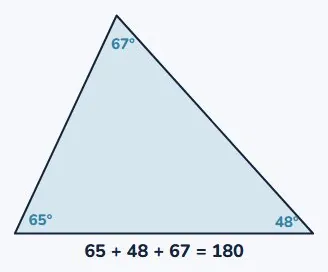
Angles in a triangle add to 180
- You have known this for years. Every triangle, always 180°.
- Tear the three corners off and they make a straight line.
- Now: what happens when the shape has more sides?
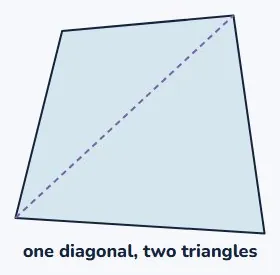
A quadrilateral is two triangles
- Draw one diagonal, corner to opposite corner.
- The shape falls into two triangles, and nothing is left over.
- Two lots of 180° is 360°.
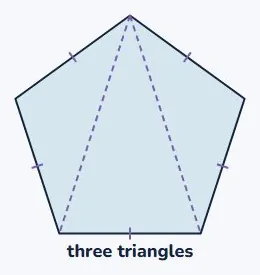
A pentagon is three
- Same trick. Pick a corner and draw to every other one.
- From a pentagon you get three triangles.
- Three lots of 180° is 540°.
The count is always two fewer
- 4 sides gave 2 triangles. 5 sides gave 3. 6 gives 4.
- Always two fewer triangles than sides.
- Because the corner you draw from cannot reach its neighbours.
| Shape | Cuts into | Sum |
|---|---|---|
| Triangle | 1 triangle | 180° |
| Quadrilateral | 2 triangles | 360° |
| Pentagon | 3 triangles | 540° |
| Hexagon | 4 triangles | 720° |
So the formula writes itself
- n sides gives n − 2 triangles.
- Each one is 180°.
- Interior angle sum = 180(n − 2). An octagon: 180 × 6 = 1080°.
| Step | Working | Gives |
|---|---|---|
| n sides | always gives | n − 2 triangles |
| Each triangle | 180° | |
| So the sum is | 180(n − 2)° | |
| Octagon, n = 8 | 180 × 6 | 1080° |
Geometry board
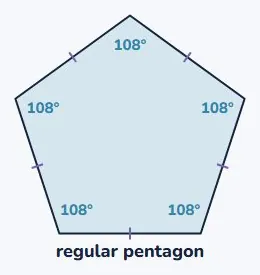
One angle of a regular polygon
- Regular means all sides equal and all angles equal.
- So share the total out: a pentagon is 540 ÷ 5 = 108°.
- A hexagon is 120°. An octagon is 135°.
Now the angle on the outside
- Extend one side past the corner.
- The angle between that extension and the next side is exterior.
- It sits on a straight line with the interior one.
| Fact | Working | Gives |
|---|---|---|
| They sit on a straight line | so they add to 180° | |
| Pentagon: interior 108° | 180 − 108 | exterior 72° |
| Hexagon: interior 120° | 180 − 120 | exterior 60° |
Walk right round the outside
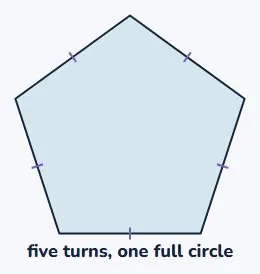
- Set off along one side. At each corner, turn.
- How much you turn is exactly the exterior angle.
- Back at the start, facing the same way: one full turn. 360°.
Try it: walk round the shape
And that never changes
- A triangle: three turns of 120°. A square: four of 90°.
- A fifty-sided shape: fifty tiny turns. Still 360° in total.
- Interior sums grow without limit. Exterior sums never move.
| Shape | Working | Total |
|---|---|---|
| Triangle | 3 × 120 | 360° |
| Square | 4 × 90 | 360° |
| Pentagon | 5 × 72 | 360° |
| Hexagon | 6 × 60 | 360° |
Which gives a very fast shortcut
- If the polygon is regular, all the turns are equal.
- So one exterior angle is just 360 ÷ n.
- An octagon: 360 ÷ 8 = 45°. Then interior is 180 − 45 = 135°.
| Step | Working | Gives |
|---|---|---|
| Exterior angle | 360 ÷ n | |
| Regular pentagon | 360 ÷ 5 | 72° |
| Regular octagon | 360 ÷ 8 | 45° |
| Then interior | 180 − exterior | 135° |
Finding a missing angle
- Work out the total, then subtract what you were given.
- A triangle with 65° and 48°: 180 − 113 = 67°.
- A quadrilateral with 90°, 90° and 120°: 360 − 300 = 60°.
| Given | Working | Missing |
|---|---|---|
| Triangle, 65° and 48° | 180 − 113 | 67° |
| Quadrilateral, 90° 90° 120° | 360 − 300 | 60° |
| Method | sum, minus what you have |
Now: moving a shape about
- Slide it, and that is a translation.
- Flip it over a line, a reflection. Turn it, a rotation.
- All three leave the shape exactly the same size.
| Transformation | What you do | What survives |
|---|---|---|
| Translation | slide it | size and angles unchanged |
| Reflection | flip it over a line | size and angles unchanged |
| Rotation | turn it about a point | size and angles unchanged |
On the coordinate plane
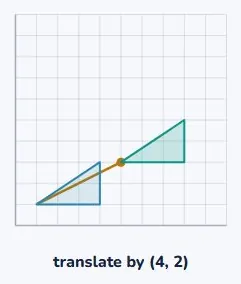
- A translation adds the same amount to every point.
- Here, 4 to the right and 2 up. Every vertex, the same move.
- The shape is identical. Only where it sits has changed.
Scaling is the one that changes size
- Multiply every length by the same factor.
- Factor 2 doubles every side. Factor ½ halves them.
- The angles do not change at all. Same shape, different size.
| Transformation | What you do | What survives |
|---|---|---|
| Translation | slide it | size and angles unchanged |
| Reflection | flip it over a line | size and angles unchanged |
| Rotation | turn it about a point | size and angles unchanged |
| Scaling | resize by a factor | angles unchanged, lengths not |
Try it: scale it up
Last: what a map scale means
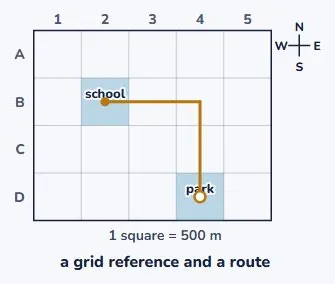
- A scale like 1 : 50 000 is a ratio.
- One of anything on the map is 50 000 of the same thing outside.
- Same units on both sides. That is the bit people miss.
So convert it into something useful
- 1 cm on the map means 50 000 cm on the ground.
- 50 000 cm is 500 m, which is half a kilometre.
- So 4 cm on that map is 2 kilometres.
| Step | Working | Gives |
|---|---|---|
| 1 : 50 000 | 1 cm on the map | 50 000 cm real |
| 50 000 cm | in metres | 500 m |
| So 1 cm | 0.5 km | |
| And 4 cm | 2 km |
Try it: read the map scale
Common mistakes
- An octagon's interior angles add to 180 × 8 = 1440°.An octagon splits into n − 2 = 6 triangles, so 180(n − 2) = 180 × 6 = 1080°.
- The exterior angles of a hexagon add to 720°, the same as its interior angles.Exterior angles always add to 360° for any polygon, so each one in a regular hexagon is 360 ÷ 6 = 60°.
- At 1 : 25 000, 6 cm on the map is 150 000 km.Both sides of the ratio use the same unit: 6 × 25 000 = 150 000 cm, which is 1500 m or 1.5 km.
- Scaling a triangle by a factor of 2 doubles its angles too.Scaling multiplies the lengths only; the angles stay the same, so the shape is the same, just bigger.
Your turn: eight questions
- Try all eight.
- Question 2 has two routes. Either is fine.
- Question 4 wants kilometres, so convert twice.
What do the interior angles of a pentagon add to?
What is one exterior angle of a regular hexagon?
A triangle has angles of 55° and 70°. Find the third.
On a 1:25 000 map, how far is 6 cm in real life?
A triangle is scaled by a factor of 2. Which statement is true?
The point (2, −1) is translated 4 to the right and 2 up. Where does it land?
Mia says the interior angles of a hexagon add to 1080°, because 180 × 6. What has she done wrong?
Each interior angle of a regular polygon is 160°. How many sides does it have?
Show answer
1. 540°. It cuts into 3 triangles, or use 180 × (5 − 2). 2. 60°. Either 360 ÷ 6, or 180 − 120 using the interior angle. 3. 55°. The three add to 180, and 55 + 70 = 125. 4. 1.5 km. 1 cm is 25 000 cm, which is 250 m, so 6 cm is 1500 m. 5. Every side doubles; the angles stay the same. Scaling multiplies every length by the factor and never changes an angle. 6. (6, 1). Right adds 4 to x, so 2 + 4 = 6, and up adds 2 to y, so −1 + 2 = 1. 7. She used 6 triangles; a hexagon cuts into 4, so 720°. A hexagon makes n − 2 = 4 triangles, and 180 × 4 = 720°. 8. 18 sides. Each exterior angle is 180 − 160 = 20°, and 360 ÷ 20 = 18.
The answers
- A pentagon is 540°, from three triangles.
- A regular hexagon has 60° exterior angles, from 360 ÷ 6.
- The third angle is 55°. And 6 cm at 1:25 000 is 1.5 km.
| Answer | |
|---|---|
| 1 | 540° |
| 2 | 60° |
| 3 | 55° |
| 4 | 1.5 km |
What to take away
- Interior angles: 180(n − 2), because you get n − 2 triangles.
- Exterior angles: 360°, for every polygon, because you walk a circle.
- And a map scale is a ratio, so match the units before you start.
| Remember | |
|---|---|
| Interior sum | 180(n − 2)°, from n − 2 triangles |
| Exterior sum | 360°, for every polygon there is |
| Regular polygon | exterior angle is 360 ÷ n |
| At any corner | interior + exterior = 180° |
| Map scale | a ratio, so the units must match first |
Challenge
On a 1 : 25 000 map, a farm near Taupō covers an area of 8 cm². (a) What is the real area of the farm in km²? (b) A second map shows the same farm covering only 0.5 cm². What is the scale of the second map?
Hint
First find how many metres 1 cm on the map stands for. A 1 cm by 1 cm square on the map is then a real square with that side length.
Answer
(a) 0.5 km². (b) 1 : 100 000.
Step by step
- On the first map, 1 cm stands for 25 000 cm, which is 250 m.
- So a 1 cm² square on the map is a real square 250 m by 250 m, which is 62 500 m².
- 8 of those squares is 500 000 m². A km² is 1000 × 1000 = 1 000 000 m², so the farm is 0.5 km².
- On the second map, 0.5 cm² stands for 0.5 km², so 1 cm² stands for 1 km².
- A 1 cm square stands for a 1 km square, so 1 cm stands for 1 km, which is 100 000 cm.
Full working
- 1 cm on map = 25 000 cm = 250 msame units on both sides of the ratio
- 1 cm² on map = 250 × 250 = 62 500 m²area uses the length factor twice
- 8 × 62 500 = 500 000 m²the farm
- 500 000 ÷ 1 000 000 = 0.5 km²1 km² = 1 000 000 m²
- 0.5 cm² stands for 0.5 km², so 1 cm² stands for 1 km²second map
- 1 cm stands for 1 km = 100 000 cmside of a 1 km² square is 1 km
- (a) 0.5 km²; (b) 1 : 100 000
A regular polygon has its corners labelled A, B, C, D and so on, in order. The diagonal AC is drawn, and angle BAC is 12°. (a) How many sides does the polygon have? (b) What do all its interior angles add up to? (c) Find angle ACD.
Hint
AB and BC are two sides of the same regular polygon, so triangle ABC has two equal sides. Use it to find the interior angle at B.
Answer
(a) 15 sides. (b) 2340°. (c) Angle ACD = 144°.
Step by step
- AB and BC are both sides of the regular polygon, so they are equal and triangle ABC is isosceles.
- Its base angles BAC and BCA are both 12°, so angle ABC = 180 − 12 − 12 = 156°. That is the polygon's interior angle.
- The exterior angle is 180 − 156 = 24°, and the exterior angles add to 360°, so there are 360 ÷ 24 = 15 sides.
- A 15-sided polygon splits into 13 triangles from one corner, so its interior angles add to 13 × 180 = 2340°.
- At C, the interior angle BCD is 156° and angle BCA takes 12° of it, so angle ACD = 156 − 12 = 144°.
Full working
- AB = BCsides of a regular polygon
- angle BCA = angle BAC = 12°isosceles triangle ABC
- angle ABC = 180 − 12 − 12 = 156°angles in a triangle
- exterior = 180 − 156 = 24°; 360 ÷ 24 = 15exterior angles add to 360°
- (15 − 2) × 180 = 2340°interior angle sum
- angle ACD = 156 − 12 = 144°split the interior angle at C
- (a) 15 sides; (b) 2340°; (c) 144°
ABCDE is a regular pentagon. A square ABPQ is drawn on the side AB, on the outside of the pentagon, so that Q is next to A and P is next to B. The point Q is joined to E. Find the size of angle AEQ and the size of angle DEQ.
Hint
Find the angle EAQ first, by going all the way round the point A. Then look at which sides of triangle AEQ are equal.
Answer
Angle AEQ = 9° and angle DEQ = 117°.
Step by step
- Each interior angle of a regular pentagon is 108°, and each angle of a square is 90°.
- The angles round point A add to 360°, so angle EAQ = 360 − 108 − 90 = 162°.
- AE is a side of the pentagon and AQ is a side of the square, and both equal AB, so triangle AEQ is isosceles.
- Its two equal base angles share 180 − 162 = 18°, so angle AEQ = 9°.
- Q lies outside the pentagon, so angle DEQ is the pentagon's angle AED plus the extra 9°: 108 + 9 = 117°.
Full working
- 180(5 − 2) ÷ 5 = 108°one angle of a regular pentagon
- angle EAQ = 360 − 108 − 90 = 162°angles round a point
- AE = AB = AQpentagon side and square side
- angle AEQ = (180 − 162) ÷ 2 = 9°isosceles triangle AEQ
- angle DEQ = angle DEA + angle AEQ = 108 + 9QE lies outside the pentagon
- Angle AEQ = 9°, angle DEQ = 117°
Practise this
Report a mistake
More in Geometry
Is your child on track?
Take the free placement test