Duration, timetables and telling the time properly
What this lesson covers
- Duration questions can involve fractions of time and converting between units of time.
Two and a half hours is not 2 h 50
- Write 2.5 hours on a page and it looks like 2 and a bit.
- The bit is half an hour, and half an hour is 30 minutes.
- So 2 h 30. Not 2 h 50. That gap causes real trouble.
| Written | Because | Means |
|---|---|---|
| 2.5 hours | half of 60 is 30 | 2 h 30 min |
| Not | 2 h 50 min |
Time is the odd one out
- Every other unit you have converted runs in tens.
- 100 centimetres in a metre. 1000 millilitres in a litre.
- But 60 minutes in an hour. And 24 hours in a day.
| Measuring | Converts by | Pattern |
|---|---|---|
| Length | 1 m = 100 cm | tens |
| Volume | 1 L = 1000 mL | tens |
| Time | 1 h = 60 min | sixties |
| And | 1 day = 24 h | neither |
Which is exactly why the trap works
- You have spent two lessons multiplying by powers of ten.
- A decimal point in an hour is a fraction of sixty.
- 2.5 hours is 150 minutes. 2 h 50 would be 170. Different.
| Written | Because | Means |
|---|---|---|
| 2.5 hours | half of 60 is 30 | 2 h 30 min |
| Not | 2 h 50 min | |
| In minutes | 2.5 × 60 | 150 min |
| 2 h 50 would be | 170 min |
Fractions of an hour, through 60
- Half an hour is half of 60, so 30 minutes.
- A quarter is 15. Three quarters is 45.
- A third is 20, so two thirds is 40. Always via 60.
| Fraction | Working | Minutes |
|---|---|---|
| 1/2 hour | half of 60 | 30 min |
| 1/4 hour | a quarter of 60 | 15 min |
| 3/4 hour | three quarters of 60 | 45 min |
| 1/3 hour | 60 ÷ 3 | 20 min |
| 2/3 hour | two lots of 20 | 40 min |
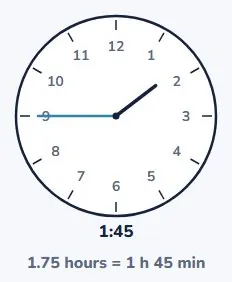
So what is 1.75 hours?
- 0.75 is three quarters.
- Three quarters of 60 minutes is 45.
- So 1 hour 45 minutes. Never 1 h 75.
Hours and minutes into minutes
- Turn the hours into minutes first, then add the rest.
- 2 h 45 is 120 plus 45, which is 165 minutes.
- 3 h 20 is 180 plus 20, so 200 minutes.
| Time | Working | Minutes |
|---|---|---|
| 2 h 45 min | 2 × 60, then + 45 | 165 min |
| 3 h 20 min | 3 × 60, then + 20 | 200 min |
| 1 h 05 min | 60 + 5 | 65 min |
Try it: 12-hour and 24-hour
And minutes back into hours
- Ask how many whole 60s fit in.
- 135 minutes: 60 goes in twice, leaving 15.
- So 2 hours 15 minutes.
| Minutes | Working | Gives |
|---|---|---|
| 135 min | how many whole 60s? | 2, with 15 left |
| So | 2 h 15 min | |
| 90 min | 1 whole hour, 30 left | 1 h 30 min |
Now a timetable
- A timetable never prints the number you actually want.
- It gives departure and arrival. You work out the gap.
- These times are made up, but the stations are real enough.
| Station | Morning | Afternoon |
|---|---|---|
| Avondale | 09:45 | 14:50 |
| Mount Albert | 09:58 | 15:03 |
| Kingsland | 10:12 | 15:18 |
| Britomart | 11:20 | 16:05 |
Do not subtract 9:45 from 11:20
- Treat those as decimals and you get 1.75, which means nothing.
- Subtract properly and you have to borrow 60, not 10.
- There is an easier way that never borrows at all.
| Method | Problem | |
|---|---|---|
| 11.20 − 9.45 as decimals | gives 1.75, which is wrong | |
| Column subtraction | borrowing in base 60 | error-prone |
| Counting up | no borrowing at all | use this |
Count up through the whole hours
- 09:45 to 10:00 is 15 minutes.
- 10:00 to 11:00 is a whole hour.
- 11:00 to 11:20 is 20 more. So 1 hour 35 minutes.
| From | Adds | |
|---|---|---|
| 09:45 to 10:00 | 15 min | |
| 10:00 to 11:00 | 1 hour | |
| 11:00 to 11:20 | 20 min | |
| Total | 1 h, 15 + 20 | 1 h 35 min |
Try it: count up through the hour
You have done this before
- It is how you worked out change from a $50 note.
- Get to the next round number, then jump.
- No borrowing, and it is how people actually do it.
| Situation | Get to | Then |
|---|---|---|
| Change from $50 | the next whole dollar | jump in tens |
| Duration from 09:45 | the next whole hour | jump in hours |
The afternoon service, same method
- 14:50 to 15:00 is 10 minutes.
- 15:00 to 16:00 is an hour.
- Then 5 minutes to 16:05. One hour 15.
| From | Adds | |
|---|---|---|
| 14:50 to 15:00 | 10 min | |
| 15:00 to 16:00 | 1 hour | |
| 16:00 to 16:05 | 5 min | |
| Total | 1 h 15 min |
Comparing two journeys
- The morning trip took 1 h 35. The afternoon took 1 h 15.
- So the afternoon one is 20 minutes quicker.
- Both in the same units before you compare. Always.
| Service | Duration | In minutes |
|---|---|---|
| Morning | 1 h 35 min | 95 |
| Afternoon | 1 h 15 min | 75 |
| Difference | 20 min | 20 |
Adding durations, and carrying 60
- 45 minutes plus 50 minutes is 95 minutes.
- 95 is more than an hour, so it is 1 h 35.
- 2 h 45 plus 1 h 30 gives 3 h 75, which carries to 4 h 15.
| Sum | Working | Gives |
|---|---|---|
| 45 min + 50 min | 95 min | |
| 95 min | 60 into 95 once, 35 left | 1 h 35 min |
| 2 h 45 + 1 h 30 | gives 3 h 75 min | |
| Carry the 60 | 4 h 15 min |
Three answers that are never right
- Anything with 60 or more minutes in it, like 3 h 75.
- 2.5 hours written as 2 h 50.
- A duration got by subtracting clock times as decimals.
| Written | Should be | |
|---|---|---|
| 3 h 75 min | 4 h 15 min | |
| 2.5 h = 2 h 50 | 2 h 30 min | |
| 11.20 − 9.45 = 1.75 | 1 h 35 min |
Common mistakes
- 1.75 hours is 1 h 75 min.0.75 of an hour is three quarters of 60 minutes, so 1.75 hours is 1 h 45 min.
- 11:20 − 9:45 = 1.75, so the trip took 1 h 75 min.Clock times are not decimals; count up: 15 min to 10:00, 1 hour to 11:00, 20 min more is 1 h 35 min.
- 2 h 45 + 1 h 30 = 3 h 75.75 minutes is more than an hour, so carry 60: 3 h 75 is 4 h 15.
- Two thirds of an hour is 66 minutes.A fraction of an hour is a fraction of 60, not 100: 60 ÷ 3 × 2 = 40 minutes.
Your turn: eight questions
- Try all eight.
- For question 3, count up through 09:00 and 10:00.
- Question 2 is a fraction of 60, not of 100.
How many minutes is 3 hours 20 minutes?
How many minutes is two thirds of an hour?
A train leaves at 08:50 and arrives at 10:15. How long is the trip?
Write 135 minutes in hours and minutes.
Write 1.2 hours in hours and minutes.
One ferry crosses the harbour in 1 h 50 min and another takes 95 minutes. How much quicker is the second ferry?
A tramper walks 2 h 40 min to a hut, then 1 h 35 min to a lake. How long is that altogether?
A movie is 155 minutes long and starts at 7:50 pm. What time does it finish?
Show answer
1. 200 minutes. Three hours is 180, plus the 20. 2. 40 minutes. A third of 60 is 20, so two thirds is 40. 3. 1 hour 25 minutes. Count up: 10 minutes to 09:00, an hour to 10:00, then 15 more. 4. 2 hours 15 minutes. Sixty goes into 135 twice, leaving 15. 5. 1 hour 12 minutes. The 0.2 is a fraction of 60, and 0.2 × 60 = 12. 6. 15 minutes. 1 h 50 min is 60 + 50 = 110 minutes, and 110 − 95 = 15. 7. 4 hours 15 minutes. 2 h 40 + 1 h 35 gives 3 h 75 min, and 75 minutes carries to 1 hour and 15 minutes. 8. 10:25 pm. 155 minutes is 2 h 35 min; 7:50 pm plus 2 hours is 9:50 pm, and 35 more minutes is 10:25 pm.
The answers
- 3 h 20 is 180 plus 20, which is 200 minutes.
- Two thirds of an hour is 40 minutes.
- 08:50 to 10:15 is 1 h 25. And 135 minutes is 2 h 15.
| Answer | |
|---|---|
| 1 | 200 min |
| 2 | 40 min |
| 3 | 1 h 25 min |
| 4 | 2 h 15 min |
What to take away
- Time runs in 60s, so a decimal hour is a fraction of 60.
- Count durations up through the whole hour. Never subtract.
- And if your answer has 60 or more minutes in it, carry.
| Remember | |
|---|---|
| Time | runs in 60s and 24s, never in tens |
| 2.5 hours | is 2 h 30 min, because half of 60 is 30 |
| A fraction of an hour | is that fraction of 60 minutes |
| Durations | count up through the whole hour |
| Over 60 minutes | carry an hour, do not write 75 |
Challenge
An audiobook lasts 7 h 12 min at normal speed. (a) How long does it last when played at 1.2 times normal speed? (b) Ana wants to finish it in 4 h 48 min. At what speed must she play it?
Hint
Change everything into minutes before you divide. Playing faster divides the time by the speed.
Answer
(a) 6 hours. (b) 1.5 times normal speed.
Step by step
- 7 h 12 min is 7 × 60 + 12 = 432 minutes.
- At 1.2 times speed it takes 432 ÷ 1.2 = 360 minutes, which is exactly 6 hours.
- 4 h 48 min is 4 × 60 + 48 = 288 minutes.
- The speed must be 432 ÷ 288 = 1.5 times normal.
Full working
- 7 × 60 + 12 = 432 minnormal length
- 432 ÷ 1.2 = 360 min = 6 hfaster means less time
- 4 × 60 + 48 = 288 minAna's target
- 432 ÷ 288 = 1.5speed needed
- (a) 6 h; (b) 1.5 times normal speed
One ferry runs back and forth between Devonport and the city. The crossing takes 12 minutes each way, and the ferry waits 8 minutes at each end before setting off again. Its first trip leaves Devonport at 06:15. No trip may leave Devonport after 23:30. (a) How many trips leave Devonport in a day? (b) At what time does the last one leave? (c) When is the ferry back at Devonport after that last trip?
Hint
Work out how long it takes from one Devonport departure to the next. Then count how many of those gaps fit before 23:30.
Answer
(a) 26 trips. (b) 22:55. (c) 23:27.
Step by step
- One full cycle is 12 + 8 + 12 + 8 = 40 minutes, so a trip leaves Devonport every 40 minutes.
- From 06:15 to 23:30 is 17 h 15 min, which is 1035 minutes.
- 1035 ÷ 40 is 25 whole gaps with 35 minutes over, so after the first trip there are 25 more: 26 trips.
- The last leaves 25 × 40 = 1000 minutes after 06:15. 1000 minutes is 16 h 40 min, so 22:55.
- It crosses (12), waits (8) and crosses back (12): 32 minutes, arriving at 23:27.
Full working
- 12 + 8 + 12 + 8 = 40 minone round cycle
- 06:15 to 23:30 = 17 h 15 min = 1035 mincount up through the hours
- 1035 ÷ 40 = 25 rem 35whole gaps that fit
- 1 + 25 = 26 tripsthe first trip plus 25 more
- 25 × 40 = 1000 min = 16 h 40 min; 06:15 + 16 h 40 = 22:55last departure
- 22:55 + 32 min = 23:27cross, wait, cross back
- (a) 26; (b) 22:55; (c) 23:27
Tama spends a day out. Of the whole time from leaving home to getting back, 15 is travelling (split equally between going and coming back), 25 is at the museum, 16 is at lunch, and the rest, 70 minutes, is at the park. He did them in this order: travel, museum, lunch, park, travel. He left home at 08:50. At what time did lunch start, and when did he get home?
Hint
First find what fraction of the day the park was. That fraction is 70 minutes, so you can find the whole time.
Answer
Lunch started at 11:20 and he got home at 13:50.
Step by step
- The fractions so far add to 15 + 25 + 16 = 2330, so the park is 730 of the time.
- 730 of the time is 70 minutes, so 130 is 10 minutes and the whole outing is 300 minutes, 5 hours.
- Travel is 60 minutes (30 each way), the museum 120 minutes, lunch 50 minutes.
- 08:50 plus 30 min is 09:20, plus 2 hours at the museum is 11:20, when lunch starts.
- 5 hours after 08:50 is 13:50, when he gets home.
Full working
- 15 + 25 + 16 = 630 + 1230 + 530 = 2330known parts
- 1 − 2330 = 730the park
- 730 of the time = 70 min, so 130 = 10 mindivide by 7
- whole time = 30 × 10 = 300 min = 5 hall of it
- travel 60 min, museum 120 min, lunch 50 min15, 25 and 16 of 300
- 08:50 + 30 min = 09:20; + 2 h = 11:20lunch starts
- 08:50 + 5 h = 13:50check: 11:20 + 50 + 70 + 30 min = 13:50
- Lunch at 11:20; home at 13:50
Practise this
Report a mistake
More in Measurement

Is your child on track?
Take the free placement test