Angle rules, parallel lines and directions
What this lesson covers
- The interior angle sum of a triangle is 180°; for a quadrilateral, it is 360°.
- The interior angle sum of any polygon can be found using the formula 180(n−2)°, where n represents the total number of sides.
Eight angle rules, or two?
- Supplementary, complementary, vertically opposite...
- Corresponding, alternate, co-interior.
- They all come out of two facts.
| This | Makes |
|---|---|
| Along a straight line | 180° |
| All the way round a point | 360° |
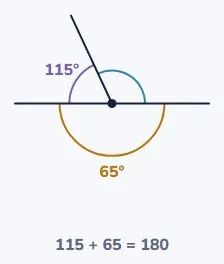
One: a straight line is 180°
- Half a full turn.
- So two angles sitting on a line add to 180.
- They are called supplementary.
Two: all the way round is 360°
- A full turn.
- So angles meeting at a point add to 360.
- That is the whole list of facts.
| This | Makes |
|---|---|
| Along a straight line | 180° |
| All the way round a point | 360° |
Try it: angles at a point
Everything else is one of those two
- Complementary is 90, half a straight line.
- Angles at a point is the full turn.
- And vertically opposite comes from the straight line.
| Name | Says | Comes from |
|---|---|---|
| Supplementary | add to 180° | straight line |
| Complementary | add to 90° | half a straight line |
| Vertically opposite | equal | both on a straight line with a third |
| Angles at a point | add to 360° | full turn |
Why vertically opposite angles are equal
- A and b sit on a line, so a + b = 180.
- b and c sit on a line, so b + c = 180.
- Both a and c equal 180 − b. So a = c.
| Because | Which means | |
|---|---|---|
| a and b | on a straight line | a + b = 180 |
| b and c | on a straight line | b + c = 180 |
| So | a and c both equal 180 − b | a = c |
So you do not have to remember it
- You can rebuild it in three lines.
- The same is true of every rule coming up.
- Which is why there are only two to learn.
| Name | Says | Comes from |
|---|---|---|
| Supplementary | add to 180° | straight line |
| Complementary | add to 90° | half a straight line |
| Vertically opposite | equal | both on a straight line with a third |
| Angles at a point | add to 360° | full turn |
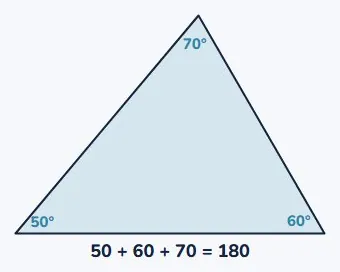
The triangle sum
- Every triangle, however it is shaped, has angles adding to 180.
- You have used this since Year 6.
- Now it is going to build something.
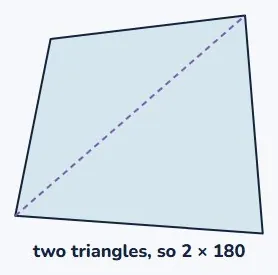
A quadrilateral is two triangles
- Draw one diagonal from a corner.
- Two triangles, 180 each.
- So a quadrilateral is 360.
And any polygon at all
- A pentagon splits into three triangles. 540.
- A hexagon into four. 720.
- n sides gives n − 2 triangles: 180(n − 2).
| Shape | Splits into | Angle sum |
|---|---|---|
| Triangle | 1 triangle | 180° |
| Quadrilateral | 2 triangles | 360° |
| Pentagon | 3 triangles | 540° |
| Hexagon | 4 triangles | 720° |
| n sides | n − 2 triangles | 180(n − 2) |
Check it against last lesson
- A regular pentagon: 540 ÷ 5 = 108° each.
- Last lesson we got 180 − 72 = 108.
- Two different routes, one answer.
| Route | Working | Answer |
|---|---|---|
| Angle sum | 540 ÷ 5 | 108° |
| Exterior | 180 − 72 | 108° |
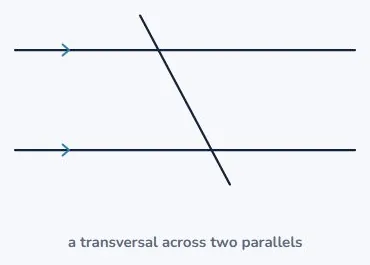
Two parallel lines, and one crossing them
- The crossing line is called a transversal.
- It makes eight angles.
- And there are only two different sizes among them.
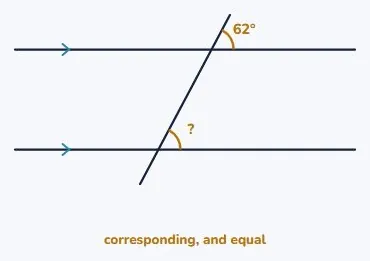
Corresponding angles are equal
- Matching positions at each crossing.
- Because the two lines are parallel...
- ...the second crossing is a copy of the first.
Geometry board
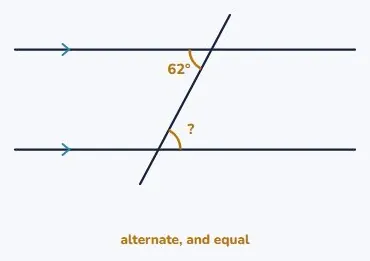
Alternate angles are equal
- Opposite sides of the transversal, both inside.
- Also equal, and you can get there two ways.
- Corresponding, then vertically opposite.
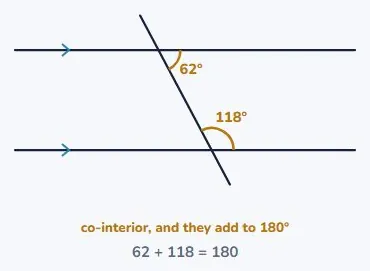
Co-interior angles add to 180
- Same side of the transversal, both inside.
- These two are NOT equal.
- They sit on a straight line, so 180.
The three names, in one place
- Corresponding and alternate: equal.
- Co-interior: add to 180.
- If you forget which, work it out from the straight line.
| Name | Where | Relationship |
|---|---|---|
| Corresponding | matching positions | equal |
| Alternate | opposite sides, inside | equal |
| Co-interior | same side, inside | add to 180° |
Try it: F, Z and C angles
Setting up an equation
- Two angles on a straight line: x + x + 40 and nothing else.
- So 2x + 40 = 180.
- Take 40 off, divide by 2. x = 70.
| Step | Working | Why |
|---|---|---|
| Set it up | 2x + 40 = 180 | a straight line |
| Take 40 off both | 2x = 140 | |
| Divide both by 2 | x = 70 | 70° |
| Check | 140 + 40 = 180 | true |
Eight directions, 45° apart
- North, east, south, west: 90° apart.
- Then the halfway ones between them.
- NE is 45° east of north.
| Point | Clockwise from N |
|---|---|
| N | 0° |
| NE | 45° |
| E | 90° |
| SE | 135° |
| S | 180° |
| SW | 225° |
| W | 270° |
| NW | 315° |
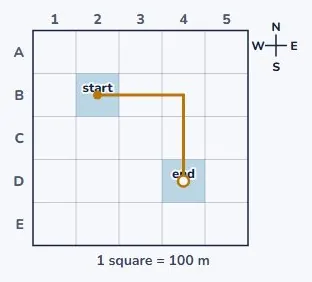
Describing a route
- Start at B2. Go 2 squares east to B4.
- Then 2 squares south to D4.
- Squares, and a direction, for each leg.
Try it: turns and routes
Common mistakes
- Co-interior angles are equal, so the missing angle is 115°.Co-interior angles add to 180°, so the missing angle is 180 − 115 = 65°; only corresponding and alternate angles are equal.
- A heptagon has 7 sides, so its angles add to 180 × 7 = 1260°.Use 180(n − 2): a heptagon splits into 5 triangles, so its interior angles add to 180 × 5 = 900°.
- 2x + 40 = 180, so 2x = 220 and x = 110.Take 40 off both sides, not add it: 2x = 140, so x = 70.
- 135° clockwise from north is north-east.North-east is only 45°; 135° is three 45° steps round from north, which is south-east.
Your turn: eight questions
- Try all eight.
- On question 1, count the triangles.
- On question 3, remember co-interior is the 180 one.
Find the interior angle sum of a heptagon (7 sides).
Two angles lie on a straight line. One is 115°. Find the other.
Parallel lines are cut by a transversal. One angle is 73°. Find its co-interior partner.
Which compass direction is 135° clockwise from north?
Parallel lines are cut by a transversal. Which pair of angles adds to 180°?
Three angles meet at a point. Two of them are 100° and 70°. Find the third.
Hemi faces south-east and turns 135° clockwise. Which way does he face now?
Two angles on a straight line are 3x and x + 20. Find x.
Show answer
1. 900°. 180 × (7 − 2) = 180 × 5. 2. 65°. They are supplementary, so 180 − 115. 3. 107°. Co-interior angles add to 180, so 180 − 73. 4. South-east. Each of the eight points is 45° apart, and 135 is three of those from north. 5. Co-interior angles: same side of the transversal, both inside. Corresponding and alternate angles are equal instead. 6. 190°. Angles at a point add to 360°, so 360 − 100 − 70 = 190°. 7. West. South-east is 135° clockwise from north, and 135 + 135 = 270°, which is west. 8. x = 40. They add to 180, so 4x + 20 = 180, then 4x = 160, and x = 40.
The answers
- A heptagon is 5 triangles: 900°.
- 180 − 115 = 65°. And 180 − 73 = 107°.
- 135° clockwise from north is south-east.
| Answer | |
|---|---|
| 1 | 900° |
| 2 | 65° |
| 3 | 107° |
| 4 | south-east |
What to take away
- Two facts: a straight line is 180, a full turn is 360.
- Every other angle rule is one of those, applied.
- A polygon splits into n − 2 triangles, so 180(n − 2).
| Remember | |
|---|---|
| Straight line | 180°: this is half of everything |
| Round a point | 360°: this is the other half |
| Polygon sum | 180(n − 2), because n − 2 triangles fit |
| Parallel lines | corresponding and alternate equal, co-interior 180 |
| Compass | eight points, 45° apart |
Challenge
A polygon has one interior angle of 90°. Every other interior angle is 150°. How many sides does the polygon have?
Hint
Call the number of sides n. Write the angle sum two ways: once with 180(n − 2), and once by adding up the angles you are told about.
Answer
10 sides.
Step by step
- If there are n sides, there are n − 1 angles of 150° and one of 90°.
- The angles add to 180(n − 2), because the polygon splits into n − 2 triangles.
- Each 150° angle is 30° short of 180°, and the 90° angle is 90° short. Altogether the shortfall is 2 × 180 = 360°, since the sum is 180n minus 360.
- So 30(n − 1) + 90 = 360, which gives 30(n − 1) = 270, n − 1 = 9 and n = 10.
- Check: 9 × 150 + 90 = 1440, and 180 × 8 = 1440.
Full working
- 150(n − 1) + 90 = 180(n − 2)two ways to write the angle sum
- 150n − 60 = 180n − 360expand both sides
- 300 = 30nadd 360, take 150n off both
- n = 10divide by 30
- check: 9 × 150 + 90 = 1440 = 180 × 8true
- 10 sides
Mere leaves her tent and walks north-east. She then turns clockwise and walks due south, then turns clockwise again and walks due west, which brings her straight back to her tent. Find the angle she turns through at each of the two corners, and the turn she must make at the tent to face north-east again. Find the three angles inside her triangle, give both names of the triangle, and explain why her south leg and her west leg must be the same length.
Hint
Measure each direction clockwise from north (NE is 45°). The turn is the difference between the two directions. Each inside angle sits on a straight line with its turn.
Answer
Turns: 135°, 90° and 135° (total 360°). Inside angles: 45° at the first corner, 90° at the second corner and 45° at the tent. It is a right isosceles triangle. The 45° angles are equal, so the sides opposite them, the west leg and the south leg, are equal.
Step by step
- Clockwise from north, NE is 45°, S is 180° and W is 270°.
- First corner: 180 − 45 = 135°. Second corner: 270 − 180 = 90°. At the tent, from 270° round to 405° (which is 45°): 135°. They total 360°, one full turn.
- Each inside angle and its turn sit on a straight line, so the inside angles are 180 − 135 = 45°, 180 − 90 = 90° and 45°.
- One 90° angle makes it right, and two equal angles make it isosceles.
- The angle at the first corner faces the west leg and the angle at the tent faces the south leg. Equal angles face equal sides.
Full working
- NE 45°, S 180°, W 270°clockwise from north
- 180 − 45 = 135°turn at first corner
- 270 − 180 = 90°turn at second corner
- 405 − 270 = 135°turn at the tent back to NE
- 135 + 90 + 135 = 360°one full turn
- 180 − 135 = 45°, 180 − 90 = 90°, 180 − 135 = 45°inside angles, sum 180°
- right isosceles; the south and west legs are equal
Two straight roads run east to west and are parallel. A path goes from point A on the north road to a bend at point B between the roads, then on to point C on the south road. B is further east than both A and C. On the east side of A, the path AB makes an angle of (2x + 5)° with the north road. On the east side of C, the path CB makes an angle of (3x − 10)° with the south road. The angle ABC at the bend is 120°. Find x and both angles at the roads, and explain why the angle at the bend equals the sum of the two angles at the roads.
Hint
Draw a third line through B, parallel to the roads. It splits the 120° into two parts. Which angles at the roads are each part equal to?
Answer
x = 25, so the angles at the roads are 55° and 65°. A line through B parallel to the roads splits angle ABC into two alternate angles, one equal to each road angle, so the bend angle is their sum.
Step by step
- Draw a line through B parallel to the two roads. It points west from B, into the angle ABC.
- AB crosses the north road and the new line, so the top part of angle ABC is alternate to the angle at A: it equals (2x + 5)°.
- In the same way the bottom part equals the angle at C, (3x − 10)°.
- So (2x + 5) + (3x − 10) = 120, which is 5x − 5 = 120, 5x = 125, x = 25.
- The angles are 2 × 25 + 5 = 55° and 3 × 25 − 10 = 65°, and 55 + 65 = 120.
Full working
- top part of angle B = 2x + 5alternate angles, AB as transversal
- bottom part of angle B = 3x − 10alternate angles, CB as transversal
- (2x + 5) + (3x − 10) = 120the two parts make the bend
- 5x − 5 = 120collect like terms
- 5x = 125, x = 25add 5, divide by 5
- 2 × 25 + 5 = 55°, 3 × 25 − 10 = 65°check 55 + 65 = 120
- x = 25; angles 55° and 65°
Where science uses this
Practise this
Report a mistake
More in Geometry
Is your child on track?
Take the free placement test