Exterior angles, transformations and nets
What this lesson covers
- The sum of the exterior angles of a polygon is 360°.
- In a regular polygon, all exterior angles are the same; an exterior angle can be found by subtracting the interior angle from 180° or by dividing 360° by the number of sides.
Walk round any shape and you turn 360°
- Any polygon at all. Three sides or thirty.
- Regular or completely lopsided.
- Always exactly one full circle.
What an exterior angle is
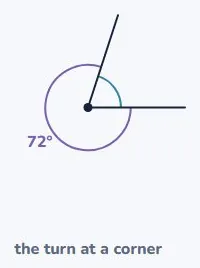
- Stand on a side and walk to the corner.
- How far do you swing round to face the next side?
- That swing is the exterior angle.
Why they total 360
- Walk the whole way round and come back.
- You end up facing the direction you started.
- So the turns added up to one whole circle.
| Step | What happens | Total |
|---|---|---|
| At each corner | you turn by the exterior angle | |
| Back at the start | you face the original way | |
| So you turned | exactly one full circle | 360° |
Try it: walk round the shape
The number of sides makes no difference
- More corners means more turns.
- But each one is smaller.
- The total is still one circle. Always 360.
A regular polygon shares them out equally
- All its corners are identical.
- So each exterior angle is 360 divided by the sides.
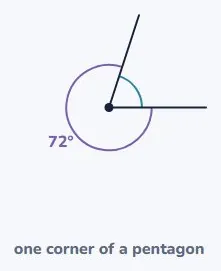
- A pentagon: 360 ÷ 5 = 72°.
| Shape | Exterior | Interior |
|---|---|---|
| Triangle | 360 ÷ 3 = 120° | 60° |
| Square | 360 ÷ 4 = 90° | 90° |
| Pentagon | 360 ÷ 5 = 72° | 108° |
| Hexagon | 360 ÷ 6 = 60° | 120° |
| Octagon | 360 ÷ 8 = 45° | 135° |
And the interior angle comes free
- The interior and exterior sit on a straight line.
- So they add to 180.
- Pentagon: 180 − 72 = 108°.
| Fact | Working | Answer |
|---|---|---|
| Interior + exterior | they lie on a straight line | 180° |
| Pentagon exterior | 72° | |
| So its interior | 180 − 72 | 108° |
A regular octagon
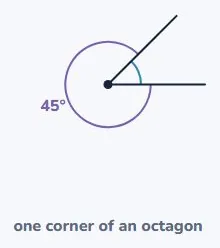
- Eight sides, so exterior is 360 ÷ 8 = 45°.
- Interior is 180 − 45 = 135°.
- Two divisions and one subtraction. That is all of it.
| Shape | Exterior | Interior |
|---|---|---|
| Triangle | 360 ÷ 3 = 120° | 60° |
| Square | 360 ÷ 4 = 90° | 90° |
| Pentagon | 360 ÷ 5 = 72° | 108° |
| Hexagon | 360 ÷ 6 = 60° | 120° |
| Octagon | 360 ÷ 8 = 45° | 135° |
Now moving shapes about
- Three ways: slide, flip and turn.
- Translation, reflection and rotation.
- Each one needs to be told something different.
| Name | Plain word | Needs |
|---|---|---|
| Translation | a slide | how far across and up |
| Reflection | a flip | the mirror line |
| Rotation | a turn | the centre and the angle |
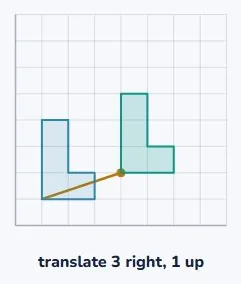
A slide
- Every point moves the same distance the same way.
- Here: 3 across and 1 up.
- The shape arrives exactly as it left.
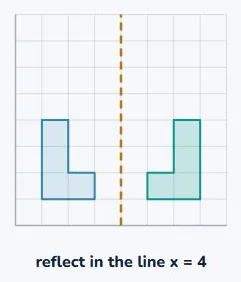
A flip
- Every point crosses the mirror line.
- And lands the same distance on the other side.
- The shape is reversed but not resized.
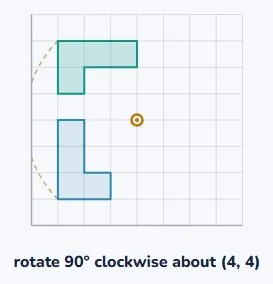
A turn
- Pick a centre point and an angle.
- Here: a quarter turn about (4, 4).
- Multiples of 90 keep it on the grid lines.
Try it: slide, flip and turn
What never changes
- The sides are the same length.
- The angles are the same size. The area is the same.
- Only its position moved.
| Property | After the move |
|---|---|
| Side lengths | unchanged |
| Angles | unchanged |
| Area | unchanged |
| Where it is | THIS is what changes |
Solids are made of flat shapes
- A cube is six squares.
- A triangular prism is two triangles and three rectangles.
- Name the flat shapes and you know the solid.
| Solid | Made of | and |
|---|---|---|
| Cube | 6 squares | |
| Triangular prism | 2 triangles | 3 rectangles |
| Square pyramid | 1 square | 4 triangles |
| Hexagonal prism | 2 hexagons | 6 rectangles |
A net is the solid, unfolded
- Cut along some edges and flatten it out.
- Every face is still there.
- None appear, none disappear.
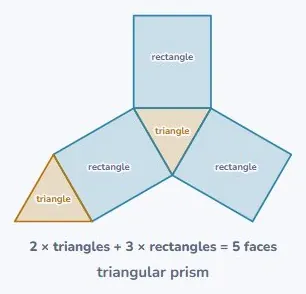
Counting a prism net
- One rectangle for each side of the base.
- Plus the two ends.
- A triangular prism: 3 rectangles and 2 triangles.
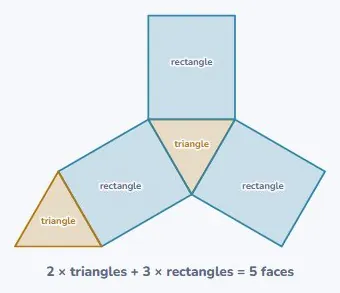
And a pyramid
- One triangle for each side of the base.
- Plus the base itself. Only one, not two.
- A square pyramid: 4 triangles and 1 square.
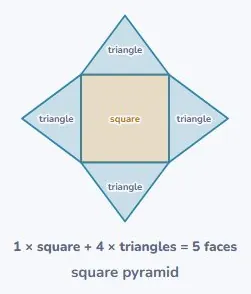
So you can count without drawing
- A prism on an n-sided base has n + 2 faces.
- A pyramid on an n-sided base has n + 1.
- A hexagonal prism: 6 + 2 = 8 faces.
| Solid | Made of | Total |
|---|---|---|
| Prism on an n-gon | n rectangles + 2 ends | n + 2 faces |
| Pyramid on an n-gon | n triangles + 1 base | n + 1 faces |
Try it: build the faces
Common mistakes
- A regular octagon has more sides, so its exterior angles add to more than 360°.Exterior angles always total 360° for any polygon; more sides just means each one is smaller (360 ÷ 8 = 45°).
- Each exterior angle of a regular pentagon is 360 ÷ 5 = 72°, so the interior angle is 72° too.Interior and exterior sit on a straight line, so the interior angle is 180 − 72 = 108°.
- A square pyramid net has 4 triangles and 2 squares, like a prism.A pyramid has only one base, so its net is 4 triangles and 1 square: n + 1 faces, not n + 2.
- A quarter turn about (4, 4) made the shape smaller, so I drew it smaller.Translations, reflections and rotations change only position; side lengths, angles and area stay exactly the same.
Your turn: eight questions
- Try all eight.
- Question 1 needs one division and nothing else.
- Question 4 wants a reason.
A regular polygon has 12 sides. Find one exterior angle.
Find one interior angle of that same polygon.
How many faces does the net of a pentagonal prism have?
A shape is rotated 90° about a point. Does its area change?
Which flat shapes make up a hexagonal pyramid?
The point (2, 5) is translated 3 to the right and 1 down. Where does it land?
The point (3, 2) is reflected in the y-axis. Where does it land?
Each exterior angle of a regular polygon is 40°. How many sides does it have?
Show answer
1. 30°. The exterior angles total 360 and there are 12 of them, so 360 ÷ 12. 2. 150°. Interior and exterior make a straight line, so 180 − 30. 3. 7. Five rectangles round the sides plus two pentagon ends. 4. No. A rotation changes where a shape is and nothing about the shape itself. 5. 1 hexagon and 6 triangles. A pyramid has one triangle for each side of the base, plus the base itself, only once. 6. (5, 4). Right adds 3 to the first number, 2 + 3 = 5, and down takes 1 off the second, 5 − 1 = 4. 7. (−3, 2). It crosses the y-axis and lands the same distance, 3, on the other side; its height 2 does not change. 8. 9 sides. The exterior angles total 360°, so 360 ÷ 40 = 9.
The answers
- 360 ÷ 12 = 30°, and 180 − 30 = 150°.
- A pentagonal prism net has 5 + 2 = 7 faces.
- No. A rotation moves a shape and changes nothing about it.
| Answer | |
|---|---|
| 1 | 30° |
| 2 | 150° |
| 3 | 7 faces |
| 4 | no, area is unchanged |
What to take away
- Exterior angles always total 360, whatever the polygon.
- For a regular one, each is 360 ÷ n, and interior is 180 − that.
- Sliding, flipping and turning change nothing but position.
| Remember | |
|---|---|
| Exterior angles | always total 360°, whatever the polygon |
| Regular polygon | each exterior angle is 360 ÷ n |
| Interior | is 180 − exterior |
| Slide, flip, turn | the shape never changes, only its position |
| A net | has every face the solid has, and no more |
Challenge
Triangle PQR has corners P(1, 2), Q(5, 4) and R(2, −1). Ana reflects it in the vertical mirror line x = 3 (every point on it has x-coordinate 3). She then reflects that image in the vertical mirror line x = 7. Find the corners of the final triangle. What single transformation would move PQR straight onto the final triangle, and is the final triangle reversed like a mirror image? What single transformation does she get if she reflects in x = 7 first and then in x = 3?
Hint
A reflected point lands the same distance from the mirror line, on the other side, at the same height. Do the two reflections one at a time, then compare where each corner started and finished.
Answer
The final corners are (9, 2), (13, 4) and (10, −1). It is a translation of 8 units right and 0 up, and the triangle is not reversed: the second flip undoes the first. Reflecting in x = 7 first and then x = 3 gives a translation of 8 units left instead, to (−7, 2), (−3, 4) and (−6, −1).
Step by step
- Reflecting in x = 3: P is 2 to the left of the line, so it lands 2 to the right at (5, 2). Q is 2 to the right, so it lands at (1, 4). R is 1 to the left, so it lands at (4, −1). The heights do not change.
- Reflecting those in x = 7: (5, 2) is 2 to the left, so it lands at (9, 2). (1, 4) is 6 to the left, so it lands at (13, 4). (4, −1) is 3 to the left, so it lands at (10, −1).
- Each corner has moved 8 to the right and not up or down, so one translation of 8 right does the same job.
- The first flip reverses the triangle and the second flip reverses it back, so the final triangle faces the same way as PQR, just as a slide leaves it.
- The 8 is twice the 4-unit gap between the mirror lines. In the other order, P goes to (13, 2) and then (−7, 2), Q to (9, 4) then (−3, 4), R to (12, −1) then (−6, −1): every corner moves 8 to the left.
Full working
- x = 3: P(1, 2) → (5, 2), Q(5, 4) → (1, 4), R(2, −1) → (4, −1)same distance, other side
- x = 7: (5, 2) → (9, 2), (1, 4) → (13, 4), (4, −1) → (10, −1)second reflection
- 9 − 1 = 13 − 5 = 10 − 2 = 8every corner moves 8 right, 0 up
- flip then flip backnot reversed, so a translation
- 2 × (7 − 3) = 8twice the gap between the mirrors
- x = 7 then x = 3: (−7, 2), (−3, 4), (−6, −1)each corner moves 8 left
- final corners (9, 2), (13, 4), (10, −1): a translation 8 right; the other order is a translation 8 left
Polygons A and B are both regular. A has three times as many sides as B. Each interior angle of A is 40° bigger than each interior angle of B. What are the two polygons, and what is the interior angle of each?
Hint
Compare exterior angles instead of interior ones. If the interior angle is 40° bigger, what happens to the exterior angle?
Answer
B is a regular hexagon (interior angle 120°) and A is a regular 18-sided polygon (interior angle 160°).
Step by step
- Interior plus exterior is always 180°, so if A's interior angle is 40° bigger, its exterior angle is 40° smaller.
- Say B has n sides. Its exterior angle is 360 ÷ n. A has 3n sides, so its exterior angle is a third of B's.
- So B's exterior angle minus a third of it is 40°: two thirds of it is 40°, and the whole is 60°.
- 360 ÷ 60 = 6, so B is a hexagon, with interior angle 180 − 60 = 120°.
- A has 18 sides, exterior angle 20°, interior angle 160°, which is 40° more than 120°.
Full working
- exterior of A = exterior of B − 40interiors differ by 40
- exterior of A = exterior of B ÷ 3three times the sides
- 23 of exterior of B = 40difference of the two
- exterior of B = 60°so B has 360 ÷ 60 = 6 sides
- A: 18 sides, exterior 360 ÷ 18 = 20°check 60 − 20 = 40
- interiors: 180 − 60 = 120°, 180 − 20 = 160°160 − 120 = 40
- B: hexagon, 120°; A: 18-sided polygon, 160°
A drone flies 20 m in a straight line, turns 150° clockwise, flies another 20 m, turns 150° clockwise again, and keeps repeating this. How many 20 m legs has it flown when it is first back at its starting point facing its starting direction? Through how many full turns has it swung in total? Its path crosses itself, so explain why its turns do not add up to 360° like the exterior angles of an ordinary polygon.
Hint
To face the starting direction again, the total amount turned must be a whole number of full turns. Which multiples of 150 are also multiples of 360?
Answer
12 legs (240 m). It turns 12 × 150 = 1800°, which is 5 full turns. It draws a 12-pointed star; the 360° rule is for walking once round a shape that does not cross itself, and this path winds round its centre 5 times.
Step by step
- Facing the start direction again needs the total turn to be a multiple of 360°.
- Go through multiples of 150: 150, 300, 450, ... The first that is also a multiple of 360 is 1800 = 12 × 150 = 5 × 360.
- Its directions so far are 12 different headings, 30° apart, and 12 equal legs spread evenly like that bring it back to the start.
- So it flies 12 legs, 12 × 20 = 240 m, and swings round 5 full turns.
- A drone turning 30° each time would trace a regular 12-sided polygon, turning only once round: 12 × 30 = 360°. The star crosses itself and goes round 5 times instead.
Full working
- 150 × k must be a multiple of 360back to the start heading
- 150 × 12 = 1800 = 5 × 360first time this happens
- headings 0°, 150°, 300°, 90°, 240°, 30°, ...12 different directions, 30° apart
- 12 × 20 = 240 mdistance flown
- 1800 ÷ 360 = 5full turns
- 12 legs, 5 full turns
Practise this
Report a mistake
More in Geometry
Is your child on track?
Take the free placement test