How we see: light sources, reflection and refraction
What this lesson covers
- Light sources, and why we see objects that give out no light
- How Ibn al-Haytham challenged Plato's idea of sight
- Drawing light as rays that travel in straight lines
- Reflection, the normal, and equal angles at a mirror
- How we see a reflection
- Refraction when light passes between air, water and glass
Two ways light reaches your eyes
- A light source gives out its own light: the Sun, a lamp, a fire, a phone screen, even a glow-worm in the Waitomo caves.
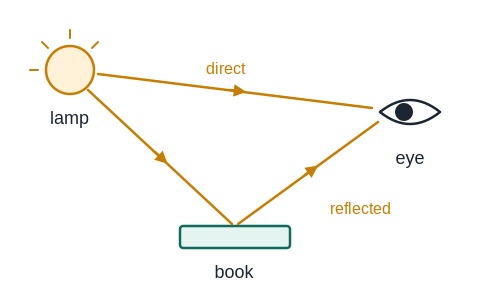
- Most things are not sources. A book, a tree or the Moon only send light to us because light from a source bounces off them.
- So you see a source when its light travels straight into your eyes.
- You see every other object when light goes from a source to the object, reflects off it, and then enters your eyes.
- In a totally dark room you see nothing, even with your eyes wide open, because no light is arriving at them.
Try it: source or reflector?
Ibn al-Haytham and Plato
- The Greek philosopher Plato, around 2400 years ago, taught that sight works by a kind of fire or ray streaming out of the eyes towards objects.
- Ideas like this were widely accepted for well over a thousand years.
- Ibn al-Haytham, a scientist born in Basra (in modern Iraq) who worked in Cairo about 1000 years ago, argued the opposite: light travels from objects into the eye.
- He pointed to evidence, such as the pain of looking at the bright Sun, and tested his ideas with experiments in darkened rooms where light came through a small hole.
- His Book of Optics showed how careful experiments can overturn an idea, even a very old one held by famous thinkers.
Light travels in straight lines
- In air, light travels in straight lines, which is why shadows have sharp edges and you cannot see round a corner.
- Scientists draw light as rays: straight lines drawn with a ruler, with an arrow showing which way the light is going.
- Arrows always point away from the source and towards the eye, never out of the eye.
- A ray diagram shows the path of light, not what the objects look like.
Reflection off a mirror
- Reflection is light bouncing off a surface.
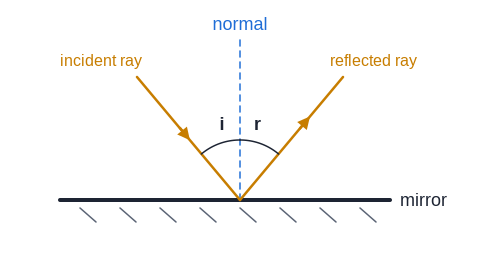
- To measure angles at a mirror, draw the normal: a dashed line at right angles (90°) to the mirror where the ray hits it.
- The angle between the incoming ray and the normal is the angle of incidence. The angle between the reflected ray and the normal is the angle of reflection.
- For any flat mirror, these two angles are always equal.
- A smooth surface such as a mirror or still water reflects rays neatly, so you see an image. A rough surface such as paper scatters them in all directions, so you just see the paper.
How you see a reflection
- On a calm morning Lake Matheson on the West Coast mirrors the Southern Alps.
- The light has made a journey in three legs: from the Sun to the mountains, from the mountains down to the lake surface, then off the water and up into your eyes.
- Your brain assumes light always travels in straight lines, so it traces the rays back and the mountains seem to sit upside down under the water.
- The same thing happens with a bathroom mirror: the image seems to be behind the glass, as far behind it as you are in front.
Working out a reflected angle
- A torch beam hits a flat mirror. The beam makes an angle of 50° with the mirror surface. What is the angle of reflection?
- Angles are measured from the normal, not the mirrorthe normal is at 90° to the mirror
- Angle of incidence = 90° − 50° = 40°the two angles make a right angle
- Angle of reflection = angle of incidencetrue for every flat mirror
- Angle of reflection = 40°
Try it: a plane mirror
Refraction: light changing direction
- Light travels at different speeds in different materials. It is slower in water than in air, and slower still in glass.
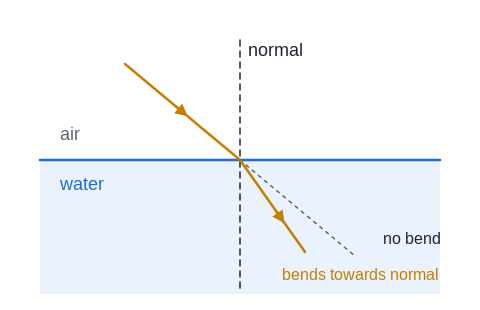
- When light crosses at an angle from one material into another, the change of speed makes it change direction. This is called refraction.
- Going from air into water or glass, the ray bends towards the normal. Coming back out into air, it bends away from the normal.
- A ray that meets the surface straight on, along the normal, slows down but does not change direction.
Try it: bend a ray
Why the pool looks shallow
- Someone standing beside a pool sees a coin on the bottom. Explain why the coin seems higher up than it really is.
- Light from the coin travels up through the waterthe coin reflects light from the sky
- At the surface it passes into air and bends away from the normalit speeds up as it leaves the water
- The brain traces the bent ray back in a straight lineit assumes light never bends
- That line ends above the real coin, so the pool seems shallower than it is
Room 8 tests angle and refraction
- Room 8 shone a ray box at the flat side of a clear plastic half-disc block, changing the angle of incidence and measuring the angle of the ray inside the block with a protractor.
- They kept the same block, the same ray box and the same narrow slit for every reading, and traced each ray in pencil before measuring.
| Angle in air | Angle in block |
|---|---|
| 0° | 0° |
| 20° | 13° |
| 40° | 26° |
| 60° | 35° |
- At 0° the ray goes straight throughit travels along the normal
- Each angle in the block is smaller than in airthe ray bends towards the normal
- The bigger the angle in air, the more it bends: 7° at 20°, 25° at 60°compare the differences
- Light bends towards the normal entering plastic, and bends more at larger angles
Common mistakes
- We see a book because light comes out of our eyes and hits it.Light from a source reflects off the book and travels into our eyes; arrows on a ray diagram point towards the eye.
- The angle of incidence is measured between the ray and the mirror.Both angles are measured from the normal, the line at 90° to the mirror.
- Refraction is when light bounces off water.Bouncing off is reflection; refraction is light changing direction as it passes into a new material.
- A ray going into glass always bends.A ray that hits the surface along the normal slows down but carries straight on.
Make a hidden coin appear
You need: an opaque mug or bowl, a coin, a jug of water, a helper, a piece of Blu Tack
- Stick the coin to the middle of the bottom of the empty mug with a small piece of Blu Tack.
- Look at the coin over the rim, then slowly move your head back and down until the rim just hides it. Keep your head there.
- Ask your helper to pour water slowly into the mug without moving the coin.
- Keep still and see what happens to the coin as the water level rises.
- Look for the coin coming back into view: light from the coin now bends as it leaves the water, so it reaches your eye over the rim.
Safety: Do this at a table or bench, not near a phone or charger, and wipe up spilt water straight away so nobody slips on a wet floor.
Your turn
Is the Moon a light source? Explain how we see it.
A ray hits a mirror with an angle of incidence of 25°. What is the angle of reflection?
A ray makes an angle of 70° with a mirror surface. What is the angle of reflection?
A ray of light passes from air into a glass block at an angle. Does it bend towards or away from the normal?
What evidence did Ibn al-Haytham use against the idea that sight comes from rays leaving the eye?
Show answer
1. No; sunlight reflects off the Moon and travels to our eyes. 2. 25°, because the angle of reflection always equals the angle of incidence. 3. 20°: the angle of incidence is 90° − 70° = 20°, and reflection matches it. 4. Towards the normal, because light slows down in glass. 5. Looking at the bright Sun hurts the eyes, which makes sense only if light is entering them; he also tested ideas with experiments in darkened rooms.
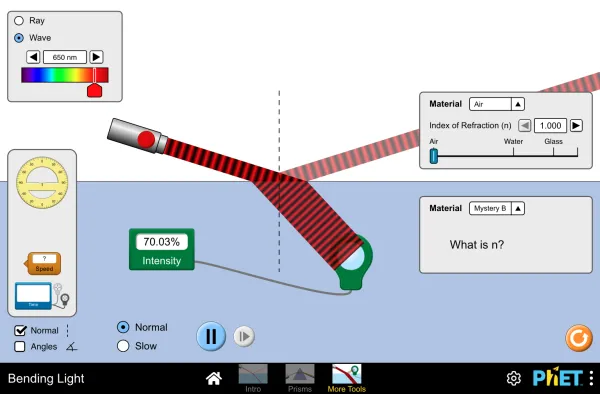
Bending Light
Full screen · PhET Interactive Simulations, University of Colorado Boulder, CC BY 4.0
Recap
- We see sources by their own light and everything else by light that reflects off it into our eyes.
- Ibn al-Haytham used evidence and experiments to show light enters the eye, overturning Plato's idea of rays leaving it.
- Light travels in straight lines, drawn as ruled rays with arrows pointing towards the eye.
- At a mirror, the angles of incidence and reflection are equal, both measured from the normal.
- Refraction is light changing direction as it crosses into a new material: towards the normal going into water or glass, away from it coming out.
Challenge
Two flat mirrors, A and B, stand upright on a table and meet at a right angle (90°), like the corner of a box. Looking down from above, a narrow torch beam hits mirror A with an angle of incidence of 25°, reflects onto mirror B, and reflects again. (a) What is the angle of reflection at mirror A? (b) What is the angle of incidence at mirror B? (c) Show that the beam leaving mirror B travels back parallel to the beam that came in, but in the opposite direction. (d) Bike reflectors and the reflectors astronauts left on the Moon use corners like this. Why is that useful?
Hint
Turn each angle with the normal into an angle with the mirror (90° minus it). The beam between the mirrors and the two mirrors make a triangle, and a triangle's angles add to 180°.
Answer
(a) 25°. (b) 65°. (c) The beam is turned 130° at A and 50° at B, 180° in total, so it heads straight back the way it came. (d) Light returns towards its source whatever angle it arrives at, so a driver's headlights light the reflector up for the driver, and a laser fired from Earth comes back to the telescope that sent it.
Step by step
- At A the angle of reflection equals the angle of incidence.
- The beam leaves A at 90° − 25° = 65° to mirror A. In the triangle made by the beam and the two mirrors, the corner is 90°, so the beam meets mirror B at 180° − 90° − 65° = 25° to the mirror.
- An angle of 25° with the mirror means 65° with the normal.
- At a mirror, a beam with angle of incidence i is turned through 180° − 2i, because it reverses its direction except for the two equal angles either side of the normal. Add the turns at A and B.
- A total turn of 180° means the beam goes back the way it came, shifted sideways but parallel, and this works for any starting angle that hits both mirrors.
Full working
- Angle of reflection at A = 25°equals angle of incidence
- Beam to mirror A = 90° − 25° = 65°angle with the surface
- Beam to mirror B = 180° − 90° − 65° = 25°angles in the triangle
- Angle of incidence at B = 90° − 25° = 65°measured from the normal
- Turn at A = 180° − 2 × 25° = 130°25° incidence turns the beam by 130°
- Turn at B = 180° − 2 × 65° = 50°65° incidence turns the beam by 50°
- Total turn = 130° + 50° = 180°a full reversal
- (a) 25° (b) 65° (c) total turn 180°, so it returns parallel (d) light goes back to its source from any angle
Rawiri is 1.70 m tall and his eyes are 1.60 m above the floor. He stands 1.5 m in front of a flat mirror fixed to a wall. (a) What is the shortest mirror in which he can see his whole body, from his feet to the top of his head? (b) How high above the floor must its bottom edge and its top edge be? (c) He steps back to 3 m from the wall. Does he now need a longer, shorter or the same mirror? Explain.
Hint
Light from his feet must reflect off the mirror and into his eyes with equal angles either side of the normal. His image is as far behind the mirror as he is in front, so trace a straight line from his eye to the image of his feet.
Answer
(a) 0.85 m, half his height. (b) Bottom edge 0.80 m above the floor, top edge 1.65 m. (c) The same mirror: the answer does not depend on how far away he stands.
Step by step
- The ray from his feet hits the mirror and reflects into his eye with equal angles. His brain traces it back in a straight line to the image of his feet, 1.5 m behind the mirror.
- The line from his eye to that image crosses the mirror exactly halfway along, because the mirror is halfway between him and his image. So it crosses at half the height of his eyes.
- In the same way, light from the top of his head reaches the mirror halfway between head height and eye height.
- The mirror only needs to cover the part between those two points, which is half his height.
- Moving back doubles both distances, him to the mirror and the mirror to the image, so the halfway points stay at the same heights.
Full working
- Feet: reflection point = 1.60 ÷ 2 = 0.80 m above the floorhalfway between feet and eyes
- Head: reflection point = (1.60 + 1.70) ÷ 2 = 1.65 mhalfway between eyes and top of head
- Mirror length = 1.65 − 0.80 = 0.85 mfrom bottom edge to top edge
- 0.85 m = 1.70 ÷ 2half his height
- At 3 m: the mirror is still halfway between him and his imageheights unchanged
- (a) 0.85 m (b) bottom 0.80 m, top 1.65 m (c) the same mirror
Use Room 8's results from the half-disc block: a ray entering the plastic from air at 20°, 40° and 60° to the normal travelled inside at 13°, 26° and 35°. (a) A ray inside the same block hits the flat side from the inside at 26° to the normal and passes out into the air. Predict its angle in air, and give a reason. (b) Hemi stands on a rock and sees a pātiki (flounder) lying on the sandy bottom of a clear, still estuary. If he throws a spear straight at where the fish appears to be, does it pass above or below the fish? (c) His friend shines a laser pointer straight at where the fish appears to be. Does the laser beam hit the fish? Explain both answers with a ray diagram described in words.
Hint
Light paths can be reversed: if light can travel along a path one way, it can travel back along exactly the same path. A spear does not bend at the water's surface; light does.
Answer
(a) 40°, because the path is the reverse of the 40° to 26° ray. (b) Above the fish: the fish appears higher than it really is, so he must aim below where it appears. (c) Yes: the laser travels back along the path that light from the fish took to his eye, bending at the surface towards the normal and reaching the real fish.
Step by step
- In the class results, a ray going in at 40° travelled at 26° inside. Coming out, light retraces that path, so 26° inside becomes 40° in air.
- Light from the fish travels up, bends away from the normal at the surface, and enters Hemi's eye. His brain traces the ray back in a straight line, to a point above the real fish.
- A spear keeps going in a straight line, so aimed at the image it passes above the real fish.
- A laser aimed at the image travels along that same ray backwards. At the surface it bends towards the normal, exactly undoing the bend, and follows the original path down to the real fish.
- So the spear needs aiming lower than the image, but the laser needs aiming straight at it.
Full working
- Air 40° to plastic 26°from Room 8's table
- Reverse: plastic 26° to air 40°light paths are reversible
- Fish to eye: up through water, bends away from the normal at the surfacespeeds up in air
- Eye traces the ray back in a straight lineimage above the real fish
- Spear: straight line to the imagepasses above the fish
- Laser: reverse of the fish's ray, bends towards the normal entering waterreaches the real fish
- (a) 40° (b) above the fish, so aim lower (c) yes, the laser hits the fish
The maths behind it
Report a mistake
How is Year 8 maths going?
See the Year 8 maths guide