Order of operations and column methods
What this lesson covers
- In expressions that have more than one operation, the order of operations is important; operations are done as follows: operations grouped inside brackets exponents such as squaring multiplication and division, from left to right addition and subtraction, from left to right.
- Addition and subtraction can be carried out mentally, using known facts, place value and partitioning, or column methods.
What is 2 + 3 × 4?
- Work left to right and you get 20.
- Do the multiplying first and you get 14.
- Same marks on the page. Two different answers.
| Read it as | Answer |
|---|---|
| (2 + 3) × 4 | 20 |
| 2 + (3 × 4) | 14 |
Maths is not allowed two answers
- A written sum has to mean one thing to everybody.
- So mathematicians agreed an order and stuck to it.
- It is a convention, not a law of nature, but it is universal.
The agreed order
- Brackets first, always.
- Then squares and cubes.
- Then multiplying and dividing, left to right.
- Then adding and subtracting, left to right.
| Order | Do these |
|---|---|
| 1 | Brackets |
| 2 | Squares and cubes |
| 3 | × and ÷, left to right |
| 4 | + and −, left to right |
Try it: one step at a time
Brackets are an instruction
- Brackets say: this part is one lump, do it first.
- (2 + 3) × 4 makes the adding happen first.
- They are how you override the order on purpose.
| Expression | First step | Answer |
|---|---|---|
| (2 + 3) × 4 | 5 × 4 | 20 |
| 2 + 3 × 4 | 2 + 12 | 14 |
Squares come before multiplying
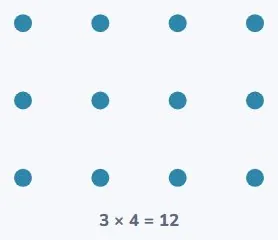
- In 2 × 3², deal with the 3² first.
- 3² is 9, so the sum becomes 2 × 9.
- That is 18, not 6² , which would be 36.
| Step | Expression |
|---|---|
| Start | 2 × 3² |
| Square first | 2 × 9 |
| Then multiply | 18 |
Multiplying and dividing share a stage
- They are not first and second. They are joint.
- When both appear, work left to right.
- Whichever you meet first is the one you do first.
| Order | Do these |
|---|---|
| 1 | Brackets |
| 2 | Squares and cubes |
| 3 | × and ÷, left to right |
| 4 | + and −, left to right |
So do adding and subtracting
- Same arrangement: joint, and left to right.
- 10 − 4 + 3 is 6 + 3, which is 9.
- Not 10 − 7. Left to right, every time.
| Step | Expression |
|---|---|
| Start | 10 − 4 + 3 |
| Leftmost first | 6 + 3 |
| Answer | 9 |
Back to 2 + 3 × 4
- No brackets. No squares.
- So the multiplying goes first: 3 × 4 is 12.
- Then the adding: 2 + 12.
- The answer is 14. Twenty was the wrong reading.
A longer one: 4 + 2 × 3²
- No brackets, so start with the square. 3² is 9.
- Now 4 + 2 × 9. Multiplying before adding.
- 2 × 9 is 18, so it becomes 4 + 18.
- The answer is 22.
| Step | Expression |
|---|---|
| Start | 4 + 2 × 3² |
| Square | 4 + 2 × 9 |
| Multiply | 4 + 18 |
| Add | 22 |
The trap: 12 ÷ 3 × 2
- The list says "multiplication and division", so × looks first.
- It is not. They are joint, and this is left to right.
- 12 ÷ 3 is 4, then 4 × 2 is 8.
- Do the × first and you get 2. That is the mistake.
| Reading | Working | Answer |
|---|---|---|
| Left to right | 4 × 2 | 8 |
| × first | 12 ÷ 6 | 2 |
Adding in your head by partitioning
- 347 + 285. Split both by place value.
- 300 + 200 is 500. 40 + 80 is 120. 7 + 5 is 12.
- Then 500 + 120 + 12 is 632.
- No paper needed: just place value and known facts.
| Part | Sum |
|---|---|
| Hundreds | 300 + 200 = 500 |
| Tens | 40 + 80 = 120 |
| Ones | 7 + 5 = 12 |
| Total | 632 |
The same sum in columns
- Line the numbers up by place value, not by their left edge.
- Ones under ones, tens under tens.
- Add each column, starting from the ones.
- 347 + 285 = 632, the same answer as before.
| H | T | O | |
|---|---|---|---|
| 3 | 4 | 7 | |
| + | 2 | 8 | 5 |
| = | 6 | 3 | 2 |
What the little carried 1 actually is
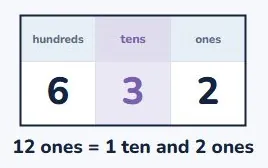
- 7 + 5 is 12, which will not fit in the ones column.
- So 10 of those ones become 1 ten and move across.
- The carried 1 is not a 1. It is ten ones, renamed.
- That is why the method works at all.
Subtracting across a zero
- 502 − 168. In the ones, 2 − 8 will not go.
- The tens column is a 0, so borrow from the hundreds first.
- 500 becomes 4 hundreds and 10 tens.
- Now the borrowing works, and the answer is 334.
| H | T | O | |
|---|---|---|---|
| 5 | 0 | 2 | |
| − | 1 | 6 | 8 |
| = | 3 | 3 | 4 |
Multiplying 542 × 12
- Split both numbers by place value.
- 542 becomes 500, 40 and 2. Twelve becomes 10 and 2.
- Every box is one easy multiplication.
- Six boxes, six answers, none of them hard.
| × | 500 | 40 | 2 |
|---|---|---|---|
| 10 | 5,000 | 400 | 20 |
| 2 | 1,000 | 80 | 4 |
Try it: multiply with a grid
Then add the boxes up
- 5,000 + 400 + 20 gives 5,420; that is 542 × 10.
- 1,000 + 80 + 4 gives 1,084; that is 542 × 2.
- Together, 5,420 + 1,084 = 6,504.
- So 542 × 12 = 6,504.
| Row | Adds to |
|---|---|
| 542 × 10 | 5,420 |
| 542 × 2 | 1,084 |
| Total | 6,504 |
Is 6,504 even sensible?
- Round first: 542 is about 500.
- 500 × 12 is 6,000.
- 6,504 is a bit more than 6,000, which is right.
- If you had got 650 or 65,000, the estimate would have caught it.
| Step | Value |
|---|---|
| Estimate | 500 × 12 = 6,000 |
| Actual | 6,504 |
Common mistakes
- 2 + 3 × 4 = 5 × 4 = 20Multiply before you add: 3 × 4 = 12, then 2 + 12 = 14.
- 12 ÷ 3 × 2 = 12 ÷ 6 = 2× and ÷ share a stage, so go left to right: 12 ÷ 3 = 4, then 4 × 2 = 8.
- 2 × 3² = 6² = 36Square before you multiply: 3² = 9, then 2 × 9 = 18.
- 542 × 12 = 542 × 1 + 542 × 2 = 542 + 1,084 = 1,626The 1 in 12 is a ten, so it is 542 × 10 = 5,420, plus 1,084. That makes 6,504.
Eight to try
Work out 5 + 2 × 6.
Work out 20 ÷ 4 × 5.
Work out 604 − 247 in columns.
Work out 236 × 14 using a grid.
Work out 2 × 5² − 10.
Where do brackets go so that 6 + 4 × 3 equals 30?
In 347 + 285 set out in columns, 7 + 5 = 12. What does the 1 carried into the tens column stand for?
Mia works out 452 − 178 in columns and gets 326. What went wrong?
Show answer
Answers: 1. 17: multiply first; 42 means they went left to right. 2. 25, left to right; 1 means they did the × first, which is the trap beat again. 3. 357, and it needs borrowing across the zero in the tens. 4. 3,304 (200×10=2000, 30×10=300, 6×10=60, 200×4=800, 30×4=120, 6×4=24). Ask for the estimate on 4 before the answer: 236 is about 240, so roughly 240 × 14 = 3,360. 5. 40. Square first: 5² = 25. Then multiply: 2 × 25 = 50. Then subtract: 50 − 10 = 40. 6. (6 + 4) × 3. The brackets make the adding happen first: 10 × 3 = 30. Without them, 6 + 12 = 18. 7. Ten ones, renamed as 1 ten. 12 ones is 1 ten and 2 ones, so the ten moves across to the tens column. 8. She took the smaller digit from the bigger one in each column (8 − 2, 7 − 5) instead of regrouping. The answer is 274.
The order, and nothing else
- Four stages. Two of them are shared, and both go left to right.
- When in doubt, brackets make your meaning obvious.
| Order | Do these |
|---|---|
| 1 | Brackets |
| 2 | Squares and cubes |
| 3 | × and ÷, left to right |
| 4 | + and −, left to right |
Challenge
Look at 8 + 4 × 6 − 2 ÷ 2. Without brackets it equals 31. Add exactly one pair of brackets (around two or more numbers) to make the answer as large as possible, and then, separately, as small as possible. What are the largest and smallest answers?
Hint
Brackets help most when they make an add happen before a multiply, or when they make a big total get divided. Try the brackets that start at the 8 first.
Answer
Largest 71 from (8 + 4) × 6 − 2 ÷ 2; smallest 15 from (8 + 4 × 6 − 2) ÷ 2
Step by step
- Without brackets: 4 × 6 = 24 and 2 ÷ 2 = 1, so 8 + 24 − 1 = 31.
- Putting 8 + 4 in brackets makes the 8 get multiplied by 6 too: 12 × 6 − 1 = 71.
- Putting everything before the last ÷ 2 in brackets makes the whole total get halved: 30 ÷ 2 = 15.
- The other places give 16, 19, 28 or 31, all between 15 and 71.
Full working
- 8 + 4 × 6 − 2 ÷ 2 = 8 + 24 − 1 = 31× and ÷ first
- (8 + 4) × 6 − 2 ÷ 2 = 12 × 6 − 1 = 71the 8 is now multiplied by 6
- (8 + 4 × 6 − 2) ÷ 2 = (8 + 24 − 2) ÷ 2 = 30 ÷ 2 = 15the whole lot is halved
- 8 + 4 × (6 − 2) ÷ 2 = 16, 8 + (4 × 6 − 2) ÷ 2 = 19, 8 + 4 × (6 − 2 ÷ 2) = 28the other choices
- Largest 71, smallest 15
In this column subtraction, four digits are hidden: 8 0 0 □ − □ 7 □ 9 = 2 □ 6 5. Each □ is a single digit. Find all four hidden digits.
Hint
Start in the ones column. Can the top digit minus 9 give 5 without borrowing? Then follow the borrowing across the zeros.
Answer
8004 − 5739 = 2265
Step by step
- Ones: no digit minus 9 gives 5, so we must borrow ten. Top digit + 10 − 9 = 5, so the top digit is 4.
- To borrow in the ones, we go across both zeros, so the tens column becomes 9 and the hundreds column becomes 9, and the 8 becomes 7.
- Tens: 9 − □ = 6, so the hidden digit is 3.
- Hundreds: 9 − 7 = 2, so the answer's hundreds digit is 2.
- Thousands: 7 − □ = 2, so the hidden digit is 5. Check: 8004 − 5739 = 2265.
Full working
- □ + 10 − 9 = 5, so □ = 4ones column must borrow
- 8 0 0 4 becomes 7 thousands, 9 hundreds, 9 tens, 14 onesborrowing across two zeros
- 9 − □ = 6, so □ = 3tens column
- 9 − 7 = 2hundreds column of the answer
- 7 − □ = 2, so □ = 5thousands column
- 8004 − 5739 = 2265
Fill each box in 6 □ 3 □ 2 □ 4 with +, − or × (you may use the same sign more than once, and no brackets are allowed). Find the only way to make 20, and the two different ways to make 16.
Hint
Because × is done first, decide where the × signs go before anything else. Think about whether 6 × 3 = 18 is a good start.
Answer
20 = 6 × 3 − 2 + 4; 16 = 6 + 3 × 2 + 4 and 16 = 6 × 3 + 2 − 4
Step by step
- Group the fillings by where the × signs go, because those parts are worked out first.
- Starting with 6 × 3 = 18, adding or taking away the 2 and the 4 gives 18 − 2 + 4 = 20 and 18 + 2 − 4 = 16.
- With 3 × 2 = 6 in the middle: 6 + 6 + 4 = 16, while the other signs give 8, 4 or −4.
- Checking all 27 fillings, 20 appears once and 16 appears twice.
- A trap: 6 + 3 × 2 + 4 is not 9 × 2 + 4 = 22, because × goes before +.
Full working
- 6 × 3 − 2 + 4 = 18 − 2 + 4 = 20multiply first, then left to right
- 6 × 3 + 2 − 4 = 18 + 2 − 4 = 16multiply first, then left to right
- 6 + 3 × 2 + 4 = 6 + 6 + 4 = 163 × 2 before the adding
- 6 × 3 × 2 − 4 = 32, 6 × 3 + 2 × 4 = 26, 6 + 3 × 2 × 4 = 30nearby fillings miss
- 20 = 6 × 3 − 2 + 4; 16 = 6 × 3 + 2 − 4 or 6 + 3 × 2 + 4
Where science uses this
Practise this
Report a mistake
More in Number
 Big numbers and rounding7 min
 Negative numbers, squares and cubes7 minOrder of operations and column methods7 min
 Division and what to do with the remainder6 min
 Tenths, hundredths and thousandths7 min
 Comparing and adding fractions7 min
 Fractions and percentages of amounts7 min
 Money, discounts and having enough6 min
Is your child on track?
Take the free placement test