Comparing and adding fractions
What this lesson covers
- Percentages can be used to compare quantities to a value or whole.
- Fractions should have the same denominator before using them in addition or subtraction.
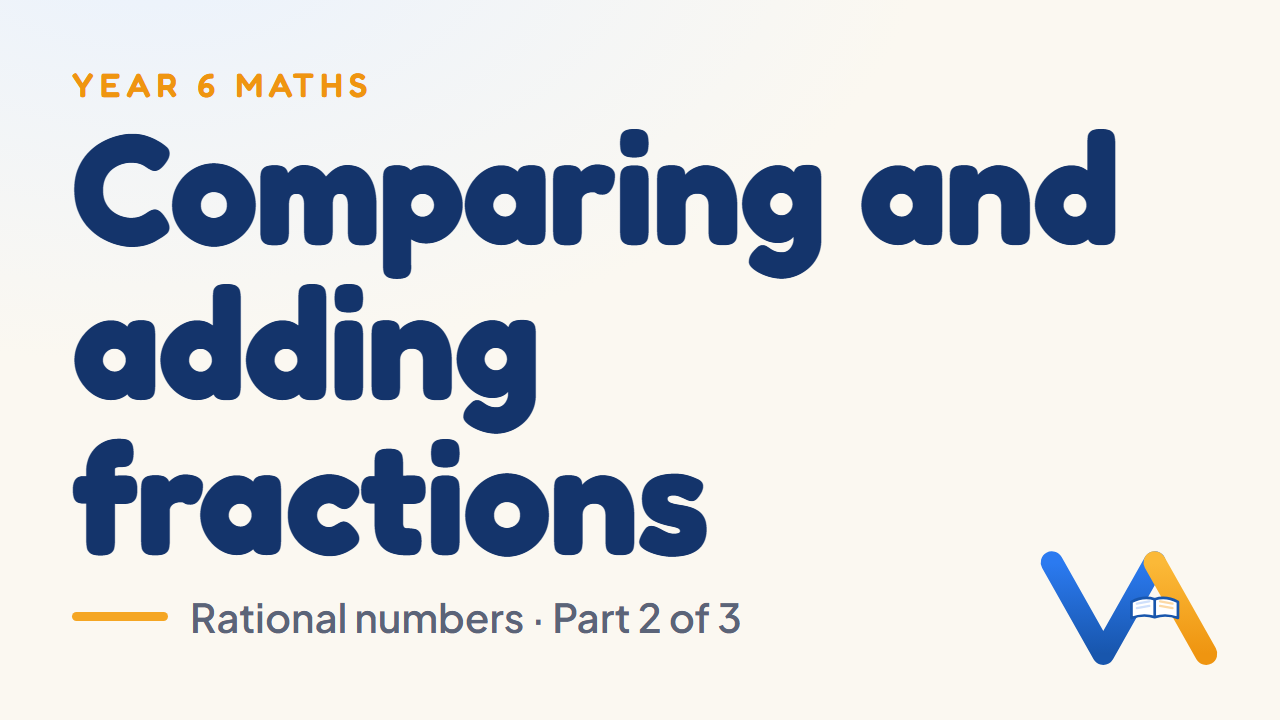
What is 1/2 + 1/4?
- A very common answer is 2/6.
- Add the tops: 1 + 1 = 2. Add the bottoms: 2 + 4 = 6.
- It looks tidy. It is completely wrong.
You can prove it is wrong without any rules
- 2/6 is the same as 1/3, which is about 0.33.
- But we started with 1/2, which is 0.5.
- So adding a quarter supposedly made it smaller.
- That cannot happen. The method is broken.
| Stage | Fraction | Value |
|---|---|---|
| We started with | 1/2 | 0.5 |
| We added | 1/4 | 0.25 |
| Tops-and-bottoms says | 2/6 | 0.33 |
You can only add pieces of the same size
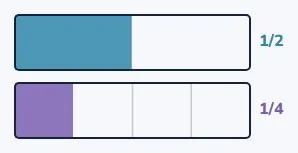
- Halves and quarters are different-sized pieces.
- Adding 1 half to 1 quarter is like adding 1 cat to 1 dog.
- You get 2 animals, not 2 of either one.
- First make the pieces match.
One half is also two quarters
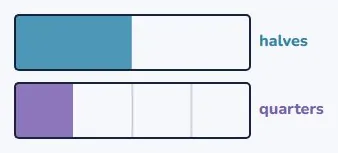
- Cut each half in two and you have quarters.
- The shading has not moved: 1/2 = 2/4.
- Same amount, smaller pieces, more of them.
Maths blocks
Now the addition is easy
- Rewrite 1/2 as 2/4. Leave the 1/4 alone.
- Now both are quarters, so just add the tops.
- 2/4 + 1/4 = 3/4.
- And 3/4 is bigger than 1/2, as it has to be.
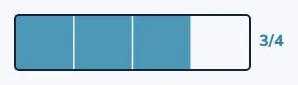
Try it: make the pieces match
The rule, now that you can see why
- Fractions must share a denominator before you add them.
- When one bottom is a multiple of the other, use the bigger.
- 4 is a multiple of 2, so quarters were the right choice.
- Rewrite only the one that needs it.
| Sum | Rewritten | Answer |
|---|---|---|
| 1/2 + 1/4 | 2/4 + 1/4 | 3/4 |
| 1/3 + 1/6 | 2/6 + 1/6 | 3/6 = 1/2 |
| 3/4 − 1/8 | 6/8 − 1/8 | 5/8 |
Adding 1/3 and 1/6
- 6 is a multiple of 3, so work in sixths.
- 1/3 is 2/6. The 1/6 stays as it is.
- 2/6 + 1/6 = 3/6.
- And 3/6 simplifies to 1/2. Always tidy the answer.
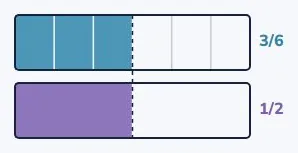
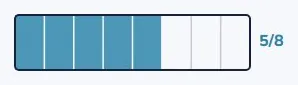
Subtracting works the same way
- 3/4 − 1/8. Eighths are the smaller pieces, so use eighths.
- 3/4 is 6/8.
- 6/8 − 1/8 = 5/8.
- Same first step every time: make the pieces match.
Which is bigger, 2/3 or 5/6?
- You cannot tell by looking at the numbers.
- 6 is a multiple of 3, so put both over sixths.
- 2/3 is 4/6. And 4/6 is less than 5/6.
- So 5/6 is the bigger fraction.
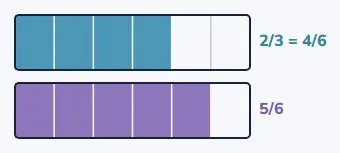
Try it: which is bigger?
Ordering 1/2, 3/8 and 3/4
- 8 is a multiple of both 2 and 4, so use eighths.
- 1/2 is 4/8. 3/4 is 6/8. The 3/8 is already eighths.
- Now compare the tops: 3, 4, 6.
- So the order is 3/8, then 1/2, then 3/4.
| Fraction | In eighths |
|---|---|
| 1/2 | 4/8 |
| 3/8 | 3/8 |
| 3/4 | 6/8 |
When the top is bigger than the bottom
- 7/4 means seven quarters.
- Four quarters make a whole, so there is more than one whole here.
- A fraction like that is called improper, which just means top-heavy.
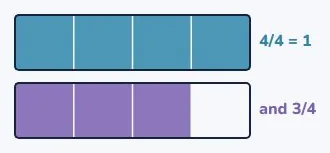
Turning 7/4 into a mixed number
- Ask how many whole fours fit into 7. One.
- That leaves 3 quarters over.
- So 7/4 = 1 3/4.
- It is a division, and you already know how to do those.
| Improper | Divide | Mixed |
|---|---|---|
| 7/4 | 7 ÷ 4 = 1 r 3 | 1 3/4 |
| 9/2 | 9 ÷ 2 = 4 r 1 | 4 1/2 |
| 7/3 | 7 ÷ 3 = 2 r 1 | 2 1/3 |
A fraction bar is a division sign
- 7/4 and 7 ÷ 4 are the same thing written differently.
- 7 ÷ 4 is 1 remainder 3, which is 1 and 3/4.
- The remainder becomes the top of the fraction.
- That is why the two methods always agree.
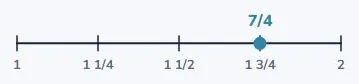
And back the other way
- Turn 2 1/3 into thirds.
- Each whole is 3 thirds, and there are 2 wholes: 6 thirds.
- Plus the 1 third already there makes 7.
- So 2 1/3 = 7/3.
| Step | Working |
|---|---|
| 2 wholes | 2 × 3 = 6 thirds |
| plus the third | 6 + 1 = 7 |
| Answer | 7/3 |
Adding mixed numbers
- 1 1/2 + 2 1/4. Deal with the wholes first: 1 + 2 = 3.
- Now the fractions: 1/2 + 1/4, which we know is 3/4.
- Put them back together: 3 3/4.
- Wholes with wholes, fractions with fractions.
| Part | Sum |
|---|---|
| Wholes | 1 + 2 = 3 |
| Fractions | 2/4 + 1/4 = 3/4 |
| Answer | 3 3/4 |
3 3/4 is also 3.75
- 3/4 is 0.75, so 3 3/4 is 3.75.
- Fractions and decimals are the same numbers, differently written.
- Which means adding decimals needs the same first step.
- Make the pieces match before you add.
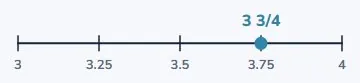
Adding 2.35 and 1.4
- A common answer is 3.39 (adding 4 onto 35).
- But 1.4 is 1.40, not 1.04.
- Write it as 1.40 so the places line up, then add.
- 2.35 + 1.40 = 3.75.
| Ones | Tenths | Hundredths | |
|---|---|---|---|
| 2 | 3 | 5 | |
| + | 1 | 4 | 0 |
| = | 3 | 7 | 5 |
The same with thousandths
- 1.256 + 2.4. Line up the decimal points, not the right edges.
- Write 2.4 as 2.400 and every column has a digit.
- 1.256 + 2.400 = 3.656.
- The zeros do nothing except hold the places open.
| Ones | Tenths | Hundredths | Thousandths | |
|---|---|---|---|---|
| 1 | 2 | 5 | 6 | |
| + | 2 | 4 | 0 | 0 |
| = | 3 | 6 | 5 | 6 |
Common mistakes
- 1/2 + 1/4 = 2/6Make the pieces match first: 1/2 = 2/4, so 2/4 + 1/4 = 3/4. Adding the bottoms changes the size of the pieces.
- 2.35 + 1.4 = 3.391.4 is 1.40, not 1.04. Line up the points: 2.35 + 1.40 = 3.75.
- 3/5 is bigger than 7/10, because fifths are bigger pieces than tenths.Put both in tenths: 3/5 = 6/10, and 6/10 is less than 7/10, so 7/10 is bigger.
- 11/4 = 3 2/411 ÷ 4 is 2 remainder 3, so 11/4 = 2 3/4. Check: 2 wholes is 8 quarters, plus 3 makes 11.
Eight to try
Work out 1/3 + 1/9.
Which is bigger, 3/5 or 7/10?
Write 11/4 as a mixed number.
Work out 4.7 + 3.25.
Write 3 2/5 as an improper fraction.
Work out 5/6 − 1/3.
Put 2/3, 5/12 and 3/4 in order, smallest first.
Work out 5.3 − 2.146.
Show answer
Answers: 1. 3/9 + 1/9 = 4/9: ninths, because 9 is a multiple of 3. 2. 7/10, since 3/5 is 6/10. 3. 11 ÷ 4 = 2 remainder 3, so 2 3/4. 4. 7.95; write 4.7 as 4.70 first; 7.32 or 7.12 means they aligned the right-hand edges. On question 1 a "2/12" answer is the tops-and-bottoms method again, and the beat to revisit is 2. 5. 17/5. Each whole is 5 fifths, so 3 × 5 = 15 fifths, plus the 2 fifths already there makes 17. 6. 1/2. 6 is a multiple of 3, so 1/3 is 2/6, and 5/6 − 2/6 = 3/6, which simplifies to 1/2. 7. 5/12, 2/3, 3/4. In twelfths they are 8/12, 5/12 and 9/12, so compare the tops: 5, 8, 9. 8. 3.154. Write 5.3 as 5.300 so the places line up, then 5.300 − 2.146 = 3.154.
Fractions: Equality
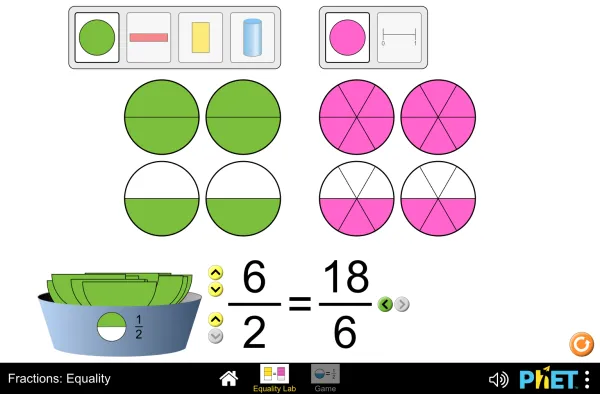
Full screen · PhET Interactive Simulations, University of Colorado Boulder, CC BY 4.0
Make the pieces match first
- Fractions: find a common denominator.
- Decimals: line up the points and fill the gaps with zeros.
- It is the same instruction twice.
| Sum | Rewritten | Answer |
|---|---|---|
| 1/2 + 1/4 | 2/4 + 1/4 | 3/4 |
| 1/3 + 1/6 | 2/6 + 1/6 | 1/2 |
| 2.35 + 1.4 | 2.35 + 1.40 | 3.75 |
| 1.256 + 2.4 | 1.256 + 2.400 | 3.656 |
Challenge
Here are six fractions: 12, 13, 14, 16, 18 and 112. Mere picks two different ones and adds them, and her answer is exactly 512. Which two could she have picked? Find every possible pair.
Hint
Before adding anything, rewrite all six fractions with the same bottom number. 24 works for every one of them. What is 512 in twenty-fourths?
Answer
Two pairs work: 13 + 112 and 14 + 16
Step by step
- 24 is a multiple of 2, 3, 4, 6, 8 and 12, so put everything in twenty-fourths.
- The six fractions become 1224, 824, 624, 424, 324 and 224, and the target 512 is 1024.
- Now we need two of the tops 12, 8, 6, 4, 3 and 2 that add to 10.
- 12 is already too big. 8 + 2 = 10 and 6 + 4 = 10. No pair with the 3 works, because 10 − 3 = 7 is not on the list.
- So the pairs are 13 and 112, and 14 and 16.
Full working
- 12 = 1224, 13 = 824, 14 = 624make the pieces match
- 16 = 424, 18 = 324, 112 = 224the rest in twenty-fourths
- 512 = 1024the target, in the same pieces
- tops: 12, 8, 6, 4, 3, 2; need a pair adding to 1012 is too big on its own
- 8 + 2 = 10 and 6 + 4 = 103 needs a 7, which is not there
- 13 + 112 = 512 and 14 + 16 = 512
Put 56, 1112, 78 and 910 in order from smallest to largest without finding a common bottom number for all four. Then find the fraction with the smallest possible bottom number that lies between 78 and 910 (not equal to either).
Hint
Each of these is one piece short of a whole. Which is closer to 1: a number that is a sixth short, or one that is a twelfth short?
Answer
56, 78, 910, 1112; the fraction is 89
Step by step
- Each fraction is exactly one piece short of a whole: 56 is 16 short, 78 is 18 short, 910 is 110 short and 1112 is 112 short.
- Smaller pieces missing means closer to 1. Twelfths are the smallest pieces, sixths the biggest.
- So the order is 56, 78, 910, 1112.
- A fraction that is one ninth short of a whole is 89. A ninth is smaller than an eighth but bigger than a tenth, so 89 sits between 78 and 910.
- No bottom number from 1 to 8 works: with pieces of 18 or bigger, the largest fraction below 1 is at most 78, and the next one up is 1 itself, so nothing fits strictly between 78 and 910.
Full working
- 1 − 56 = 16, 1 − 78 = 18, 1 − 910 = 110, 1 − 1112 = 112how far short of 1
- 16 > 18 > 110 > 112bigger bottom, smaller piece
- 56 < 78 < 910 < 1112smallest gap means largest fraction
- 1 − 89 = 19, and 110 < 19 < 18so 89 is between them
- 78 = 0.875, 89 = 0.888…, 910 = 0.9a decimal check
- Order: 56, 78, 910, 1112; between 78 and 910: 89
Rua has three measuring scoops: a 12 cup, a 13 cup and a 14 cup. A recipe needs exactly 2 34 cups of flour. He wants to use every scoop at least once, and each scoop is filled exactly level each time. What is the fewest number of scoops he can use, and how many of each? Show that no other way uses that few.
Hint
Turn everything into twelfths: the scoops hold 6, 4 and 3 twelfths. How many twelfths is 2 34? Is that number odd or even, and which scoop can make it odd?
Answer
7 scoops: three 12 cups, three 13 cups and one 14 cup; it is the only way with 7
Step by step
- In twelfths the scoops hold 6, 4 and 3, and 2 34 cups is 33 twelfths.
- 6 and 4 are even, so only the 3-twelfths scoop can make the total odd. It must be used an odd number of times: 1, 3, 5, ...
- With one 14 cup, the other scoops make 30 twelfths. Using 6s and 4s (at least one of each), the only ways are 3 halves and 3 thirds (7 scoops in all) or 1 half and 6 thirds (8 scoops in all).
- With three 14 cups, 24 twelfths are left, and the only way is 2 halves and 3 thirds: 8 scoops in all. Five 14 cups leave 18 twelfths: 1 half and 3 thirds, 9 scoops in all. Seven, nine or eleven 14 cups leave 12, 6 or 0 twelfths, which cannot use both a 12 cup and a 13 cup, so those fail.
- So the fewest is 7 scoops, three of each of the bigger scoops and one 14 cup, and no other mix gets down to 7.
Full working
- 12 = 612, 13 = 412, 14 = 312make the pieces match
- 2 34 = 114 = 33122 wholes is 8 quarters, plus 3
- 33 is odd, so the number of 14 scoops is odd6 and 4 only make even totals
- one 14: 30 = 6 × 3 + 4 × 3 (7 scoops) or 6 × 1 + 4 × 6 (8 scoops)30 twelfths left
- three 14: 24 = 6 × 2 + 4 × 3 (8 scoops); five 14: 18 = 6 × 1 + 4 × 3 (9 scoops)7, 9 or 11 quarters leave 12, 6 or 0: impossible
- 3 × 12 + 3 × 13 + 14 = 1 12 + 1 + 14 = 2 34check
- Fewest is 7: three 12 cups, three 13 cups and one 14 cup
Practise this
Report a mistake
More in Number
 Big numbers and rounding7 min
 Negative numbers, squares and cubes7 min
 Order of operations and column methods7 min
 Division and what to do with the remainder6 min
 Tenths, hundredths and thousandths7 minComparing and adding fractions7 min
 Fractions and percentages of amounts7 min
 Money, discounts and having enough6 min
Is your child on track?
Take the free placement test