Blood, the heart and how food reaches every part of you
What this lesson covers
- How digested food and water get into the blood
- The heart pumps blood through blood vessels
- Arteries take blood away from the heart
- Veins bring blood back to the heart
- Capillaries swap substances with body cells
- What the body uses nutrients for
- What different models of the circulatory system show well, and what they miss
From your gut into your blood
- Digestion breaks food down into tiny pieces. The useful substances in food, such as sugars, fats and proteins, are called nutrients.
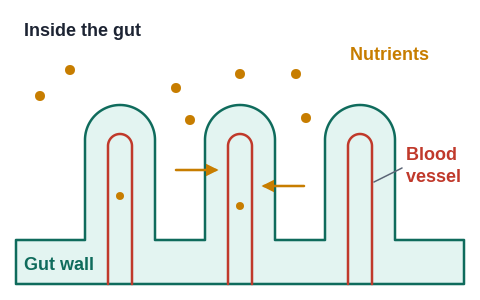
- The small intestine is a long, coiled tube below your stomach. Its inside is covered in tiny finger-like bumps, each packed with even tinier blood vessels.
- Digested nutrients and water pass through the thin walls of these bumps and into the blood.
- Most of the rest of the water is taken in further along, in the large intestine.
The heart and the circulatory system
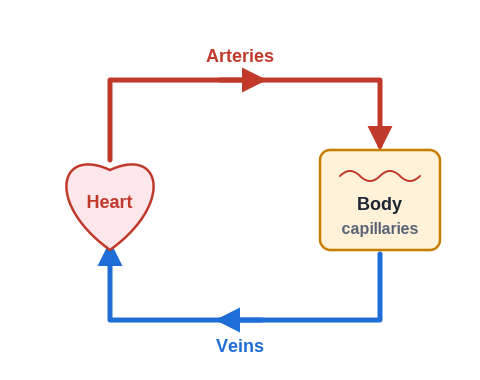
- The circulatory system is your heart, your blood vessels and the blood inside them.
- Blood vessels are the tubes that carry blood all through your body.
- The heart is a muscle about the size of your fist. Each time it squeezes, it pushes blood out into the blood vessels. This pumping keeps the blood moving round and round, all day and all night.
Try it: the heart and blood vessels
Arteries: away from the heart
- Arteries are the blood vessels that take blood away from the heart and out to the body.
- Each squeeze of the heart pushes blood into them hard, so arteries have thick, stretchy walls.
- Your pulse is that push, felt where an artery runs close to the skin, such as on the inside of your wrist or the side of your neck.
Veins: back to the heart
- Veins are the blood vessels that return blood from the body to the heart.
- Blood in veins flows more gently, so veins have thinner walls than arteries.
- The bluish lines you can see on the inside of your wrist are veins. The blood inside them is dark red, not blue; it only looks blue through your skin.
Capillaries: where the swapping happens
- Cells are the tiny building blocks that every part of your body is made of. A tissue is a group of similar cells working together, like muscle.
- Capillaries are tiny blood vessels, thinner than a hair, that run through every tissue. They join the arteries to the veins.
- Their walls are so thin that substances can pass through. Nutrients and oxygen move out of the blood into the body cells, and wastes such as carbon dioxide move from the cells into the blood.
Try it: artery, vein or capillary?
Following a bit of sugar from your lunch
- Trace a bit of sugar from the bread in your sandwich to a muscle in your leg.
- Stomach and small intestine: the bread is digested into sugardigestion
- Small intestine: the sugar passes into the capillaries in the gut wallabsorbed
- Veins carry the blood back to the heart, passing through the liver on the waytoward the heart
- The heart pumps it out along the arteries to the legaway from the heart
- Capillaries in the leg muscle: the sugar moves into the muscle cellsswapped
- Gut → capillaries → veins → heart → arteries → capillaries → muscle cells
What your body does with nutrients
- Once nutrients reach your cells, your body uses them in two main ways.
| Use | What it means | Example |
|---|---|---|
| Fuel | Releasing energy for moving and for staying warm | Sugar from kūmara or bread powering your muscles in a game of touch |
| Building blocks | Making new cells for growing and for repair | Protein from eggs, fish or beans used to heal a grazed knee |
| Keeping things working | Helping every other life process run | Calcium from milk keeping bones strong |
Comparing models of the circulatory system
- A model is a simpler version of something real that helps us understand it. Every model shows some things well and leaves other things out.
- Our loop diagram is a model. It makes the direction of flow clear, but it leaves out the lungs and shows only one of the thousands of capillary networks.
| Model | Shows well | Not so good at |
|---|---|---|
| Labelled drawing | Where every part is, all at once | Movement: nothing flows |
| Animation | Blood flowing and the heart pumping | Seeing every part at the same time |
| Squeeze bottle and tubes | How a pump pushes liquid round a loop | The real size, shape and number of vessels |
| Loop diagram | Which way blood goes in arteries and veins | The lungs, and how many vessels there are |
Measuring a pulse
- Mere counted her pulse for 15 seconds. Sitting still she counted 21 beats. After 1 minute of skipping she counted 33 beats. Work out her beats per minute each time, and explain the change.
- There are 4 lots of 15 seconds in 1 minutescale up
- Resting: 21 × 4 = 84 beats a minute
- After skipping: 33 × 4 = 132 beats a minute
- Her heart beat faster after skipping, 132 compared with 84, because her working muscles needed more fuel and oxygen delivered by the blood
Common mistakes
- Arteries carry blood to the heart and veins carry it away.It is the other way round: arteries take blood away from the heart, and veins bring it back.
- Blood in veins is blue.Blood is always red; veins only look blue because you see them through your skin.
- Nutrients go straight from the stomach to the muscles.Nutrients pass into the blood in the small intestine, travel through the heart, and leave the blood through capillaries.
- The heart makes the blood.The heart is a pump; it pushes blood round the body, but the blood is made elsewhere, inside your bones.
Measure your pulse at rest and after exercise
You need: a clock, timer or phone with seconds, paper and a pencil, a helper
- Sit still for 2 minutes. Find your pulse by pressing two fingers gently on the inside of your wrist, below your thumb.
- Have your helper time 15 seconds while you count the beats. Multiply by 4 and write down your beats per minute.
- Do star jumps for 1 minute, then count your pulse again for 15 seconds and multiply by 4.
- Sit and rest for 3 minutes and measure once more.
- Look for this: your pulse is highest just after exercise and drops back toward your resting rate as you rest.
Safety: Ask an adult first, and skip the star jumps if you have asthma or a heart condition; stop straight away if you feel dizzy, sick or short of breath.
Your turn
Which blood vessels carry blood away from the heart?
Where do digested nutrients get into the blood?
Why are capillary walls so thin?
Tama counts 18 beats in 15 seconds. What is his pulse in beats per minute?
An animation shows blood flowing. What is one thing it is not so good at showing?
Show answer
1. Arteries. 2. In the small intestine, through the walls of its finger-like bumps. 3. So nutrients, oxygen and wastes can pass between the blood and the body cells. 4. 18 × 4 = 72 beats per minute. 5. All the parts at the same time, so it is hard to see the whole system at once.
Recap
- Digested nutrients and water pass from the intestines into the blood.
- The heart pumps blood round the body through blood vessels.
- Arteries carry blood away from the heart; veins bring it back.
- In capillaries, nutrients and oxygen move into body cells and wastes move out.
- Nutrients are fuel for moving and warmth, and building blocks for growth and repair.
- Each model of the circulatory system shows some things well and hides others.
Challenge
Use these figures for one adult. She has about 5 litres of blood. At rest her heart beats 72 times a minute, and each beat pushes 70 mL of blood into the arteries that go to her body. During a hard run her heart pushes 15 litres of blood a minute into those arteries while beating 150 times a minute. (a) How much blood does each beat push out during the run? (b) About how many times as much blood reaches her body each minute during the run as at rest? (c) During the run, how many seconds does her heart take to push out an amount equal to all 5 litres of her blood? (d) Why does her body need this change?
Hint
Find the litres per minute at rest first (beats × mL per beat). For (a), share the running litres per minute between the beats.
Answer
(a) 100 mL a beat. (b) About 3 times (15 litres compared with about 5 litres a minute). (c) 20 seconds. (d) Her working muscles use fuel and oxygen much faster, so the blood has to deliver them much faster; the heart beats faster and pushes more blood with each beat.
Step by step
- At rest: 72 beats × 70 mL = 5040 mL, about 5 litres a minute.
- During the run: 15 litres is 15 000 mL, shared between 150 beats, so 100 mL each beat.
- 15 litres compared with about 5 litres is about 3 times as much blood each minute.
- 15 litres a minute is 5 litres every third of a minute, which is 20 seconds.
- Running muscles need sugar and oxygen delivered faster, and the blood carries both.
Full working
- 72 × 70 = 5040 mL a minuteat rest, about 5 litres
- 15 000 ÷ 150 = 100 mL a beatduring the run
- 15 000 ÷ 5040 ≈ 2.98, about 3 timescompare the minutes
- 5 litres ÷ 15 litres a minute = 13 minute = 20 secondstime for 5 litres
- 100 mL a beat, about 3 times as much, 20 seconds; working muscles need fuel and oxygen faster
Straight after 2 minutes of skipping, Ana sits down and counts her pulse for one full minute. She counts 102 beats. Her brother, holding the timer, noticed she had already counted 30 beats by the end of the first 15 seconds. He says, "30 × 4 is 120, so one of your counts must be wrong." (a) Work out her heart rate in beats per minute for the first 15 seconds and for the last 45 seconds. (b) Explain why both counts can be right. (c) If you want her pulse just after exercise, which count is better, and why?
Hint
How many beats were left for the last 45 seconds? Think about what happens to a pulse while you rest.
Answer
(a) First 15 seconds: 120 beats per minute. Last 45 seconds: 72 beats, which is 96 beats per minute. (b) Her pulse was dropping as she rested, so the full-minute count mixes a fast start with a slower finish and comes out lower than 120. (c) The 15-second count, because it is taken before her heart has had time to slow down.
Step by step
- In the first 15 seconds: 30 beats, and 30 × 4 = 120 beats per minute.
- The last 45 seconds had 102 − 30 = 72 beats.
- 45 seconds is 3 lots of 15 seconds, so 72 ÷ 3 = 24 beats each 15 seconds, and 24 × 4 = 96 beats per minute.
- Once she stops, her muscles need less fuel and oxygen, so her heart slows back toward its resting rate.
- A full-minute count lets the pulse fall while you count, so a short count straight away is better.
Full working
- 30 × 4 = 120 beats per minutefirst 15 seconds
- 102 − 30 = 72 beatslast 45 seconds
- 72 ÷ 3 = 24 beats each 15 seconds45 s is 3 lots of 15 s
- 24 × 4 = 96 beats per minuterate in the last 45 seconds
- 120 then 96: her pulse was falling as she rested, so both counts are right; the 15-second count shows her pulse just after exercise
A science show uses made-up readings to test students. Four blood samples, A to D, were taken from one person. The readings are in made-up units. A: oxygen 95, sugar 50. B: oxygen 70, sugar 48. C: oxygen 30, sugar 44. D: oxygen 65, sugar 80. The four places were: an artery going to the leg; a vein leaving the leg while the person sat still; a vein leaving the leg during a run; a vein leaving the small intestine an hour after lunch. Match each sample to its place and give a reason for each.
Hint
In which kind of vessel has blood not yet passed through any capillaries in the leg? Then ask what the cells next to each set of capillaries take in, and what the small intestine adds.
Answer
A is the artery going to the leg; B is the leg vein while sitting; C is the leg vein during the run; D is the vein leaving the small intestine after lunch.
Step by step
- Blood in the artery has not yet reached the leg's capillaries, so nothing has been taken out: the most oxygen, 95. That is A.
- In capillaries, cells take oxygen and sugar out of the blood, so blood in veins from the leg has less of both than A.
- Working muscles use oxygen and sugar fastest, so the lowest readings, C, are from the leg during the run; B, with a smaller drop, is from the resting leg.
- After lunch, digested sugar passes from the small intestine into its capillaries, so blood leaving it has extra sugar. D has far more sugar than A.
- The intestine's own cells use some oxygen, which is why D has less oxygen than A.
Full working
- A: oxygen 95, the highestnothing taken out yet: artery to the leg
- B and C: less oxygen and sugar than Aleg cells took some out in the capillaries
- C: oxygen 30, sugar 44, the biggest dropworking muscles use the most: leg vein during the run
- B: oxygen 70, sugar 48, a small dropresting leg vein
- D: sugar 80, more than A's 50sugar added from digested lunch: vein from the small intestine
- A artery to the leg, B leg vein at rest, C leg vein during the run, D vein from the small intestine
The maths behind it
Report a mistake
How is Year 6 maths going?
See the Year 6 maths guide