Discrete random variables: mean and standard deviation
What this lesson covers
- The mean of a discrete random variable is each value times its probability, added up.
- The probabilities in a table must sum to 1, which finds any missing value.
More from the same table
- Level 2: the mean as a long-run average.
- Level 3: the spread as well.
- And what scaling does to both.
Bikes per booking
- X = number of bikes in one booking.
- Three probabilities are known.
- The one for 3 bikes is k.
| Bikes, x | P(X = x) |
|---|---|
| 1 | 0.35 |
| 2 | 0.3 |
| 3 | k |
| 4 | 0.15 |
The probabilities add to 1
- Probabilities add to 1.
- Each is between 0 and 1.
- If not, find the error.
- 0.35 + 0.3 + k + 0.15 = 1sum to 1
- 0.8 + k = 1
- k = 1 − 0.8 = 0.2
- 0 ≤ 0.2 ≤ 1
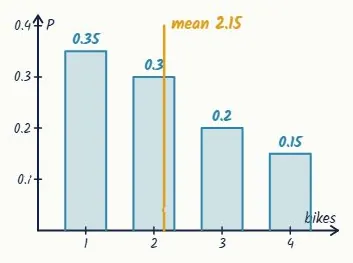
The distribution, drawn
- One bike is the most likely.
- The bars step down to 0.15.
- The mean is the balance point.
Try it: the mean in the long run
The mean: Σ x × P(X = x)
- Value × probability.
- Write every product.
- E(X) = Σ x × P(X = x)
- = 1 × 0.35 + 2 × 0.3
- + 3 × 0.2 + 4 × 0.15
- = 0.35 + 0.6 + 0.6 + 0.6
- = 2.15 bikes
Try it: mean and standard deviation
One more sum: E(X²)
- Square each value first.
- Then times its probability.
- E(X²) = Σ x² × P(X = x)
- = 1² × 0.35 + 2² × 0.3
- + 3² × 0.2 + 4² × 0.15
- = 0.35 + 1.2 + 1.8 + 2.4
- = 5.75
Variance and standard deviation
- Var(X) = E(X²) − μ².
- Square root for σ.
- Var(X) = E(X²) − [E(X)]²
- = 5.75 − 2.15²
- = 5.75 − 4.6225
- = 1.1275
- σ = √1.1275 = 1.0618 bikes
Rounding early: the 2025 warning
- Round μ to 2.2: Var = 0.91.
- Nearly 20% too small.
- Keep 4 decimal places.
- μ ≈ 2.2: 2.2² = 4.84
- Var = 5.75 − 4.84 = 0.91rounded too early
- Var = 5.75 − 4.6225 = 1.1275
- 0.91/1.1275 = 0.8071about 19% too small
The expectation rules in the booklet
- E(aX + b) = aE(X) + b.
- Var(aX + b) = a²Var(X).
- Adding b does not change the spread.
| Rule | Gives |
|---|---|
| E(aX + b) | aE(X) + b |
| Var(aX + b) | a²Var(X) |
| SD(aX + b) | |a| × SD(X) |
The charge: T = 30X + 10
- E(T) = 30E(X) + 10.
- No + 10 in the spread.
- T = 30X + 10
- E(T) = 30 × E(X) + 10
- = 30 × 2.15 + 10
- = 64.50 + 10 = $74.50
- Var(T) = 30² × Var(X)
- = 900 × 1.1275 = 1014.75
- SD(T) = √1014.75 = 31.8551
- ≈ $31.86
- 30 × 1.1275 + 10a not squared, + 10
Try it: k, the balance point and aX + b
What the mean means
- Over many bookings: 2.15 bikes on average.
- No single booking hires 2.15 bikes.
- 200 × $74.50 = $14,900.
Where the marks are
- Achieved: missing probability and the mean.
- Merit: SD, the rules, meaning in context.
- Excellence: accurate through a long problem.
What to take away
- Sum to 1, then the mean, then E(X²) − μ², with four decimal places throughout.
| Missing p | sum to 1, then check |
| E(X) | Σ x × P(X = x) |
| Var(X) | E(X²) − μ² |
| SD | √Var(X) |
| aX + b | mean: aμ + b |
| variance: a²Var(X) | |
| Working | four decimal places |
Common mistakes
- μ ≈ 2.2, so Var(X) = 5.75 − 2.2² = 0.91Keep μ = 2.15 exact: Var(X) = 5.75 − 4.6225 = 1.1275; rounding the mean early made the variance about 19% too small.
- E(X²) = [E(X)]² = 2.15² = 4.6225E(X²) means square each value, then times its probability: Σ x² × P(X = x) = 5.75, which is not the same as squaring the mean.
- Var(30X + 10) = 30 × 1.1275 + 10Var(aX + b) = a²Var(X), so Var(T) = 900 × 1.1275 = 1014.75; adding 10 does not change the spread.
- The standard deviation is the variance, 1.1275 bikes.The standard deviation is the square root of the variance: σ = √1.1275 = 1.0618 bikes.
Your turn: eight questions
- X = hockey goals: x = 0, 1, 2, 3.
- Question 3: $50 a goal plus $20.
| Given | Find | |
|---|---|---|
| 1 | P: 0.1, 0.4, k, 0.2 | k |
| 2 | the same X | E(X), SD |
| 3 | Y = 50X + 20 dollars | E(Y), SD(Y) |
| 4 | E(X) = 1.6 goals | meaning |
| 5 | SD(X) = 1.5, Y = 5 − 2X | SD(Y) |
| 6 | win $10 with P 0.15, else lose $2 | E(gain), meaning |
| 7 | E(X) = 2.35, E(X²) = 6.45 | Var(X) |
| 8 | x = 1, 2, 3, 4; P: 0.1, a, b, 0.2; E(X) = 2.6 | a and b |
Show answer
1. 0.1 + 0.4 + k + 0.2 = 1, so k = 0.3. 2. E(X) = 1.6; E(X²) = 3.4; Var(X) = 3.4 − 2.56 = 0.84; SD = 0.9165. 3. E(Y) = 50 × 1.6 + 20 = $100; Var(Y) = 2500 × 0.84 = 2100; SD(Y) = $45.83. 4. Over many games, the team averages 1.6 goals a game; no single game has 1.6. 5. SD(Y) = 3. SD(aX + b) = |a| × SD(X) = 2 × 1.5, and adding 5 does not change the spread. 6. E(gain) = 10 × 0.15 − 2 × 0.85 = 1.5 − 1.7 = −$0.20, so over many games a player loses 20 cents a game on average. 7. Var(X) = 6.45 − 2.35² = 6.45 − 5.5225 = 0.9275. Rounding the mean to 2.4 first gives 0.69, far too small. 8. a = 0.4, b = 0.3. Sum to 1 gives a + b = 0.7; the mean gives 0.1 + 2a + 3b + 0.8 = 2.6, so 2a + 3b = 1.7.
The answers: questions 1 and 2
- 1. 0.1 + 0.4 + k + 0.2 = 1
- 0.7 + k = 1, so k = 0.3
- 2. E(X) = 0 × 0.1 + 1 × 0.4
- + 2 × 0.3 + 3 × 0.2
- = 0 + 0.4 + 0.6 + 0.6 = 1.6
- E(X²) = 0 × 0.1 + 1 × 0.4
- + 4 × 0.3 + 9 × 0.2
- = 0 + 0.4 + 1.2 + 1.8 = 3.4
The answers: questions 2 to 4
- E(X) = 1.6, E(X²) = 3.4
- Var(X) = 3.4 − 1.6² = 3.4 − 2.56
- = 0.84
- SD = √0.84 = 0.9165
- 3. E(Y) = 50 × 1.6 + 20 = $100
- Var(Y) = 50² × 0.84 = 2500 × 0.84
- = 2100
- SD(Y) = √2100 = $45.83
- 4. 1.6 goals a game, on average
Sample question: Achieved
X is the number of coffees a customer buys on one visit to a café. P(X = 0) = 0.15, P(X = 1) = 0.4, P(X = 2) = k and P(X = 3) = 0.1. Find k and E(X).
Hint
The probabilities add to 1. Then E(X) is each value times its probability, added up.
Answer
k = 0.35; E(X) = 1.4 coffees
Step by step
- Rule 1: the probabilities in a distribution add to 1.
- So 0.15 + 0.4 + k + 0.1 = 1, which is 0.65 + k = 1, so k = 0.35.
- Check k is between 0 and 1. It is.
- Rule 2: E(X) = Σ x × P(X = x). Multiply each value by its probability, then add.
- 0 × 0.15 + 1 × 0.4 + 2 × 0.35 + 3 × 0.1 = 0 + 0.4 + 0.7 + 0.3 = 1.4.
- Meaning: over many visits, customers buy 1.4 coffees on average. No single customer buys 1.4.
- Check: 1.4 lies between the smallest value 0 and the largest value 3, and near the most likely value 1.
Full working
- 0.15 + 0.4 + k + 0.1 = 1probabilities sum to 1
- k = 0.35
- E(X) = 0 × 0.15 + 1 × 0.4 + 2 × 0.35 + 3 × 0.1Σ x × P(X = x)
- = 0.4 + 0.7 + 0.3
- k = 0.35, E(X) = 1.4
Sample questions: Merit
A random variable X takes the values 1, 2, 3 and 4 with P(X = 1) = 0.1, P(X = 2) = a, P(X = 3) = b and P(X = 4) = 0.2. Given E(X) = 2.5, find a and b, and the standard deviation of X.
Hint
Two unknowns need two equations: one from the sum to 1 and one from the mean.
Answer
a = 0.5, b = 0.2; SD(X) = 0.9220
Step by step
- There are two unknowns, so we need two equations.
- Equation 1, the sum to 1: 0.1 + a + b + 0.2 = 1, so a + b = 0.7.
- Equation 2, the mean: 1 × 0.1 + 2a + 3b + 4 × 0.2 = 2.5, so 2a + 3b = 1.6.
- From equation 1, a = 0.7 − b. Substitute: 2(0.7 − b) + 3b = 1.6, so 1.4 + b = 1.6 and b = 0.2.
- Then a = 0.7 − 0.2 = 0.5. Both are between 0 and 1, so they are valid.
- For the spread, recall Var(X) = E(X²) − [E(X)]². First find E(X²): square each value, then times its probability.
- E(X²) = 1 × 0.1 + 4 × 0.5 + 9 × 0.2 + 16 × 0.2 = 0.1 + 2 + 1.8 + 3.2 = 7.1.
- Var(X) = 7.1 − 2.5² = 7.1 − 6.25 = 0.85.
- SD(X) = √0.85 = 0.9220.
- Classic mistake: squaring the probabilities instead of the values. Only x is squared in E(X²).
- Check the mean with your a and b: 0.1 + 1 + 0.6 + 0.8 = 2.5. Correct.
Full working
- a + b = 0.7sum to 1
- 2a + 3b = 1.6E(X) = 2.5
- b = 0.2, a = 0.5substitute a = 0.7 − b
- E(X²) = 0.1 + 2 + 1.8 + 3.2 = 7.1
- Var(X) = 7.1 − 2.5² = 0.85E(X²) − μ²
- a = 0.5, b = 0.2, SD(X) = 0.9220
X is the number of kayaks hired in one booking: P(X = 1) = 0.4, P(X = 2) = 0.35, P(X = 3) = 0.15 and P(X = 4) = 0.1. Each booking costs $25 per kayak plus a booking fee of $15. Find the mean and standard deviation of the charge for a booking, and explain what the mean means in context.
Hint
Find E(X) and SD(X) first. The charge is C = 25X + 15, so use the rules for aX + b.
Answer
E(C) = $63.75, SD(C) = $24.33. Over many bookings the average charge is $63.75
Step by step
- Start with X. E(X) = 1 × 0.4 + 2 × 0.35 + 3 × 0.15 + 4 × 0.1 = 0.4 + 0.7 + 0.45 + 0.4 = 1.95.
- E(X²) = 1 × 0.4 + 4 × 0.35 + 9 × 0.15 + 16 × 0.1 = 0.4 + 1.4 + 1.35 + 1.6 = 4.75.
- Var(X) = 4.75 − 1.95² = 4.75 − 3.8025 = 0.9475. Keep all four decimals: rounding 1.95 to 2 would wreck this.
- The charge is C = 25X + $15.
- Recall the rules: E(aX + b) = aE(X) + b, and Var(aX + b) = a²Var(X).
- E(C) = 25 × 1.95 + 15 = 48.75 + 15 = $63.75.
- Var(C) = 25² × 0.9475 = 625 × 0.9475 = 592.1875. SD(C) = √592.1875 = $24.33.
- Why no 15 in the spread? Adding the same fee to every booking moves every charge up, but does not spread them out.
- Meaning: over many bookings, the average charge is $63.75. No single booking costs exactly that.
Full working
- E(X) = 0.4 + 0.7 + 0.45 + 0.4 = 1.95
- E(X²) = 0.4 + 1.4 + 1.35 + 1.6 = 4.75
- Var(X) = 4.75 − 1.95² = 0.9475
- E(C) = 25 × 1.95 + 15 = 63.75E(aX + b) = aE(X) + b
- Var(C) = 25² × 0.9475 = 592.1875Var(aX + b) = a²Var(X)
- SD(C) = √592.1875 = 24.33
- E(C) = $63.75, SD(C) = $24.33
Sample questions: Excellence
A quiz has 3 questions. X, the number a student gets right, has P(X = x) = k(x² + 1) for x = 0, 1, 2 and 3. Find k, E(X) and Var(X) exactly. The teacher scales the marks to Y = aX + b, with a > 0, so that Y has mean 50 and standard deviation 10. Find a and b.
Hint
Write out all four probabilities in terms of k first. For Y, the mean gives one equation and the standard deviation gives another.
Answer
k = 118; E(X) = 73; Var(X) = 79; a = 30√7 ≈ 11.3389, b ≈ 23.5425
Step by step
- Write out the table: P(X = 0) = k, P(X = 1) = 2k, P(X = 2) = 5k, P(X = 3) = 10k.
- They add to 1: 18k = 1, so k = 118.
- E(X) = 0 × 1 + 1 × 2 + 2 × 5 + 3 × 1018 = 4218 = 73.
- E(X²) = 0 + 1 × 2 + 4 × 5 + 9 × 1018 = 11218 = 569.
- Var(X) = 569 − (73)² = 569 − 499 = 79. So SD(X) = √73.
- Now the scaling. Recall: SD(aX + b) = a × SD(X) when a > 0, and the b does not change the spread.
- So a × √73 = 10, which gives a = 30√7 = 11.3389.
- The mean: E(Y) = aE(X) + b = 50, so b = 50 − 30√7 × 73 = 50 − 10√7 = 23.5425.
- Classic mistake: putting b into the spread equation, or setting a × Var(X) = 10. Standard deviation scales by a, variance by a².
- Check: E(Y) = 11.3389 × 2.3333 + 23.5425 = 50.0, and SD(Y) = 11.3389 × 0.8819 = 10.0. Both match.
Full working
- k + 2k + 5k + 10k = 1, k = 118sum to 1
- E(X) = 4218 = 73
- E(X²) = 11218 = 569
- Var(X) = 569 − 499 = 79E(X²) − μ²
- a × √73 = 10, a = 30√7 = 11.3389SD(aX + b) = a × SD(X)
- b = 50 − a × 73 = 50 − 10√7 = 23.5425E(aX + b) = aE(X) + b
- k = 118, E(X) = 73, Var(X) = 79, a = 11.3389, b = 23.5425
A stall at a weekend market runs 5 days a week. X, the number of wet days in a week, has P(X = 0) = 0.3, P(X = 1) = 0.35, P(X = 2) = 0.2, P(X = 3) = 0.1 and P(X = 4) = 0.05. The stall makes $180 profit on each dry day and has $250 of costs each week, so the weekly profit is Y = 650 − 180X dollars. The owner is offered a fixed $400 a week instead. Find the mean and standard deviation of Y, the probability that Y is under $400, and advise the owner, with one limitation.
Hint
Find E(X) and Var(X), then use the rules with a = −180. For P < 400, turn it into a condition on X.
Answer
E(Y) = $425, SD(Y) = $204.24, P(Y < 400) = 0.35. The stall earns $25 more on average but is below $400 in 35% of weeks, so the fixed $400 suits an owner who needs a steady income
Step by step
- Start with X. E(X) = 0 × 0.3 + 1 × 0.35 + 2 × 0.2 + 3 × 0.1 + 4 × 0.05 = 1.25 wet days.
- E(X²) = 0 + 0.35 + 0.8 + 0.9 + 0.8 = 2.85, so Var(X) = 2.85 − 1.25² = 1.2875.
- Profit: Y = 650 − 180X, so a = −180 and b = 650.
- E(Y) = 650 − 180 × 1.25 = 650 − 225 = $425.
- Var(Y) = (−180)² × 1.2875 = 32400 × 1.2875 = 41715. The square makes it positive: spread is never negative.
- SD(Y) = √41715 = $204.24.
- Profit under $400: 650 − 180X < 400, so 180X > 250 and X > 1.39. X is a whole number, so X ≥ 2.
- P(X ≥ 2) = 0.2 + 0.1 + 0.05 = 0.35.
- Advice: the stall beats $400 by only $25 a week on average, has a large spread of about $204, and falls below $400 in 35% of weeks.
- So take the fixed $400 if a steady income matters; keep the stall only if the owner can ride out bad weeks.
- Limitation: the table is assumed to be the same all year, but winter weeks are likely wetter, so the real risk could be higher.
Full working
- E(X) = 0.35 + 0.4 + 0.3 + 0.2 = 1.25
- E(X²) = 2.85, Var(X) = 2.85 − 1.5625 = 1.2875
- E(Y) = 650 − 180 × 1.25 = 425E(aX + b) = aE(X) + b
- Var(Y) = (−180)² × 1.2875 = 41715Var(aX + b) = a²Var(X)
- SD(Y) = √41715 = 204.24
- 650 − 180X < 400 gives X ≥ 2X is whole
- P(X ≥ 2) = 0.2 + 0.1 + 0.05 = 0.35
- E(Y) = $425, SD(Y) = $204.24, P(Y < 400) = 0.35: fixed $400 is safer
Challenge
At a school gala, a player tosses a fair coin, stopping as soon as a head appears, but never tossing more than 4 times. Let X be the number of tosses made. (a) Find the probability distribution of X, and E(X) and SD(X). (b) The organisers want to raise the limit of 4 tosses so that the mean number of tosses is more than 1.95. Find the smallest limit that works.
Hint
X = 4 happens in two ways: three tails then a head, or four tails. For (b), work out the mean for a limit of 5, then 6, and look for a pattern.
Answer
(a) P(X = 1) = 12, P(X = 2) = 14, P(X = 3) = 18, P(X = 4) = 18; E(X) = 158 = 1.875 tosses, Var(X) = 7164, SD(X) = 1.0533 tosses. (b) A limit of 5 gives a mean of 1.9375 and a limit of 6 gives 1.96875, so the smallest limit is 6 tosses.
Step by step
- X = 1: head first, 12. X = 2: tail then head, 14. X = 3: two tails then head, 18.
- X = 4 covers TTTH and TTTT: 116 + 116 = 18. Check the total is 1.
- E(X) = Σ x × P(X = x); E(X²) = Σ x² × P(X = x); Var(X) = E(X²) − [E(X)]².
- With a limit of m tosses, the mean is 2 − 12^(m − 1): it creeps up towards 2.
- Try m = 5 and m = 6 and compare with 1.95.
Full working
- P(X = 4) = (12)⁴ + (12)⁴ = 18TTTH or TTTT
- 12 + 14 + 18 + 18 = 1check
- E(X) = 1 × 12 + 2 × 14 + 3 × 18 + 4 × 18 = 158 = 1.875Σ x × P
- E(X²) = 1 × 12 + 4 × 14 + 9 × 18 + 16 × 18 = 378Σ x² × P
- Var(X) = 378 − (158)² = 7164 = 1.1094E(X²) − μ²
- SD(X) = √1.1094 = 1.0533square root
- limit 5: 12 + 24 + 38 + 416 + 516 = 1.9375under 1.95
- limit 6: 12 + 24 + 38 + 416 + 532 + 632 = 1.96875over 1.95
- E(X) = 1.875, SD(X) = 1.0533; smallest limit 6 tosses
An invented phone insurance policy has a $100 excess: when a phone is damaged, the insurer pays the repair cost minus $100, or nothing if the repair costs $100 or less. For one policy in a year, the repair cost X dollars is $0 with probability 0.7, $80 with probability 0.15, $200 with probability 0.1 and $600 with probability 0.05. (a) A student says the expected payout is E(X) − 100. Find E(X) and explain why the student must be wrong. (b) Find the distribution of the payout Y, and E(Y) and SD(Y). (c) Find the yearly premium that gives the insurer an expected profit of $15 per policy, and the standard deviation of the insurer's profit per policy.
Hint
The payout is not a rule of the form aX + b: it is 0 for some values of X. Work out Y for each value of X first.
Answer
(a) E(X) = $62, so E(X) − 100 = −$38, a negative payout, which is impossible; the excess does not take $100 off a $0 or $80 repair. (b) Y = 0 with probability 0.85, 100 with probability 0.1, 500 with probability 0.05; E(Y) = $35, SD(Y) = $110.79. (c) Premium $50; SD of the profit = SD(Y) = $110.79.
Step by step
- E(aX + b) = aE(X) + b only works when the same rule applies to every value; here the payout is cut off at 0.
- Find the payout for each repair cost: 0 → 0, 80 → 0, 200 → 100, 600 → 500.
- Combine the two zero payouts: 0.7 + 0.15 = 0.85.
- Profit = premium − Y, so E(profit) = premium − E(Y).
- Subtracting from a constant does not change the spread: SD(premium − Y) = SD(Y).
Full working
- E(X) = 0 × 0.7 + 80 × 0.15 + 200 × 0.1 + 600 × 0.05 = 62Σ x × P
- E(X) − 100 = −38 < 0impossible for a payout
- Y: 0 (0.85), 100 (0.1), 500 (0.05)payout for each cost
- E(Y) = 100 × 0.1 + 500 × 0.05 = 35Σ y × P
- E(Y²) = 100² × 0.1 + 500² × 0.05 = 1000 + 12500 = 13500Σ y² × P
- Var(Y) = 13500 − 35² = 12275E(Y²) − μ²
- SD(Y) = √12275 = 110.79square root
- premium − 35 = 15, so premium = 50expected profit $15
- E(Y) = $35, SD(Y) = $110.79; premium $50, SD of profit $110.79
In a fundraising game, a $1 play gives a player a net result X dollars: −1 with probability 0.5, 0 with probability 0.3 and +3 with probability 0.2. Kiri can either play twice at $1 each (total result T, the plays independent) or play once at double stakes (result D = 2X). (a) Find the probability distribution of T. (b) Find E(T) and SD(T), and E(D) and SD(D). (c) Find the probability that Kiri loses money under each option, and explain why playing twice is not the same as doubling one play.
Hint
For T, list all 9 pairs of results with their probabilities and add pairs that give the same total. For D, use the rules for aX.
Answer
(a) T = −2 (0.25), −1 (0.3), 0 (0.09), 2 (0.2), 3 (0.12), 6 (0.04). (b) E(T) = $0.20, Var(T) = 4.58, SD(T) = $2.14; E(D) = $0.20, Var(D) = 9.16, SD(D) = $3.03. (c) P(T < 0) = 0.55 and P(D < 0) = 0.5. Both have the same mean, but two separate plays can partly cancel out, so T has half the variance of D. Yet T has the higher chance of losing money, because a single loss in either play (with no win) leaves her behind.
Step by step
- T adds two independent results; pairs such as (−1, 0) and (0, −1) both give −1, so add their probabilities.
- E(T) and Var(T) come from the T table: Σ t × P and E(T²) − μ².
- D = 2X: E(D) = 2E(X), Var(D) = 4Var(X).
- Var(T) works out to 2Var(X), half of Var(D) = 4Var(X).
- Losing money means T < 0 or D < 0; read these from each distribution.
Full working
- E(X) = −1 × 0.5 + 0 × 0.3 + 3 × 0.2 = 0.1one play
- Var(X) = (1 × 0.5 + 0 + 9 × 0.2) − 0.1² = 2.3 − 0.01 = 2.29E(X²) − μ²
- T = −2: 0.5² = 0.25; T = −1: 2 × 0.5 × 0.3 = 0.3; T = 0: 0.3² = 0.09pairs
- T = 2: 2 × 0.5 × 0.2 = 0.2; T = 3: 2 × 0.3 × 0.2 = 0.12; T = 6: 0.2² = 0.04pairs, total 1
- E(T) = −0.5 − 0.3 + 0 + 0.4 + 0.36 + 0.24 = 0.2Σ t × P
- E(T²) = 1 + 0.3 + 0 + 0.8 + 1.08 + 1.44 = 4.62Σ t² × P
- Var(T) = 4.62 − 0.2² = 4.58, SD(T) = √4.58 = 2.1401E(T²) − μ²
- E(D) = 2 × 0.1 = 0.2; Var(D) = 4 × 2.29 = 9.16, SD(D) = √9.16 = 3.0265rules for aX
- P(T < 0) = 0.25 + 0.3 = 0.55; P(D < 0) = P(X = −1) = 0.5losing money
- E(T) = E(D) = $0.20; SD(T) = $2.14, SD(D) = $3.03; P(lose): 0.55 against 0.5
Practise this
Report a mistake
More in AS 91586
 Choosing a distribution, and naming it every time7 minDiscrete random variables: mean and standard deviation9 min
 Binomial and Poisson: at least, at most, and the rate10 min
 The normal distribution: forwards, backwards and conditional11 min
 Uniform and triangular distributions, and judging a model10 min
 Choosing a distribution: 7 exam questions solved step by step10 min
 Discrete random variables: 7 exam questions solved step by step11 min
 Binomial and Poisson: 7 exam questions solved step by step10 min
 Normal distribution: 7 exam questions solved step by step10 min
 Uniform and triangular: 7 exam questions solved step by step10 min
Is your child on track?
Take the free placement test