Uniform and triangular: 7 exam questions solved step by step

What this lesson covers
- Continuous uniform and triangular probabilities are areas of rectangles and triangles.
- A model is judged by comparing its probabilities with the data's relative frequencies.
Uniform and triangular distributions
- Sketch the pdf and shade the area.
- Height: 1 ÷ (b − a) uniform, 2 ÷ (b − a) triangle peak.
- Find the area of the rectangle or triangle.
- Judge the model by how well it fits the data.
Question 1 · Achieved
- Pizza delivery times are uniform
- Between 20 and 45 minutes.
- Find P(a delivery takes under 30 min).
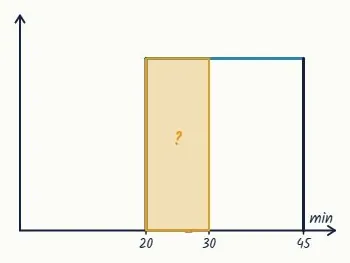
Q1: a rectangle
- Flat pdf: height 1 ÷ (b − a).
- Width × height.
- X ~ U(20, 45)minutes
- height = 1 ÷ (45 − 20) = 1/25
- 25 × 1/25 = 1total area 1
- P(X < 30) = width × height
- = (30 − 20) × 1/25
- = 10/25 = 0.4
- 30 × 1/25 = 1.2over 1: impossible
- a 40% chanceunder 30 min
Try it: a rectangle
Question 2 · Achieved
- Cross-country times are triangular:
- a = 12, c = 15, b = 24 minutes.
- Find the peak height and
- P(a runner takes over 20 min).
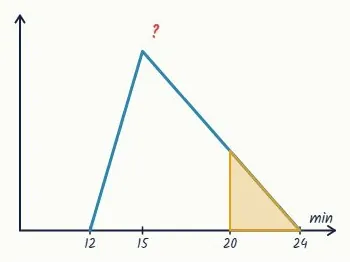
Q2: the peak, then a triangle
- Total area 1 fixes the peak.
- ½ × base × height.
- a = 12, c = 15, b = 24
- peak = 2 ÷ (24 − 12) = 1/6
- ½ × 12 × 1/6 = 1total area 1
- f(20) = (4/9) × (1/6)similar triangles
- = 4/54 = 2/27
- P(X > 20) = ½ × base × height
- = ½ × 4 × 2/27
- = 4/27 = 0.14814 d.p.
Try it: a triangle
Question 3 · Merit
- The same run: a = 12, c = 15, b = 24.
- Find P(14 < X < 20).
- Careful: the middle is not a triangle.
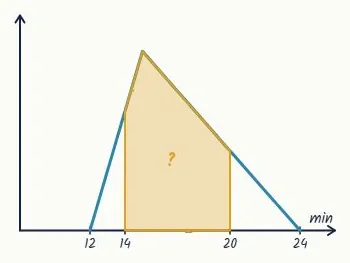
Q3: 1 minus both tails
- The tails are triangles.
- Take them off 1.
- P(14 < X < 20)
- = 1 − P(X < 14) − P(X > 20)not a triangle
- f(14) = (2/3) × (1/6) = 1/9similar triangles
- P(X < 14) = ½ × 2 × 1/9 = 1/9
- P(X > 20) = 4/27from question 2
- 1 − 1/9 − 4/27
- = 27/27 − 3/27 − 4/27
- = 20/27 = 0.74074 d.p.
Question 4 · Merit, in context
- A garden centre says a delivery takes
- At least 2 days, at most 9,
- And most often 3. Use a triangular
- Model to find P(over 6 days).
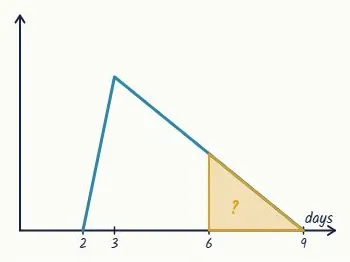
Q4: choose a, c, b
- Least, most likely, most.
- Then the right tail.
- a = 2, c = 3, b = 9least, likeliest, most
- peak = 2 ÷ (9 − 2) = 2/7
- f(6) = (3/6) × (2/7) = 1/7similar triangles
- P(X > 6) = ½ × 3 × 1/7
- = 3/14 = 0.21434 d.p.
- about 21% take over 6 days
Question 5 · Merit, in context
- A learner shearer's times are uniform,
- From 2 to 6 minutes a sheep.
- Of 200 sheep, how many over 5 min?
- A sheep has taken 3 min: P(over 5)?
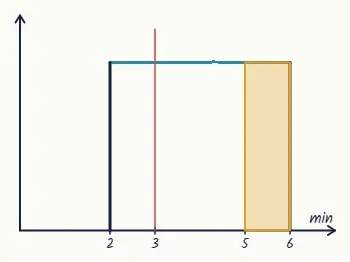
Q5: count, then given
- n × probability.
- "Given" shrinks the total.
- X ~ U(2, 6), height 1/4
- P(X > 5) = (6 − 5) × 1/4 = 1/4
- 200 × 1/4 = 50 sheep
- P(X > 5 | X > 3)
- = P(X > 5) ÷ P(X > 3)over 5 is over 3
- P(X > 3) = (6 − 3) × 1/4 = 3/4
- (1/4) ÷ (3/4) = 1/3
- = 0.33334 d.p.
- about 1 in 3 of those sheep
Question 6 · Excellence
- The garden centre: model a = 2, c = 3, b = 9.
- Their records for 60 deliveries are below.
- Compare model and data at both tails.
| Under 3 days | Over 6 days | Total | |
|---|---|---|---|
| Deliveries | 11 | 9 | 60 |
Q6: model against data
- Model: an area.
- Data: a relative frequency.
- P(X < 3) = ½ × 1 × 2/7 = 1/7
- = 0.1429model
- data: 11/60 = 0.1833
- P(X > 6) = 3/14 = 0.2143from question 4
- data: 9/60 = 0.15
- 0.1429 < 0.1833model too low
- 0.2143 > 0.15model too high
- too many long waits: b too big
Question 7 · Excellence
- Change the model to b = 8.
- Recalculate both tails and
- Judge: is b = 8 a better model?
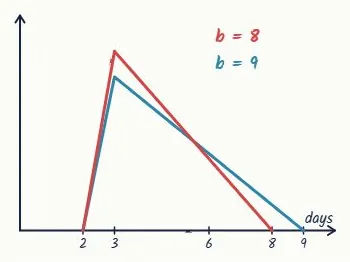
Q7: try b = 8
- Smaller b: taller peak.
- Compare both tails again.
- a = 2, c = 3, b = 8
- peak = 2 ÷ (8 − 2) = 1/3
- P(X < 3) = ½ × 1 × 1/3 = 1/6
- = 0.1667data 0.1833
- f(6) = (2/5) × (1/3) = 2/15similar triangles
- P(X > 6) = ½ × 2 × 2/15 = 2/15
- = 0.1333data 0.15
- both gaps now about 0.017were 0.04 and 0.06
- b = 8 is the better model
Try it: cut off the area
Common mistakes
- The area of a triangular model's middle is a triangle.Find the two tails, then subtract from 1.
- The peak height of a triangle is 1.The total area is 1, so the peak is 2 ÷ (b − a).
- Mixing up c and b.c is the most likely value. a and b are the ends.
The method that solved all seven
- Sketch, find the height, find the area, then judge the model against the data.
| Step | How |
|---|---|
| Uniform | height 1 ÷ (b − a) |
| Triangular | peak 2 ÷ (b − a) |
| Heights | similar triangles |
| Middle | 1 minus both tails |
| Choose | a least, c most likely, b most |
| Judge | model against data, each tail |
Challenge
A ferry crossing time X minutes is modelled as uniform between a and b. Records show P(X < 50) = 0.25 and P(X > 62) = 0.15. Find a and b. Then find P(52 < X < 60), and the probability that a crossing that has already taken 52 minutes finishes within 60 minutes.
Hint
Both tails are rectangles with the same height, 1 ÷ (b − a). Add the two tail widths and compare them with the whole width.
Answer
a = 45, b = 65; P(52 < X < 60) = 0.4; P(X < 60 | X > 52) = 813 ≈ 0.6154
Step by step
- Every rectangle under a uniform pdf has the same height, so a probability is just a width as a share of the whole width b − a.
- The two tails together have probability 0.25 + 0.15 = 0.4, and their widths add to (50 − a) + (b − 62) = (b − a) − 12.
- So (b − a) − 12 = 0.4(b − a), which gives 0.6(b − a) = 12 and b − a = 20.
- Then 50 − a = 0.25 × 20 = 5, so a = 45, and b − 62 = 0.15 × 20 = 3, so b = 65.
- P(52 < X < 60) = 8 ÷ 20 = 0.4.
- Given X > 52, the possible region shrinks to 52 to 65, width 13. Of that, 52 to 60 has width 8, so the answer is 8 ÷ 13.
Full working
- (50 − a) + (b − 62) = 0.4(b − a)the two tails together
- (b − a) − 12 = 0.4(b − a), so b − a = 20
- 50 − a = 0.25 × 20 = 5, b − 62 = 0.15 × 20 = 3each tail
- a = 45, b = 65, height 120
- P(52 < X < 60) = 8 × 120 = 0.4rectangle
- P(52 < X < 60) ÷ P(X > 52) = 0.4 ÷ (13 × 120) = 0.4 ÷ 0.65given shrinks the total
- a = 45, b = 65; 0.4; 813 ≈ 0.6154
The time X minutes to pack a bin of kiwifruit is triangular with a = 10, c = 16 and b = 40. The packhouse wants the middle 80% of packing times: the times below which the fastest 10% fall and above which the slowest 10% fall. Find both times exactly, then to 2 decimal places.
Hint
Each cut-off leaves a triangle of area 0.1 in a tail. Write that tail area in terms of the cut-off using similar triangles, but first check which side of the peak each cut-off lies.
Answer
Fastest 10%: under 10 + 3√2 ≈ 14.24 min; slowest 10%: over 40 − 6√2 ≈ 31.51 min
Step by step
- The peak height is 2 ÷ (40 − 10) = 115.
- Check sides first: P(X < 16) = ½ × 6 × 115 = 0.2. That is more than 0.1, so the lower cut-off is left of the peak; the upper one is right of it.
- Lower cut-off t: the left tail is a triangle with base t − 10 and height (t − 10) ÷ 6 × 115, so its area is (t − 10)² ÷ 180. Set this to 0.1: (t − 10)² = 18, so t = 10 + √18 = 10 + 3√2.
- Upper cut-off s: the right tail has base 40 − s and height (40 − s) ÷ 24 × 115, so its area is (40 − s)² ÷ 720. Set this to 0.1: (40 − s)² = 72, so s = 40 − √72 = 40 − 6√2.
- Take the root that lands inside the range: 10 − 3√2 and 40 + 6√2 are outside 10 to 40.
- So the middle 80% of bins take between about 14.24 and 31.51 minutes.
Full working
- peak = 2 ÷ (40 − 10) = 115
- P(X < 16) = ½ × 6 × 115 = 0.2 > 0.1lower cut-off is left of c
- ½ × (t − 10) × t − 106 × 115 = (t − 10)²180 = 0.1similar triangles
- (t − 10)² = 18, t = 10 + 3√2 ≈ 14.24
- ½ × (40 − s) × 40 − s24 × 115 = (40 − s)²720 = 0.1right tail
- (40 − s)² = 72, s = 40 − 6√2 ≈ 31.51
- middle 80%: 10 + 3√2 ≈ 14.24 min to 40 − 6√2 ≈ 31.51 min
Waits X minutes at a city bus stop are modelled as triangular with a = 1, c = 4 and an unknown maximum b. In 200 recorded waits, 40 were over 10 minutes and 17 were under 3 minutes. Find the value of b that makes the model match the over-10-minute data exactly. Then compare the model with the data for waits under 3 minutes, and comment on the fit.
Hint
Write P(X > 10) in terms of b: the peak is 2 ÷ (b − 1), and the height at 10 comes from similar triangles. Setting it equal to the data gives a quadratic; one root does not make sense.
Answer
b = 16; model P(X < 3) = 445 ≈ 0.0889 against data 17200 = 0.085, so the model fits both tails well
Step by step
- The data's upper tail is 40 ÷ 200 = 0.2, so the model needs P(X > 10) = 0.2.
- Peak height 2 ÷ (b − 1). The right tail triangle has base b − 10 and height (b − 10) ÷ (b − 4) × 2 ÷ (b − 1).
- So P(X > 10) = (b − 10)² ÷ ((b − 1)(b − 4)). Setting this to 0.2 and clearing fractions gives 4b² − 95b + 496 = 0.
- The roots are b = 16 and b = 7.75. A wait over 10 minutes must be possible, so b must be more than 10: b = 16.
- With b = 16 the peak is 215. The left tail to 3 has base 2 and height (2 ÷ 3) × 215 = 445, so P(X < 3) = ½ × 2 × 445 = 445 ≈ 0.0889.
- The data give 17 ÷ 200 = 0.085. The gap is under 0.004, so the model with b = 16 fits both tails closely.
Full working
- data: 40 ÷ 200 = 0.2 over 10 min, 17 ÷ 200 = 0.085 under 3 min
- P(X > 10) = ½ × (b − 10) × b − 10b − 4 × 2b − 1 = (b − 10)²(b − 1)(b − 4)similar triangles
- 5(b − 10)² = (b − 1)(b − 4)set equal to 0.2
- 5b² − 100b + 500 = b² − 5b + 4, so 4b² − 95b + 496 = 0
- b = (95 ± 33) ÷ 8 = 16 or 7.75b must exceed 10
- peak 215; P(X < 3) = ½ × 2 × (23 × 215) = 445 ≈ 0.0889lower tail
- b = 16; 0.0889 against 0.085, a close fit at both tails
Practise this
Report a mistake
More in AS 91586
 Choosing a distribution, and naming it every time7 min
 Discrete random variables: mean and standard deviation9 min
 Binomial and Poisson: at least, at most, and the rate10 min
 The normal distribution: forwards, backwards and conditional11 min
 Uniform and triangular distributions, and judging a model10 min
 Choosing a distribution: 7 exam questions solved step by step10 min
 Discrete random variables: 7 exam questions solved step by step11 min
 Binomial and Poisson: 7 exam questions solved step by step10 min
 Normal distribution: 7 exam questions solved step by step10 minUniform and triangular: 7 exam questions solved step by step10 min
Is your child on track?
Take the free placement test