Normal distribution: 7 exam questions solved step by step
What this lesson covers
- A normal probability is an area under the curve, found from the mean and standard deviation.
- Working backwards from a probability finds an unknown value, mean or standard deviation.
Normal distribution, both directions
- Sketch the curve and shade the area.
- Forwards: find z, then the area.
- Backwards: area to the left, find z, solve for x.
- Round at the end and answer in context.
Question 1 · Achieved
- Hawke's Bay apple weights are normal:
- Mean 172 g, sd 18 g.
- Apples under 150 g go to juice.
- Find P(an apple goes to juice).
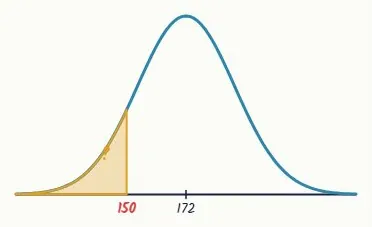
Q1: P(X < 150)
- Below the mean: z < 0.
- A small left tail.
- X ~ N(172, 18²)grams
- P(X < 150)
- z = (150 − 172) ÷ 18
- = −22 ÷ 18 = −1.2222below: negative
- P(X < 150) = 0.110812
- = 0.11084 d.p.
- about 11% go to juice
Try it: shade the area
Question 2 · Achieved
- The same apples: mean 172 g, sd 18 g.
- The heaviest 10% are sold as premium.
- Find the lightest premium weight.
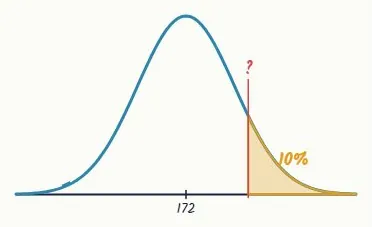
Q2: the top 10%
- Backwards: area to z.
- Use the area to the left.
- P(X > H) = 0.1
- P(X < H) = 0.9area to the left
- z = 1.2816inverse normal
- H = 172 + 1.2816 × 18
- = 172 + 23.0688 = 195.0688
- about 195.07 gabove the mean
- 172 − 23.0688 = 148.93wrong tail
Try it: the top 10%
Question 3 · Merit
- Avocado weights are normal:
- Mean 215 g, sd 22 g.
- Find P(an avocado is 190 g to 250 g).
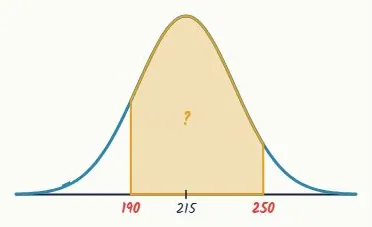
Q3: P(190 < X < 250)
- Two values, two z-values.
- Left area minus left area.
- X ~ N(215, 22²)
- P(190 < X < 250)
- z = (190 − 215) ÷ 22 = −1.1364
- z = (250 − 215) ÷ 22 = 1.5909
- P(X < 250) = 0.944185
- P(X < 190) = 0.127902
- 0.944185 − 0.127902 = 0.816283
- = 0.81634 d.p.
Question 4 · Merit
- Times to finish a long day walk are
- Normal with mean 6.5 hours.
- 12% take longer than 8 hours.
- Find the standard deviation.
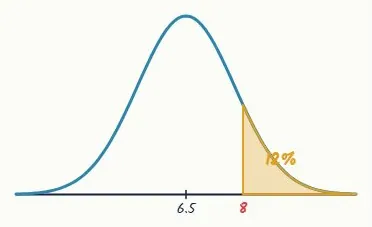
Q4: find σ
- Area to the left: 0.88.
- Substitute, solve for σ.
- μ = 6.5, σ unknown
- P(X > 8) = 0.12
- P(X < 8) = 0.88area to the left
- z = 1.1750inverse normal
- 1.1750 = (8 − 6.5) ÷ σ
- σ = 1.5 ÷ 1.1750
- = 1.2766 hours4 d.p.
- about 77 minutes
- σ = 1.2766: P(X > 8) = 0.1200
Question 5 · Merit, in context
- An e-scooter range is normal, sd 3.2 km.
- Only 4% may fall under 30 km.
- What mean range is needed?
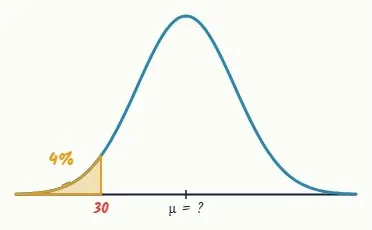
Q5: find μ
- 30 is below: z < 0.
- Solve for μ.
- σ = 3.2, μ unknown
- P(X < 30) = 0.04
- z = −1.7507below: negative
- −1.7507 = (30 − μ) ÷ 3.2
- −1.7507 × 3.2 = 30 − μ
- −5.6022 = 30 − μ
- μ = 30 + 5.6022 = 35.6022
- a mean range of about 35.6 km
- μ = 35.6022: P(X < 30) = 0.0400
Question 6 · Excellence
- The apples again: mean 172 g, sd 18 g.
- An apple is not for juice (over 150 g).
- Find P(it is over 205 g).
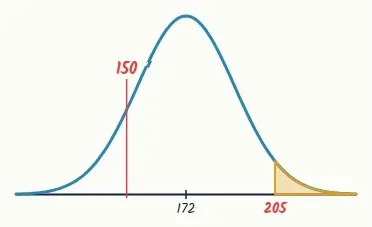
Q6: given over 150 g
- "Given" shrinks the total.
- Over 205 is over 150.
- P(X > 205 | X > 150)
- = P(X > 205) ÷ P(X > 150)over 205 is over 150
- z = (205 − 172) ÷ 18 = 1.8333
- P(X > 205) = 0.033377
- P(X > 150) = 1 − 0.110812from question 1
- = 0.889188the reduced total
- 0.033377 ÷ 0.889188 = 0.037536
- = 0.03754 d.p.
- about 1 in 27 of these apples
Question 7 · Excellence
- The apples: 11% go to juice (Q1).
- A bag holds 8 apples picked at random.
- Find P(at least 2 in the bag
- Would go to juice).
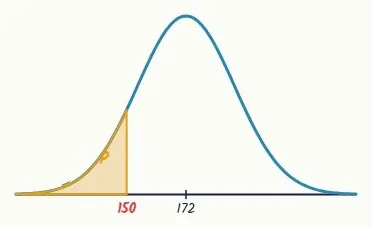
Q7: normal, then binomial
- Normal gives p.
- Binomial counts the bag.
- p = P(X < 150) = 0.110812from question 1
- Y ~ Bin(8, 0.110812)8 apples, independent
- P(Y ≥ 2) = 1 − P(Y ≤ 1)
- P(Y = 0) = 0.889188⁸ = 0.390795
- P(Y = 1) = 8 × p × (1 − p)⁷
- = 0.389612
- 1 − (0.390795 + 0.389612)
- = 1 − 0.780407 = 0.219593
- = 0.21964 d.p.
Try it: find σ, find μ, fill a bag
Common mistakes
- Using the z value for the area instead of the value.Choose the tail first: 12% above means 88% below for the inverse.
- Rounding early, such as 0.11 in the next step.Keep 4 decimal places in the working, and round at the end.
- Conditional normal questions use P(A) alone.Divide by the probability of the condition: P(A and B) ÷ P(B).
The method that solved all seven
- Sketch, z or inverse normal, solve, check, say it in context.
| Step | How |
|---|---|
| Sketch | shade the area you want |
| Forwards | z = (x − μ) ÷ σ, then area |
| Backwards | area to the left gives z |
| Unknown | z = (x − μ) ÷ σ, solve |
| Given that | divide by the reduced total |
| Two stages | normal p into a binomial |
Challenge
Apple weights at a Hawke's Bay orchard are normally distributed with mean 172 g, and 8% of apples weigh under 150 g. The packhouse rejects every apple under 150 g or over 200 g. Find the standard deviation and the proportion of apples rejected. The grower can shift the mean by thinning but cannot change the standard deviation. Find the mean that gives the fewest rejects, and the proportion rejected at that mean.
Hint
Use the inverse normal on the 8% to find z, then σ. Rejects are both tails added together. The normal curve is highest at its mean, so a 50 g window catches the most apples when it is centred on the mean.
Answer
σ = 15.66 g. Now 0.0800 + 0.0369 = 0.1169 of apples are rejected. The fewest rejects come with the mean at 175 g, midway between 150 g and 200 g, where 2 × 0.0552 = 0.1103 are rejected.
Step by step
- 8% below 150 g: the area to the left is 0.08, so z = −1.4051 and 150 = 172 − 1.4051σ.
- So σ = 22 ÷ 1.4051 = 15.657 g.
- Rejects now: 0.08 under 150 g, and z = (200 − 172) ÷ 15.657 = 1.7883 gives 0.0369 over 200 g. Total 0.1169.
- The kept apples are those in a 50 g window from 150 g to 200 g. The curve is highest at the mean and falls away evenly on both sides, so the window holds the most area when its centre, 175 g, is at the mean.
- At μ = 175 both limits are 25 g from the mean: z = ±1.5967, each tail is 0.0552, and the rejects total 0.1103.
Full working
- P(X < 150) = 0.08: z = −1.4051inverse normal
- 150 = 172 − 1.4051σ, σ = 22 ÷ 1.4051 = 15.657 g
- P(X > 200): z = (200 − 172) ÷ 15.657 = 1.7883, area 0.0369
- rejects now = 0.0800 + 0.0369 = 0.1169
- best mean = (150 + 200) ÷ 2 = 175 gwindow centred on the peak
- z = ±25 ÷ 15.657 = ±1.5967, each tail 0.0552
- rejects = 2 × 0.0552 = 0.1103
- σ = 15.66 g; rejects 0.1169 now; fewest at μ = 175 g, rejects 0.1103
A packhouse takes 60% of its apples from Orchard A, with weights N(172, 18²) in grams, and 40% from Orchard B, with weights N(160, 15²). Apples under 150 g go to juice. An apple picked at random from the juice bin: what is the probability it came from Orchard B?
Hint
Draw a tree: first the orchard, then juice or not. Find P(under 150 g) for each orchard from its own normal model. Then the juice bin is the reduced total.
Answer
P(from B given juice) = 0.1010 ÷ 0.1675 = 0.6030, about 60%, even though B supplies only 40% of the apples.
Step by step
- Orchard A: z = (150 − 172) ÷ 18 = −1.2222, P(under 150) = 0.1108.
- Orchard B: z = (150 − 160) ÷ 15 = −0.6667, P(under 150) = 0.2525.
- Juice from A: 0.6 × 0.1108 = 0.0665. Juice from B: 0.4 × 0.2525 = 0.1010. All juice: 0.1675.
- Given the apple is in the juice bin, divide by the reduced total: 0.1010 ÷ 0.1675 = 0.6030.
- B's apples are lighter on average, so B supplies more than its share of the juice apples.
Full working
- A: P(X < 150) = 0.110812z = −1.2222
- B: P(X < 150) = 0.252493z = −0.6667
- P(A and juice) = 0.6 × 0.110812 = 0.066487
- P(B and juice) = 0.4 × 0.252493 = 0.100997
- P(juice) = 0.066487 + 0.100997 = 0.167484
- P(B given juice) = 0.100997 ÷ 0.167484 = 0.6030
- P(from Orchard B) = 0.6030
Apple weights are normal with standard deviation 18 g, and apples under 150 g go to juice. A supermarket buys bags of 8 apples picked at random and wants at least 75% of bags to contain no juice apples. The grower can raise the mean weight with better thinning, but the standard deviation stays 18 g. What is the smallest mean weight that meets the supermarket's target?
Hint
Work backwards in two stages. First, if p is the chance one apple is under 150 g, a bag has no juice apples with probability (1 − p)⁸. Find the largest p allowed. Then use the inverse normal with that p to find μ.
Answer
p must be at most 1 − 0.75^(18) = 0.0353, so z = −1.8078 and μ = 150 + 1.8078 × 18 = 182.54 g. The mean must be at least about 182.5 g.
Step by step
- Let p = P(one apple is under 150 g). For 8 independent apples, P(no juice apples) = (1 − p)⁸, a binomial P(Y = 0).
- We need (1 − p)⁸ ≥ 0.75, so 1 − p ≥ 0.75^(18) = 0.96468, which gives p ≤ 0.035321.
- Now the normal stage, backwards: the area to the left of 150 is 0.035321, so z = −1.8078.
- −1.8078 = (150 − μ) ÷ 18, so μ = 150 + 1.8078 × 18 = 182.54 g.
- Check: with μ = 182.54, P(X < 150) = 0.0353 and 0.9647⁸ = 0.75. At the current mean of 172 g only 39% of bags have no juice apples.
Full working
- P(Y = 0) = (1 − p)⁸Y ~ Bin(8, p)
- (1 − p)⁸ ≥ 0.75supermarket target
- 1 − p ≥ 0.75^(18) = 0.964679
- p ≤ 0.035321
- P(X < 150) = 0.035321: z = −1.8078inverse normal
- −1.8078 = (150 − μ) ÷ 18
- μ = 150 + 32.54 = 182.54 g
- check: P(X < 150) = 0.0353, (1 − 0.0353)⁸ = 0.75
- The mean must be at least about 182.5 g
Practise this
Report a mistake
More in AS 91586
 Choosing a distribution, and naming it every time7 min
 Discrete random variables: mean and standard deviation9 min
 Binomial and Poisson: at least, at most, and the rate10 min
 The normal distribution: forwards, backwards and conditional11 min
 Uniform and triangular distributions, and judging a model10 min
 Choosing a distribution: 7 exam questions solved step by step10 min
 Discrete random variables: 7 exam questions solved step by step11 min
 Binomial and Poisson: 7 exam questions solved step by step10 minNormal distribution: 7 exam questions solved step by step10 min
 Uniform and triangular: 7 exam questions solved step by step10 min
Is your child on track?
Take the free placement test