Trapezium and Simpson's rules: numerical areas

What this lesson covers
- When a function cannot be integrated, or only data is given, the area is estimated from ordinates.
- The strip width h is the interval width divided by the number of strips, not the number of ordinates.
When you cannot integrate
- No antiderivative, or only data.
- Estimate from the heights: ordinates.
- Equally spaced values of x.
Both rules are in the booklet
- Trapezium rule and Simpson's rule.
- Know what goes into them.
- h = (b − a) ÷ number of strips.
y = 1/x, from 1 to 3, four strips
- Each strip is a trapezium.
- h = (3 − 1)/4 = 0.5.
- The tops sit just above the curve.
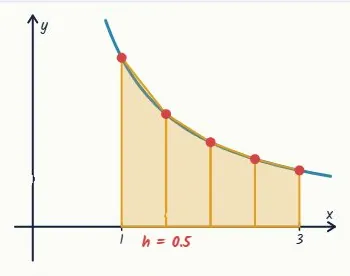
Try it: add more strips
Four strips, five ordinates
- One ordinate at each strip edge.
- Ends count once.
- Middle ordinates count twice.
| x | y = 1/x | Weight |
|---|---|---|
| 1 | 1 | 1 |
| 1.5 | 2/3 | 2 |
| 2 | 1/2 | 2 |
| 2.5 | 2/5 | 2 |
| 3 | 1/3 | 1 |
The trapezium rule
- Ends once, middle twice.
- Exact fractions, then 4 d.p.
- A ≈ (h/2)[ends + 2 × middle]
- h/2 = 0.5/2 = 1/4
- ends: 1 + 1/3 = 4/3
- middle: 2/3 + 1/2 + 2/5
- = 20/30 + 15/30 + 12/30 = 47/30
- 2 × 47/30 = 47/15
- bracket = 20/15 + 47/15 = 67/15
- A ≈ (1/4)(67/15) = 67/60
- ≈ 1.1167
The wrong h: a 2025 error
- Strips, not ordinates.
- Strips = ordinates − 1.
- bracket = 67/15
- h = (3 − 1)/5 = 0.45 ordinates
- 0.2 × 67/15 = 67/75 ≈ 0.8933
- h = (3 − 1)/4 = 0.54 strips
- 0.25 × 67/15 = 67/60 ≈ 1.1167
Simpson's rule
- An even number of strips.
- Weights 1, 4, 2, 4, …, 4, 1.
- Multiply by h/3, not h/2.
Simpson's rule on y = 1/x
- Weights: odd 4, even 2.
- Then multiply by h/3.
- A ≈ (h/3)[ends + 4 odd + 2 even]
- h/3 = 0.5/3 = 1/6
- ends: 1 + 1/3 = 4/3
- 4(2/3 + 2/5) = 4(16/15) = 64/15
- 2(1/2) = 1the even ordinate
- bracket = 4/3 + 64/15 + 1
- = 20/15 + 64/15 + 15/15 = 99/15
- A ≈ (1/6)(99/15) = 99/90
- = 11/10 = 1.1
How close are they?
- Exact: ln 3 ≈ 1.0986.
- Trapezium is over: the curve bends up.
- Simpson's is much closer.
| Value | |
|---|---|
| exact | ln 3 ≈ 1.0986 |
| trapezium | ≈ 1.1167, over |
| Simpson's | 1.1000 |
Try it: the exact area to compare
From a table: a car speeding up
- Distance = area under the speed graph.
- 7 readings, so 6 strips.
- 6 is even, so both rules work.
| t (s) | v (m/s) | Simpson |
|---|---|---|
| 0 | 0 | 1 |
| 2 | 5 | 4 |
| 4 | 9 | 2 |
| 6 | 12 | 4 |
| 8 | 14 | 2 |
| 10 | 15 | 4 |
| 12 | 15 | 1 |
Distance: the trapezium rule
- h = 2, so h/2 = 1.
- Ends once, middle twice.
- h = (12 − 0)/6 = 2, h/2 = 1
- ends: 0 + 15 = 15
- middle: 5 + 9 + 12 + 14 + 15 = 55
- d ≈ 1 × [15 + 2(55)]trapezium rule
- = 15 + 110 = 125 m
Distance: Simpson's rule
- Simpson's: h/3 = 2/3.
- Units, and what it means.
- h/3 = 2/3
- ends: 0 + 15 = 15
- 4(5 + 12 + 15) = 4(32) = 128t = 2, 6, 10
- 2(9 + 14) = 2(23) = 46t = 4, 8
- bracket = 15 + 128 + 46 = 189
- d ≈ (2/3)(189) = 126 m
- about 126 m in the first 12 s
Try it: find the slip
Show every ordinate
- Write the rule with each ordinate.
- Full accuracy, then 3 s.f.
- Odd strips: no Simpson's.
Where the marks are
- Achieved: the trapezium rule, right h.
- Merit, Excellence: part of a bigger problem.
- Compare with exact, or use in context.
What to take away
- h is the interval width over the number of strips.
| h | (b − a) ÷ strips |
| Ordinates | strips + 1 |
| Trapezium | ends + 2 × middle |
| Simpson's | ends + 4 odd + 2 even |
| Simpson's n | must be even |
| Show it | every ordinate |
Common mistakes
- 5 ordinates from 1 to 3, so h = (3 − 1)/5 = 0.4.h uses strips, not ordinates: 5 ordinates make 4 strips, so h = (3 − 1)/4 = 0.5.
- A ≈ (1/4)[1 + 2/3 + 1/2 + 2/5 + 1/3]The middle ordinates count twice: (h/2)[ends + 2 × middle] = (1/4)(4/3 + 47/15) ≈ 1.1167.
- Simpson's rule: multiply the bracket by h/2.Simpson's uses h/3 with weights 1, 4, 2, 4, ..., 4, 1, and it needs an even number of strips.
- Rounding each ordinate to 2 d.p. before adding them up.Keep exact values or full accuracy inside the bracket, and round only the final answer, e.g. to 3 s.f.
Your turn: eight questions
- Question 3 uses the integral in 2.
- Write out h and every ordinate.
| Given | Find | |
|---|---|---|
| 1 | x = 1 to 5, 8 strips | h, and ordinates |
| 2 | ∫₀⁴ √x dx, 4 strips | trapezium rule |
| 3 | the same integral | Simpson's rule |
| 4 | y: 3, 5, 6, 4, 2 | Simpson's, x = 0 to 4 |
| 5 | 7 ordinates, x = 2 to 14 | h |
| 6 | ∫₀² e^(x²) dx, 5 strips | Simpson's rule? |
| 7 | (h/2)[y₀ + 4y₁ + 2y₂ + 4y₃ + y₄] | the error in Simpson's |
| 8 | river depths 0, 1.2, 2.0, 2.4, 1.6, 0 m, every 3 m across | cross-section area |
Show answer
1. h = (5 − 1)/8 = 0.5, with 9 ordinates. 2. h = 1, ordinates 0, 1, √2, √3, 2: 0.5[0 + 2 + 2(1 + √2 + √3)] ≈ 5.15. 3. (1/3)[0 + 2 + 4(1 + √3) + 2√2] ≈ 5.25, closer to the exact 16/3 ≈ 5.33. 4. (1/3)[3 + 2 + 4(5 + 4) + 2(6)] = 53/3 ≈ 17.7. 5. h = 2. 7 ordinates make 6 strips, so h = (14 − 2) ÷ 6 = 2. 6. No: 5 strips is odd, and Simpson's rule needs an even number of strips. Use the trapezium rule. 7. h/2 should be h/3. The weights 1, 4, 2, 4, 1 are right, but Simpson's multiplies by h/3, not h/2. 8. 21.6 m². 6 depths make 5 strips (odd), so use the trapezium rule: (3/2)[0 + 0 + 2(1.2 + 2.0 + 2.4 + 1.6)] = 21.6.
The answers: questions 1 and 2
- 1. h = (5 − 1)/8 = 0.5
- 8 strips, so 9 ordinates
- 2. h = (4 − 0)/4 = 1
- ordinates: 0, 1, √2, √3, 2
- (1/2)[0 + 2 + 2(1 + √2 + √3)]trapezium rule
- = (1/2)(4 + 2√2 + 2√3)
- = (1/2)(10.2925) = 5.14634 d.p.
- ≈ 5.15
The answers: questions 3 and 4
- 3. (1/3)[0 + 2 + 4(1 + √3) + 2√2]
- = (1/3)(6 + 4√3 + 2√2)
- = (1/3)(15.7566) = 5.25224 d.p.
- ≈ 5.25
- exact: (2/3)(8) = 16/3 ≈ 5.3333Simpson is closer
- 4. (1/3)[3 + 2 + 4(5 + 4) + 2(6)]
- = (1/3)(5 + 36 + 12) = 53/3
- ≈ 17.7
Sample question: Achieved
Use the trapezium rule with 4 strips to estimate ∫₁⁵ √x dx. Give your answer to 4 decimal places.
Hint
h = (5 − 1) ÷ 4 = 1. Find the 5 ordinates, then use (h2)[ends + 2 × middle].
Answer
≈ 6.7643
Step by step
- First find the strip width: h = (b − a) ÷ number of strips = (5 − 1) ÷ 4 = 1.
- 4 strips need 5 ordinates, one at each strip edge: x = 1, 2, 3, 4 and 5.
- Classic mistake: dividing by the number of ordinates, 5, instead of the number of strips, 4.
- The ordinates are √1 = 1, √2, √3, √4 = 2 and √5.
- The trapezium rule is (h2)[first + last + 2 × (the middle ones)].
- Ends: 1 + √5 ≈ 3.2361. Middle: √2 + √3 + 2 ≈ 5.1463, doubled is 10.2925.
- Estimate: (12)(3.2361 + 10.2925) = (12)(13.5286) ≈ 6.7643.
- Check: the exact value is (23)(5^(32) − 1) ≈ 6.7869. The estimate is slightly under, because √x bends downwards, so each straight top sits below the curve.
Full working
- h = (5 − 1) ÷ 4 = 1interval ÷ strips
- ordinates: 1, √2, √3, 2, √5x = 1 to 5
- ends = 1 + √5 ≈ 3.2361; 2 × middle ≈ 10.2925
- (12)(3.2361 + 10.2925)(h2)[ends + 2 × middle]
- ≈ 6.7643
Sample questions: Merit
The function e^(−x²) cannot be integrated with the rules you know. Use Simpson's rule with 4 strips to estimate ∫₀¹ e^(−x²) dx, to 4 decimal places.
Hint
h = 0.25. Weight the ordinates 1, 4, 2, 4, 1 and multiply the total by h3.
Answer
≈ 0.7469
Step by step
- No antiderivative means we estimate from heights. Simpson's rule needs an even number of strips, and 4 is even.
- h = (1 − 0) ÷ 4 = 0.25, so the x values are 0, 0.25, 0.5, 0.75 and 1.
- Ordinates, to 4 decimal places: e⁰ = 1, e^(−0.0625) ≈ 0.9394, e^(−0.25) ≈ 0.7788, e^(−0.5625) ≈ 0.5698, e^(−1) ≈ 0.3679.
- Classic mistake: working out e^(−x)² instead of e^(−x²). Square x first, then make it negative.
- Simpson's weights are 1, 4, 2, 4, 1: ends once, odd ordinates times 4, even middle ordinates times 2.
- Ends: 1 + 0.3679 = 1.3679. Odd ones: 4 × (0.9394 + 0.5698) = 6.0368. Even middle: 2 × 0.7788 = 1.5576.
- Bracket total: 1.3679 + 6.0368 + 1.5576 = 8.9623.
- Multiply by h3 = 0.25 ÷ 3: 8.9623 × 0.25 ÷ 3 ≈ 0.7469.
- Check: the calculator's numerical value is 0.7468, so Simpson's rule is very close.
Full working
- h = (1 − 0) ÷ 4 = 0.254 strips, 5 ordinates
- y: 1, 0.9394, 0.7788, 0.5698, 0.3679y = e^(−x²)
- 1.3679 + 4(0.9394 + 0.5698) + 2(0.7788) = 8.9623weights 1, 4, 2, 4, 1
- (0.25 ÷ 3) × 8.9623× h3
- ≈ 0.7469
A stream is 12 m wide. Its depth, measured every 2 m across from one bank, is 0, 1.2, 2.1, 2.6, 2.4, 1.5 and 0 metres. Use Simpson's rule to estimate the area of the cross-section. The water flows at an average of 0.5 m per second. Estimate the volume of water passing each second.
Hint
7 depths means 6 strips with h = 2. The volume per second is the cross-section area times the speed.
Answer
Area ≈ 20.1 m²; about 10.1 m³ of water passes each second
Step by step
- The cross-section is the area under the depth graph, from one bank to the other.
- 7 readings means 6 strips. 6 is even, so Simpson's rule can be used. h = 12 ÷ 6 = 2 m.
- Simpson's rule: (h3)[ends + 4 × odd + 2 × even middle].
- Ends: 0 + 0 = 0. Odd ones, the 2nd, 4th and 6th readings: 1.2 + 2.6 + 1.5 = 5.3, and 4 × 5.3 = 21.2.
- Even middle ones, the 3rd and 5th readings: 2.1 + 2.4 = 4.5, and 2 × 4.5 = 9.
- Bracket: 0 + 21.2 + 9 = 30.2. Times h3 = 23: 30.2 × 23 ≈ 20.13 m².
- Classic mistake: using h2 from the trapezium rule with Simpson's weights. Simpson's always uses h3.
- Flow: each second, a slice of water 0.5 m long passes. Its volume is area × length = 20.13 × 0.5 ≈ 10.07 m³.
- Check: the trapezium rule gives 2 ÷ 2 × (0 + 2 × 9.8) = 19.6 m², close to 20.1, so the answer is sensible.
Full working
- h = 12 ÷ 6 = 27 readings, 6 strips
- ends 0 + 0 = 0first and last
- 4(1.2 + 2.6 + 1.5) = 21.2odd ordinates
- 2(2.1 + 2.4) = 9even middle ordinates
- A ≈ (23)(30.2) ≈ 20.13 m²× h3
- volume per second ≈ 20.13 × 0.5area × speed
- Area ≈ 20.1 m², flow ≈ 10.1 m³ each second
Sample questions: Excellence
Use the trapezium rule with 4 strips to estimate ∫₀^π sin x dx, giving an exact expression. Compare it with the exact value and explain why the trapezium rule gives an underestimate here. Then use Simpson's rule with the same 4 strips and comment on its accuracy.
Hint
h = π4, and the ordinates are 0, √22, 1, √22, 0. Think about whether the curve bends up or down between ordinates.
Answer
Trapezium (π4)(1 + √2) ≈ 1.896, under the exact value 2 by about 5.2%, because sin x bends downwards on 0 to π. Simpson's (π6)(2√2 + 1) ≈ 2.005, within about 0.23%.
Step by step
- Exact value first: ∫₀^π sin x dx = [−cos x]₀^π = −cos π + cos 0 = 1 + 1 = 2.
- Strip width: h = (π − 0) ÷ 4 = π4. The x values are 0, π4, π2, 3π4 and π.
- Ordinates: sin 0 = 0, sin(π4) = √22, sin(π2) = 1, sin(3π4) = √22, sin π = 0.
- Trapezium rule: (h2)[ends + 2 × middle] = (π8)[0 + 2(√22 + 1 + √22)] = (π8)(2√2 + 2) = (π4)(1 + √2).
- That is about 1.896, which is less than 2 by about 0.104, or 5.2%.
- Why it is under: on 0 to π, sin x is concave down, like a hill. Each strip's straight top joins two points on the curve, and the curve bulges above that line.
- So every trapezium misses a thin sliver of area above it, and the estimate is too small.
- Classic mistake: saying the trapezium rule always overestimates. It depends on the curve: over when it bends up, under when it bends down.
- Simpson's rule: (h3)[ends + 4 × odd + 2 × even] = (π12)[0 + 4(√22 + √22) + 2(1)] = (π12)(4√2 + 2) = (π6)(2√2 + 1).
- That is about 2.005, only about 0.23% above 2.
- Simpson's fits curves through the points instead of straight lines, so it follows the hill much more closely with the same ordinates.
Full working
- exact = [−cos x]₀^π = 2
- h = π4; ordinates 0, √22, 1, √22, 0
- T = (π8)(2√2 + 2) = (π4)(1 + √2) ≈ 1.896under by about 5.2%
- sin x is concave down, so the chords lie below the curvewhy it is under
- S = (π12)(4√2 + 2) = (π6)(2√2 + 1) ≈ 2.005within 0.23%
- Trapezium ≈ 1.896 (under); Simpson's ≈ 2.005, much closer to 2
a is a positive constant. Show that Simpson's rule with 2 strips gives the exact value of ∫₀^(2a) x³ dx for every value of a, but the trapezium rule with 2 strips does not. By what percentage is the trapezium rule wrong?
Hint
With 2 strips, h = a and the ordinates are at x = 0, a and 2a. Work out each rule in terms of a and compare with the exact integral.
Answer
Exact 4a⁴; Simpson's gives 4a⁴ (exact for every a); trapezium gives 5a⁴, which is 25% too big
Step by step
- This is a general result, so keep a as a letter the whole way.
- Exact value: ∫₀^(2a) x³ dx = [(14)x⁴]₀^(2a) = (2a)⁴4 = 16a⁴4 = 4a⁴.
- Classic mistake: (2a)⁴ = 2a⁴. The 2 is inside the bracket, so it is raised to the power too: 2⁴ = 16.
- Two strips over 0 to 2a means h = a. The ordinates are at x = 0, a and 2a: 0, a³ and 8a³.
- Simpson's rule: (h3)[ends + 4 × middle] = (a3)[0 + 8a³ + 4a³] = (a3)(12a³) = 4a⁴.
- That equals the exact value, and a was never given a number, so it holds for every a > 0.
- Trapezium rule: (h2)[ends + 2 × middle] = (a2)[0 + 8a³ + 2a³] = (a2)(10a³) = 5a⁴.
- 5a⁴ is not 4a⁴, so the trapezium rule is not exact. It is over by a⁴.
- Percentage error: a⁴ ÷ 4a⁴ = 14 = 25% too big, whatever a is.
- It is too big because x³ bends upwards on 0 to 2a, so the straight tops sit above the curve.
- Check with a = 3: exact 4 × 81 = 324, Simpson's (33)(0 + 216 + 4 × 27) = 324. It matches.
Full working
- ∫₀^(2a) x³ dx = (2a)⁴4 = 4a⁴exact
- h = a; ordinates 0, a³, 8a³
- S = (a3)(0 + 8a³ + 4a³) = 4a⁴equals the exact value
- T = (a2)(0 + 8a³ + 2a³) = 5a⁴over by a⁴
- a⁴ ÷ 4a⁴ = 25%same for every a
- Simpson's is exact (4a⁴); the trapezium rule gives 5a⁴, 25% too big
Challenge
Use the trapezium rule with 2 strips to estimate ∫ from 0 to 2 of eˣ dx. Show that the estimate is (1 + e)²2 and that it is too big by exactly (3 − e)(1 + e)2. Then find the percentage error of Simpson's rule with the same 2 strips.
Hint
Keep everything in terms of e until the very end. For the error, subtract the exact value and factorise the quadratic in e.
Answer
Trapezium (1 + e)²2 ≈ 6.913, too big by (3 − e)(1 + e)2 ≈ 0.524 (about 8.2%). Simpson's 1 + 4e + e²3 ≈ 6.421, about 0.50% too big.
Step by step
- The exact value is [eˣ] from 0 to 2 = e² − 1.
- h = 1, the ordinates are e⁰ = 1, e¹ = e and e².
- Trapezium: (12)(1 + 2e + e²), and 1 + 2e + e² is the perfect square (1 + e)².
- Subtract e² − 1: the difference is 3 + 2e − e²2, which factorises as (3 − e)(1 + e)2.
- e is less than 3, so both factors are positive: the estimate is too big, as it must be for a curve that bends upwards.
- Simpson's: (13)(1 + 4e + e²); compare with e² − 1.
Full working
- exact = e² − e⁰ = e² − 1 ≈ 6.389∫ eˣ dx = eˣ
- T = (12)(1 + 2e + e²) = (1 + e)²2 ≈ 6.913h = 1, ordinates 1, e, e²
- T − exact = 1 + 2e + e² − 2e² + 22 = 3 + 2e − e²2common denominator
- 3 + 2e − e² = (3 − e)(1 + e)check: 3 + 3e − e − e²
- T − exact = (3 − e)(1 + e)2 ≈ 0.524, about 8.2%e < 3, so positive
- S = (13)(1 + 4e + e²) ≈ 6.421Simpson's, h3 = 13
- Simpson's error ≈ (6.421 − 6.389) ÷ 6.389 ≈ 0.50% too big
A farm pond is 4 m deep. Its surface area A m² at depth d m below the top is: 500 at d = 0, 420 at d = 1, 310 at d = 2, 180 at d = 3 and 0 at d = 4. The volume of water is ∫ from 0 to 4 of A dd. Use Simpson's rule to estimate the volume of the full pond and the volume in its top 2 m. A pump removes 5 m³ per minute. Estimate how long the pump takes to lower the water to half the pond's depth, and what percentage of the water is gone by then.
Hint
Each thin layer of water has volume about A × (its thickness), so the volume is the area under the A against d graph. The top 2 m is a Simpson's estimate on its own, with 2 strips.
Answer
Full pond ≈ 1173 m³; top 2 m ≈ 830 m³; about 166 minutes, by which time about 71% of the water is gone
Step by step
- Volume is the area under the graph of A against d, so Simpson's rule applies with h = 1.
- Full pond: 4 strips, weights 1, 4, 2, 4, 1.
- Top 2 m: 2 strips from d = 0 to d = 2, weights 1, 4, 1.
- Lowering the water to 2 m deep removes the top 2 m, so the time is 830 ÷ 5.
- The pond is wider at the top, so half the depth holds well over half the water.
Full working
- h = 1, h3 = 13depths 1 m apart
- V ≈ (13)(500 + 4(420 + 180) + 2(310) + 0) = (13)(3520)4 strips
- V ≈ 1173 m³full pond
- top 2 m ≈ (13)(500 + 4(420) + 310) = (13)(2490) = 830 m³2 strips
- time = 830 ÷ 5 = 166 minutes5 m³ per minute
- 830 ÷ (35203) × 100 ≈ 70.7%share of the water
- About 166 minutes; about 71% of the water is gone
It is known that ∫ from 0 to 1 of 41 + x² dx = π exactly. Use 4 strips with the trapezium rule and with Simpson's rule to estimate π, using exact fractions for the ordinates. Give each estimate to 5 decimal places and its percentage error. The curve bends downwards on part of the interval and upwards on the rest. Use this to explain why the trapezium rule's error is smaller than you might expect, and say whether its estimate is too big or too small.
Hint
Over a stretch where a curve bends downwards, the trapezium tops sit below it; where it bends upwards, they sit above it. The bend changes direction where the second derivative is 0.
Answer
Trapezium 53231700 ≈ 3.13118 (about 0.33% too small); Simpson's 80112550 ≈ 3.14157 (about 0.0008% too small). The over and under errors partly cancel; the downward-bending part wins, so the trapezium estimate is too small.
Step by step
- h = 14. The ordinates are 4, 6417, 165, 6425 and 2.
- Trapezium: (h2)(ends + 2 × middle). Simpson's: (h3)(ends + 4 × odd + 2 × even).
- Compare each with π ≈ 3.14159.
- The second derivative of 41 + x² is 0 at x = 1√3 ≈ 0.577: before that the curve bends downwards, after it upwards.
- So the trapezia undershoot on the first part and overshoot on the second, and the two errors partly cancel.
- The estimate is below π, so the undershoot is the bigger of the two.
Full working
- y = 4, 6417, 165, 6425, 2 at x = 0, 14, 12, 34, 141 + x²
- T = (18)(4 + 2 + 2(6417 + 165 + 6425)) = 53231700 ≈ 3.13118h2 = 18
- (π − T) ÷ π × 100 ≈ 0.33%too small
- S = (112)(4 + 2 + 4(6417 + 6425) + 2(165)) = 80112550 ≈ 3.14157h3 = 112
- (π − S) ÷ π × 100 ≈ 0.0008%too small, by about 0.00002
- d²ydx² = 8(3x² − 1)(1 + x²)³ = 0 at x = 1√3the bend changes direction
- Trapezium ≈ 3.13118, too small; Simpson's ≈ 3.14157; errors partly cancel
Practise this
Report a mistake
More in AS 91579
 The integration toolkit: surds, e, trig and the chain rule10 min
 Integrating fractions: when it is ln, and when it is not9 min
 The constant of integration: find c, never assume it9 min
 Definite integrals and area, including between two curves11 minTrapezium and Simpson's rules: numerical areas10 min
 Differential equations: growth, decay and Newton's cooling11 min
 Integration toolkit: 7 exam questions solved step by step10 min
 Integrating fractions: 7 exam questions solved step by step10 min
 Constant of integration: 7 exam questions solved step by step11 min
 Definite integrals: 7 exam questions solved step by step11 min
 Numerical integration: 6 exam questions solved step by step11 min
 Differential equations: 6 exam questions solved step by step11 min
Is your child on track?
Take the free placement test