Definite integrals and area, including between two curves
What this lesson covers
- A definite integral gives a signed area, so regions below the axis count as negative.
- The area between two curves is the integral of the top curve minus the bottom one.
A definite integral
- Integrate, then F(b) − F(a).
- The answer is a signed area.
- Below the x axis counts as negative.
∫ from −1 to 2 of (3x² − 2x) dx
- Integrate each term.
- Top limit, then bottom.
- Subtract, with brackets.
- ∫₋₁² (3x² − 2x) dx
- = [x³ − x²]₋₁²integrate each term
- F(2) = 2³ − 2² = 8 − 4 = 4top limit
- F(−1) = (−1)³ − (−1)²bottom limit
- = −1 − 1 = −2
- F(2) − F(−1) = 4 − (−2)brackets
- = 6
Missing brackets: a 2025 error
- No brackets: a sign is lost.
- Put all of F(a) in brackets.
- F(2) = 4, F(−1) = −1 − 1
- 4 − −1 − 1no brackets
- = 4 + 1 − 1 = 4sign lost
- 4 − (−1 − 1)all of F(a) in brackets
- = 4 − (−2)
- = 6
y = x² − 4x, from 0 to 5
- Below the axis from 0 to 4.
- Above the axis from 4 to 5.
- Straight across: −25/3.
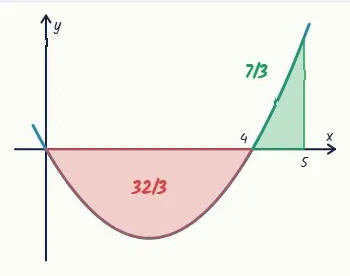
Try it: signed area
Roots, then F at every limit
- Split at the roots.
- Evaluate F at 0, 4 and 5.
- x² − 4x = x(x − 4) = 0factorise
- x = 0 or x = 4
- F(x) = x³/3 − 2x²integrate
- F(0) = 0
- F(4) = 64/3 − 32 = −32/3
- F(5) = 125/3 − 50 = −25/3
- ∫₀⁵ = F(5) − F(0) = −25/3not the area
Split at the roots
- Integrate each piece.
- Add the sizes, not signs.
- F(0) = 0
- F(4) = −32/3
- F(5) = −25/3
- ∫₀⁴ = F(4) − F(0) = −32/3below the axis
- ∫₄⁵ = F(5) − F(4)
- = −25/3 − (−32/3) = 7/3above the axis
- Area = 32/3 + 7/3add the sizes
- = 39/3 = 13
- −32/3 + 7/3 = −25/3pieces add up
The area between two curves
- Integrate top minus bottom.
- Limits: where the curves meet.
- If they swap over, split there.
Graphing calculator
Between y = x and y = x² − 2
- They meet at two points.
- The line is on top.
- Top minus bottom: no splitting.
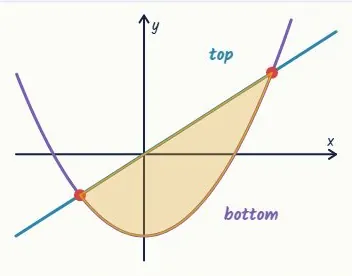
Where they meet, and the integral
- Set the curves equal.
- Then top minus bottom.
- x² − 2 = xset equal
- x² − x − 2 = 0rearrange
- (x − 2)(x + 1) = 0factorise
- x = −1 or x = 2
- A = ∫₋₁² (x − (x² − 2)) dxtop − bottom
- = ∫₋₁² (2 + x − x²) dxsimplify
Evaluating the area
- Integrate, then subtract.
- Area = 9/2.
- A = ∫₋₁² (2 + x − x²) dx
- = [2x + x²/2 − x³/3]₋₁²integrate
- F(2) = 4 + 2 − 8/3 = 10/3
- F(−1) = −2 + 1/2 + 1/3
- = −7/6
- A = 10/3 − (−7/6)brackets
- = 20/6 + 7/6 = 27/6
- = 9/2
Solving for an unknown limit
- Integrate, then set equal.
- Reject a root, and say why.
- ∫₀ᵏ (2x + 1) dx = 12
- [x² + x]₀ᵏ = 12integrate
- (k² + k) − 0 = 12substitute k and 0
- k² + k − 12 = 0rearrange
- (k − 3)(k + 4) = 0factorise
- k = 3 or k = −4
- k = −4k must be positive
- k = 3
- 3² + 3 = 12
Try it: between curves, and k
Keep the 1/a factor
- Reverse chain rule: ÷ 2.
- Dropping it scored nothing.
- ∫ e²ˣ dx, from 0 to ln 2
- = [(1/2)e²ˣ] from 0 to ln 2
- e^(2 ln 2) = e^(ln 4) = 4top limit
- e⁰ = 1bottom limit
- = (1/2)(4 − 1) = 3/2
- 4 − 1 = 3no 1/2: no credit
Trig limits are in radians
- Integrate: divide by 3.
- Check the calculator mode.
- ∫ cos 3x dx, from 0 to π/6
- = [(1/3)sin 3x] from 0 to π/6
- 3(π/6) = π/2, sin(π/2) = 1top limit
- sin 0 = 0bottom limit
- = (1/3)(1 − 0) = 1/3
Show the integrated function
- No credit for a calculator answer alone.
- Unknown constants stop the calculator.
- Brackets, substitution, answer.
Where the marks are
- Achieved: evaluate, or solve for an unknown.
- Merit: areas, including below the axis.
- Excellence: unfamiliar areas, clear notation.
What to take away
- Signed area: split at the roots, and integrate top minus bottom.
| Evaluate | F(b) − F(a) |
| Brackets | around F(a) |
| Below the axis | split at the roots |
| Between curves | top − bottom |
| Unknown limit | check both roots |
| Show it | every integration |
Common mistakes
- F(2) − F(−1) = 4 − −1 − 1 = 4Put all of F(−1) in brackets: 4 − (−1 − 1) = 4 − (−2) = 6.
- Area between y = x² − 4x and the x-axis from 0 to 5 = ∫₀⁵ = −25/3.Split at the root x = 4 and add the sizes: 32/3 + 7/3 = 13. A straight integral gives a signed area.
- k² + k − 12 = 0, so k = 3 or k = −4.Reject k = −4 and say why (k must be positive), then check: 3² + 3 = 12.
- ∫ e²ˣ dx from 0 to ln 2 = [e²ˣ] = 4 − 1 = 3Keep the 1/2 from the reverse chain rule: (1/2)(4 − 1) = 3/2. Dropping it scored no credit.
Your turn: eight questions
- Question 2: find the roots first.
- Question 3: which curve is on top?
| Given | Find | |
|---|---|---|
| 1 | 6x² − 4x, x = 1 to 2 | the integral |
| 2 | y = x² − 3x, x = 0 to 4 | total area |
| 3 | y = 6 − x² and y = x | area enclosed |
| 4 | ∫₀ᵏ e²ˣ dx = 4 | k, exactly |
| 5 | 3x² − 2, x = −1 to 2 | the integral |
| 6 | cos 3x, x = 0 to π/6 | the integral |
| 7 | y = x³ − x, x = −1 to 1 | the integral, and the area |
| 8 | ∫₀ᵏ (2x − 2) dx = 3, k > 0 | k |
Show answer
1. [2x³ − 2x²] from 1 to 2 = 8 − 0 = 8. 2. Roots 0 and 3: ∫₀³ = −9/2 and ∫₃⁴ = 11/6, so the area is 9/2 + 11/6 = 19/3. 3. They meet at x = −3 and x = 2; ∫(6 − x − x²) dx from −3 to 2 = 125/6 ≈ 20.8. 4. (e²ᵏ − 1)/2 = 4, so e²ᵏ = 9 and k = ln 3 ≈ 1.10. 5. 3. [x³ − 2x] gives F(2) = 4 and F(−1) = 1, so 4 − (1) = 3. 6. 1/3. [sin 3x/3] gives sin(π/2)/3 − 0 = 1/3, in radians. 7. Integral 0, area 1/2. The pieces are 1/4 above and −1/4 below the axis: they cancel, but the sizes add. 8. k = 3. k² − 2k = 3 gives (k − 3)(k + 1) = 0, and k > 0 rejects −1.
The answers: questions 1 and 2
- 1. [2x³ − 2x²]₁²integrate
- = (16 − 8) − (2 − 2) = 8
- 2. x(x − 3) = 0, so x = 0 or 3roots
- F(x) = x³/3 − 3x²/2integrate
- ∫₀³ = F(3) − F(0) = 9 − 27/2
- = −9/2
- ∫₃⁴ = F(4) − F(3)
- = −8/3 − (−9/2) = 11/6
- Area = 9/2 + 11/6 = 19/3add the sizes
The answers: question 3
- 3. 6 − x² = xset equal
- x² + x − 6 = 0rearrange
- (x + 3)(x − 2) = 0, so x = −3 or 2
- A = ∫₋₃² (6 − x² − x) dxparabola on top
- = [6x − x³/3 − x²/2]₋₃²integrate
- F(2) = 12 − 8/3 − 2 = 22/3
- F(−3) = −18 + 9 − 9/2 = −27/2
- A = 22/3 − (−27/2) = 125/6
- ≈ 20.8
The answers: question 4
- 4. ∫₀ᵏ e²ˣ dx = [(1/2)e²ˣ]₀ᵏreverse chain rule
- = (1/2)(e²ᵏ − 1) = 4substitute k and 0
- e²ᵏ − 1 = 8, so e²ᵏ = 9multiply by 2
- 2k = ln 9ln both sides
- k = (1/2)ln 9 = ln 3ln 9 = 2 ln 3
- ≈ 1.10
Sample question: Achieved
Find ∫₁³ (3x² − 4x + 1) dx.
Hint
Integrate each term, then work out F(3) − F(1), with brackets around F(1).
Answer
12
Step by step
- A definite integral means: integrate, then subtract the value at the bottom limit from the value at the top limit.
- Integrate each term: 3x² becomes x³, −4x becomes −2x², and 1 becomes x. So F(x) = x³ − 2x² + x. No + c is needed, because it would cancel.
- Top limit: F(3) = 27 − 18 + 3 = 12.
- Bottom limit: F(1) = 1 − 2 + 1 = 0.
- Subtract: F(3) − F(1) = 12 − (0) = 12.
- Classic mistake: dropping the brackets around F(1). It does not matter here, but it does when F(1) is negative.
- Check: a calculator gives ∫₁³ (3x² − 4x + 1) dx = 12.
Full working
- F(x) = x³ − 2x² + xintegrate each term
- F(3) = 27 − 18 + 3 = 12top limit
- F(1) = 1 − 2 + 1 = 0bottom limit
- 12 − (0) = 12
Sample questions: Merit
Find the total area between the curve y = x² − 2x − 3, the x axis, and the lines x = 0 and x = 4.
Hint
Find where the curve crosses the x axis between 0 and 4. Integrate each piece separately and add their sizes.
Answer
343 square units
Step by step
- Area below the x axis comes out negative in an integral. So first find where the curve crosses the axis.
- Solve x² − 2x − 3 = 0: (x − 3)(x + 1) = 0, so x = 3 or x = −1. Only x = 3 is between 0 and 4.
- Test a value: at x = 1, y = 1 − 2 − 3 = −4. So the curve is below the axis from 0 to 3 and above it from 3 to 4.
- Integrate: F(x) = x³3 − x² − 3x.
- F(0) = 0. F(3) = 9 − 9 − 9 = −9. F(4) = 643 − 16 − 12 = −203.
- From 0 to 3: F(3) − F(0) = −9. The negative sign says it is below the axis. Its size is 9.
- From 3 to 4: F(4) − F(3) = −203 − (−9) = −203 + 273 = 73. This piece is above the axis.
- Total area: add the sizes, 9 + 73 = 273 + 73 = 343.
- Classic mistake: integrating straight from 0 to 4. That gives −9 + 73 = −203, where the two pieces partly cancel. That is not the area.
- Check: 343 ≈ 11.3, and a calculator gives ∫₀⁴ |x² − 2x − 3| dx ≈ 11.3.
Full working
- (x − 3)(x + 1) = 0, so x = 3the root inside 0 to 4
- F(x) = x³3 − x² − 3xintegrate
- ∫₀³ = F(3) − F(0) = −9below the axis
- ∫₃⁴ = −203 − (−9) = 73above the axis
- Area = 9 + 73add the sizes
- 343 square units
Find the area enclosed between the curve y = x² and the line y = 2x + 3.
Hint
Set them equal to find where they meet. Then integrate top minus bottom between those x values.
Answer
323 square units
Step by step
- The area between two graphs is the integral of the top one minus the bottom one, between the points where they meet.
- Where they meet: x² = 2x + 3, so x² − 2x − 3 = 0, which is (x − 3)(x + 1) = 0. So x = −1 and x = 3.
- Which is on top? Test x = 0, between the two: the line gives 3 and the curve gives 0. So the line is on top.
- Area = ∫₋₁³ (2x + 3 − x²) dx.
- Integrate: F(x) = x² + 3x − x³3.
- F(3) = 9 + 9 − 9 = 9.
- F(−1) = 1 − 3 + 13 = −53.
- Area = 9 − (−53) = 273 + 53 = 323.
- Classic mistake: losing the brackets on F(−1) and getting 9 − 53. Always bracket the bottom value.
- Check: 323 ≈ 10.7, and a calculator gives the same.
Full working
- x² = 2x + 3, so (x − 3)(x + 1) = 0where they meet
- x = −1 and x = 3; the line is on toptest x = 0
- A = ∫₋₁³ (2x + 3 − x²) dxtop − bottom
- F(x) = x² + 3x − x³3
- F(3) = 9, F(−1) = −53
- A = 9 − (−53) = 323 square units
Sample questions: Excellence
k is a positive constant. Show that the area enclosed between y = x² and y = kx is k³6. Hence find k if the area is 36 square units.
Hint
The graphs meet at x = 0 and x = k, and the line is on top between them. Integrate kx − x² with the limits 0 and k.
Answer
Area = k³6; k = 6
Step by step
- This is a general result, so we work with k the whole way and only use a number at the end.
- Where they meet: x² = kx, so x² − kx = 0, which is x(x − k) = 0. So x = 0 or x = k.
- Which is on top? Test x = k2: the line gives k²2 and the curve gives k²4. Since k > 0, the line is higher.
- Area = ∫₀ᵏ (kx − x²) dx. Integrate: F(x) = kx²2 − x³3.
- F(k) = k × k²2 − k³3 = k³2 − k³3.
- Common denominator: 3k³6 − 2k³6 = k³6. And F(0) = 0.
- So the area is k³6 − 0 = k³6, as required.
- Hence: k³6 = 36, so k³ = 216 and k = ∛216 = 6.
- Classic mistake: integrating x² − kx, bottom minus top. That gives −k³6 and then k³ = −216, which does not fit k > 0.
- Check with k = 6: ∫₀⁶ (6x − x²) dx = [3x² − (13)x³]₀⁶ = 108 − 72 = 36. Correct.
Full working
- x² = kx, so x(x − k) = 0meet at x = 0 and x = k
- kx > x² for 0 < x < kline on top
- A = ∫₀ᵏ (kx − x²) dx = [(12)kx² − (13)x³]₀ᵏ
- = k³2 − k³3 = k³6shown
- k³6 = 36, so k³ = 216hence
- Area = k³6; k = 6
Find the value of k > 0 for which ∫₀ᵏ (x² − 4x) dx = 0. Explain what this result means about the regions between the curve y = x² − 4x and the x axis.
Hint
Integrate, set the result equal to 0 and factorise. For the meaning, find where the curve crosses the axis between 0 and k.
Answer
k = 6. The region below the axis (x = 0 to 4) and the region above it (x = 4 to 6) have the same area, 323 each, so they cancel.
Step by step
- Integrate: F(x) = x³3 − 2x². So the integral from 0 to k is k³3 − 2k² − 0.
- Set it to 0: k³3 − 2k² = 0. Factorise: k²(k3 − 2) = 0.
- So k = 0 or k3 = 2, which gives k = 6. The question wants k > 0, so k = 6.
- Classic mistake: dividing both sides by k² without saying why. That is fine here only because k > 0, so k ≠ 0.
- Now the meaning. An integral of 0 does not mean there is no area. It means the signed areas cancel.
- The curve y = x(x − 4) crosses the axis at x = 0 and x = 4. It is below the axis between 0 and 4 and above it after 4.
- Below: ∫₀⁴ (x² − 4x) dx = 643 − 32 = −323, so that region has area 323.
- Above: ∫₄⁶ (x² − 4x) dx = (72 − 72) − (−323) = 323, so that region also has area 323.
- The two regions are the same size, one negative and one positive, so the integral from 0 to 6 is 0.
- So the total area between the curve and the axis from 0 to 6 is 643, not 0.
- Check: F(6) = 2163 − 72 = 72 − 72 = 0. Correct.
Full working
- ∫₀ᵏ (x² − 4x) dx = k³3 − 2k²integrate
- k²(k3 − 2) = 0, so k = 6k > 0
- x(x − 4) = 0 at x = 0 and 4where the curve crosses
- ∫₀⁴ = −323, ∫₄⁶ = 323below, then above
- −323 + 323 = 0the signed areas cancel
- k = 6; equal areas of 323 below and above the axis cancel
Calculus Grapher
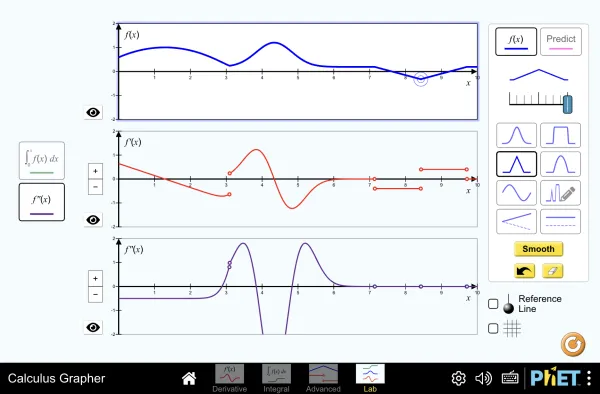
Full screen · PhET Interactive Simulations, University of Colorado Boulder, CC BY 4.0
Challenge
The curve y = x³ − 2x² and the line y = 3x enclose two regions. Find the total area of the two regions.
Hint
Find all three crossing points first. Then check which graph is on top in each region: it is not the same one both times.
Answer
716 ≈ 11.8 square units (712 from x = −1 to 0, plus 454 from x = 0 to 3)
Step by step
- Set the curve equal to the line: x³ − 2x² − 3x = 0, which factorises to x(x − 3)(x + 1) = 0.
- The graphs cross at x = −1, 0 and 3, so there are two regions.
- Test a point in each: at x = −0.5 the curve is higher; at x = 1 the line is higher.
- Integrate top minus bottom on each region separately, then add the two areas.
- One integral from −1 to 3 would let the pieces partly cancel, so it would be wrong.
Full working
- x³ − 2x² − 3x = x(x − 3)(x + 1) = 0set equal
- x = −1, 0, 3crossing points
- x = −0.5: curve −0.625, line −1.5; x = 1: curve −1, line 3who is on top
- ∫ from −1 to 0 of (x³ − 2x² − 3x) dx = [x⁴4 − 2x³3 − 3x²2] = 0 − (14 + 23 − 32) = 712curve on top
- ∫ from 0 to 3 of (3x + 2x² − x³) dx = [3x²2 + 2x³3 − x⁴4] = 272 + 18 − 814 = 454line on top
- 712 + 454 = 712 + 13512 = 14212add the sizes
- Total area = 716 ≈ 11.8 square units
Find the equation of the tangent to y = eˣ at the point where x = 1. Then find the exact area of the region bounded by the curve, this tangent and the y axis.
Hint
The tangent goes through the origin. Sketch it: on this region, which graph is on top?
Answer
Tangent y = ex; area e2 − 1 ≈ 0.359 square units
Step by step
- The gradient at x = 1 is e¹ = e, and the point is (1, e).
- The tangent is y − e = e(x − 1), which simplifies to y = ex.
- eˣ bends upwards, so the curve is above its tangent, touching only at x = 1.
- The region runs from the y axis (x = 0) to the touching point (x = 1).
- Integrate eˣ − ex from 0 to 1.
Full working
- dydx = eˣ, so the gradient at x = 1 is epoint (1, e)
- y − e = e(x − 1), so y = extangent
- Area = ∫ from 0 to 1 of (eˣ − ex) dxcurve on top
- = [eˣ − ex²2] from 0 to 1integrate
- = (e − e2) − (e⁰ − 0) = e2 − 1e⁰ = 1
- Area = e2 − 1 ≈ 0.359 square units
The region R is enclosed between y = 4 − x² and the x axis. The curve y = ax², where a is a positive constant, cuts R into a part above the curve and two parts below it. Find a so that the part above the curve has exactly half the area of R.
Hint
Let the two curves meet at x = ±b. Write a in terms of b, then find the top area in terms of b alone: the algebra gets much simpler.
Answer
a = 3 (the curves meet at x = ±1; the area of R is 323, the top part is 163)
Step by step
- The area of R is the integral of 4 − x² from −2 to 2, which is 323. Half of it is 163.
- The curves meet where 4 − x² = ax². Call the crossing points x = ±b, so (1 + a)b² = 4.
- The top part is the integral of 4 − (1 + a)x² from −b to b.
- Replace (1 + a) by 4b²: the top area becomes 16b3.
- Set 16b3 = 163, so b = 1, and then 1 + a = 4.
Full working
- Area of R = ∫ from −2 to 2 of (4 − x²) dx = [4x − x³3] = 163 − (−163) = 323x axis crossings ±2
- 4 − x² = ax² gives (1 + a)b² = 4crossing points x = ±b
- Top part = ∫ from −b to b of (4 − (1 + a)x²) dx = 2(4b − (1 + a)b³3)symmetric, top minus bottom
- = 2(4b − 4b3) = 16b3(1 + a)b² = 4
- 16b3 = 163, so b = 1half of 323
- 1 + a = 41² = 4from (1 + a)b² = 4
- a = 3
Practise this
Report a mistake
More in AS 91579
 The integration toolkit: surds, e, trig and the chain rule10 min
 Integrating fractions: when it is ln, and when it is not9 min
 The constant of integration: find c, never assume it9 minDefinite integrals and area, including between two curves11 min
 Trapezium and Simpson's rules: numerical areas10 min
 Differential equations: growth, decay and Newton's cooling11 min
 Integration toolkit: 7 exam questions solved step by step10 min
 Integrating fractions: 7 exam questions solved step by step10 min
 Constant of integration: 7 exam questions solved step by step11 min
 Definite integrals: 7 exam questions solved step by step11 min
 Numerical integration: 6 exam questions solved step by step11 min
 Differential equations: 6 exam questions solved step by step11 min
Is your child on track?
Take the free placement test