Definite integrals: 7 exam questions solved step by step

What this lesson covers
- A definite integral gives a signed area, so regions below the axis count as negative.
- The area between two curves is the integral of the top curve minus the bottom one.
Definite integrals and areas
- Integrate and write F(x), with no + c.
- Work out F(b) − F(a), with brackets.
- Area: split at the roots (below the axis is negative).
- Between two curves: integrate top minus bottom.
Question 1 · Achieved
- Evaluate ∫₋₁² (4x³ − 6x + 2) dx
Q1: ∫₋₁² (4x³ − 6x + 2) dx
- Integrate each term.
- Brackets around F(−1).
- F(x) = x⁴ − 3x² + 2xintegrate
- F(2) = 16 − 12 + 4 = 8top limit
- F(−1) = 1 − 3 − 2 = −4bottom limit
- F(2) − F(−1) = 8 − (−4)brackets
- = 12
- 8 − 1 − 3 − 2 = 2brackets dropped
Question 2 · Achieved
- Evaluate exactly
- ∫ from 0 to π/6 of 4 sin 2x dx
Q2: 4 sin 2x, from 0 to π/6
- Reverse chain rule: ÷ 2.
- Radians, not degrees.
- ∫ sin 2x dx = −(1/2)cos 2xreverse chain rule
- ∫ 4 sin 2x dx = −2 cos 2x× 4
- = [−2 cos 2x] from 0 to π/6
- x = π/6: −2 cos(π/3) = −1top limit
- x = 0: −2 cos 0 = −2bottom limit
- −1 − (−2) = 1brackets
Question 3 · Merit
- Find the area enclosed by
- y = x² − 2x − 3 and the x-axis.
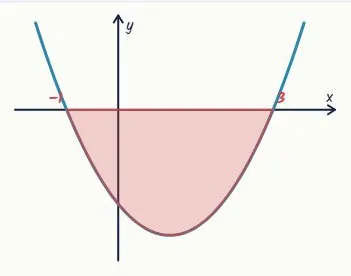
Q3: a region below the axis
- The roots are the limits.
- An area is positive.
- x² − 2x − 3 = (x − 3)(x + 1)factorise
- x = −1 or x = 3
- F(x) = x³/3 − x² − 3xintegrate
- F(3) = 9 − 9 − 9 = −9top limit
- F(−1) = −1/3 − 1 + 3 = 5/3bottom limit
- ∫₋₁³ = −9 − 5/3 = −32/3below the axis
- Area = 32/3 ≈ 10.7 units²
Try it: below the axis
Question 4 · Merit
- y = x³ − 3x² + 2x
- Find the total area between the curve
- And the x-axis from x = 0 to x = 2.
- Careful: the curve crosses the axis.
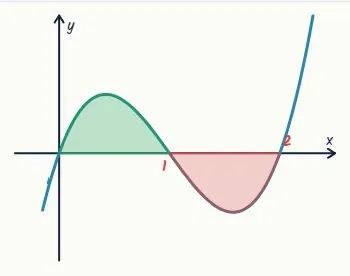
Q4: roots, then F at each one
- Split where it crosses.
- F at 0, 1 and 2.
- x³ − 3x² + 2x = x(x − 1)(x − 2)
- roots: x = 0, 1, 2
- F(x) = x⁴/4 − x³ + x²integrate
- F(0) = 0
- F(1) = 1/4 − 1 + 1 = 1/4
- F(2) = 4 − 8 + 4 = 0
- ∫₀² = F(2) − F(0) = 0not the area
Q4: add the sizes
- One integral per region.
- Add sizes, not signs.
- F(0) = 0, F(1) = 1/4, F(2) = 0
- ∫₀¹ = 1/4 − 0 = 1/4above the axis
- ∫₁² = 0 − 1/4 = −1/4below the axis
- Area = 1/4 + 1/4add the sizes
- = 1/2 unit²
- 1/4 + (−1/4) = 0pieces give ∫₀²
Question 5 · Merit, in context
- A garden bed is the region between
- y = x² and y = 8 − x², in metres.
- Find the area of the bed.
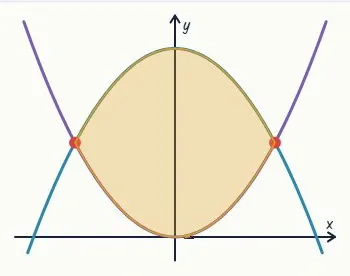
Q5: between two curves
- Limits: where they meet.
- Top minus bottom.
- x² = 8 − x²set equal
- 2x² = 8, x² = 4, x = ±2
- A = ∫₋₂² ((8 − x²) − x²) dxtop − bottom
- = ∫₋₂² (8 − 2x²) dx
- = [8x − 2x³/3]₋₂²integrate
- F(2) = 16 − 16/3 = 32/3
- F(−2) = −16 + 16/3 = −32/3
- A = 32/3 − (−32/3) = 64/3
- ≈ 21.3 m²
Try it: between two curves
Question 6 · Excellence
- The line y = kx, with k > 0, and
- The curve y = x² enclose an area
- Of 36 square units. Find k.
Q6: y = kx and y = x²
- The limits depend on k.
- Area in k, then solve.
- x² = kxset equal
- x(x − k) = 0, so x = 0 or k
- kx ≥ x² for 0 ≤ x ≤ kthe line is on top
- A = ∫₀ᵏ (kx − x²) dxtop − bottom
- = [kx²/2 − x³/3]₀ᵏk is a constant
- = k³/2 − k³/3 = k³/6
- k³/6 = 36, so k³ = 216
- k = 6
- 6³/6 = 216/6 = 36
Question 7 · Excellence
- Find a > 0 so that
- ∫₀ᵃ (3x² − 6x) dx = 0.
- Explain what this means for area.
Q7: solve for a
- Integrate, set to 0.
- Reject with a reason.
- [x³ − 3x²]₀ᵃ = 0integrate
- a³ − 3a² = 0F(0) = 0
- a²(a − 3) = 0factorise
- a = 0a > 0, no width
- a = 3
Q7: what the zero means
- Find where it crosses.
- Signed areas cancel.
- a = 3
- 3x² − 6x = 3x(x − 2): roots 0, 2
- ∫₀² = 8 − 12 = −4below the axis
- ∫₂³ = 0 − (−4) = 4above the axis
- area below = area above = 4
- total area 8 units², not 0
Try it: signed or total area
Common mistakes
- The total area from 0 to 2 is the integral from 0 to 2.Regions below the axis count negative. Split at each crossing and add the sizes.
- An area can be negative.A negative integral means the region is below the axis. Give its size.
- ∫ (lower − upper) dx for the area between curves.Use upper minus lower, so the area comes out positive.
The method that solved all seven
- Integrate, substitute with brackets, split at roots.
| Step | How |
|---|---|
| Integrate | show F(x), no + c |
| Substitute | F(b) − F(a), with brackets |
| Below axis | split at the roots |
| Add areas | add sizes, not signs |
| Two curves | top minus bottom |
| Unknown | reject a root with a reason |
Challenge
For x > 0, the curves y = sin x and y = cos x cross many times. Find the exact area of the region enclosed between them from their first crossing to their second crossing.
Hint
Crossings are where sin x = cos x, so divide by cos x. Then test one point between the crossings to see which curve is on top.
Answer
2√2 ≈ 2.83 square units (between x = π4 and x = 5π4)
Step by step
- sin x = cos x means tan x = 1, so the first two positive crossings are x = π4 and x = 5π4.
- At x = π2 (in between), sin x = 1 and cos x = 0, so sin x is on top.
- Integrate top minus bottom: ∫ (sin x − cos x) dx = −cos x − sin x.
- At 5π4 both cos and sin are −√22, so the value is √2. At π4 both are √22, so the value is −√2.
- Subtract with brackets: √2 − (−√2) = 2√2.
Full working
- sin x = cos x, so tan x = 1÷ cos x
- x = π4 and x = 5π4first two crossings
- sin(π2) = 1 > cos(π2) = 0sin x on top
- A = [−cos x − sin x] from π4 to 5π4top minus bottom
- x = 5π4: √22 + √22 = √2cos, sin both −√22
- x = π4: −√22 − √22 = −√2
- A = √2 − (−√2) = 2√2 ≈ 2.83 square units
The region R is enclosed between the curve y = x² and the line y = 4. A horizontal line y = c, with 0 < c < 4, cuts R into two parts of equal area. Find the exact value of c.
Hint
The part of R below y = c is itself a region between y = x² and a horizontal line. Find its area in terms of c, with limits ±√c, and set it equal to half of R.
Answer
c = ∛16 = 2∛2 ≈ 2.52
Step by step
- The region between y = x² and any line y = c runs from x = −√c to x = √c, with the line on top.
- Its area is ∫ (c − x²) dx between those limits, which works out to (43)c√c.
- With c = 4 this gives the whole of R: (43)(8) = 323.
- The lower part must be half of that, 163. So (43)c^(32) = 163 and c^(32) = 4.
- Square both sides and cube root: c³ = 16, so c = ∛16 ≈ 2.52. It is above halfway (2) because R is wider at the top.
Full working
- x² = c, so x = ±√climits
- A(c) = [cx − x³3] from −√c to √cline on top
- = 2(c√c − c√c3) = (43)c^(32)symmetric about x = 0
- A(4) = (43)(8) = 323the whole of R
- (43)c^(32) = 163, so c^(32) = 4half of R
- c³ = 16square both sides
- c = ∛16 = 2∛2 ≈ 2.52
The curves y = eˣ and y = 4e^(−x) cross at one point. Region A is bounded by the two curves and the y axis. Region B is bounded by the two curves and the line x = a, where a is to the right of the crossing. Find the area of A, and the exact value of a for which B has the same area as A.
Hint
Find the crossing by multiplying eˣ = 4e^(−x) through by eˣ. On each side of the crossing a different curve is on top. For B, you will meet e^a and e^(−a) together: let u = e^a.
Answer
Area of A = 1 square unit; a = ln 4 ≈ 1.39
Step by step
- eˣ = 4e^(−x) gives e^(2x) = 4, so the crossing is at x = ln 2.
- Left of ln 2 (at x = 0: 1 against 4), 4e^(−x) is on top. Area A = ∫ from 0 to ln 2 of (4e^(−x) − eˣ) dx = 1.
- Right of ln 2, eˣ is on top. B = ∫ from ln 2 to a of (eˣ − 4e^(−x)) dx = e^a + 4e^(−a) − 4.
- Set B = 1: e^a + 4e^(−a) = 5. Multiply by u = e^a: u² − 5u + 4 = 0, so u = 1 or u = 4.
- u = 1 gives a = 0, which is left of the crossing, so reject it. u = 4 gives a = ln 4.
Full working
- e^(2x) = 4, so x = ln 2× eˣ
- A = [−4e^(−x) − eˣ] from 0 to ln 24e^(−x) on top
- = (−2 − 2) − (−4 − 1) = 1e^(−ln 2) = 12, e^(ln 2) = 2
- B = [eˣ + 4e^(−x)] from ln 2 to a = e^a + 4e^(−a) − 4eˣ on top
- e^a + 4e^(−a) − 4 = 1B = A
- u² − 5u + 4 = 0, (u − 1)(u − 4) = 0u = e^a
- u = 1 gives a = 0 < ln 2reject
- Area of A = 1; a = ln 4 ≈ 1.39
Practise this
Report a mistake
More in AS 91579
 The integration toolkit: surds, e, trig and the chain rule10 min
 Integrating fractions: when it is ln, and when it is not9 min
 The constant of integration: find c, never assume it9 min
 Definite integrals and area, including between two curves11 min
 Trapezium and Simpson's rules: numerical areas10 min
 Differential equations: growth, decay and Newton's cooling11 min
 Integration toolkit: 7 exam questions solved step by step10 min
 Integrating fractions: 7 exam questions solved step by step10 min
 Constant of integration: 7 exam questions solved step by step11 minDefinite integrals: 7 exam questions solved step by step11 min
 Numerical integration: 6 exam questions solved step by step11 min
 Differential equations: 6 exam questions solved step by step11 min
Is your child on track?
Take the free placement test