Polar form by hand: modulus, argument and quadrants

What this lesson covers
- Modulus is a distance, so it is never negative; argument is an angle measured from the positive real axis.
- The quadrant decides the argument, so a sketch comes before the calculator.
Polar form: a distance and a direction
- x + iy is the point (x, y).
- Modulus r: the distance from the origin.
- Argument θ: the angle from the real axis.
The Argand diagram
- z = 1 + √3i: first quadrant.
- w = −2 + 2i: second quadrant.
- u = 1 − i: fourth quadrant.
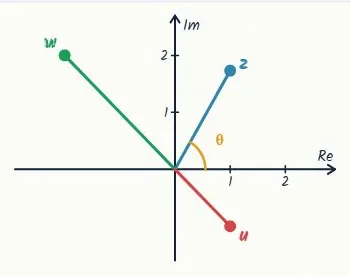
z = 1 + √3i
- Sketch: name the quadrant.
- Modulus, then argument.
- Check by converting back.
- z = 1 + √3i: x > 0, y > 0first quadrant
- r = √(1² + (√3)²)modulus
- = √(1 + 3) = √4 = 2
- θ = tan⁻¹(√3/1) = π/3argument
- first quadrant: keep π/3
- z = 2 cis(π/3)
- 2(1/2) + 2(√3/2)i = 1 + √3i
Try it: drag a complex number
w = −2 + 2i
- Sketch: second quadrant.
- Calculator says −π/4.
- Then π − reference angle.
- w = −2 + 2i: x < 0, y > 0second quadrant
- r = √((−2)² + 2²)modulus
- = √(4 + 4) = √8 = 2√2
- calculator: tan⁻¹(−1) = −π/4fourth quadrant
- reference: tan⁻¹(2/2) = π/4
- θ = π − π/4 = 3π/4second quadrant
- w = 2√2 cis(3π/4)
- 2√2(−√2/2) = −2, 2√2(√2/2) = 2
The 2025 error: the lost minus sign
- Below the axis: θ < 0.
- Measured clockwise.
- Range: −π < θ ≤ π.
- u = 1 − i: x > 0, y < 0fourth quadrant
- r = √(1² + (−1)²) = √2modulus
- reference: tan⁻¹(1/1) = π/4
- θ = π/4sign lost
- θ = −π/4below the real axis
- u = √2 cis(−π/4)
- −π < θ ≤ πthe usual range
The modulus, written right
- Square b, not bi.
- A modulus: never negative.
- |3 + 4i| = √(3² + 4²)no i
- = √(9 + 16) = √25 = 5
- √(3² + (4i)²) = √(9 − 16)squared the i
- = √(−7)not a distance
- |z| ≥ 0never negative
Exact values, no calculator
- Converting by hand needs exact values.
- Π/6, π/4 and π/3 cover most questions.
| θ | cos θ | sin θ |
|---|---|---|
| π/6 | √3/2 | 1/2 |
| π/4 | √2/2 | √2/2 |
| π/3 | 1/2 | √3/2 |
4 cis(−2π/3) in rectangular form
- x = r cos θ, y = r sin θ.
- Exact values only.
- x = r cos θ, y = r sin θ
- −2π/3: third quadrantreference π/3
- cos(−2π/3) = −1/2
- sin(−2π/3) = −√3/2
- x = 4(−1/2) = −2
- y = 4(−√3/2) = −2√3
- 4 cis(−2π/3) = −2 − 2√3i
- √(4 + 12) = √16 = 4modulus
Multiplying in polar form
- Multiply the moduli.
- Add the arguments.
- Bring it into range.
- z = 2 cis(π/3), v = 3 cis(5π/6)
- |zv| = 2 × 3 = 6multiply moduli
- arg = π/3 + 5π/6add arguments
- = 2π/6 + 5π/6 = 7π/6
- 7π/6 > πout of range
- 7π/6 − 12π/6 = −5π/6subtract 2π
- zv = 6 cis(−5π/6)
Try it: multiply moduli, add arguments
Dividing, and the answer form
- Divide the moduli.
- Subtract the arguments.
- Then give the form asked.
- |z/v| = 2 ÷ 3 = 2/3divide moduli
- arg = π/3 − 5π/6subtract arguments
- = 2π/6 − 5π/6 = −3π/6
- = −π/2in range
- z/v = (2/3) cis(−π/2)
- cos(−π/2) = 0, sin(−π/2) = −1
- (2/3)(0 − i) = −(2/3)ithe form asked
Try it: pin it on the Argand diagram
Sketch before the calculator
- Sketch the point, name the quadrant.
- Reference angle from the sizes of x and y.
- Adjust for the quadrant, check the sign.
Where the marks are
- Achieved: modulus, argument, converting.
- Merit: use that a modulus is positive.
- Excellence: quotients, argument and parts.
What to take away
- Sketch first: the quadrant decides the argument.
| Sketch first | which quadrant? |
| Modulus | √(x² + y²), positive |
| Argument | from positive real axis |
| Below the axis | negative argument |
| Multiply | × moduli, + arguments |
| Divide | ÷ moduli, − arguments |
Common mistakes
- u = 1 − i, so θ = π/4.1 − i is below the real axis, so θ = −π/4; the lost minus sign was a named 2025 error.
- |3 + 4i| = √(3² + (4i)²) = √(−7)Square b, not bi: |3 + 4i| = √(9 + 16) = 5, and a modulus is never negative.
- −2 + 2i: tan⁻¹(−1) = −π/4, so arg = −π/4.−2 + 2i is in the second quadrant, so θ = π − π/4 = 3π/4; sketch the point before trusting the calculator.
- zv = 6 cis(7π/6)7π/6 is more than π, so subtract 2π: zv = 6 cis(−5π/6), inside −π < θ ≤ π.
Your turn: eight questions
- No calculator: sketch every point first.
- Give question 3 exactly.
| Given | Find | |
|---|---|---|
| 1 | −√3 + i | modulus, argument |
| 2 | −3 − 3i | polar form |
| 3 | 6 cis(−π/3) | a + bi, exactly |
| 4 | 2cis(3π/4) × 3cis(π/2) | polar form |
| 5 | 5 − 12i | modulus |
| 6 | 2√3 − 2i | argument |
| 7 | −5i | polar form |
| 8 | 6 cis(5π/6) ÷ 3 cis(−π/2) | polar form |
Show answer
1. Second quadrant: modulus 2, argument π − π/6 = 5π/6. 2. Third quadrant: 3√2 cis(−3π/4), not 3π/4 or π/4. 3. 6(1/2) + 6(−√3/2)i = 3 − 3√3i. 4. 6 cis(5π/4), brought into range as 6 cis(−3π/4). 5. 13. |5 − 12i| = √(5² + 12²) = √(25 + 144) = √169 = 13, and a modulus is never negative. 6. −π/6. The point (2√3, −2) is in the fourth quadrant with reference angle tan⁻¹(2/(2√3)) = π/6, and below the axis θ is negative, so θ = −π/6. 7. 5 cis(−π/2). The point (0, −5) is on the negative imaginary axis, 5 from the origin, so θ = −π/2. 8. 2 cis(−2π/3). Modulus 6 ÷ 3 = 2, argument 5π/6 − (−π/2) = 4π/3, and 4π/3 − 2π = −2π/3 brings it into range.
The answers: questions 1 and 2
- 1. −√3 + i: second quadrant
- r = √(3 + 1) = √4 = 2
- reference: tan⁻¹(1/√3) = π/6
- θ = π − π/6 = 5π/6
- 2. −3 − 3i: third quadrant
- r = √(9 + 9) = √18 = 3√2
- reference: tan⁻¹(3/3) = π/4
- θ = −(π − π/4) = −3π/4below the axis
- −3 − 3i = 3√2 cis(−3π/4)
The answers: questions 3 and 4
- 3. x = 6 cos(−π/3) = 6(1/2) = 3
- y = 6 sin(−π/3) = 6(−√3/2) = −3√3
- 6 cis(−π/3) = 3 − 3√3i
- 4. modulus 2 × 3 = 6multiply moduli
- argument 3π/4 + π/2 = 5π/4add arguments
- 5π/4 − 2π = −3π/4more than π
- 6 cis(−3π/4)
Sample question: Achieved
Write z = −1 − √3i in polar form r cis θ, with −π < θ ≤ π.
Hint
Sketch it first: both parts are negative, so z is in the third quadrant and its argument is negative.
Answer
z = 2 cis(−2π3)
Step by step
- Sketch first. The real part −1 and the imaginary part −√3 are both negative, so z is in the third quadrant.
- Modulus: r = √((−1)² + (−√3)²) = √(1 + 3) = 2. A modulus is a distance, so it is never negative.
- Reference angle: use the sizes only. tan⁻¹(√31) = π3.
- In the third quadrant, with −π < θ ≤ π, the argument is −(π − π3) = −2π3.
- A calculator gives tan⁻¹(√3) = π3, which is the first quadrant. That is the classic mistake: always let the sketch decide.
- So z = 2 cis(−2π3).
- Check: 2cos(−2π3) = 2(−12) = −1 and 2sin(−2π3) = 2(−√32) = −√3. Correct.
Full working
- x < 0, y < 0third quadrant
- r = √(1 + 3) = 2
- reference: tan⁻¹(√3) = π3
- θ = −(π − π3) = −2π3third quadrant, negative argument
- z = 2 cis(−2π3)
Sample questions: Merit
z = 2 cis(3π4) and w = 4 cis(−π3). Find zw and z ÷ w in polar form, with arguments between −π and π.
Hint
Multiply: multiply the moduli and add the arguments. Divide: divide the moduli and subtract the arguments. Then bring each argument into range.
Answer
zw = 8 cis(5π12) and z ÷ w = (12) cis(−11π12)
Step by step
- The rules: to multiply, multiply the moduli and add the arguments. To divide, divide the moduli and subtract the arguments.
- zw: modulus 2 × 4 = 8. Argument 3π4 + (−π3) = 9π12 − 4π12 = 5π12.
- 5π12 is between −π and π, so zw = 8 cis(5π12).
- z ÷ w: modulus 2 ÷ 4 = 12. Argument 3π4 − (−π3) = 9π12 + 4π12 = 13π12.
- Watch the double negative: subtracting −π3 means adding π3.
- 13π12 is more than π, so subtract a full turn: 13π12 − 24π12 = −11π12.
- So z ÷ w = (12) cis(−11π12).
- Check: (12) × 4 = 2 and −11π12 + (−π3) = −15π12, which is 9π12 = 3π4 after adding 2π. That gives back z.
Full working
- |zw| = 2 × 4 = 8, arg = 3π4 − π3 = 5π12add the arguments
- zw = 8 cis(5π12)
- |z ÷ w| = 2 ÷ 4 = 12, arg = 3π4 + π3 = 13π12subtract the arguments
- 13π12 − 2π = −11π12bring into range
- zw = 8 cis(5π12), z ÷ w = (12) cis(−11π12)
z = k + 2i, where k is real, and arg z = 2π3. Find the exact values of k and |z|.
Hint
An argument of 2π3 puts z in the second quadrant, so k is negative. Use tan of the reference angle π3.
Answer
k = −2√33 and |z| = 4√33
Step by step
- arg z = 2π3 is between π2 and π, so z is in the second quadrant. That means the real part k is negative.
- The reference angle is π − 2π3 = π3.
- In the right triangle, tan(reference angle) = (size of imaginary part) ÷ (size of real part). So tan(π3) = 2|k|.
- tan(π3) = √3, so √3 = 2|k| and |k| = 2√3.
- Rationalise: 2√3 = 2√33. Since k is negative, k = −2√33.
- Modulus: |z| = √(k² + 2²) = √(43 + 4) = √(163) = 4√3.
- Rationalise: 4√3 = 4√33.
- Check: |z|cos(2π3) = (4√33)(−12) = −2√33 = k. Correct.
Full working
- second quadrant, so k < 0arg between π2 and π
- tan(π3) = 2|k|reference angle π3
- |k| = 2√3 = 2√33, k = −2√33
- |z| = √(43 + 4) = √(163) = 4√3
- |z|cos(2π3) = −2√33 = kcheck
- k = −2√33, |z| = 4√33
Sample questions: Excellence
u = −√3 + i and v = 1 + i. Write u and v in polar form, and hence find u ÷ v in polar form. By also finding u ÷ v in the form a + bi, find the exact value of cos(7π12).
Hint
u is in the second quadrant. Divide in polar form, then divide again using the conjugate, and match the real parts of the two answers.
Answer
u = 2 cis(5π6), v = √2 cis(π4), u ÷ v = √2 cis(7π12), cos(7π12) = √2 − √64
Step by step
- u = −√3 + i is in the second quadrant. Modulus √(3 + 1) = 2. Reference tan⁻¹(1√3) = π6, so arg u = π − π6 = 5π6.
- v = 1 + i is in the first quadrant. Modulus √2, argument π4.
- Divide in polar form: modulus 2 ÷ √2 = √2, argument 5π6 − π4 = 10π12 − 3π12 = 7π12. So u ÷ v = √2 cis(7π12).
- Now divide the same numbers in rectangular form. Multiply top and bottom by the conjugate 1 − i. The bottom becomes 2.
- Top: (−√3 + i)(1 − i) = −√3 + √3i + i − i² = (1 − √3) + (1 + √3)i.
- So u ÷ v = 1 − √32 + (1 + √32)i.
- The two forms are the same number. √2 cis(7π12) has real part √2 cos(7π12), so √2 cos(7π12) = 1 − √32.
- Divide by √2: cos(7π12) = 1 − √32√2.
- Rationalise by multiplying top and bottom by √2: √2 − √64.
- Sense check: 7π12 is a little more than π2, so its cosine should be small and negative. √2 − √64 ≈ −0.259, and cos(7π12) ≈ −0.259. Correct.
Full working
- u = 2 cis(5π6)second quadrant, π − π6
- v = √2 cis(π4)
- u ÷ v = √2 cis(5π6 − π4) = √2 cis(7π12)
- u ÷ v = (−√3 + i)(1 − i)2 = 1 − √32 + (1 + √32)iconjugate
- √2 cos(7π12) = 1 − √32equate real parts
- cos(7π12) = 1 − √32√2 = √2 − √64
z = r cis θ, where r > 0, and z̄ is its conjugate. Prove that z × z̄ = r² and that z ÷ z̄ = cis 2θ. Hence write (3 − 3i) ÷ (3 + 3i) in the form a + bi without multiplying by a conjugate.
Hint
The conjugate reflects z in the real axis, so z̄ = r cis(−θ). Then use the polar rules for multiplying and dividing.
Answer
z × z̄ = r² cis 0 = r² and z ÷ z̄ = cis 2θ. (3 − 3i) ÷ (3 + 3i) = −i.
Step by step
- The conjugate flips the sign of the imaginary part, which reflects z in the real axis.
- A reflection keeps the distance from the origin and turns the angle θ into −θ. So z̄ = r cis(−θ).
- Multiply: moduli r × r = r², arguments θ + (−θ) = 0. So z × z̄ = r² cis 0 = r²(1 + 0i) = r².
- Divide: moduli r ÷ r = 1, arguments θ − (−θ) = 2θ. So z ÷ z̄ = cis 2θ. Both results hold for every z, so they are proved.
- Hence: 3 + 3i is the conjugate of z = 3 − 3i, so the question asks for z ÷ z̄.
- z = 3 − 3i is in the fourth quadrant. Reference angle tan⁻¹(33) = π4, so θ = −π4.
- z ÷ z̄ = cis(2 × (−π4)) = cis(−π2).
- cos(−π2) = 0 and sin(−π2) = −1, so the answer is 0 − i = −i.
- Check: (3 + 3i)(−i) = −3i − 3i² = 3 − 3i. Correct.
Full working
- z̄ = r cis(−θ)reflection in the real axis
- z × z̄ = r² cis(θ − θ) = r²multiply moduli, add arguments
- z ÷ z̄ = 1 cis(θ + θ) = cis 2θdivide moduli, subtract arguments
- z = 3 − 3i, θ = −π4fourth quadrant
- z ÷ z̄ = cis(−π2)check: (3 + 3i)(−i) = 3 − 3i
- (3 − 3i) ÷ (3 + 3i) = −i
Challenge
A complex number z satisfies arg z = π6 and arg(z − 4) = π3. Find z in the form a + bi and in polar form.
Hint
Sketch O, the point 4 and z. arg(z − 4) is the direction of the arrow from 4 to z. Work out the three angles of the triangle: what kind of triangle is it?
Answer
z = 6 + 2√3i = 4√3 cis(π6).
Step by step
- z − 4 is the arrow from the point 4 to z, so it makes an angle of π3 with the positive real axis.
- In the triangle with corners O, 4 and z, the angle at O is π6 and the angle at 4 is π − π3 = 2π3.
- The angle at z is then π6, the same as at O, so the triangle is isosceles and the side from 4 to z is 4 long.
- So z − 4 = 4 cis(π3). Convert and add 4, then check both arguments.
Full working
- angle at O = π6arg z
- angle at 4 = π − π3 = 2π3the interior angle
- angle at z = π − π6 − 2π3 = π6angle sum of a triangle
- |z − 4| = 4, the side from O to 4isosceles: equal angles at O and z
- z − 4 = 4 cis(π3) = 4(12 + (√32)i) = 2 + 2√3ipolar to rectangular
- z = 6 + 2√3iadd 4
- |z| = √(36 + 12) = √48 = 4√3, arg z = tan⁻¹(2√36) = tan⁻¹(1√3) = π6check
- z = 6 + 2√3i = 4√3 cis(π6)
z lies on the circle |z| = 2 and arg(z + 2) = π6. (a) Find z in the form a + bi. (b) Find arg(z − 2), and show that arg(z − 2) − arg(z + 2) = π2. (c) Explain why arg(z − 2) − arg(z + 2) = π2 for every z on this circle with a positive imaginary part.
Hint
Write z + 2 = t cis(π6) with t > 0, so z = −2 + t cis(π6), and use |z|² = 4 to find t. For (c), −2 and 2 are the two ends of a diameter.
Answer
(a) z = 1 + √3i. (b) arg(z − 2) = 2π3, and 2π3 − π6 = π2. (c) −2 and 2 are the ends of a diameter, so the angle at z in the triangle with corners −2, 2 and z is a right angle (the angle in a semicircle), and arg(z − 2) − arg(z + 2) is exactly that angle.
Step by step
- z + 2 is the arrow from −2 to z, so it has length t and argument π6.
- Put z = −2 + t cis(π6) into |z|² = 4. One answer is t = 0, the point −2 itself, which has no argument; the other gives z.
- z − 2 = −1 + √3i is in the second quadrant, so its argument is π minus the reference angle π3.
- The difference of the two arguments is the angle between the arrows from −2 to z and from 2 to z, which is the angle at z.
- That angle stands on the diameter from −2 to 2, so it is always a right angle.
Full working
- z = −2 + t cis(π6) = (−2 + (√32)t) + (t2)i, t > 0z + 2 has argument π6
- |z|² = (−2 + (√32)t)² + t²4 = 4 − 2√3t + t²expand
- 4 − 2√3t + t² = 4, so t(t − 2√3) = 0, t = 2√3t > 0
- z = −2 + 2√3(√32 + (12)i) = −2 + 3 + √3i = 1 + √3isubstitute
- z − 2 = −1 + √3i: second quadrant, arg = π − π3 = 2π3reference angle π3
- 2π3 − π6 = 4π6 − π6 = π2a right angle
- angle at z, standing on the diameter from −2 to 2, is π2angle in a semicircle
- z = 1 + √3i, and arg(z − 2) − arg(z + 2) = π2
Find every complex number z with z² = i z̄, where z̄ is the conjugate of z. Give your answers in the form a + bi.
Hint
Write z = r cis θ. Then z² = r² cis 2θ, z̄ = r cis(−θ) and i = cis(π2). Match the moduli, then the arguments, and do not forget r = 0.
Answer
z = 0, z = −i, z = √32 + (12)i and z = −√32 + (12)i.
Step by step
- Write both sides in polar form with z = r cis θ, multiplying moduli and adding arguments.
- Moduli: r² = r, so r = 0 or r = 1. r = 0 gives z = 0, which works.
- Arguments: two arguments of the same number can differ by a whole number of turns, so 2θ = π2 − θ + 2πk.
- That gives θ = π6 + 2πk3, three different angles between −π and π.
- Convert each to a + bi and check one in the original equation.
Full working
- z² = r² cis 2θmultiply moduli, add arguments
- i z̄ = cis(π2) × r cis(−θ) = r cis(π2 − θ)same rule
- r² = r, so r = 0 or r = 1moduli match
- 2θ = π2 − θ + 2πk, so θ = π6 + 2πk3arguments match up to whole turns
- θ = π6, 5π6, −π2k = 0, 1, −1
- cis(π6) = √32 + (12)i, cis(5π6) = −√32 + (12)i, cis(−π2) = −iexact values
- check z = −i: z² = −1 and i z̄ = i × i = −1works
- z = 0, −i, √32 + (12)i, −√32 + (12)i
Practise this
Report a mistake
More in AS 91577
 Complex arithmetic, conjugates and equating parts9 minPolar form by hand: modulus, argument and quadrants10 min
 De Moivre's theorem: powers and roots of complex numbers11 min
 Complex roots of polynomials: factor theorem and conjugates11 min
 Algebra with k: quadratics, discriminants and surd equations10 min
 Complex loci, purely real conditions and proofs11 min
 Complex arithmetic: 7 exam questions solved step by step11 min
 Polar form: 7 exam questions solved step by step11 min
 De Moivre's theorem: 7 exam questions solved step by step12 min
 Complex polynomials: 7 exam questions solved step by step12 min
 Algebra with constants: 7 exam questions solved step by step12 min
 Complex loci and proof: 7 exam questions solved step by step12 min
Is your child on track?
Take the free placement test