Complex roots of polynomials: factor theorem and conjugates
What this lesson covers
- Real polynomials have complex roots in conjugate pairs, so one complex root of a cubic gives a second for free.
- The factor and remainder theorems turn a known root into an equation for an unknown coefficient.
Polynomials with complex roots
- Real coefficients, complex roots.
- They come in conjugate pairs.
- The remainder and factor theorems.
The remainder theorem
- Remainder: p(a)
- Factor: p(a) = 0
- p(z) = z³ + kz² + 3z − 4
- p(2) = 2³ + k(2²) + 3(2) − 4substitute z = 2
- = 8 + 4k + 6 − 4
- = 10 + 4k
- 10 + 4k = 2the remainder is 2
- 4k = −8
- k = −2
Two unknown constants
- p(1) = 0: factor theorem
- z + 1: substitute z = −1
- Add to eliminate b
- p(z) = z³ + az² + bz − 5
- p(1) = 1 + a + b − 5 = 0factor theorem
- a + b = 4
- p(−1) = −1 + a − b − 5 = −8z + 1 = z − (−1)
- a − b = −2
- 2a = 2, so a = 1add the equations
- b = 4 − 1 = 3substitute back
- a = 1, b = 3
Divide by z − 1
- Divide by the known factor
- Discriminant < 0: complex
- (z³ + z² + 3z − 5) ÷ (z − 1)
- z²(z − 1) = z³ − z²leaves 2z² + 3z − 5
- 2z(z − 1) = 2z² − 2zleaves 5z − 5
- 5(z − 1) = 5z − 5leaves 0
- p(z) = (z − 1)(z² + 2z + 5)
- b² − 4ac = 2² − 4(1)(5)
- = 4 − 20 = −16< 0: complex roots
The complex pair
- Complete the square
- √−4 = 2i
- Check a root
- z² + 2z + 5 = 0
- z² + 2z = −5
- z² + 2z + 1 = −5 + 1add 1 to both sides
- (z + 1)² = −4
- z + 1 = ±√−4 = ±2i√−4 = 2i
- z = −1 ± 2i
- roots 1, −1 + 2i, −1 − 2i
- (−1 + 2i)² = −3 − 4icheck
- −3 − 4i − 2 + 4i + 5 = 0
Try it: a conjugate pair
A conjugate pair makes a quadratic
- Sum and product
- Real coefficients only
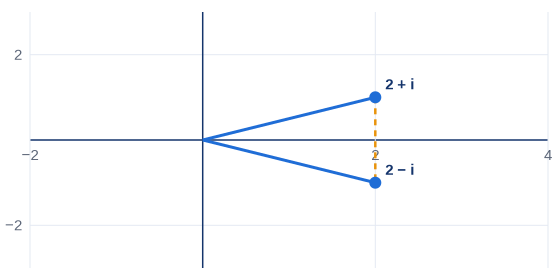
- z = 2 + i and z = 2 − i
- sum = (2 + i) + (2 − i) = 4
- product = (2 + i)(2 − i)
- = 4 − i² = 4 + 1 = 5i² = −1
- z² − (sum)z + product
- z² − 4z + 5
Try it: one real root, one conjugate pair
A cubic from one complex root
- Pair gives z² − 4z + 5
- Compare constants
- Expand, then compare
- (z² − 4z + 5)(z + c)the other factor
- 5c = 15, so c = 3compare constants
- (z² − 4z + 5)(z + 3)
- = z³ + 3z² − 4z² − 12z + 5z + 15
- = z³ − z² − 7z + 15collect terms
- a = −1, b = −7compare coefficients
- z + 3 = 0, so z = −3
- roots 2 + i, 2 − i, −3
Or substitute z = 2 + i
- Substitute z = 2 + i
- Expand the powers first
- (2 + i)² = 4 + 4i + i²expand
- = 3 + 4ii² = −1
- (2 + i)³ = (3 + 4i)(2 + i)
- = 6 + 3i + 8i + 4i²expand
- = 2 + 11ii² = −1
- (2 + 11i) + a(3 + 4i)
- + b(2 + i) + 15 = 0
Equate real and imaginary parts
- Real part = 0
- Imaginary part = 0
- Double, then subtract
- (2 + 11i) + a(3 + 4i)
- + b(2 + i) + 15 = 0
- real: 2 + 3a + 2b + 15 = 0
- 17 + 3a + 2b = 0
- imaginary: 11 + 4a + b = 0
- 22 + 8a + 2b = 0double the second
- 5 + 5a = 0, so a = −1subtract the first
- b = −11 − 4(−1) = −7substitute back
Try it: substitute to find the constants
Forming a polynomial from its roots
- Add the conjugate root
- Multiply the factors
- roots 3, 1 − 2i, 1 + 2ireal coefficients
- sum = 2, product = 1 − 4i² = 5
- factor z² − 2z + 5
- (z² − 2z + 5)(z − 3)
- = z³ − 3z² − 2z² + 6z + 5z − 15
- = z³ − 5z² + 11z − 15
Show every step
- Unknown constants stop the calculator.
- Expand and factorise carefully.
- Check: substitute a root back in.
Where the marks are
- Achieved: find a constant, solve a quadratic.
- Merit: a cubic from one complex root.
- Excellence: equate parts, form equations.
What to take away
- Substitute to find constants, and pair every complex root with its conjugate.
| Remainder | p(a) when ÷ (z − a) |
| Factor | p(a) = 0 |
| Real polynomial | roots in conjugate pairs |
| Pair a ± bi | z² − 2az + a² + b² |
| Unknowns | equate real, imaginary |
| Show it | every step by hand |
Common mistakes
- z + 1 is a factor, so substitute z = 1.z + 1 = z − (−1), so the factor theorem needs p(−1) = 0.
- (z + 1)² = −4, so z + 1 = ±2 and z = 1 or z = −3.√−4 = 2i, so z + 1 = ±2i and z = −1 ± 2i; the negative under the root is what makes the roots complex.
- Roots 3 and 1 − 2i, so p(z) = (z − 3)(z − 1 + 2i).With real coefficients 1 + 2i is a root too, so p(z) = (z − 3)(z² − 2z + 5) = z³ − 5z² + 11z − 15.
- Roots 2 + i and 2 − i give the factor z² + 4z + 5.The factor is z² − (sum)z + product, so the sum 4 is subtracted: z² − 4z + 5.
Your turn: eight questions
- Question 3: find the other roots too.
- Question 4: leading coefficient 1.
| Given | Find | |
|---|---|---|
| 1 | z³ + kz² + 2z − 1 | k, remainder 3 by z − 2 |
| 2 | z² − 4z + 13 = 0 | both roots |
| 3 | z³ + az² + bz − 10 = 0 | a, b, if 1 + 2i a root |
| 4 | roots −1 and 2 + 3i | the real cubic |
| 5 | z³ − z² + 2 | remainder by z − i |
| 6 | real cubic, one root 3 − 4i | a quadratic factor |
| 7 | z³ + az² + bz + 6, factor z − 2 | a, b, remainder 15 by z + 1 |
| 8 | z³ − 3z² + kz − 10, factor z − 2 | the complex roots |
Show answer
1. p(2) = 11 + 4k = 3, so k = −2. 2. (z − 2)² = −9, so z = 2 ± 3i. 3. Factor z² − 2z + 5, then 5c = −10 gives z − 2: a = −4, b = 9, roots 1 ± 2i and 2. 4. (z² − 4z + 13)(z + 1) = z³ − 3z² + 9z + 13. 5. 3 − i. Remainder theorem: p(i) = i³ − i² + 2 = −i + 1 + 2 = 3 − i. 6. z² − 6z + 25. The conjugate 3 + 4i is also a root; sum 6, product 9 + 16 = 25. 7. a = 1, b = −9. p(2) = 0 gives 2a + b = −7 and p(−1) = 15 gives a − b = 10, so adding gives 3a = 3. 8. z = 1/2 ± (√19/2)i. p(2) = 0 gives k = 7, dividing gives z² − z + 5, and the discriminant is 1 − 20 = −19.
The answers: questions 1 and 2
- 1. p(2) = 2³ + k(2²) + 2(2) − 1remainder theorem
- = 8 + 4k + 4 − 1 = 11 + 4k
- 11 + 4k = 3, so k = −2the remainder is 3
- 2. z² − 4z + 4 = −13 + 4add 4 to both sides
- (z − 2)² = −9
- z − 2 = ±√−9 = ±3i√−9 = 3i
- z = 2 ± 3i
The answers: question 3
- 3. roots 1 + 2i and 1 − 2ireal coefficients
- sum 2, product 1 + 4 = 5
- factor z² − 2z + 5
- × (z + c): 5c = −10, c = −2compare constants
- (z² − 2z + 5)(z − 2)
- = z³ − 2z² − 2z² + 4z + 5z − 10
- = z³ − 4z² + 9z − 10collect terms
- a = −4, b = 9
- roots 1 + 2i, 1 − 2i, 2
The answers: question 4
- 4. roots −1, 2 + 3i, 2 − 3ireal coefficients
- sum 4, product 4 − 9i² = 13
- factor z² − 4z + 13
- (z² − 4z + 13)(z + 1)
- = z³ + z² − 4z² − 4z + 13z + 13
- = z³ − 3z² + 9z + 13
Sample question: Achieved
When p(z) = z³ + kz² − 4z + 3 is divided by z − 2, the remainder is 7. Find k.
Hint
By the remainder theorem, the remainder on dividing by z − 2 is p(2).
Answer
k = 1
Step by step
- The remainder theorem: when p(z) is divided by z − a, the remainder is p(a).
- Here we divide by z − 2, so a = 2 and the remainder is p(2).
- p(2) = 2³ + k(2²) − 4(2) + 3 = 8 + 4k − 8 + 3 = 4k + 3.
- Set it equal to the remainder: 4k + 3 = 7, so 4k = 4 and k = 1.
- Check: p(2) = 8 + 4 − 8 + 3 = 7. Correct.
Full working
- remainder = p(2)remainder theorem
- p(2) = 8 + 4k − 8 + 3 = 4k + 3
- 4k + 3 = 7
- k = 1
Sample questions: Merit
z = 1 − 3i is a root of z³ + az² + bz + 20 = 0, where a and b are real. Find a and b, and the other two roots.
Hint
Real coefficients means 1 + 3i is also a root. Build the quadratic factor from the pair, then find the linear factor.
Answer
a = 0, b = 6; the other roots are 1 + 3i and −2
Step by step
- The coefficients are real, so complex roots come in conjugate pairs. So 1 + 3i is also a root.
- Build the quadratic factor from the pair. Sum: (1 − 3i) + (1 + 3i) = 2. Product: 1 − 9i² = 1 + 9 = 10.
- The factor is z² − (sum)z + product = z² − 2z + 10.
- The cubic is this quadratic times a linear factor: (z² − 2z + 10)(z + c).
- Match the constant terms: 10c = 20, so c = 2. The third root is z = −2.
- Expand to find a and b: (z² − 2z + 10)(z + 2) = z³ + 2z² − 2z² − 4z + 10z + 20 = z³ + 6z + 20.
- There is no z² term, so a = 0. The z term gives b = 6.
- Check z = −2: (−8) + 6(−2) + 20 = 0. Correct.
Full working
- 1 + 3i is a rootreal coefficients, conjugate pair
- sum 2, product 1 + 9 = 10, factor z² − 2z + 10
- (z² − 2z + 10)(z + c), 10c = 20, c = 2match constants
- (z² − 2z + 10)(z + 2) = z³ + 6z + 20expand
- a = 0, b = 6check: −8 − 12 + 20 = 0
- a = 0, b = 6; roots 1 + 3i, 1 − 3i, −2
p(z) = z³ + az² + bz − 26. z − 2 is a factor of p(z), and when p(z) is divided by z + 1 the remainder is −30. Find a and b, then solve p(z) = 0.
Hint
The factor theorem gives p(2) = 0 and the remainder theorem gives p(−1) = −30. Solve the pair of equations, then divide by z − 2.
Answer
a = 2, b = 5; z = 2, −2 + 3i or −2 − 3i
Step by step
- Recall: z − 2 is a factor exactly when p(2) = 0, and the remainder on dividing by z + 1 is p(−1).
- p(2) = 8 + 4a + 2b − 26 = 0, so 4a + 2b = 18, which is 2a + b = 9.
- p(−1) = −1 + a − b − 26 = −30, so a − b = −3.
- Add the two equations: 3a = 6, so a = 2. Then b = 9 − 2(2) = 5.
- So p(z) = z³ + 2z² + 5z − 26. Divide by z − 2 to get the quadratic factor z² + 4z + 13.
- Check the division: (z − 2)(z² + 4z + 13) = z³ + 4z² + 13z − 2z² − 8z − 26 = z³ + 2z² + 5z − 26.
- Solve z² + 4z + 13 = 0 by completing the square: (z + 2)² + 9 = 0, so (z + 2)² = −9.
- z + 2 = ±√−9 = ±3i, so z = −2 ± 3i.
- The roots are 2, −2 + 3i and −2 − 3i. The complex ones are a conjugate pair, as expected for real coefficients.
Full working
- p(2) = 8 + 4a + 2b − 26 = 0, so 2a + b = 9factor theorem
- p(−1) = −1 + a − b − 26 = −30, so a − b = −3remainder theorem
- 3a = 6, a = 2, b = 5add the equations
- p(z) = (z − 2)(z² + 4z + 13)divide by z − 2
- (z + 2)² = −9, z + 2 = ±3icomplete the square
- z = 2, −2 + 3i, −2 − 3i
Sample questions: Excellence
Show that z = 1 + i is a root of z⁴ − 2z³ + 3z² − 2z + 2 = 0. Hence solve the equation fully.
Hint
Work out (1 + i)², then build the higher powers from it. For the hence, the conjugate 1 − i is also a root, so a quadratic factor divides the quartic.
Answer
z = 1 + i, 1 − i, i or −i
Step by step
- To show 1 + i is a root, substitute it and show the result is 0.
- Powers first: (1 + i)² = 1 + 2i + i² = 2i. Then (1 + i)³ = 2i(1 + i) = 2i − 2 = −2 + 2i. And (1 + i)⁴ = (2i)² = −4.
- Substitute: −4 − 2(−2 + 2i) + 3(2i) − 2(1 + i) + 2.
- That is −4 + 4 − 4i + 6i − 2 − 2i + 2. Real parts: −4 + 4 − 2 + 2 = 0. Imaginary parts: −4i + 6i − 2i = 0. So it is a root.
- Hence: the coefficients are real, so 1 − i is also a root.
- The pair gives a quadratic factor. Sum 2, product (1 + i)(1 − i) = 2, so the factor is z² − 2z + 2.
- The other factor is a quadratic z² + pz + q. Match the constants: 2q = 2, so q = 1. Match the z³ terms: p − 2 = −2, so p = 0.
- So the quartic is (z² − 2z + 2)(z² + 1). Check by expanding: z⁴ − 2z³ + 3z² − 2z + 2. Correct.
- z² + 1 = 0 gives z² = −1, so z = i or z = −i.
- The four roots are 1 + i, 1 − i, i and −i. A quartic has four roots, so we have them all.
Full working
- (1 + i)² = 2i, (1 + i)³ = −2 + 2i, (1 + i)⁴ = −4
- −4 − 2(−2 + 2i) + 3(2i) − 2(1 + i) + 2 = 0so 1 + i is a root
- 1 − i is a rootreal coefficients
- factor z² − 2z + 2sum 2, product 2
- (z² − 2z + 2)(z² + 1) = z⁴ − 2z³ + 3z² − 2z + 2match constants and z³ terms
- z² = −1, so z = ±i
- z = 1 + i, 1 − i, i, −i
p(z) = z³ − z² + kz − k, where k is real. Show that z − 1 is a factor of p(z) for every value of k. Hence find all three roots in terms of k when k > 0, and state the values of k for which all three roots are real.
Hint
Work out p(1). For the hence, group the four terms in pairs and take out the common factor z − 1.
Answer
p(1) = 0 for every k. For k > 0 the roots are 1, i√k and −i√k. All three roots are real when k ≤ 0.
Step by step
- By the factor theorem, z − 1 is a factor exactly when p(1) = 0.
- p(1) = 1 − 1 + k − k = 0. The k terms cancel, so this is 0 for every k. That proves z − 1 is always a factor.
- To find the other factor, group the terms in pairs: z³ − z² = z²(z − 1) and kz − k = k(z − 1).
- So p(z) = z²(z − 1) + k(z − 1) = (z − 1)(z² + k).
- The roots are z = 1 and the solutions of z² = −k.
- When k > 0, −k is negative, so z = ±√−k = ±i√k. The three roots are 1, i√k and −i√k.
- They are a conjugate pair, as they must be, because the coefficients are real.
- When k ≤ 0, −k is 0 or positive, so z = ±√(−k) is real. Then all three roots are real.
- So all three roots are real exactly when k ≤ 0. At k = 0 the roots are 1, 0 and 0.
- Check with k = 4: (z − 1)(z² + 4) has roots 1 and ±2i, and 2i = i√4. Correct.
Full working
- p(1) = 1 − 1 + k − k = 0 for every kfactor theorem
- p(z) = z²(z − 1) + k(z − 1)group in pairs
- = (z − 1)(z² + k)
- k > 0: z² = −k, so z = ±i√k
- k ≤ 0: z = ±√(−k), real
- k = 4: roots 1, ±2icheck
- roots 1, i√k, −i√k for k > 0; all real for k ≤ 0
Challenge
p(z) = z³ + az² + bz + c, where a, b and c are real. The three roots of p(z) = 0 are the corners of an equilateral triangle on the Argand diagram whose centre is the point 2, and one root is z = 4. (a) Find the other two roots, and a, b and c. (b) Show that p(z) = (z − 2)³ − 8, and use this to explain why the roots of p(z) = 0 must form an equilateral triangle centred at 2.
Hint
Every corner is the same distance from the centre as 4 is, and the corners are a third of a turn apart. Multiply out the conjugate pair first.
Answer
(a) z = 1 + √3i and z = 1 − √3i; a = −6, b = 12, c = −16. (b) (z − 2)³ − 8 = z³ − 6z² + 12z − 16 = p(z). So the roots are z = 2 + w, where w is a cube root of 8: 2, 2cis(2π3) or 2cis(−2π3). These are all 2 from 0 and 2π3 apart, so the roots are all 2 from the point 2 and 2π3 apart around it.
Step by step
- The root 4 is 2 units from the centre 2, so every corner is 2 units from 2, at turns of 2π3.
- 2 + 2cis(2π3) = 2 + 2(−12 + (√32)i) = 1 + √3i, and the third corner is its conjugate 1 − √3i, as real coefficients require.
- The pair has sum 2 and product 1 + 3 = 4, giving the factor z² − 2z + 4, and p(z) = (z − 4)(z² − 2z + 4) = z³ − 6z² + 12z − 16.
- Expanding (z − 2)³ − 8 gives z³ − 6z² + 12z − 8 − 8, the same polynomial.
- So p(z) = 0 means (z − 2)³ = 8. The three cube roots of 8 sit on a circle of radius 2 round 0, a third of a turn apart; adding 2 moves that picture to centre 2.
Full working
- |4 − 2| = 2, so each corner is 2 from the point 2centre 2
- 2 + 2cis(±2π3) = 2 + 2(−12 ± (√32)i) = 1 ± √3ithird-turns
- sum 2, product 1 + 3 = 4: z² − 2z + 4conjugate pair
- (z − 4)(z² − 2z + 4) = z³ − 6z² + 12z − 16expand
- a = −6, b = 12, c = −16compare coefficients
- (z − 2)³ − 8 = z³ − 6z² + 12z − 8 − 8 = p(z)expand the cube
- (z − 2)³ = 8: z − 2 = 2, 2cis(2π3) or 2cis(−2π3)cube roots of 8
- |4 − (1 + √3i)| = √(9 + 3) = 2√3 = |(1 + √3i) − (1 − √3i)|equal sides
- Roots 4, 1 + √3i, 1 − √3i; a = −6, b = 12, c = −16; p(z) = (z − 2)³ − 8
z = 1 + 2i is a root of z⁴ + az² + b = 0, where a and b are real. Find a and b, and all four roots.
Hint
Only even powers of z appear, so if z is a root, what else must be? Alternatively, let u = z² and think about which quadratic u satisfies.
Answer
a = 6, b = 25; the roots are 1 + 2i, 1 − 2i, −1 + 2i and −1 − 2i.
Step by step
- Let u = z². The equation becomes u² + au + b = 0, a quadratic in u with real coefficients.
- z = 1 + 2i gives u = (1 + 2i)² = −3 + 4i, so the conjugate −3 − 4i is the other value of u.
- That pair has sum −6 and product 9 + 16 = 25, so u² + 6u + 25 = 0, giving a = 6 and b = 25.
- The z values come from z² = −3 + 4i and z² = −3 − 4i. Each has two square roots, opposite in sign.
- Since z² = −3 + 4i has root 1 + 2i, its other root is −1 − 2i. The conjugates 1 − 2i and −1 + 2i are the roots of z² = −3 − 4i.
Full working
- u = z²: u² + au + b = 0only even powers of z
- u = (1 + 2i)² = 1 + 4i + 4i² = −3 + 4ii² = −1
- other u = −3 − 4iconjugate pair, real coefficients
- sum = −6, product = 9 + 16 = 25of the pair
- u² + 6u + 25 = 0, so a = 6, b = 25u² − (sum)u + product
- z² = −3 + 4i: z = ±(1 + 2i)z and −z have the same square
- z² = −3 − 4i: z = ±(1 − 2i)conjugates
- a = 6, b = 25; roots 1 + 2i, 1 − 2i, −1 + 2i, −1 − 2i
p(z) = z³ − 5z² + kz − 30, where k is real. Two of the roots of p(z) = 0 are non-real and have real part 1. Find k and all three roots. Then show that the three roots are the corners of an isosceles triangle on the Argand diagram, and find its area.
Hint
Call the non-real roots 1 + ni and 1 − ni. They give a quadratic factor z² − 2z + m with m unknown, and the third factor is z − r. Expand and compare coefficients.
Answer
k = 16; the roots are 3, 1 + 3i and 1 − 3i. Both non-real roots are √13 from 3, so the triangle is isosceles, and its area is 6 square units.
Step by step
- The non-real roots are a conjugate pair 1 ± ni, with sum 2 and product 1 + n², so they give a factor z² − 2z + m with m = 1 + n².
- Write p(z) = (z² − 2z + m)(z − r) and expand: the z² coefficient is −(r + 2) and the constant is −mr.
- Comparing with −5 and −30 gives r = 3 and m = 10, so n = 3. Then k = m + 2r = 16.
- On the Argand diagram the points are (3, 0), (1, 3) and (1, −3). Each non-real root is √(2² + 3²) = √13 from 3.
- The side from 1 − 3i to 1 + 3i is vertical with length 6, and the point 3 is 2 units to the right of it, so the area is half of 6 × 2.
Full working
- roots 1 ± ni: sum 2, product 1 + n² = mconjugate pair
- (z² − 2z + m)(z − r) = z³ − (r + 2)z² + (m + 2r)z − mrexpand
- r + 2 = 5, so r = 3compare z² coefficients
- mr = 30, so m = 10 and n² = 9, n = 3compare constants
- k = m + 2r = 10 + 6 = 16compare z coefficients
- |(1 + 3i) − 3| = |(1 − 3i) − 3| = √(4 + 9) = √13two equal sides
- area = 12 × 6 × 2 = 6base from 1 − 3i to 1 + 3i, height 3 − 1
- k = 16; roots 3, 1 + 3i, 1 − 3i; isosceles triangle with area 6 square units
Practise this
Report a mistake
More in AS 91577
 Complex arithmetic, conjugates and equating parts9 min
 Polar form by hand: modulus, argument and quadrants10 min
 De Moivre's theorem: powers and roots of complex numbers11 minComplex roots of polynomials: factor theorem and conjugates11 min
 Algebra with k: quadratics, discriminants and surd equations10 min
 Complex loci, purely real conditions and proofs11 min
 Complex arithmetic: 7 exam questions solved step by step11 min
 Polar form: 7 exam questions solved step by step11 min
 De Moivre's theorem: 7 exam questions solved step by step12 min
 Complex polynomials: 7 exam questions solved step by step12 min
 Algebra with constants: 7 exam questions solved step by step12 min
 Complex loci and proof: 7 exam questions solved step by step12 min
Is your child on track?
Take the free placement test