Complex arithmetic, conjugates and equating parts
What this lesson covers
- A complex number has a real part and an imaginary part, and equating those parts turns one equation into two.
- Multiplying by the conjugate is how a complex denominator, or a surd denominator, is made real.
z = a + bi
- Real part a, imaginary part b.
- A and b are both real numbers.
- i² = −1 does most of the work.
z = 3 + 2i, w = 1 − 4i
- Add: group the parts.
- Multiply: expand, then simplify.
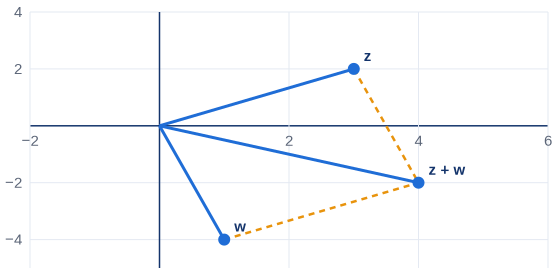
- z + w = (3 + 1) + (2 − 4)igroup the parts
- = 4 − 2i
- zw = (3 + 2i)(1 − 4i)
- = 3 − 12i + 2i − 8i²expand
- = 3 − 10i + 8i² = −1
- = 11 − 10i
Try it: add and multiply on the diagram
The conjugate
- a + bi has conjugate a − bi.
- The product is always real.
- (3 + 2i)(3 − 2i)
- = 9 − 6i + 6i − 4i²expand
- = 9 + 4i terms cancel, i² = −1
- = 13
- (a + bi)(a − bi) = a² + b²always real
Try it: drag a complex number
(7 + i) ÷ (1 − i)
- Multiply by the bottom's conjugate.
- Divide both parts.
- (7 + i)/(1 − i) × (1 + i)/(1 + i)
- bottom: (1 − i)(1 + i) = 1 + 1
- = 2real
- top: (7 + i)(1 + i)
- = 7 + 7i + i + i²expand
- = 6 + 8ii² = −1
- (6 + 8i)/2 = 3 + 4idivide both parts
The 2025 error: the answer form
- A fraction over 17 is not a + bi.
- Split it into its two parts.
- z/w = (3 + 2i)/(1 − 4i)
- × (1 + 4i)/(1 + 4i)conjugate of the bottom
- bottom: 1 + 16 = 17
- top: 3 + 12i + 2i + 8i²
- = −5 + 14ii² = −1
- z/w = (−5 + 14i)/17not finished
- = −5/17 + (14/17)ithe form asked
6 ÷ (3 − √3)
- The same conjugate trick.
- The bottom becomes rational.
- 6/(3 − √3) × (3 + √3)/(3 + √3)
- bottom: (3 − √3)(3 + √3)
- = 9 − 3 = 6√3 × √3 = 3
- top: 6(3 + √3) = 18 + 6√3
- (18 + 6√3)/6 = 3 + √3divide both terms
Equating real and imaginary parts
- Equal means both parts are equal.
- One equation becomes two.
- That is how you find unknowns.
(a + bi)(1 + 2i) = 7 + 4i
- Expand and group.
- Equate both parts.
- Solve the pair.
- a + 2ai + bi + 2bi²expand
- = (a − 2b) + (2a + b)ii² = −1, group
- a − 2b = 7real parts
- 2a + b = 4imaginary parts
- 4a + 2b = 8double the second
- 5a = 15, so a = 3add to the first
- b = 4 − 6 = −2substitute back
- a = 3, b = −2
Try it: expand, cancel, equate
The square roots of 3 + 4i
- Let the root be x + iy.
- Square it, then equate parts.
- (x + iy)² = 3 + 4ix and y real
- x² + 2xyi + i²y² = 3 + 4iexpand
- (x² − y²) + 2xyi = 3 + 4ii² = −1
- x² − y² = 3real parts
- 2xy = 4imaginary parts
- y = 2/x
Solving for x
- Substitute y = 2/x.
- A quadratic in x².
- x² − y² = 3
- y = 2/x
- x² − 4/x² = 3substitute y = 2/x
- x⁴ − 3x² − 4 = 0multiply by x²
- (x² − 4)(x² + 1) = 0factorise
- x² = 4 or x² = −1
Reject, keep both signs, check
- x is real: reject x² = −1, and say so.
- Keep both signs of the root.
- Square one root to check.
- x² = −1x is real
- x = 2: y = 2/2 = 1
- x = −2: y = −1
- roots 2 + i and −2 − i
- (2 + i)² = 4 + 4i + i²check
- = 3 + 4i
Show the algebra
- Unknown constants stop the calculator.
- Write the conjugate, expansion, grouping.
- Cross out working you reject.
Where the marks are
- Achieved: arithmetic, conjugates, surds.
- Merit: solve with i, check validity.
- Excellence: quotients, equating parts.
What to take away
- Multiply by the conjugate, equate both parts, and answer in the form asked.
| i² | −1 |
| Add | group the parts |
| Divide | × bottom’s conjugate |
| Surds | conjugate again |
| Unknowns | equate both parts |
| Answer | in the form asked |
Common mistakes
- z/w = (−5 + 14i)/17, finished.A single fraction over 17 is not in the form a + bi; split it into −5/17 + (14/17)i, the step the 2025 examiners looked for.
- (3 + 2i)(1 − 4i) = 3 − 12i + 2i − 8 = −5 − 10i−8i² = −8(−1) = +8, so the product is 11 − 10i; replacing i² with −1 flips the sign.
- To divide by 1 − i, multiply the top and bottom by 1 − i.Multiply by the conjugate 1 + i, so the bottom becomes (1 − i)(1 + i) = 2, a real number.
- x² = 4 or x² = −1, so x = 2 and the square root of 3 + 4i is 2 + i.Reject x² = −1 because x is real, and say so, but keep x = −2 as well: the roots are 2 + i and −2 − i.
Your turn: eight questions
- Questions 1 and 2: the form a + bi.
- Question 4 needs two equations.
| Given | Find | |
|---|---|---|
| 1 | (2 + 3i)(4 − i) | a + bi |
| 2 | (5 + 5i) ÷ (2 + i) | a + bi |
| 3 | 4 ÷ (√5 − 1) | rationalise |
| 4 | (a+bi)(2+i) = 1+8i | real a and b |
| 5 | (5 − 2i)(5 + 2i) | a real number |
| 6 | 3 ÷ (1 + 2i) | a + bi |
| 7 | z + 2z̄ = 9 − 4i, z̄ the conjugate | z = a + bi |
| 8 | −5 + 12i | both square roots |
Show answer
1. 8 − 2i + 12i − 3i² = 11 + 10i. 2. Multiply by 2 − i: (15 + 5i)/5 = 3 + i. 3. Multiply by √5 + 1: 4(√5 + 1)/4 = √5 + 1. 4. 2a − b = 1 and a + 2b = 8, so a = 2, b = 3. 5. 29. A number times its conjugate is a² + b², so 25 − 4i² = 25 + 4 = 29. 6. 3/5 − (6/5)i. Multiply by 1 − 2i: the top is 3 − 6i and the bottom is 1 + 4 = 5, then split into both parts. 7. z = 3 + 4i. (a + bi) + 2(a − bi) = 3a − bi, so 3a = 9 and −b = −4, giving a = 3 and b = 4. 8. 2 + 3i and −2 − 3i. (x + iy)² gives x² − y² = −5 and 2xy = 12, so x² = 4 (x² = −9 is rejected), x = ±2 and y = 6/x.
The answers: questions 1 and 2
- 1. (2 + 3i)(4 − i)
- = 8 − 2i + 12i − 3i²expand
- = 8 + 10i + 3 = 11 + 10ii² = −1
- 2. × (2 − i)/(2 − i)conjugate of the bottom
- top: (5 + 5i)(2 − i) = 15 + 5i
- bottom: 4 + 1 = 5
- (15 + 5i)/5 = 3 + i
The answers: questions 3 and 4
- 3. × (√5 + 1)/(√5 + 1)conjugate of the bottom
- bottom: 5 − 1 = 4
- 4(√5 + 1)/4 = √5 + 1the fours cancel
- 4. (2a − b) + (a + 2b)i = 1 + 8iexpand, group
- 2a − b = 1, a + 2b = 8equate parts
- 5a = 10, so a = 2double the first, add
- b = 2(2) − 1 = 3
Sample question: Achieved
z = 2 − 3i and w = 1 + 2i. Find z ÷ w in the form a + bi.
Hint
Multiply the top and the bottom by the conjugate of the bottom, 1 − 2i.
Answer
z ÷ w = −45 − (75)i
Step by step
- To divide, we make the bottom real. Multiplying by the conjugate does that, because (a + bi)(a − bi) = a² + b².
- The bottom is 1 + 2i, so its conjugate is 1 − 2i. Multiply top and bottom by 1 − 2i.
- Bottom: (1 + 2i)(1 − 2i) = 1 + 4 = 5.
- Top: (2 − 3i)(1 − 2i) = 2 − 4i − 3i + 6i² = 2 − 7i − 6 = −4 − 7i.
- So z ÷ w = −4 − 7i5. The question asks for a + bi, so split it: −45 − (75)i.
- Check: (1 + 2i)(−45 − (75)i) = −45 − (75)i − (85)i + 145 = 2 − 3i. Correct.
Full working
- 2 − 3i1 + 2i × 1 − 2i1 − 2iconjugate of the bottom
- bottom: 1 + 4 = 5
- top: 2 − 4i − 3i + 6i² = −4 − 7ii² = −1
- −4 − 7i5split into real and imaginary parts
- −45 − (75)i
Sample questions: Merit
Find the two square roots of −5 + 12i in the form a + bi.
Hint
Let (x + iy)² = −5 + 12i, with x and y real. Equate the real parts and the imaginary parts.
Answer
2 + 3i and −2 − 3i
Step by step
- A square root of −5 + 12i is a number x + iy whose square is −5 + 12i, with x and y real.
- Expand: (x + iy)² = x² + 2xyi + i²y² = (x² − y²) + 2xyi.
- Equate parts. Real: x² − y² = −5. Imaginary: 2xy = 12, so y = 6x.
- Substitute: x² − 36x² = −5. Multiply by x²: x⁴ + 5x² − 36 = 0.
- This is a quadratic in x². It factorises: (x² + 9)(x² − 4) = 0.
- x² = −9 is impossible, because x is real. So x² = 4 and x = 2 or x = −2.
- Keep both signs. x = 2 gives y = 62 = 3. x = −2 gives y = 6−2 = −3.
- So the roots are 2 + 3i and −2 − 3i. They are negatives of each other, as square roots always are.
- Check: (2 + 3i)² = 4 + 12i + 9i² = −5 + 12i. Correct.
Full working
- (x + iy)² = (x² − y²) + 2xyi = −5 + 12i
- x² − y² = −5 and xy = 6equate real and imaginary parts
- x² − 36x² = −5y = 6x
- x⁴ + 5x² − 36 = 0, so (x² + 9)(x² − 4) = 0
- x² = 4, x = ±2x is real, so x² ≠ −9
- x = 2, y = 3; x = −2, y = −3check: (2 + 3i)² = −5 + 12i
- 2 + 3i and −2 − 3i
Find the real numbers x and y such that x1 + i + y2 − i = 3.
Hint
Make each denominator real first, then equate the real parts and the imaginary parts. The right side, 3, has imaginary part 0.
Answer
x = 2 and y = 5
Step by step
- x and y are real, so the plan is to write the left side as (real part) + (imaginary part)i, then match it with 3 + 0i.
- First fraction: multiply top and bottom by 1 − i. The bottom becomes 1 + 1 = 2, so x1 + i = x(1 − i)2 = x2 − (x2)i.
- Second fraction: multiply top and bottom by 2 + i. The bottom becomes 4 + 1 = 5, so y2 − i = y(2 + i)5 = 2y5 + (y5)i.
- Real parts: x2 + 2y5 = 3.
- Imaginary parts: −x2 + y5 = 0, because 3 has no imaginary part.
- Add the two equations: the x terms cancel, leaving 3y5 = 3, so y = 5.
- Put y = 5 into −x2 + y5 = 0: −x2 + 1 = 0, so x = 2.
- Check: 21 + i = 1 − i and 52 − i = 2 + i. Their sum is 3. Correct.
Full working
- x1 + i = x(1 − i)2conjugate, bottom 1 + 1 = 2
- y2 − i = y(2 + i)5conjugate, bottom 4 + 1 = 5
- x2 + 2y5 = 3real parts
- −x2 + y5 = 0imaginary parts
- 3y5 = 3, so y = 5add the equations
- x = 2check: (1 − i) + (2 + i) = 3
- x = 2, y = 5
Sample questions: Excellence
Find every complex number z such that z² = 2z̄, where z̄ is the conjugate of z.
Hint
Write z = x + iy, so z̄ = x − iy. Equate the parts, and factorise the imaginary equation: do not divide by y.
Answer
z = 0, z = 2, z = −1 + √3i or z = −1 − √3i
Step by step
- Let z = x + iy with x and y real. The conjugate flips the sign of the imaginary part: z̄ = x − iy.
- Left side: z² = (x² − y²) + 2xyi. Right side: 2z̄ = 2x − 2yi.
- Equate the imaginary parts: 2xy = −2y, so 2xy + 2y = 0, which is 2y(x + 1) = 0.
- Do not divide by y here. That would lose every answer with y = 0. Factorising keeps both cases.
- Case y = 0: the real parts give x² = 2x, so x(x − 2) = 0. That gives z = 0 or z = 2.
- Case x = −1: the real parts give x² − y² = 2x, so 1 − y² = −2 and y² = 3. That gives y = √3 or y = −√3.
- So z = −1 + √3i or z = −1 − √3i.
- There are four answers: 0, 2, −1 + √3i and −1 − √3i.
- Check z = −1 + √3i: z² = 1 − 2√3i − 3 = −2 − 2√3i, and 2z̄ = 2(−1 − √3i) = −2 − 2√3i. They match.
Full working
- z = x + iy, z̄ = x − iy
- (x² − y²) + 2xyi = 2x − 2yi
- 2xy = −2y, so 2y(x + 1) = 0imaginary parts; factorise, never divide by y
- y = 0: x² = 2x, so x = 0 or 2real parts
- x = −1: 1 − y² = −2, so y = ±√3real parts
- z = −1 + √3i: z² = −2 − 2√3i = 2z̄check
- z = 0, 2, −1 + √3i, −1 − √3i
z is a complex number with |z| = 1 and z ≠ 1. Prove that 1 + z1 − z is purely imaginary.
Hint
Write z = x + iy with x² + y² = 1. Multiply top and bottom by the conjugate of 1 − z and look at the real part of the top.
Answer
With z = x + iy and x² + y² = 1, 1 + z1 − z = 2yi(1 − x)² + y², whose real part is 0.
Step by step
- Purely imaginary means the real part is 0. So the aim is to show the real part is 0 for every z with |z| = 1, not just a few examples.
- Let z = x + iy. Then |z| = 1 means x² + y² = 1. This fact is what makes the proof work.
- The fraction is 1 + x + iy1 − x − iy. The bottom is (1 − x) − iy, so its conjugate is (1 − x) + iy.
- Multiply top and bottom by (1 − x) + iy. The bottom becomes (1 − x)² + y², which is real.
- The bottom is not zero, because z ≠ 1. That is why the question rules out z = 1.
- Top: (1 + x + iy)(1 − x + iy) = (1 + x)(1 − x) + iy(1 + x) + iy(1 − x) + i²y².
- Tidy it: 1 − x² + 2iy − y² = (1 − x² − y²) + 2yi.
- Now use x² + y² = 1: the real part 1 − x² − y² is 1 − 1 = 0. So the top is just 2yi.
- So 1 + z1 − z = 2yi(1 − x)² + y², where the bottom is real. The real part is 0, so the number is purely imaginary.
- Check with z = i: 1 + i1 − i = (1 + i)²2 = 2i2 = i, purely imaginary.
Full working
- z = x + iy, x² + y² = 1|z| = 1
- × (1 − x) + iy(1 − x) + iyconjugate of the bottom
- bottom: (1 − x)² + y² ≠ 0real, and z ≠ 1
- top: (1 − x² − y²) + 2yiexpand, i² = −1
- 1 − x² − y² = 0x² + y² = 1
- 1 + z1 − z = 2yi(1 − x)² + y²
- Re = 0, so 1 + z1 − z is purely imaginary
Challenge
Let w = (1 + √2 i) ÷ (√2 − i). Write w in the form a + bi, and hence find w²⁰²⁷ exactly. No calculator: show the algebra.
Hint
Multiply the top and bottom by the conjugate of the bottom, √2 + i. Then look at how the powers of your answer repeat.
Answer
w = i, so w²⁰²⁷ = i²⁰²⁷ = −i.
Step by step
- Multiply top and bottom by √2 + i, the conjugate of the bottom.
- The bottom becomes (√2)² + 1² = 3, a real number.
- The top expands to √2 + i + 2i + √2 i², and the √2 terms cancel because i² = −1, leaving 3i.
- So w = 3i ÷ 3 = i.
- Powers of i repeat every 4: i, −1, −i, 1. 2027 = 4 × 506 + 3, so i²⁰²⁷ = i³ = −i.
Full working
- w = (1 + √2 i)(√2 + i) ÷ ((√2 − i)(√2 + i))multiply by the bottom's conjugate
- bottom: 2 − i² = 2 + 1 = 3(a − bi)(a + bi) = a² + b²
- top: √2 + i + 2i + √2 i² = √2 + 3i − √2 = 3ii² = −1
- w = 3i ÷ 3 = idivide both parts
- 2027 = 4 × 506 + 3powers of i repeat every 4
- w²⁰²⁷ = (i⁴)⁵⁰⁶ × i³ = 1 × (−i)i⁴ = 1, i³ = −i
- w = i and w²⁰²⁷ = −i
Solve z² − (3 − 2i)z + (5 − 5i) = 0, giving both solutions in the form a + bi. No calculator: show the algebra.
Hint
The quadratic formula still works with complex coefficients. The discriminant is a complex number, so find its square root as x + iy by equating real and imaginary parts.
Answer
z = 2 + i or z = 1 − 3i
Step by step
- Use the formula with a = 1, b = −(3 − 2i), c = 5 − 5i. First find b² − 4ac.
- (3 − 2i)² = 5 − 12i, and 4(5 − 5i) = 20 − 20i, so the discriminant is −15 + 8i.
- Let (x + iy)² = −15 + 8i with x and y real. Equating parts gives x² − y² = −15 and 2xy = 8.
- Substituting y = 4x gives x⁴ + 15x² − 16 = 0, so x² = 1 (x² = −16 is rejected because x is real). The roots are ±(1 + 4i).
- Put them into the formula and divide both parts by 2. Check: (2 + i) + (1 − 3i) = 3 − 2i and (2 + i)(1 − 3i) = 5 − 5i.
Full working
- b² − 4ac = (3 − 2i)² − 4(5 − 5i)a = 1, b = −(3 − 2i), c = 5 − 5i
- = (9 − 12i − 4) − 20 + 20i = −15 + 8ii² = −1
- (x + iy)² = −15 + 8i: x² − y² = −15, 2xy = 8equate real and imaginary parts
- x² − 16x² = −15, so x⁴ + 15x² − 16 = 0substitute y = 4x
- (x² + 16)(x² − 1) = 0, x² = 1, x = ±1, y = ±4x is real: reject x² = −16
- √(−15 + 8i) = ±(1 + 4i)check: 1 + 8i − 16 = −15 + 8i
- z = (3 − 2i) ± (1 + 4i)2the formula
- z = 4 + 2i2 or 2 − 6i2take each sign
- z = 2 + i or z = 1 − 3i
p is a real number. (a) Find every value of p for which (p + i)³ is purely imaginary, and give (p + i)³ for each one. (b) Hence find every value of p for which (p + i)⁶ is real.
Hint
Expand (p + i)³ and collect the real and imaginary parts. For (b), think about w = a + bi: when is w² real?
Answer
(a) p = 0, √3 or −√3, giving (p + i)³ = −i, 8i and 8i. (b) p = 0, √3, −√3, 1√3 or −1√3.
Step by step
- Expanding gives (p + i)³ = (p³ − 3p) + (3p² − 1)i.
- Purely imaginary means the real part is 0 and the imaginary part is not: p³ − 3p = 0 gives p = 0 or p = ±√3, and 3p² − 1 is not 0 for any of them.
- For w = a + bi, w² = (a² − b²) + 2abi, which is real exactly when ab = 0, that is when w is real or purely imaginary.
- (p + i)⁶ is the square of w = (p + i)³, so it is real when (p + i)³ is purely imaginary (part a) or real.
- (p + i)³ is real when 3p² − 1 = 0, that is p = ±1√3. Put the two lists together.
Full working
- (p + i)³ = p³ + 3p²i + 3pi² + i³binomial expansion
- = (p³ − 3p) + (3p² − 1)ii² = −1, i³ = −i
- p(p² − 3) = 0, so p = 0, √3, −√3real part = 0
- p = 0: −i; p = ±√3: 8iimaginary part 3p² − 1 is −1 or 8, not 0
- w² = (a² − b²) + 2abi is real when ab = 0w = a + bi
- 3p² − 1 = 0, so p = ±1√3(p + i)³ real
- (a) p = 0, ±√3; (b) p = 0, ±√3, ±1√3
Practise this
Report a mistake
More in AS 91577
Complex arithmetic, conjugates and equating parts9 min Polar form by hand: modulus, argument and quadrants10 min
 De Moivre's theorem: powers and roots of complex numbers11 min
 Complex roots of polynomials: factor theorem and conjugates11 min
 Algebra with k: quadratics, discriminants and surd equations10 min
 Complex loci, purely real conditions and proofs11 min
 Complex arithmetic: 7 exam questions solved step by step11 min
 Polar form: 7 exam questions solved step by step11 min
 De Moivre's theorem: 7 exam questions solved step by step12 min
 Complex polynomials: 7 exam questions solved step by step12 min
 Algebra with constants: 7 exam questions solved step by step12 min
 Complex loci and proof: 7 exam questions solved step by step12 min
Is your child on track?
Take the free placement test