Growth and financial problems
What this lesson covers
- A fixed added amount is arithmetic.
- A percentage change is geometric.
- Regular deposits form a geometric series.
Which kind is it
- A fixed extra amount each time gives an arithmetic sequence.
- A percentage increase multiplies by 1 + the rate, which is geometric.
Saving a bit more each month
- Save $100 in month 1 and $20 more each month after.
- a = 100, d = 20
- t₁₂ = 100 + 11 × 20 = $320
- S₁₂ = 6(200 + 220)
- S₁₂ = $2520
Try it: saving a bit more each week
Compound interest
- $5000 at 4% a year for 5 years.
- r = 1.04
- 5000 × 1.04⁵
- = $6083.26
Try it: compound interest
Money calculator
Regular deposits
- $1000 at the start of each year at 5% a year. What is it worth after 3 years?
- 1000(1.05 + 1.05² + 1.05³)
- a = 1050, r = 1.05, n = 3
- S₃ = 1050(1.05³ − 1) ÷ 0.05
- S₃ = $3310.13
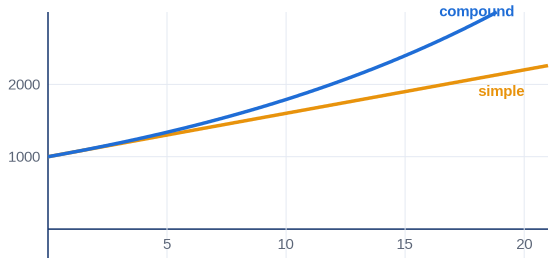
Simple against compound
- Compound growth curves upward because interest earns interest.
Common mistakes
- Using r = 0.04 for 4% growth.Growth multiplies by 1.04.
- Forgetting a bouncing ball travels up and down.After the drop, each rebound counts twice.
Try it: make the call
Your turn
What is the multiplier for a 5% rise?
$100 earns $5 simple interest a year. Find the total after 4 years.
Find $100 after 2 years at 10% compound.
What is the multiplier for a 20% fall?
A Hamilton gym raises its yearly fee by 4% each year. Which kind of sequence do the fees form?
Mere saves $50 in week 1 and $10 more each week after. How much does she save in week 8?
A student writes $2000 at 3% compound for 4 years as 2000 × 0.03⁴. What is the correct working and value?
Tama deposits $500 at the start of each year at 6% a year compound. What is it worth at the end of 4 years?
Show answer
1. 1.05 2. $120 3. $121 4. 0.8 5. Geometric, r = 1.04. A percentage rise multiplies by 1 + the rate each year, so 4% gives r = 1.04. 6. $120. a = 50 and d = 10, so t₈ = 50 + 7 × 10 = $120. 7. 2000 × 1.03⁴ = $2251.02. Growth of 3% multiplies by 1.03, not 0.03, each year. 8. $2318.55. It is 500(1.06 + 1.06² + 1.06³ + 1.06⁴), a geometric series with a = 530, r = 1.06, n = 4: S₄ = 530(1.06⁴ − 1) ÷ 0.06 = $2318.55.
Sample question: Achieved
$8,000 is invested at 4.5% a year, compounded annually. Find its value after 6 years.
Hint
Each year multiplies the amount by 1.045, so after 6 years it is 8000 × 1.045⁶.
Answer
$10,418.08
Step by step
- A percentage increase is geometric: each year the amount is multiplied by 1 + 0.045 = 1.045.
- After 1 year: 8000 × 1.045. After 2 years: 8000 × 1.045². The power is the number of years.
- After 6 years: 8000 × 1.045⁶.
- 1.045⁶ ≈ 1.30226, so the value is about $10,418.08.
- Classic mistake: simple interest, 8000 + 6 × 360 = 10 160. Compound interest also earns interest on the interest, so it is more.
- Check: the interest earned is about 2418, which is more than the 2160 simple interest. That fits.
Full working
- multiplier = 1.0454.5% increase
- 8000 × 1.045⁶6 years
- $10,418.08
Sample questions: Merit
A car bought for $32,000 loses 18% of its value each year. After how many whole years is it first worth less than $10,000?
Hint
Losing 18% leaves 82%, so multiply by 0.82 each year. Solve 32 000 × 0.82ⁿ < 10 000.
Answer
After 6 years (about $9,728; after 5 years it is still about $11,864)
Step by step
- A percentage fall is geometric. Losing 18% leaves 82%, so the multiplier is 0.82.
- Value after n years: 32 000 × 0.82ⁿ.
- We need 32 000 × 0.82ⁿ < 10 000, so 0.82ⁿ < 0.3125.
- With logs: n > log 0.3125 ÷ log 0.82 ≈ 5.86. Dividing by log 0.82, a negative number, flips the inequality.
- The first whole number above 5.86 is 6.
- Check: after 5 years 32 000 × 0.82⁵ ≈ $11,864, still above. After 6 years ≈ $9,728, below.
- Classic mistake: multiplying by 0.18 instead of 0.82. That is the amount lost, not the value left.
Full working
- value = 32 000 × 0.82ⁿ18% fall
- 0.82ⁿ < 0.3125
- n > log 0.3125 ÷ log 0.82 ≈ 5.86
- n = 5: ≈ 11 864; n = 6: ≈ 9728check
- after 6 years
Job A pays $52,000 in year 1 and rises by $1,500 each year. Job B pays $50,000 in year 1 and rises by 4% each year. Which job pays more in total over 10 years, and by how much?
Hint
A fixed rise is arithmetic and a percentage rise is geometric. Use the matching sum formula for each.
Answer
Job B, by about $12,805 (Job A $587,500, Job B about $600,305)
Step by step
- First decide the type. Job A adds the same amount each year: arithmetic, with a = 52 000 and d = 1500.
- Job B multiplies by 1.04 each year: geometric, with a = 50 000 and r = 1.04.
- Job A total: S₁₀ = (102)(2 × 52 000 + 9 × 1500) = 5(104 000 + 13 500) = 587 500.
- Job B total: S₁₀ = 50 000 × 1.04¹⁰ − 11.04 − 1 = 50 000 × 0.48024 ÷ 0.04 ≈ 600 305.
- Job B pays about 600 305 − 587 500 = $12,805 more.
- Notice: Job A starts higher, but percentage growth compounds. By year 10 Job A pays $65,500 and Job B about $71,166.
- Classic mistake: using the arithmetic formula for both. A percentage rise is never a fixed amount.
- Check Job B roughly: its average year is about 60 000, and 10 × 60 000 = 600 000. Close.
Full working
- A: a = 52 000, d = 1500fixed rise, arithmetic
- S₁₀ = 5(104 000 + 13 500) = 587 500
- B: a = 50 000, r = 1.04percentage rise, geometric
- S₁₀ = 50 000 × 1.04¹⁰ − 10.04 ≈ 600 305
- Job B, by about $12,805
Sample questions: Excellence
Aroha puts $200 into a savings account at the start of every month. The account pays 0.5% interest a month, added at the end of each month. After how many months is the balance first more than $10,000?
Hint
Track where each deposit ends up: the first one grows for n months, the last for 1 month. That makes a geometric series.
Answer
45 months (about $10,115; after 44 months it is about $9,865)
Step by step
- Think about each deposit separately at the end of month n.
- The last deposit earns 1 month of interest: 200 × 1.005. The first earns n months: 200 × 1.005ⁿ.
- Balance = 200 × 1.005 + 200 × 1.005² + ... + 200 × 1.005ⁿ. This is geometric with a = 200 × 1.005 = 201 and r = 1.005.
- Sₙ = 201(1.005ⁿ − 1)1.005 − 1 = 201(1.005ⁿ − 1)0.005.
- We need Sₙ > 10 000: 1.005ⁿ − 1 > 10 000 × 0.005 ÷ 201 ≈ 0.24876.
- 1.005ⁿ > 1.24876, so n > log 1.24876 ÷ log 1.005 ≈ 44.5.
- The first whole month is n = 45.
- Check: S₄₄ ≈ $9,864.83 and S₄₅ ≈ $10,115.16. So month 45 is the first.
- Without interest she would need 50 months. Interest saves about 5 months of deposits.
- Classic mistake: taking a = 200. Each deposit is made at the start of the month, so even the newest one has earned a month's interest.
Full working
- 200 × 1.005 + 200 × 1.005² + ... + 200 × 1.005ⁿeach deposit's growth
- a = 201, r = 1.005
- 201(1.005ⁿ − 1)0.005 > 10 000
- 1.005ⁿ > 1.24876, so n > 44.5
- S₄₄ ≈ 9864.83, S₄₅ ≈ 10 115.16check
- 45 months
A predator-free sanctuary has 120 kiwi. Each year the population grows by 8%, then 5 birds are moved to other sites at the end of the year. Show that the population after n years is Pₙ = 62.5 + 57.5 × 1.08ⁿ. Hence find the first year the population is over 200.
Hint
Write P₁, P₂ and P₃ out without simplifying. The removed birds form a geometric series you can sum.
Answer
Pₙ = 120 × 1.08ⁿ − 5(1.08ⁿ − 1)0.08 = 62.5 + 57.5 × 1.08ⁿ; the population first passes 200 after 12 years (about 207)
Step by step
- Each year: multiply by 1.08, then take 5. So P₁ = 120 × 1.08 − 5.
- P₂ = (120 × 1.08 − 5) × 1.08 − 5 = 120 × 1.08² − 5 × 1.08 − 5.
- The pattern: Pₙ = 120 × 1.08ⁿ − 5(1 + 1.08 + 1.08² + ... + 1.08ⁿ⁻¹).
- The bracket is a geometric series with a = 1, r = 1.08 and n terms: 1.08ⁿ − 10.08.
- So Pₙ = 120 × 1.08ⁿ − 5(1.08ⁿ − 1)0.08 = 120 × 1.08ⁿ − 62.5 × 1.08ⁿ + 62.5.
- Collect the 1.08ⁿ terms: Pₙ = 62.5 + 57.5 × 1.08ⁿ. That is what we had to show.
- Why 62.5? If the population were 62.5, the 8% growth would be exactly 5 birds, so it would stay still. Above 62.5 it grows.
- Hence: 62.5 + 57.5 × 1.08ⁿ > 200, so 1.08ⁿ > 137.5 ÷ 57.5 ≈ 2.3913.
- n > log 2.3913 ÷ log 1.08 ≈ 11.3, so the first whole year is 12.
- Check: P₁₁ ≈ 196.6 and P₁₂ ≈ 207.3. Also P₁ = 62.5 + 62.1 = 124.6, and 120 × 1.08 − 5 = 124.6. Correct.
- Limitation: real growth is not exactly 8% every year, and you cannot have part of a kiwi, so round to whole birds.
Full working
- P₁ = 120 × 1.08 − 5, P₂ = 120 × 1.08² − 5 × 1.08 − 5write out
- Pₙ = 120 × 1.08ⁿ − 5(1.08ⁿ − 1)0.08geometric series of removals
- Pₙ = 62.5 + 57.5 × 1.08ⁿshown
- 1.08ⁿ > 2.3913, so n > 11.3
- P₁₁ ≈ 196.6, P₁₂ ≈ 207.3check
- first over 200 after 12 years
What to take away
- Added amount: arithmetic. Percentage: geometric.
- Write the first few terms when unsure.
Challenge
Tane wants $50,000 for a house deposit in 5 years. He already has $10,000 in an account paying 0.4% interest a month, added at the end of each month. He will also deposit the same amount at the end of every month, straight after the interest is added. How much must each monthly deposit be?
Hint
Work backwards from $50,000. Find what the $10,000 grows to on its own, then the deposits must make up the rest. The last deposit earns no interest at all.
Answer
About $551.19 a month (the $10,000 grows to about $12,706.41, and the deposits must supply about $37,293.59)
Step by step
- Five years is 60 months. The $10,000 alone grows to 10 000 × 1.004⁶⁰ ≈ $12,706.41.
- The deposits must make up 50 000 − 12 706.41 = $37,293.59.
- Each deposit D is made at the end of a month, so the last one earns nothing and the first earns 59 months of interest.
- The deposits are worth D + 1.004D + 1.004²D + ... + 1.004⁵⁹D, a geometric series with a = D, r = 1.004 and 60 terms: D(1.004⁶⁰ − 1)0.004 ≈ 67.660D.
- 67.660D = 37 293.59 gives D ≈ $551.19.
- Classic mistake: forgetting the $10,000 also grows. Without its interest you would get about $591 a month, too much.
Full working
- 10 000 × 1.004⁶⁰ ≈ 12 706.41lump sum, 60 months
- 50 000 − 12 706.41 = 37 293.59left for the deposits
- D(1.004⁶⁰ − 1)0.004 ≈ 67.660Da = D, r = 1.004, n = 60
- D = 37 293.59 ÷ 67.660
- about $551.19 a month
Mere borrows $20,000 for a car at 0.6% interest a month. Interest is added at the end of each month, and she then pays the same amount R. Show that the balance after n payments is 20 000 × 1.006ⁿ − R(1.006ⁿ − 1)0.006. Hence find R if the loan is paid off in exactly 3 years, and the total interest she pays.
Hint
Write the balance after 1, 2 and 3 months without simplifying. Each payment R then keeps being multiplied by 1.006 like the loan does.
Answer
R ≈ $619.37 a month; total interest about $2,297
Step by step
- After 1 month: 20 000 × 1.006 − R. After 2 months: (20 000 × 1.006 − R) × 1.006 − R = 20 000 × 1.006² − 1.006R − R.
- After n months: 20 000 × 1.006ⁿ − R(1 + 1.006 + ... + 1.006ⁿ⁻¹).
- The bracket is geometric with a = 1, r = 1.006 and n terms, so it sums to 1.006ⁿ − 10.006. That is the result we had to show.
- Paid off in 36 months means the balance is 0: R(1.006³⁶ − 1)0.006 = 20 000 × 1.006³⁶.
- 1.006³⁶ ≈ 1.24030, so R = 20 000 × 0.006 × 1.24030 ÷ 0.24030 ≈ $619.37.
- She pays 36 × 619.37 ≈ $22,297 in total, so the interest is about $2,297.
Full working
- B₁ = 20 000 × 1.006 − R, B₂ = 20 000 × 1.006² − 1.006R − Rwrite out
- Bₙ = 20 000 × 1.006ⁿ − R(1.006ⁿ − 1)0.006geometric series of payments
- R(1.006³⁶ − 1)0.006 = 20 000 × 1.006³⁶B₃₆ = 0
- R = 120 × 1.24030 ÷ 0.24030 ≈ 619.37
- 36 × 619.37 − 20 000 ≈ 2297total interest
- R ≈ $619.37; interest about $2,297
A patient takes the same dose of D mg of a medicine every 12 hours. By the time of the next dose, 75% of the medicine in the body has been removed. The doctor needs two things in the long run: the amount just after a dose must never go above 400 mg, and the amount just before a dose must stay at 90 mg or more. Find the range of doses that works. With D = 300, after which dose is the amount just after a dose first more than 399 mg?
Hint
Just after the nth dose the amount is D + 0.25D + 0.25²D + ... (n terms). In the long run this is a sum to infinity. Just before a dose, a quarter of that is left.
Answer
270 ≤ D ≤ 300 mg; with D = 300, the 5th dose (about 399.6 mg; after the 4th it is about 398.4 mg)
Step by step
- Just after dose n: the newest dose is D, the one before has 0.25D left, the one before that 0.25²D, and so on. So Aₙ = D(1 − 0.25ⁿ)0.75.
- The amounts rise towards the sum to infinity D ÷ 0.75 but never reach it. So the after-dose amount stays at most 400 if D ÷ 0.75 ≤ 400, which gives D ≤ 300.
- Just before the next dose, a quarter is left: in the long run 0.25 × D ÷ 0.75 = D ÷ 3. We need D ÷ 3 ≥ 90, so D ≥ 270.
- So 270 ≤ D ≤ 300 mg.
- With D = 300: Aₙ = 400(1 − 0.25ⁿ). We need 400(1 − 0.25ⁿ) > 399, so 0.25ⁿ < 1400, which means 4ⁿ > 400 and n > log 400 ÷ log 4 ≈ 4.32.
- Check: A₄ = 400(1 − 0.25⁴) ≈ 398.4 and A₅ ≈ 399.6. So the 5th dose is the first.
Full working
- Aₙ = D + 0.25D + ... + 0.25ⁿ⁻¹D = D(1 − 0.25ⁿ)0.75geometric, r = 0.25
- D0.75 ≤ 400, so D ≤ 300long-run after a dose
- 0.25 × D0.75 = D ÷ 3 ≥ 90, so D ≥ 270long-run before a dose
- 400(1 − 0.25ⁿ) > 399, so 4ⁿ > 400 and n > 4.32D = 300
- A₄ ≈ 398.4, A₅ ≈ 399.6check
- 270 ≤ D ≤ 300 mg; the 5th dose
Practise this
Report a mistake
More in AS 91258
Is your child on track?
Take the free placement test