Arithmetic sequences and series
What this lesson covers
- The nth term is a + (n − 1)d.
- The sum of n terms is (n/2)(2a + (n − 1)d).
- Two known terms are enough to find a and d.
The two formulas
- A is the first term and d is the common difference.
- tₙ = a + (n − 1)d.
- Sₙ = (n/2)(2a + (n − 1)d).
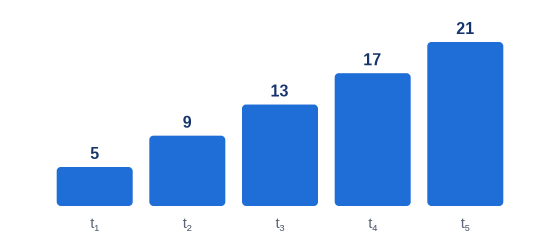
5, 9, 13, ...
- Find the 20th term and the sum of 20 terms.
- a = 5, d = 4
- t₂₀ = 5 + 19 × 4 = 81
- S₂₀ = 10(10 + 19 × 4)
- S₂₀ = 860
Given t₅ = 14 and t₁₂ = 42
- The gap between the terms holds 7 lots of d.
- 7d = 28, so d = 4
- a + 4(4) = 14
- a = −2
Try it: count the jumps
Try it: build a sequence
- Change the first term and the difference. The bars grow by the same step.
Reaching a total
- For 3, 7, 11, ... how many terms are needed to pass 200?
- Sₙ = (n/2)(6 + 4(n − 1)) = n(2n + 1)
- n = 9 gives 171
- n = 10 gives 210
- 10 terms
Try it: add up the terms
Common mistakes
- Using n × d in the nth term.The first term has had no differences added, so it is (n − 1)d.
- Mixing up the term and the sum.tₙ is one term and Sₙ adds them all.
Your turn
Find t₁₀ of 2, 5, 8, ...
Find the sum 1 + 3 + 5 + 7 + 9.
t₃ = 10 and t₇ = 26. Find d.
With t₃ = 10 and d = 4, find a.
Find the sum of the first 15 terms of 4, 7, 10, ...
Which term of 7, 11, 15, ... is 83?
Aroha saves $20 in week 1, $25 in week 2, $30 in week 3, and so on. How much has she saved in total after 12 weeks?
An arithmetic sequence has t₄ = 17 and S₁₀ = 185. Find a and d.
Show answer
1. 2 + 9 × 3 = 29 2. 25 3. 4d = 16, so d = 4 4. a = 10 − 8 = 2 5. 375. a = 4 and d = 3, so S₁₅ = (15/2)(8 + 14 × 3) = 7.5 × 50 = 375. 6. 20. 7 + (n − 1) × 4 = 83 gives n − 1 = 19, so n = 20. 7. $570. a = 20 and d = 5, so S₁₂ = 6(40 + 11 × 5) = 6 × 95 = 570. 8. a = 14, d = 1. a + 3d = 17 and 5(2a + 9d) = 185 gives 2a + 9d = 37; subtracting 2a + 6d = 34 leaves 3d = 3.
Sample question: Achieved
An arithmetic sequence has first term 7 and common difference 4. Find t₂₅ and S₂₅.
Hint
Use tₙ = a + (n − 1)d, then Sₙ = (n2)(a + l) with the last term l you just found.
Answer
t₂₅ = 103 and S₂₅ = 1375
Step by step
- Write down what you know: a = 7, d = 4, n = 25.
- nth term: t₂₅ = a + (n − 1)d = 7 + 24 × 4 = 7 + 96 = 103.
- For the sum, you now know the first and last terms, so use Sₙ = (n2)(a + l).
- S₂₅ = (252)(7 + 103) = 12.5 × 110 = 1375.
- Classic mistake: using 25 × 4 instead of 24 × 4. The first term already counts as one term, so only 24 steps follow it.
- Check with the other formula: (252)(2 × 7 + 24 × 4) = 12.5 × 110 = 1375. The same.
Full working
- t₂₅ = 7 + 24 × 4 = 103tₙ = a + (n − 1)d
- S₂₅ = (252)(7 + 103)first plus last, times n ÷ 2
- t₂₅ = 103, S₂₅ = 1375
Sample questions: Merit
An arithmetic sequence has t₄ = 11 and S₁₀ = 155. Find the first term a and the common difference d.
Hint
Write each fact as an equation in a and d, then solve them together.
Answer
a = 2 and d = 3
Step by step
- Each fact gives one equation. With two unknowns, two equations are exactly enough.
- t₄ = a + 3d = 11.
- S₁₀ = (102)(2a + 9d) = 5(2a + 9d) = 155, so 2a + 9d = 31.
- Double the first equation so the a terms match: 2a + 6d = 22.
- Subtract it from 2a + 9d = 31: 3d = 9, so d = 3.
- Put d = 3 into a + 3d = 11: a = 2.
- Classic mistake: writing t₄ = a + 4d. The fourth term is only 3 steps after the first.
- Check: the sequence is 2, 5, 8, 11, ... so t₄ = 11, and S₁₀ = 5(4 + 27) = 155. Both correct.
Full working
- a + 3d = 11t₄
- 5(2a + 9d) = 155, so 2a + 9d = 31S₁₀
- 2a + 6d = 22double the first
- 3d = 9, so d = 3, then a = 2subtract
- a = 2, d = 3
For the series 50 + 47 + 44 + ..., how many terms must be added for the sum to be negative for the first time?
Hint
Write Sₙ in terms of n and solve Sₙ < 0. Then test the whole numbers either side.
Answer
35 terms (S₃₄ = 17 and S₃₅ = −35)
Step by step
- The terms fall by 3 each time, so a = 50 and d = −3.
- Sₙ = (n2)(2a + (n − 1)d) = (n2)(100 − 3(n − 1)) = (n2)(103 − 3n).
- n is positive, so Sₙ is negative exactly when 103 − 3n < 0.
- 3n > 103, so n > 34.33.
- n must be a whole number, so the first one is n = 35.
- Check both sides: S₃₄ = 17 × (103 − 102) = 17, still positive. S₃₅ = 17.5 × (103 − 105) = −35, negative.
- Why it takes so long: the terms turn negative at t₁₈ = −1, but the early positive terms keep the total up until the negatives cancel them.
- Classic mistake: answering 18, the first negative term. The question asks about the sum, not a term.
Full working
- a = 50, d = −3
- Sₙ = (n2)(103 − 3n)sum formula
- 103 − 3n < 0, so n > 34.33n is positive
- S₃₄ = 17, S₃₅ = −35check either side
- 35 terms
Sample questions: Excellence
A new theatre has 24 seats in the front row, and each row after that has 2 more seats than the row in front. Find the fewest rows that give at least 1000 seats. The site only has room for 22 rows. How many seats would the front row need for 22 rows to hold at least 1000?
Hint
Write Sₙ in terms of n and solve Sₙ ≥ 1000 as a quadratic inequality. For the second part, n is fixed and a is unknown.
Answer
23 rows (1058 seats; 22 rows give only 990); with 22 rows the front row needs at least 25 seats (1012 seats)
Step by step
- The rows go 24, 26, 28, ..., so a = 24 and d = 2.
- Sₙ = (n2)(48 + 2(n − 1)) = (n2)(2n + 46) = n(n + 23).
- We need n(n + 23) ≥ 1000, so n² + 23n − 1000 ≥ 0.
- Solve n² + 23n − 1000 = 0 with the quadratic formula: n = (−23 + √(529 + 4000)) ÷ 2 ≈ 22.15. Ignore the negative root.
- n must be a whole number above 22.15, so n = 23.
- Check: S₂₂ = 22 × 45 = 990, just short. S₂₃ = 23 × 46 = 1058. So 23 rows are needed.
- Second part: now n = 22 is fixed and the front row a is unknown. S₂₂ = 11(2a + 21 × 2) = 11(2a + 42).
- 11(2a + 42) ≥ 1000 gives 2a + 42 ≥ 90.9, so a ≥ 24.45.
- Seats come in whole numbers, so round up: a = 25.
- Check: 11(50 + 42) = 1012 seats, enough. With a = 24 it is 990, not enough.
- Classic mistake: rounding 22.15 down to 22. Rounding down always falls short in an "at least" question.
Full working
- Sₙ = (n2)(48 + 2(n − 1)) = n(n + 23)a = 24, d = 2
- n² + 23n − 1000 ≥ 0, so n ≥ 22.15quadratic formula
- S₂₂ = 990, S₂₃ = 1058check
- 11(2a + 42) ≥ 1000, so a ≥ 24.45n = 22 fixed
- a = 25 gives 1012round up
- 23 rows; or 22 rows with 25 seats in the front row
The sum of the first n terms of a sequence is Sₙ = 3n² + 2n. Prove that the sequence is arithmetic, and find its first term and common difference.
Hint
The nth term is the sum up to n take away the sum up to n − 1: tₙ = Sₙ − Sₙ₋₁.
Answer
tₙ = 6n − 1, so the difference tₙ − tₙ₋₁ = 6 is constant; a = 5 and d = 6
Step by step
- Adding the nth term to the first n − 1 terms gives the first n terms. So tₙ = Sₙ − Sₙ₋₁.
- Sₙ₋₁ means replace n with (n − 1): 3(n − 1)² + 2(n − 1) = 3n² − 6n + 3 + 2n − 2 = 3n² − 4n + 1.
- tₙ = (3n² + 2n) − (3n² − 4n + 1) = 6n − 1.
- To prove it is arithmetic, show the gap between neighbouring terms is always the same.
- tₙ − tₙ₋₁ = (6n − 1) − (6(n − 1) − 1) = 6. This does not depend on n, so the sequence is arithmetic with d = 6.
- First term: t₁ = 6 − 1 = 5. Also S₁ = 3 + 2 = 5, which agrees.
- Why check S₁? The formula tₙ = Sₙ − Sₙ₋₁ only works for n ≥ 2, so the first term must be checked on its own.
- Classic mistake: showing the first three terms differ by 6 and stopping. A few terms are an example; the algebra proves it for every n.
- Check: 5 + 11 + 17 = 33 and S₃ = 27 + 6 = 33. Correct.
Full working
- Sₙ₋₁ = 3(n − 1)² + 2(n − 1) = 3n² − 4n + 1
- tₙ = Sₙ − Sₙ₋₁ = 6n − 1
- tₙ − tₙ₋₁ = 6constant, so arithmetic
- t₁ = 5 = S₁first term checks
- arithmetic with a = 5, d = 6
What to take away
- Same difference means arithmetic.
- Use (n − 1), never n.
Challenge
In an arithmetic sequence, the first ten terms add to 155 and the next ten terms add to 455. Explain why the difference between these two totals is 100d, and use it to find a and d. Then find the sum of terms 21 to 30 without listing them.
Hint
Pair the 1st term with the 11th, the 2nd with the 12th, and so on. How far apart is each pair?
Answer
Each of the ten pairs differs by 10d, so the totals differ by 100d; d = 3 and a = 2; terms 21 to 30 add to 755
Step by step
- Term 11 is 10 steps after term 1, so it is 10d bigger. The same is true for terms 12 and 2, 13 and 3, and so on up to 20 and 10.
- There are ten such pairs, so the second block of ten is 10 × 10d = 100d bigger than the first.
- 100d = 455 − 155 = 300, so d = 3.
- S₁₀ = 5(2a + 9d) = 155, so 2a + 27 = 31 and a = 2.
- By the same pairing, terms 21 to 30 add to 100d more than terms 11 to 20: 455 + 300 = 755.
- Check: S₃₀ = 15(4 + 87) = 1365, and 155 + 455 + 755 = 1365. Correct.
Full working
- tₙ₊₁₀ − tₙ = 10dten steps apart
- 455 − 155 = 10 × 10d = 100d, so d = 3ten pairs
- 5(2a + 27) = 155, so a = 2S₁₀
- 455 + 100d = 755terms 21 to 30
- S₃₀ = 15(2 × 2 + 29 × 3) = 1365 = 155 + 455 + 755check
- a = 2, d = 3; terms 21 to 30 add to 755
Aroha and Tama start training for a fun run on the same day. Aroha runs 2 km on day 1 and 0.5 km more each day after that. Tama runs 5 km on day 1 and 0.25 km more each day. On which day does Aroha first run further than Tama on that day? On which day does Aroha's running total first pass Tama's running total? Explain why the second answer is so much later than the first.
Hint
The first question compares single terms tₙ. The second compares sums Sₙ. Write each as an expression in n and solve an inequality.
Answer
Aroha first runs further on day 14 (8.5 km against 8.25 km); her total first passes his on day 26 (214.5 km against 211.25 km; they are level at 200 km after day 25)
Step by step
- Day n: Aroha runs 2 + 0.5(n − 1) and Tama runs 5 + 0.25(n − 1). Aroha is further when 0.25(n − 1) > 3, so n − 1 > 12 and n > 13. That is day 14.
- On day 13 they both run 8 km, so day 13 does not count.
- Totals: Aroha's is (n2)(4 + 0.5(n − 1)) = (n2)(3.5 + 0.5n) and Tama's is (n2)(10 + 0.25(n − 1)) = (n2)(9.75 + 0.25n).
- Aroha's total is bigger when 3.5 + 0.5n > 9.75 + 0.25n, so 0.25n > 6.25 and n > 25. At n = 25 both totals are 200 km, so the first day is 26.
- Why so late: for the first 13 days Tama ran further every day and built up a lead. Aroha's daily margin starts small, so it takes another 12 days to win the lead back.
Full working
- 2 + 0.5(n − 1) > 5 + 0.25(n − 1)single day
- n > 13, so day 14 (8.5 against 8.25 km)day 13 is 8 km each
- (n2)(3.5 + 0.5n) > (n2)(9.75 + 0.25n)running totals
- 0.25n > 6.25, so n > 25divide by n2
- S₂₅ = 200 for both; day 26: 214.5 against 211.25 kmcheck
- day 14 for a single run; day 26 for the running total
Sequence A is 3, 10, 17, 24, ... and sequence B is 5, 9, 13, 17, .... Both go on forever. Show that the numbers that appear in both sequences form an arithmetic sequence, and find its first term and common difference. Then find how many of these shared numbers are below 500, and their sum.
Hint
A shared number must have a gap to the next shared number that is a whole number of 7s and also a whole number of 4s. Find the first shared number by listing.
Answer
The shared numbers are 17, 45, 73, ..., arithmetic with first term 17 and common difference 28; 18 of them are below 500, and they add to 4590
Step by step
- List the start of each: A gives 3, 10, 17, ... and B gives 5, 9, 13, 17, .... The first shared number is 17.
- From one shared number to the next, you move a whole number of 7s along A and a whole number of 4s along B. So the gap is a multiple of both 7 and 4, which means a multiple of 28.
- Adding 28 to a shared number keeps it in both sequences, since 28 = 4 × 7 = 7 × 4. So the next shared number is exactly 28 further on, every time.
- The shared numbers are 17, 45, 73, ...: arithmetic with a = 17 and d = 28.
- Below 500: 17 + 28(n − 1) < 500 gives n − 1 < 17.25, so n = 18. The 18th is 17 + 17 × 28 = 493.
- Sum: S₁₈ = (182)(17 + 493) = 9 × 510 = 4590.
Full working
- first shared number 17list both
- gap is a multiple of 7 and of 4, so of 28step sizes 7 and 4
- tₙ = 17 + 28(n − 1)arithmetic, a = 17, d = 28
- 17 + 28(n − 1) < 500, so n − 1 < 17.25below 500
- n = 18, last term 49317 + 17 × 28
- S₁₈ = 9 × (17 + 493) = 4590first plus last, times n ÷ 2
- a = 17, d = 28; 18 shared numbers below 500, sum 4590
Practise this
Report a mistake
More in AS 91258
Is your child on track?
Take the free placement test