Geometric sequences and series
What this lesson covers
- The nth term is arⁿ⁻¹.
- The sum of n terms is a(rⁿ − 1) ÷ (r − 1).
- If r is between −1 and 1, the infinite sum is a ÷ (1 − r).
The three formulas
- A is the first term and r is the common ratio.
- tₙ = arⁿ⁻¹.
- Sₙ = a(rⁿ − 1) ÷ (r − 1).
- S∞ = a ÷ (1 − r), only when −1 < r < 1.
3, 6, 12, ...
- Find t₈ and S₈.
- a = 3, r = 2
- t₈ = 3 × 2⁷ = 384
- S₈ = 3(2⁸ − 1) ÷ 1
- S₈ = 765
40, 20, 10, ...
- The ratio is a half, so an infinite sum exists.
- r = 1/2
- S∞ = 40 ÷ (1 − 1/2)
- S∞ = 80
Try it: multiply instead
- Switch to Geometric. A ratio below 1 shrinks, and the sum levels off.
Terms that shrink
- Each bar is half the last, so the total never passes 80.
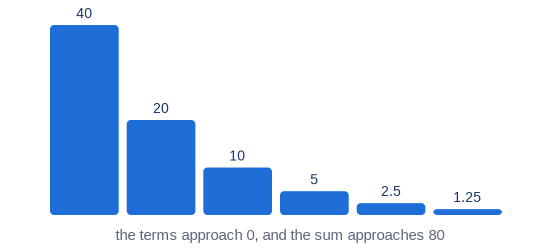
Try it: terms that shrink
Finding r
- t₂ = 6 and t₅ = 162.
- r³ = 162 ÷ 6 = 27
- r = 3
- a = 6 ÷ 3 = 2
Try it: hop by the ratio
Common mistakes
- Writing 3 × 2⁸ for the eighth term.The power is one less than the term number.
- Using S∞ when r = 2.The terms grow, so the sum has no limit.
Your turn
Find t₅ of 3, 6, 12, ...
Find the sum 1 + 2 + 4 + 8.
Find S∞ of 12, 6, 3, ...
t₁ = 5 and t₂ = 15. Find r.
Find S∞ of 18, −6, 2, ...
Which series has an infinite sum?
A car bought for $30,000 loses 15% of its value each year. Find its value after 4 years, to the nearest dollar.
How many terms of 2 + 6 + 18 + ... are needed for the sum to pass 1,000?
Show answer
1. 48 2. 15 3. 12 ÷ 0.5 = 24 4. 3 5. 13.5. r = −1/3, so S∞ = 18 ÷ (1 + 1/3) = 18 ÷ 4/3 = 13.5. 6. 5 + 4 + 3.2 + ... has r = 0.8, which is between −1 and 1; the others have r = 1.5, −2 and 1. 7. $15,660. Each year multiplies by 0.85, so the value is 30,000 × 0.85⁴ = 15,660.19, about $15,660. 8. 7. Sₙ = 2(3ⁿ − 1) ÷ 2 = 3ⁿ − 1, and S₆ = 728 but S₇ = 2,186.
Sample question: Achieved
For the geometric sequence 2, 6, 18, ..., find t₇ and S₇.
Hint
Find r by dividing a term by the one before it, then use tₙ = arⁿ⁻¹ and Sₙ = a(rⁿ − 1)r − 1.
Answer
t₇ = 1458 and S₇ = 2186
Step by step
- A geometric sequence multiplies by the same number each time: r = 6 ÷ 2 = 3, and a = 2.
- nth term: t₇ = ar⁶ = 2 × 3⁶ = 2 × 729 = 1458.
- Sum: S₇ = a(r⁷ − 1)r − 1 = 2(2187 − 1)2 = 2186.
- Classic mistake: using 3⁷ for t₇. The first term has no factor of r, so the 7th term has only 6.
- Check: the terms are 2, 6, 18, 54, 162, 486, 1458, and their total is 2186.
Full working
- a = 2, r = 3
- t₇ = 2 × 3⁶ = 1458tₙ = arⁿ⁻¹
- S₇ = 2(3⁷ − 1)3 − 1 = 2186
- t₇ = 1458, S₇ = 2186
Sample questions: Merit
A geometric sequence has t₃ = 12 and t₆ = −96. Find a, r and S₁₀.
Hint
Going from t₃ to t₆ multiplies by r three times, so divide them to get r³.
Answer
a = 3, r = −2 and S₁₀ = −1023
Step by step
- t₃ = ar² and t₆ = ar⁵. Dividing removes a: t₆ ÷ t₃ = r³.
- r³ = −96 ÷ 12 = −8, so r = −2. A cube root of a negative number is negative, and there is only one.
- a = t₃ ÷ r² = 12 ÷ 4 = 3.
- S₁₀ = a(r¹⁰ − 1)r − 1 = 3((−2)¹⁰ − 1)−2 − 1.
- (−2)¹⁰ = 1024, an even power, so it is positive. S₁₀ = 3 × 10²³ ÷ (−3) = −1023.
- Classic mistake: losing the bracket and working out −2¹⁰ = −1024. The base is −2, so it needs brackets.
- Check: the terms go 3, −6, 12, −24, 48, −96, so t₃ = 12 and t₆ = −96. Correct.
Full working
- r³ = −96 ÷ 12 = −8, so r = −2t₆ ÷ t₃
- a = 12 ÷ (−2)² = 3
- S₁₀ = 3((−2)¹⁰ − 1)−3 = 3 × 10²³−3Sₙ = a(rⁿ − 1)r − 1
- a = 3, r = −2, S₁₀ = −1023
How many terms of the series 3 + 6 + 12 + ... are needed for the sum to be more than 10 000?
Hint
Write Sₙ in terms of n, then solve for the power 2ⁿ, by trying powers of 2 or with logs.
Answer
12 terms (S₁₁ = 6141 and S₁₂ = 12 285)
Step by step
- a = 3 and r = 2, so Sₙ = 3(2ⁿ − 1)2 − 1 = 3(2ⁿ − 1).
- We need 3(2ⁿ − 1) > 10 000, so 2ⁿ − 1 > 3333.3 and 2ⁿ > 3334.3.
- Powers of 2: 2¹¹ = 2048, too small. 2¹² = 4096, big enough.
- With logs: n > log 3334.3 ÷ log 2 ≈ 11.7, so the next whole number is 12.
- Check both sides: S₁₁ = 3 × 2047 = 6141, not enough. S₁₂ = 3 × 4095 = 12 285, more than 10 000.
- Classic mistake: solving tₙ > 10 000 instead of Sₙ > 10 000. The question is about the total.
Full working
- Sₙ = 3(2ⁿ − 1)a = 3, r = 2
- 2ⁿ > 3334.3Sₙ > 10 000
- n > log 3334.3 ÷ log 2 ≈ 11.7
- S₁₁ = 6141, S₁₂ = 12 285check
- 12 terms
Sample questions: Excellence
A ball is dropped from 10 m. After each bounce it rises to 60% of the height it fell from. Assuming it bounces for ever, find the total vertical distance it travels. Explain why this is only a model.
Hint
After the first drop, each bounce height is travelled twice: up and back down. Use S∞ on the bounce heights.
Answer
40 m; in reality the ball stops after a finite number of bounces and the 60% ratio is not exact
Step by step
- List the movements: down 10, up 6, down 6, up 3.6, down 3.6, and so on.
- The first 10 m is travelled only once. Every bounce height after it is travelled twice.
- The bounce heights 6, 3.6, 2.16, ... are geometric with a = 6 and r = 0.6.
- r = 0.6 is between −1 and 1, so the sum to infinity exists: S∞ = a1 − r = 60.4 = 15.
- Total = 10 + 2 × 15 = 40 m.
- Classic mistake: using S∞ = 101 − 0.6 = 25 for everything. That counts each bounce only once.
- Model limitations: a real ball loses more energy as bounces get small and stops after a finite time; the 60% is only roughly constant; and air resistance is ignored.
- But because the heights shrink so fast, the model still gives a good estimate of the real total.
- Check: after 10 bounces the distance is 10 + 2 × 6(1 − 0.6¹⁰)0.4 ≈ 39.8 m, already close to 40.
Full working
- 10 + 2(6 + 3.6 + 2.16 + ...)each bounce up and down
- bounces: a = 6, r = 0.6−1 < r < 1
- S∞ = 61 − 0.6 = 15
- total = 10 + 2 × 15
- 40 m
The geometric series 1 + (2x − 1) + (2x − 1)² + ... depends on x. Find the values of x for which it has a sum to infinity. Find x when the sum to infinity is 4, and show that the sum to infinity, when it exists, is always greater than 12.
Hint
The ratio is r = 2x − 1. A sum to infinity needs −1 < r < 1.
Answer
It converges for 0 < x < 1; S∞ = 12 − 2x, which is 4 when x = 78; since 0 < 2 − 2x < 2, S∞ > 12
Step by step
- Each term is the one before times (2x − 1), so a = 1 and r = 2x − 1.
- A sum to infinity only exists when −1 < r < 1: −1 < 2x − 1 < 1.
- Add 1 to each part: 0 < 2x < 2, so 0 < x < 1.
- S∞ = a1 − r = 11 − (2x − 1) = 12 − 2x.
- Set it to 4: 2 − 2x = 14, so 2x = 74 and x = 78. This is between 0 and 1, so it is allowed.
- Check: x = 78 gives r = 34, and 11 − 34 = 4. Correct.
- Now the bound. For 0 < x < 1, the bottom 2 − 2x is between 0 and 2.
- One divided by a positive number less than 2 is more than 12. So S∞ > 12 always.
- It gets close to 12 as x gets close to 0 (r near −1), but never reaches it.
- Classic mistake: solving 12 − 2x = 4 and not checking that x is in the allowed range. Outside it, there is no sum to infinity at all.
Full working
- a = 1, r = 2x − 1
- −1 < 2x − 1 < 1, so 0 < x < 1condition for S∞
- S∞ = 11 − (2x − 1) = 12 − 2x
- 12 − 2x = 4, so x = 78in range
- 0 < 2 − 2x < 2, so S∞ > 12
- 0 < x < 1; x = 78; S∞ > 12
What to take away
- Same ratio means geometric.
- Check −1 < r < 1 before using S∞.
Challenge
A geometric series has a sum to infinity of 27, and its first three terms add to 19. Find a and r. Each term of the series is then squared to make a new series. Explain why the new series is also geometric, and find its sum to infinity.
Hint
Write S₃ as a(1 − r³)1 − r and notice that a1 − r is already known.
Answer
a = 9 and r = 23; the squared terms form a geometric series with first term 81 and ratio 49, so its sum to infinity is 7295 = 145.8
Step by step
- S₃ = a(1 − r³)1 − r, which is the same as (a1 − r) × (1 − r³).
- The first part is S∞ = 27, so 27(1 − r³) = 19.
- 1 − r³ = 1927, so r³ = 827 and r = 23. Then a = 27(1 − 23) = 9.
- Squaring a, ar, ar², ... gives a², a²r², a²r⁴, ...: each term is r² times the one before, so it is geometric with first term 81 and ratio 49.
- 49 is between −1 and 1, so the sum to infinity exists: 81 ÷ (1 − 49) = 81 ÷ 59 = 145.8.
- Check: 9 + 6 + 4 = 19, and 9 ÷ (1 − 23) = 27. Correct.
Full working
- S₃ = (a1 − r)(1 − r³) = 27(1 − r³)S∞ = a1 − r
- 27(1 − r³) = 19, so r³ = 827 and r = 23
- a = 27 × (1 − 23) = 9
- squares: 81, 36, 16, ... with ratio r² = 49(arⁿ)² = a²(r²)ⁿ
- 811 − 49 = 7295−1 < 49 < 1
- a = 9, r = 23; new sum to infinity 145.8
In a geometric series with a sum to infinity, the terms in odd positions (1st, 3rd, 5th, ...) add to 36 and the terms in even positions (2nd, 4th, 6th, ...) add to 12. Find a and r. Then find the smallest n for which Sₙ is within 0.01 of the sum to infinity.
Hint
The odd-position terms are a, ar², ar⁴, ... and the even-position terms are ar, ar³, ar⁵, .... Compare the two lists term by term.
Answer
a = 32 and r = 13 (sum to infinity 48); n = 8
Step by step
- Each even-position term is r times the odd-position term just before it, so the even total is r times the odd total: 12 = 36r, giving r = 13.
- The odd terms a, ar², ar⁴, ... are geometric with ratio r² = 19, so their sum is a ÷ (1 − 19) = 9a8 = 36. So a = 32.
- The whole sum to infinity is 36 + 12 = 48. Check: 32 ÷ (1 − 13) = 48.
- What is left after n terms is S∞ − Sₙ = 48 − 48(1 − (13)ⁿ) = 48 × (13)ⁿ.
- We need 48 × (13)ⁿ < 0.01, so 3ⁿ > 4800 and n > log 4800 ÷ log 3 ≈ 7.72.
- Check: 48 ÷ 3⁷ ≈ 0.022, not close enough; 48 ÷ 3⁸ ≈ 0.0073, close enough. So n = 8.
Full working
- even total = r × odd total, so 12 = 36r and r = 13
- a1 − r² = 36, so a × 98 = 36 and a = 32odd terms, ratio 19
- S∞ = 321 − 13 = 48check 36 + 12
- S∞ − Sₙ = 48 × (13)ⁿ < 0.01the gap left
- 3ⁿ > 4800, so n > 7.723⁷ = 2187, 3⁸ = 6561
- a = 32, r = 13; n = 8
Show that for any geometric series, S₂ₙ = Sₙ(1 + rⁿ). A geometric series has S₅ = 11 and S₁₀ = −341. Use this result to find r and a, then find S₁₅ without using the sum formula directly.
Hint
Split the first 2n terms into the first n and the next n. How does term n + 1 compare with term 1?
Answer
S₂ₙ = Sₙ + rⁿSₙ = Sₙ(1 + rⁿ); r = −2 and a = 1; S₁₅ = S₅(1 + r⁵ + r¹⁰) = 11 × 993 = 10 923
Step by step
- Terms n + 1 to 2n are arⁿ, arⁿ⁺¹, ..., ar²ⁿ⁻¹. Each is rⁿ times one of the first n terms, so they add to rⁿSₙ.
- So S₂ₙ = Sₙ + rⁿSₙ = Sₙ(1 + rⁿ).
- With n = 5: −341 = 11(1 + r⁵), so 1 + r⁵ = −31 and r⁵ = −32. The only real fifth root is r = −2.
- S₅ = a(r⁵ − 1)r − 1 = a(−33)−3 = 11a = 11, so a = 1.
- In the same way, terms 11 to 15 add to r¹⁰S₅, so S₁₅ = S₅(1 + r⁵ + r¹⁰) = 11(1 − 32 + 1024) = 11 × 993 = 10 923.
- Check with the formula: (−2)¹⁵ − 1−2 − 1 = −32 769 ÷ (−3) = 10 923. Correct.
Full working
- terms n + 1 to 2n = rⁿ × (terms 1 to n)arⁿ⁺ᵏ = rⁿ × arᵏ
- S₂ₙ = Sₙ + rⁿSₙ = Sₙ(1 + rⁿ)shown
- −341 = 11(1 + r⁵), so r⁵ = −32 and r = −2
- 11a = 11, so a = 1S₅ = a(−33)−3
- S₁₅ = 11(1 + (−32) + 1024) = 11 × 993blocks of five
- r = −2, a = 1, S₁₅ = 10 923
Practise this
Report a mistake
More in AS 91258
Is your child on track?
Take the free placement test