Relational thinking: linking methods in a rainwater tank problem

What this lesson covers
- In relational thinking the result of one process becomes the input to the next.
- A connected chain is only as good as its weakest step, so every link must be correct.
What relational thinking means
- Separate calculations are Achieved.
- For Merit, one answer becomes the next input.
- Every link in the chain must be correct.
| Step | Find | Which then |
|---|---|---|
| 1 | roof area | feeds the rain volume |
| 2 | rain volume in litres | compared with the tank |
| 3 | tank volume | feeds the rain needed |
| 4 | rain to fill it | and days it lasts |
The problem: a rainwater tank
- A rural home runs on roof-fed rainwater.
- How much does a storm collect?
- How long does a full tank last?
| Details | |
|---|---|
| Roof | 12 m by 8 m, seen from above |
| Tank | cylinder, radius 1.5 m, height 2 m |
| Storm | 25 mm of rain |
| Use | 180 litres a day |
Link 1: roof area to water
- Roof area from above: 96 m².
- Change 25 mm into metres first.
- Water = area × depth = 2.4 m³.
| Working | Result | |
|---|---|---|
| Roof area | 12 × 8 | 96 m² |
| Rain depth | 25 mm ÷ 1000 | 0.025 m |
| Water | 96 × 0.025 | 2.4 m³ |
The links are unit conversions
- Millimetres to metres: divide by 1000.
- Cubic metres to litres: multiply by 1000.
- Get these wrong and the chain breaks.
| Equals | So | |
|---|---|---|
| 1 m | 1000 mm | divide mm by 1000 |
| 1 m³ | 1000 litres | multiply m³ by 1000 |
| 2.4 m³ | 2400 litres |
Try it: cubic metres and litres
Link 2: the tank's volume
- The tank is a cylinder: V = πr²h.
- Π × 1.5² × 2 = 14.137 m³.
- That is 14 137 litres.
| Working | ||
|---|---|---|
| Formula | V = πr²h | |
| Substitute | π × 1.5² × 2 | |
| Volume | 14.137 m³ | 14 137 litres |
Try it: roof, rain and tank
Link 3: storm against tank
- Two answers, now in the same units.
- 2400 out of 14 137 litres.
- One storm fills about 17% of the tank.
| Value | ||
|---|---|---|
| Storm gives | 2400 litres | |
| Tank holds | 14 137 litres | |
| Fraction | 2400 ÷ 14 137 | about 17% |
Link 4: an equation for the rain needed
- Let d be the rain depth in metres.
- Water collected: 96d = tank volume.
- d = 0.147 m, so 147 mm of rain.
| Working | ||
|---|---|---|
| Water from d m | 96d m³ | |
| Equation | 96d = 14.137 | |
| Solve | d = 0.147 m | 147 mm |
Link 5: how long it lasts
- A rate: 180 litres used each day.
- 14 137 ÷ 180 = 78.5.
- Round down: 78 full days.
| Value | ||
|---|---|---|
| Full tank | 14 137 litres | |
| Daily use | 180 litres | |
| Days | 14 137 ÷ 180 = 78.5 | 78 full days |
The whole chain, in one sentence
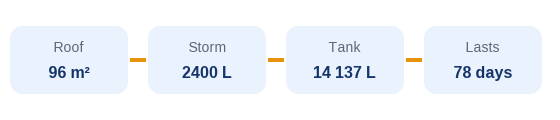
- Area fed volume, volume fed the comparison.
- The tank's volume fed the equation and the days.
- Five links, each one explained.
Carry accuracy through the chain
- Round early and every later step inherits the error.
- Keep full values on the calculator.
- Round once, at the end, to suit the context.
Try it: build the chain
Say the connection out loud
- "Using the tank volume of 14 137 litres..."
- Each step names the result it uses.
- That sentence is the evidence of the link.
What makes this Merit
- The processes are connected, not separate.
- Each part of every connection is correct.
- Excellence goes further, into assumptions.
What to take away
- Plan the chain, link it with units, round at the end.
| Relational | one answer feeds the next |
| Plan the chain | before calculating |
| Links | unit conversions join the steps |
| mm to m | divide by 1000 |
| m³ to litres | multiply by 1000 |
| Keep accuracy | round only at the end |
| Explain | each connection in words |
Common mistakes
- Water collected = 96 × 25 = 2400 m³Change 25 mm to 0.025 m first, so 96 × 0.025 = 2.4 m³, which is 2400 litres; mixing mm and m breaks every later link.
- Tank ≈ 14 m³, so 14 000 ÷ 180 = 77.8 daysKeep 14.137 m³ on the calculator and round once at the end; rounding early here loses most of a day.
- 14 137 ÷ 180 = 78.5, so the tank lasts 79 daysRound down to 78 full days, because the tank runs dry partway through the 79th day.
- Writing 96, 2.4, 14.137 and 78.5 as separate answers with no words between themName the result each step uses, such as "Using the tank volume of 14 137 litres...", because that sentence is the Merit evidence of the link.
Your turn: eight linked questions
- Each answer feeds the next question.
- Work through the chain.
- Watch the units at every link.
| Question | |
|---|---|
| Home | Roof 10 m by 9 m. Tank: radius 1.2 m, height 2.5 m. Uses 150 L a day. |
| 1 | How many litres does a 30 mm storm collect? |
| 2 | How many litres does the tank hold? |
| 3 | How many full days does a full tank last? |
| 4 | How much rain, in mm, fills the empty tank? |
| 5 | A student writes: 90 × 30 = 2700 m³ of water from a 30 mm storm. Which link in the chain is wrong? |
| 6 | A 30 mm storm collects 2700 litres. About what percentage of the full tank is that? |
| 7 | After a dry spell the tank holds 3000 L. How much rain, in mm, would bring it back to full? |
| 8 | The tank is half full when a 30 mm storm fills it further. How many full days does the water then last? |
Show answer
1. 10 × 9 = 90 m²; 30 mm = 0.03 m; 90 × 0.03 = 2.7 m³ = 2700 litres. 2. π × 1.2² × 2.5 = 11.310 m³ = 11 310 litres. 3. 11 310 ÷ 150 = 75.4, so 75 full days. 4. 90d = 11.310, so d = 0.126 m, which is 126 mm. 5. 30 mm was not changed to 0.03 m before multiplying. 90 × 0.03 = 2.7 m³, which is 2700 litres. 6. Both in litres: 2700 ÷ 11 310 × 100 = 23.9%, so about 24% of the tank. 7. Space left: 11 310 − 3000 = 8310 L = 8.310 m³. 90d = 8.310, so d = 0.0923 m, about 92 mm. 8. Half full is 5655 L, plus 2700 L from the storm is 8355 L. 8355 ÷ 150 = 55.7, so 55 full days.
The answers
- 90 × 0.03 = 2.7 m³: 2700 litres.
- Π × 1.2² × 2.5 = 11.310 m³: 11 310 litres.
- 11 310 ÷ 150 = 75.4: 75 full days.
- 90d = 11.310, d = 0.126 m: 126 mm.
Sample question: Achieved
A shed roof is 11 m by 7 m, seen from above. How many litres of water does it collect in a storm of 20 mm of rain?
Hint
Change the rain to metres, multiply by the roof area to get cubic metres, then change cubic metres to litres.
Answer
1540 litres.
Step by step
- The chain: roof area, then volume of water, then litres. Each answer feeds the next.
- Roof area = 11 × 7 = 77 m².
- Recall: 1 m = 1000 mm, so divide millimetres by 1000. 20 mm = 0.02 m.
- Volume of water = area × depth = 77 × 0.02 = 1.54 m³.
- Recall: 1 m³ = 1000 litres, so multiply by 1000. 1.54 m³ = 1540 litres.
- Classic mistake: multiplying 77 by 20 and getting 1540 cubic metres. The number looks the same, but the unit is wrong by a factor of 1000.
- Check: 1 mm on 1 m² is 1 litre, so 20 mm on 77 m² is 20 × 77 = 1540 litres. Same answer.
Full working
- 11 × 7 = 77 m²roof area
- 20 mm = 0.02 mdivide by 1000
- 77 × 0.02 = 1.54 m³area × depth
- 1.54 × 1000 = 1540 L1 m³ = 1000 L
- 1540 litres
Sample questions: Merit
A cylindrical tank has radius 1.4 m and height 2.2 m. A household uses 160 litres a day. (a) How many full days does a full tank last? (b) The tank is empty when a 30 mm storm falls on a roof of 120 m². What fraction of the tank does the storm fill, and how many full days will that water last?
Hint
Find the tank's volume with V = πr²h and change it to litres; that number feeds both parts.
Answer
(a) 13 547 litres, which lasts 84 full days. (b) The storm gives 3600 litres, about 27% of the tank, which lasts 22 full days.
Step by step
- Plan the chain: tank volume in m³, then litres, then days. For (b), storm volume, then compare with the tank, then days.
- Tank: V = πr²h = π × 1.4² × 2.2 = π × 1.96 × 2.2 ≈ 13.547 m³. Keep the full value on the calculator.
- In litres: 13.547 × 1000 ≈ 13 547 litres.
- Days: 13 547 ÷ 160 = 84.67. Only full days count, so round down: 84 days.
- (b) Rain: 30 mm = 0.03 m. Water = 120 × 0.03 = 3.6 m³ = 3600 litres.
- Fraction of the tank: 3600 ÷ 13 547 = 0.266, about 27%. This link uses the tank volume from part (a).
- Days from the storm: 3600 ÷ 160 = 22.5, so 22 full days.
- Classic mistake: rounding the days up to 85. On day 85 the water runs out partway through.
- Check: 84 × 160 = 13 440 litres, a little under 13 547. 85 × 160 = 13 600, a little over. So 84 is right.
Full working
- V = π × 1.4² × 2.2 ≈ 13.547 m³ = 13 547 Lcylinder
- 13 547 ÷ 160 = 84.67 → 84 full daysround down
- 120 × 0.03 = 3.6 m³ = 3600 L30 mm = 0.03 m
- 3600 ÷ 13 547 ≈ 0.27uses the tank volume
- 3600 ÷ 160 = 22.5 → 22 full days
- 84 days; storm fills about 27%, lasting 22 days
A house has a roof 8.5 m by 12 m, seen from above, and a 10 000 litre tank that is 35% full. How many millimetres of rain are needed to fill the tank?
Hint
Find the empty space in litres, change it to cubic metres, then solve an equation with the rain depth d.
Answer
About 64 mm of rain.
Step by step
- Chain: how full the tank is, then the empty space, then an equation for the rain depth.
- 35% full means 65% empty. Space = 0.65 × 10 000 = 6500 litres.
- Change to cubic metres: 6500 ÷ 1000 = 6.5 m³. The roof area is in m², so the water must be in m³ too.
- Roof area = 8.5 × 12 = 102 m².
- Let d be the rain depth in metres. Water collected = 102d. Set it equal to the space: 102d = 6.5.
- Solve: d = 6.5 ÷ 102 = 0.0637 m.
- Change to millimetres: 0.0637 × 1000 ≈ 63.7 mm, about 64 mm.
- Classic mistake: using the whole tank, 10 000 litres, instead of the empty part.
- Check: 102 × 0.0637 ≈ 6.5 m³ = 6500 litres. With the 3500 already in, that makes 10 000.
Full working
- space = 0.65 × 10 000 = 6500 L = 6.5 m³35% full, 65% empty
- roof = 8.5 × 12 = 102 m²
- 102d = 6.5water collected = space
- d = 6.5 ÷ 102 ≈ 0.0637 m
- About 64 mm
Sample questions: Excellence
A family of 5 uses 45 litres each a day. Their cylindrical tank (radius 1.2 m, height 2 m) is full at the start of a 50-day dry spell. The only rain is a storm of 18 mm on the evening of day 30, falling on a roof of 133 m². (a) Does the water last all 50 days? How much is left at the end? (b) What is the smallest storm, in mm, on day 30 that would let the water last the 50 days?
Hint
Track the water in order: full tank, 30 days of use, add the storm (checking it fits), then 20 more days of use.
Answer
(a) Yes, with about 192 litres left. (b) About 16.6 mm of rain.
Step by step
- Daily use = 5 × 45 = 225 litres.
- Tank: V = π × 1.2² × 2 ≈ 9.048 m³, which is about 9048 litres. Keep the full value.
- Without any rain it would last 9048 ÷ 225 = 40.2 days, so the storm matters.
- After 30 days: 9048 − 30 × 225 = 9048 − 6750 = 2298 litres left.
- Storm: 18 mm = 0.018 m. Water = 133 × 0.018 = 2.394 m³ = 2394 litres.
- Does it fit? The space in the tank is 9048 − 2298 = 6750 litres, more than 2394, so none spills. The tank now has 2298 + 2394 = 4692 litres.
- Days 31 to 50 are 20 more days: 20 × 225 = 4500 litres. Left: 4692 − 4500 ≈ 192 litres. It lasts.
- (b) Over 50 days the family needs 50 × 225 = 11 250 litres. The tank gives 9048, so the storm must give at least 11 250 − 9048 ≈ 2202 litres.
- Let d be the rain in metres: 133d = 2.202, so d ≈ 0.0166 m, about 16.6 mm.
- Check the overflow again: 2202 litres is less than the 6750 litres of space, so it all fits and the answer stands.
- Classic mistake: adding the storm at the start, when the tank is full. It would overflow and the water would be lost.
Full working
- use = 5 × 45 = 225 L a day
- V = π × 1.2² × 2 ≈ 9.048 m³ ≈ 9048 L
- after 30 days: 9048 − 6750 = 2298 L
- storm: 133 × 0.018 = 2.394 m³ = 2394 L; space 6750 Lno overflow
- 2298 + 2394 − 20 × 225 ≈ 192 L
- need 11 250 − 9048 ≈ 2202 L; 133d = 2.202, d ≈ 0.0166 m
- Yes, about 192 L left; at least about 16.6 mm
(a) Show that on a roof of area A square metres, every 1 mm of rain gives A litres of water. (b) Hence find, to the nearest mm, how much rain fills a 14 137 litre tank from a 96 m² roof. (c) A new house will have a 22 000 litre tank. What roof area is needed for 100 mm of rain to fill it? (d) If gutters and splash lose 15% of the water, what roof area is needed instead?
Hint
Change 1 mm to metres and multiply by A, then change cubic metres to litres. After that, each part is a division.
Answer
(a) 1 mm = 0.001 m, so the water is 0.001A m³ = A litres. (b) 14 137 ÷ 96 ≈ 147 mm. (c) 220 m². (d) 220 ÷ 0.85 ≈ 259 m².
Step by step
- (a) Recall the two links: 1 mm = 0.001 m, and 1 m³ = 1000 litres.
- Water from 1 mm of rain = area × depth = A × 0.001 = 0.001A cubic metres.
- In litres: 0.001A × 1000 = A litres. So each millimetre of rain gives as many litres as there are square metres of roof.
- (b) Hence: a 96 m² roof gives 96 litres for each mm. Rain needed = 14 137 ÷ 96 ≈ 147.3, so about 147 mm.
- (c) Use the rule backwards. 100 mm on A m² gives 100A litres. Set 100A = 22 000, so A = 220 m².
- (d) Only 85% of the water is kept, so each mm gives 0.85A litres.
- 100 × 0.85A = 22 000, so 85A = 22 000 and A = 22 000 ÷ 85 ≈ 258.8 m², which is about 259 m².
- Notice the size of the effect: losing 15% of the water needs about 18% more roof, because 1 ÷ 0.85 ≈ 1.18.
- Classic mistake: adding 15% to 220 and getting 253 m². That is the wrong base: 253 × 0.85 = 215, not 220.
- Check (d): 259 × 0.85 × 100 ≈ 22 015 litres, just over 22 000.
Full working
- 1 mm = 0.001 m; water = 0.001A m³area × depth
- 0.001A × 1000 = A litres1 m³ = 1000 L
- 14 137 ÷ 96 ≈ 147 mmhence
- 100A = 22 000, A = 220 m²
- 85A = 22 000, A ≈ 258.8 m²only 85% kept
- A litres per mm; 147 mm; 220 m²; about 259 m²
Challenge
A cylindrical tank has radius 1.5 m and height 2 m and is fed from a 96 m² roof. Over 6 dry days its water level falls from 1.62 m to 1.35 m. The outlet pipe is 0.15 m above the base, so water below it cannot be used. (a) How many litres a day does the household use? (b) If no rain falls, how many more full days can it draw water? (c) How much rain, in mm, would bring the level back up to 1.62 m?
Hint
The water's surface is a circle of area πr². A fall in level of h metres is πr²h cubic metres of water. Find the fall per day first.
Answer
(a) About 318 litres a day. (b) 26 full days. (c) About 19.9 mm, so a 20 mm storm would just do it.
Step by step
- The level fell 1.62 − 1.35 = 0.27 m. The surface area of the water is π × 1.5² ≈ 7.0686 m².
- Water used = 7.0686 × 0.27 ≈ 1.9085 m³ = 1908.5 litres in 6 days, so 1908.5 ÷ 6 ≈ 318 litres a day.
- The level falls 0.27 ÷ 6 = 0.045 m a day. Usable water is only down to the outlet: 1.35 − 0.15 = 1.20 m.
- 1.20 ÷ 0.045 = 26.7 days, so 26 full days. Working in metres of level means no litres are needed for this link.
- To refill 0.27 m needs 1908.5 litres. On a 96 m² roof, 1 mm of rain gives 96 litres, so 1908.5 ÷ 96 ≈ 19.9 mm.
Full working
- fall = 1.62 − 1.35 = 0.27 m; area = π × 1.5² = 7.0686 m²
- 7.0686 × 0.27 = 1.9085 m³ = 1908.5 Lm³ to litres × 1000
- 1908.5 ÷ 6 = 318 L a day
- 0.27 ÷ 6 = 0.045 m a day; usable 1.35 − 0.15 = 1.20 m
- 1.20 ÷ 0.045 = 26.7, so 26 full daysround down
- 1908.5 ÷ 96 = 19.9 mm1 mm on 96 m² gives 96 L
- 318 litres a day; 26 full days; about 19.9 mm of rain
A farmhouse has two cylindrical tanks, both 2 m high, joined by a pipe at the base so their water levels are always equal. Tank 1 has radius 1.2 m and is fed by a 60 m² roof; Tank 2 has radius 0.9 m and is fed by a 45 m² shed roof. (a) A 20 mm storm falls. By how many millimetres does the shared water level rise? (b) The level is 0.6 m. How much rain is needed to fill both tanks to the top? (c) Explain why the answer to (a) would be the same if both roofs drained into Tank 1 only.
Hint
Joined tanks behave like one tank whose base area is the sum of the two circles. Find the total water from both roofs, then divide by that area.
Answer
(a) The storm gives 105 × 20 = 2100 litres. The combined base area is π(1.2² + 0.9²) = 2.25π ≈ 7.069 m², so the level rises 2.1 ÷ 7.069 ≈ 0.297 m, about 297 mm. (b) 7.069 × 1.4 ≈ 9.896 m³ = 9896 litres, which needs 9896 ÷ 105 ≈ 94.2 mm, so at least 95 whole mm of rain. (c) The pipe shares the water between the tanks until the levels match, so only the total water and the total base area matter, not which tank it enters.
Step by step
- Total roof area is 60 + 45 = 105 m². On 105 m², 1 mm of rain gives 105 litres, so 20 mm gives 2100 litres = 2.1 m³.
- Because the levels stay equal, a rise of h metres adds π × 1.2² × h + π × 0.9² × h = π(1.44 + 0.81)h = 2.25πh m³.
- 2.25π ≈ 7.0686 m². So h = 2.1 ÷ 7.0686 ≈ 0.297 m, a rise of about 297 mm from 20 mm of rain.
- To fill from 0.6 m to 2 m, the level must rise 1.4 m: 7.0686 × 1.4 ≈ 9.896 m³ = 9896 litres.
- 9896 ÷ 105 ≈ 94.25 mm. Less than that will not fill it, so about 95 mm, rounding up.
- The joining pipe makes the two tanks act as one. The total volume and the total base area decide the level.
Full working
- roofs: 60 + 45 = 105 m²; 20 mm gives 105 × 20 = 2100 L = 2.1 m³
- base area = π(1.2² + 0.9²) = 2.25π = 7.0686 m²equal levels
- rise = 2.1 ÷ 7.0686 = 0.297 m = 297 mm
- 1.4 m to fill: 7.0686 × 1.4 = 9.896 m³ = 9896 L
- 9896 ÷ 105 = 94.2 mmround up to fill
- Rise about 297 mm; about 94.2 mm, so 95 mm of rain fills both tanks
A tiny house has a 40 m² roof and uses 120 litres a day. Its owner wants a cylindrical tank 2.1 m high that, starting full, gets through a 45-day dry spell and still has 20% of the tank left as a reserve at the end. Tanks are made in radii that go up in steps of 0.1 m. (a) What volume must the tank hold at least? (b) What radius should she order? Check that the next size down is too small. (c) How much rain fills the chosen tank from empty? (d) With the chosen tank, how many full days of use does she have before she starts using the reserve?
Hint
If 20% must be left, the 45 days of use come out of the other 80% of the tank. Then rearrange V = πr²h to find r.
Answer
(a) 120 × 45 = 5400 litres is 80% of the tank, so the tank holds at least 5400 ÷ 0.8 = 6750 litres. (b) r = √(6.75 ÷ 2.1π) ≈ 1.012 m, so order 1.1 m. A 1.0 m tank holds only 6597 litres, too small. (c) The 1.1 m tank holds about 7983 litres, which needs 7983 ÷ 40 ≈ 200 mm of rain. (d) 80% of 7983 is 6386 litres, which is 53 full days, more than the 45 needed.
Step by step
- In 45 days she uses 120 × 45 = 5400 litres. That has to come from the 80% above the reserve.
- So 0.8V = 5400 and V = 6750 litres. A common slip is 5400 × 1.2 = 6480, which leaves only 1080 litres, 16.7% of that tank, not 20%.
- 6750 litres = 6.75 m³. From V = πr²h: r² = 6.75 ÷ (2.1π) ≈ 1.0231, so r ≈ 1.012 m. Round up to the next size, 1.1 m.
- Check the size down: π × 1.0² × 2.1 ≈ 6.597 m³ = 6597 litres, under 6750. So 1.0 m is too small.
- The 1.1 m tank holds π × 1.21 × 2.1 ≈ 7.983 m³ = 7983 litres. On 40 m², 1 mm gives 40 litres, so it needs 7983 ÷ 40 ≈ 199.6 mm, about 200 mm.
- Before the reserve: 0.8 × 7983 ≈ 6386 litres. 6386 ÷ 120 ≈ 53.2, so 53 full days.
Full working
- use: 120 × 45 = 5400 L45 dry days
- 0.8V = 5400, V = 6750 L = 6.75 m³20% reserve left
- r² = 6.75 ÷ (2.1π) = 1.0231, r = 1.012 mrearranged V = πr²h
- r = 1.0: π × 1 × 2.1 = 6.597 m³ < 6.75too small, so 1.1 m
- r = 1.1: π × 1.21 × 2.1 = 7.983 m³ = 7983 L; 7983 ÷ 40 = 199.6 mm
- 0.8 × 7983 = 6386 L; 6386 ÷ 120 = 53.2round down
- At least 6750 L; order radius 1.1 m; about 200 mm of rain; 53 full days before the reserve
Report a mistake
More in AS 91945



Is your child on track?
Take the free placement test